Photos and videos of you · privacy form, rules and the law by country
Someone posted a picture of me on Instagram without my permission, or a video: what actually gets it removed
It usually starts with a message from a friend: a link, and "is this you?" A candid from a party, a clip filmed on a train, your child on another parent's grid. The shock makes everything feel equally urgent, but Instagram sorts these cases by two things only: what the picture shows, and who is asking.
Posting a photo or video of someone without asking does not, by itself, break Instagram's rules. It comes down when it breaks a specific rule, such as nudity, harassment or impersonation, or when you file Instagram's privacy form and local law gives you a right to removal. Parents file for children under 13.
Someone posted a picture of me on Instagram without my permission. Does that break a rule?
No rule on Instagram says you must ask before posting a photo of another person. A picture comes down when it breaks a specific rule, when you own its copyright, or when the law where you live gives you a right to have it removed.
Instagram's Help Centre is blunt about it. On its page for parents it says that people own the rights to all images that they've taken and shared with Instagram
, and that without a breach of the Community Standards or the Terms it can't help directly unless required to do so by law
. Its exposed private information page sets the same limit on your own photos: Instagram will remove posts you report as unauthorised if relevant privacy laws in your country require it, as long as the photo shows you, your child under 13 or someone you legally represent.
So the useful question is which of three doors is open. The first is a Community Standard the photo breaks on its own terms, such as nudity, harassment or impersonation, and anyone can report those. Copyright is the second, and it only helps if you pressed the shutter. The third is the privacy form. Meta's Privacy Violations standard, in its version dated 1 May 2026, says an adult's reported photo or video may be removed when the adult reported it from outside the United States
and applicable law may provide rights to removal.
That line explains most of the frustration. A stranger's crowd shot, an ex's throwback or a colleague's party video of you is legal to post in most of the United States, and Instagram follows suit. Had you lived in Paris or Berlin, the same post could be removable.
Someone posted a picture without my permission, but not on Instagram
The same three doors exist on most large platforms, but the forms differ, and a copy on a website is outside Instagram's reach. Its Help Centre says it can't take down private information posted publicly somewhere other than Instagram or Threads. Work through each site separately, starting with the one where the image spread first.
The first hour, before any report
Copy the link, record the post, untag yourself, then decide whether to ask the poster. Order matters here: the privacy form refuses to go on without a link.
- Copy the post's link from its menu. Instagram's privacy form stops at a single question if you have none:
We are unable to further process your report without a relevant link (URL)
. If you are blocked or the account is private, ask a friend who can see it to copy the link for you. - Record it with the username, the caption, the date label and, for a video, the whole clip with sound. A Story is gone for viewers after 24 hours unless it is saved to a Highlight, and reporting a Story before it expires covers the icon you tap on one.
- Remove your tag. On the post, tap your username, then Remove me from post. To clear several at once, open Your activity, then Tags, then Select. Instagram's Help Centre says this is not available on computers, so do it in the app.
- Read the comments. When people are naming you, sharing your handle or joking about your body under the photo, report the comments under it one at a time; they are separate items with their own reviews.
- Decide whether to ask the poster. A friend or relative will often delete within minutes, and a deleted post needs no reviewer. Skip this step when the photo is intimate, came with a threat, or the person has already targeted you.
Untagging is the step people skip, and it is the only one that works instantly. It takes the post off your profile's tagged grid and breaks the click-through to your account. It leaves the photo itself exactly where it was, which is why the next sections exist.
Which rule does the picture or video actually break?
Match what is in the frame to the policy that covers it. A report under the wrong rule is reviewed against that rule, found clean, and closed.
| What the photo or video shows | The rule or route | Who can file |
|---|---|---|
| You nude, near-nude or in a sexual act, shared without consent | Non-consensual intimate imagery, plus StopNCII (18 and over) or Take It Down (under 18) | Anyone can report; hashing is for the person pictured |
| A clip filmed in secret that zooms on your body | Meta's rule on "creepshots" and "upskirts" in the adult sexual exploitation standard | Anyone |
| You mocked, insulted or rated | Bullying and harassment | Best filed by you |
| Your photos on a profile that pretends to be you | Impersonation | You, or a representative |
| A photo you took yourself, reposted | Copyright, on Meta's IP form | The photographer |
| Your house with its street or postcode in the caption | Residential information, under privacy violations | Anyone |
| You entering or inside a clinic or hospital | Medical facility imagery, which needs extra context | You, a representative, or the facility |
| An ordinary photo or video of you, nothing else wrong | The privacy form | You; a parent for a child under 13 |
Two of those rows surprise people. Meta's adult sexual exploitation standard, updated on 5 March 2026, bans sharing secretly taken, non-commercial imagery that focuses on a person's commonly sexualised body parts
when it is shared to mock, sexualise or identify them. That covers the gym or beach clip filmed from behind, even when nobody is undressed. And the privacy standard lets a clinic or hospital ask for removal of a picture of someone in its care or on its staff, one of the few cases where a third party can file for an adult.
Intimate images have their own law in the US now. Since 19 May 2026, the TAKE IT DOWN Act has required platforms to remove a valid request for a non-consensual intimate image, and known copies of it, within 48 hours, and the FTC began enforcing it that day, with civil penalties of up to $53,088 per violation.
The rest are ordinary Instagram reports, each with its own page on this site: the bullying and harassment rules for a photo posted to humiliate, threats and doxxing when your address or school travels with it, and extortion reports when someone threatens to post a picture unless you pay or send more. For a photo you took, the copyright route for your own shots works, though Meta passes your name and email to the poster. How the in-app menu and the forms differ is set out in the six routes for a single post.
Inside Instagram's privacy form, question by question
The form asks who you are reporting for, then one or two questions about age or authority, then the links. Four of its answers end it before the Send button appears.
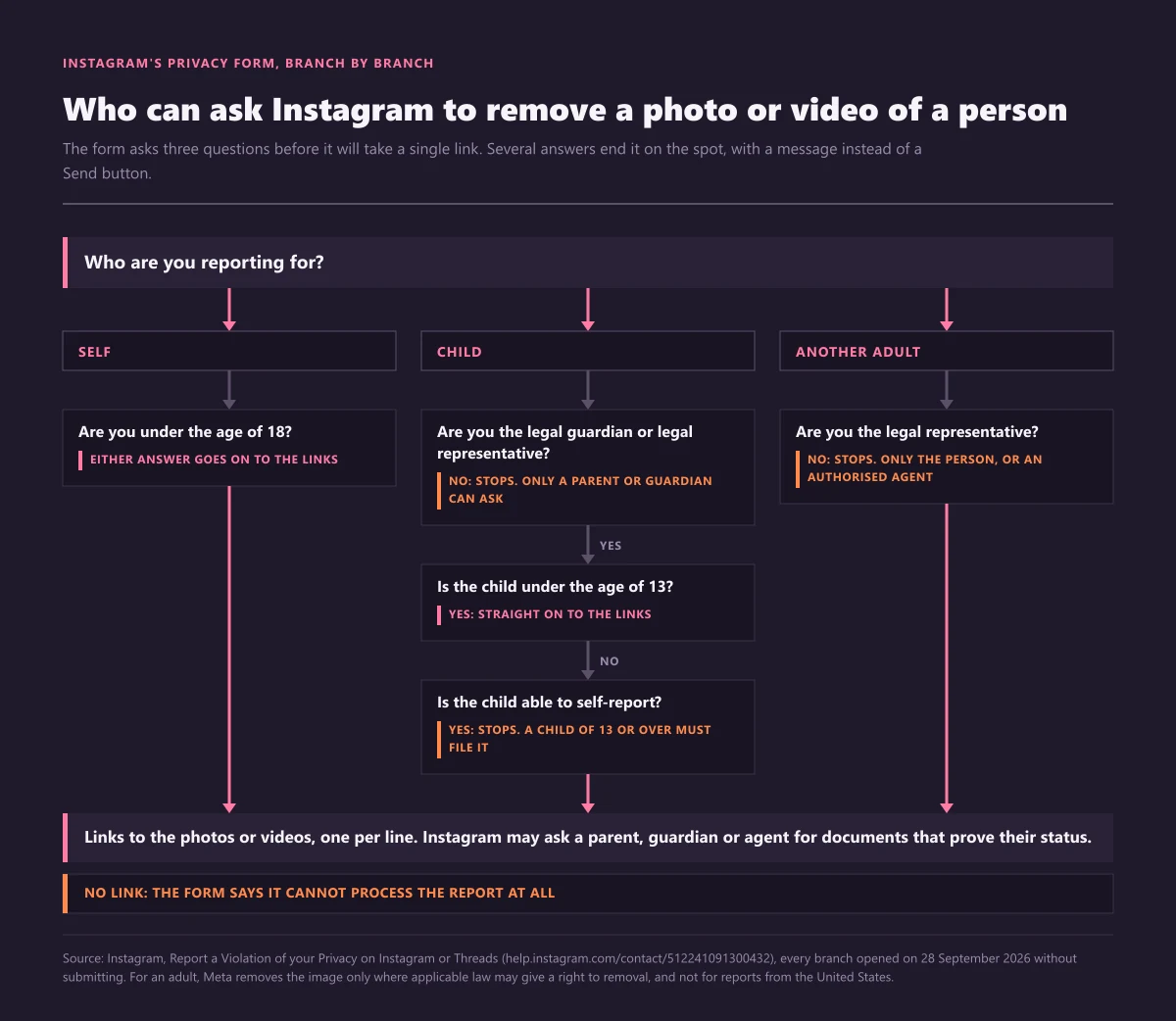
The form is titled Report a Violation of your Privacy on Instagram or Threads, and it opens with a warning that it is reserved for your image or video. It asks for your full name, country and email address, then who you are reporting for: Self, Child or Another adult. Choose Self and it asks whether you are under 18; either answer goes on to the links. Choose Another adult and it asks whether you are that person's legal representative. Answer no and the form replies that it can only support requests from the person in the content or an authorized agent or representative
, and asks you to encourage the person to write in themselves.
When we opened the form on 28 September 2026 from outside the EU, we saw 157 countries in its list and neither the United States nor any EU or EEA member state among them, which fits the US exclusion in Meta's standard. Instagram Ban Service reads that as a routing choice rather than a refusal: EU residents have the Digital Services Act and the GDPR, whose notices go through Instagram's legal channels instead. Its links box wants one URL per line, and the child and representative branches warn that Instagram may request documentation
proving your status.
Filing this form is not the same as reporting the post in the app, and the two can run side by side. A report from the post's menu is judged against the Community Standards; the privacy form is judged against your age, your authority and the law of the country you pick. What happens after either one is covered in what a report actually does, and whether the other person is told is answered in whether Instagram names the reporter: it doesn't, except on intellectual property claims.
How rarely privacy removes a single post in the EU
The EU's DSA Transparency Database lets anyone count Meta's decisions. Between 1 April and 27 September 2026, Instagram filed 1,558,691 statements under data protection and privacy violations. Only 5,677 of them removed a piece of content, only 3,214 started with a notice under Article 16 of the Digital Services Act, and only 7 cited illegal content as the ground; 1,553,007 were account terminations Meta started itself. A privacy request about one photo joins a small, hand-reviewed queue. Meta's own EU transparency report for January to June 2026 counts 388,783 notices under Article 16, of which 22,509 were filed as data protection, and says every one is reviewed by a person. Its median time to act was 28.89 hours, counting only the notices it acted on.
Does the country you live in decide whether it comes down?
For an ordinary photo of an adult, yes. The privacy form turns on whether local law gives you a right to removal, and six legal systems give very different answers.
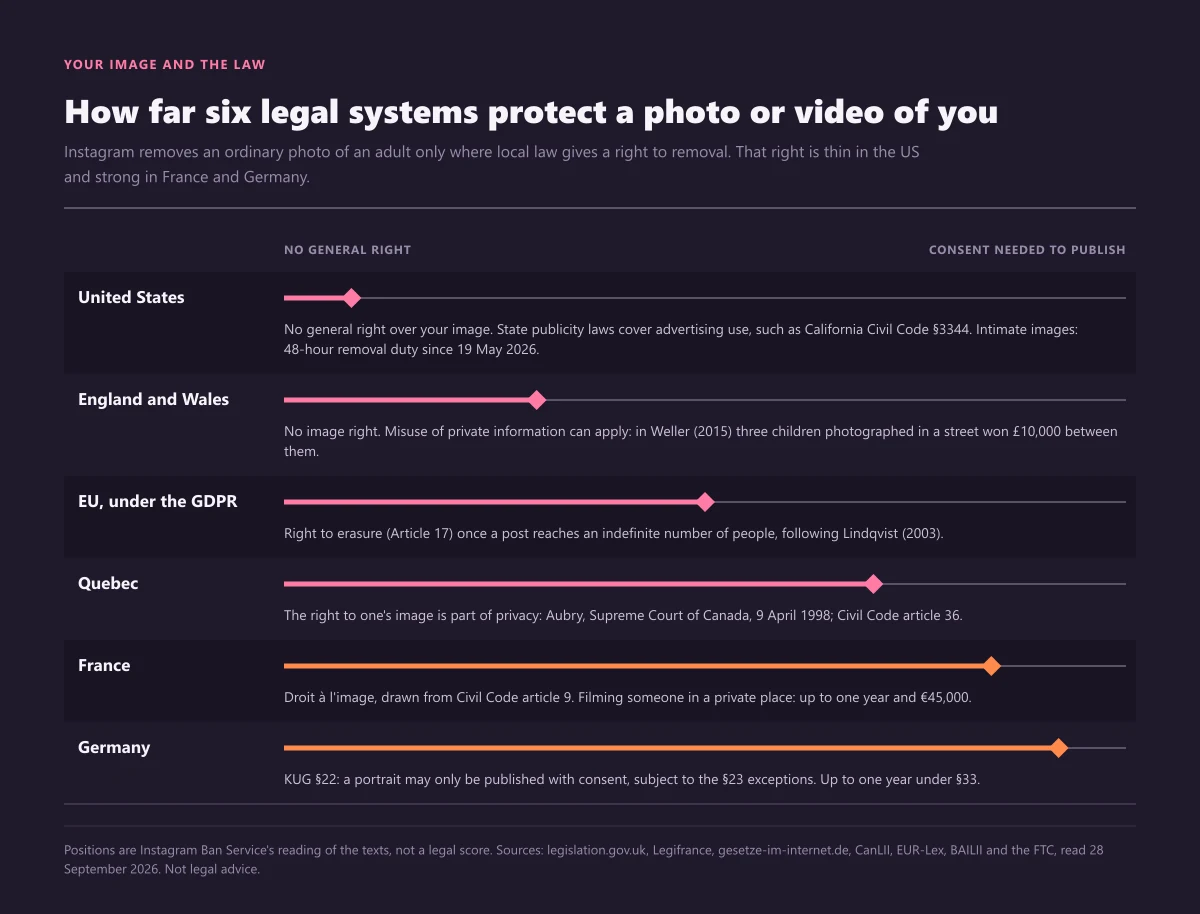
Germany is the strictest on paper. Section 22 of the Kunsturhebergesetz says portraits may be distributed or shown publicly only with the consent
of the person pictured, according to the text on gesetze-im-internet.de. Section 23 carves out exceptions: people of contemporary history, a person who is incidental to a landscape, crowds at gatherings, and some art. Section 33 makes publishing in breach a criminal offence, with up to one year in prison or a fine.
France builds the droit à l'image from Article 9 of the Civil Code, which gives everyone the right to respect for private life. Its Penal Code goes further for private places: Article 226-1 punishes capturing or transmitting someone's image in a private place without consent with one year and a €45,000 fine, and Article 226-2 applies the same penalty to spreading it. In Quebec, the Supreme Court of Canada held in Aubry v. Éditions Vice-Versa, decided on 9 April 1998, that the right to one's image is part of privacy; a teenager photographed sitting on a Montreal doorstep won damages.
England and Wales have no image right. A claim runs through misuse of private information, which is how Paul Weller's three children won £10,000 between them after Mail Online published unpixelated photos of them taken in a Los Angeles street; the Court of Appeal upheld the award in Weller v Associated Newspapers [2015] EWCA Civ 1176. Across the EU, the GDPR's household exemption covers purely personal use, but the Court of Justice held in Lindqvist on 6 November 2003 that posting to an indefinite number of people falls outside it, which opens the right to erasure in Article 17. In the United States there is no general right at all. State laws such as California Civil Code section 3344 protect your likeness from use in advertising, and filming in a public place is generally lawful.
This is a map, not legal advice. If a photo is costing you work or safety, a local lawyer can tell you whether a letter or a court order is worth it.
Someone posted a video of me on Instagram without my permission. What changes with video?
The rules are the same; the evidence and the clock are not. Video spreads as Reels, remixes and Stories, each a separate item with its own report, and a Story disappears in 24 hours.
The privacy form treats a video exactly like a photo: its warning covers their image or video
, and the links box asks for photos or videos, one per line. What differs is how many copies exist. A clip of you arguing in a shop, dancing badly at a wedding or crying on a train can be posted as a Reel, cut into another account's remix, stitched into a compilation and reposted to Stories within an hour. Each of those is a separate URL, and each needs its own report or its own line on the form. Removing the original does nothing to a copy someone else uploaded.
Sound matters too. A video in which your address or phone number is spoken or shown can fall under the privacy standard's residential and contact information rules even when the picture alone would not. Quote the timestamp, such as 0:14 to 0:22, in any form that gives you a text box, because a reviewer watching a 90-second Reel will not hunt for the second that matters.
Filming itself is usually lawful in public in the US and the UK, which is why so many gym, street and restaurant clips stay up. Three things move a video into removable territory: a private place (a changing room, a bathroom, inside your home), a focus on your body that fits Meta's creepshot line, or a caption and comments built to humiliate you. In England and Wales, recording beneath someone's clothing is a crime under section 67A of the Sexual Offences Act 2003, and sharing an intimate image without consent became an offence under section 66B on 31 January 2024. If the same person keeps filming you, the problem is the person, and someone who keeps filming or following you is a stalking report, not a photo report.
Someone posted a video of me on insta as a Story that is already gone
You can't report an expired Story from the app, because the menu goes with it. If it was saved to a Highlight it reports like a live one. If not, your recording is the evidence, and a friend's screen recording is better than nothing.
Someone posted a picture of my child on Instagram without my permission: what can a parent do?
For a child under 13, the parent or guardian files the privacy form and Instagram can remove the photo on that request alone. From 13 to 17, the teenager has to file it; a parent's request is turned away.
The age line comes straight from Meta's standard: a photo or video of a minor under 13 may be removed when reported by the minor or a parent or legal guardian
, while one of a minor between 13 and 18 needs a report by the minor. Instagram's form enforces it. Pick Child, confirm you are the legal guardian, say the child is 13 or over and able to self-report, and it answers: we require minors 13 years or older to submit the request through this form themselves
. Say you are not the guardian and it closes with the line that the right to request removal lies solely with the minor's legal guardian or parent
. An aunt, a coach or a neighbour can't file for your child, however good the reason.
Two details help parents. According to the Help Centre page on reporting an image of your child, you don't need an Instagram account to complete the form, only a link to the photo or video. And a teenager who genuinely can't file, because of illness or disability, is covered by the form's own branch: answer that the child is not able to self-report and it moves on to the links.
Some pictures of children come down whoever reports them. Instagram's page on why an image of your child might be removed says images that show nudity may be taken down to stop others reusing them. Anything sexual involving someone under 18 goes to NCMEC's Take It Down, which hashes the image on your device and shares only the hash with participating platforms, Instagram among them; report it to police as well. If the poster is the other parent, French parents now have Article 372-1 of the Civil Code, added by the law of 19 February 2024, which says both parents protect the child's image together and lets a family judge stop one of them posting.
Someone posted a picture of my child without my permission at school or a club
Ask the school or club first; most have a photo-consent policy and will take a post down on request. A private parent's post is the harder case. In the UK the data protection regulator treats photos taken for purely personal use as outside the law, though posting to a public account stretches that. When the post invites comments about your child's body or identifies their school, report it for harassment as well as privacy, and keep the child's name out of any public reply.
What Reddit threads show about photos posted without consent
Of 41 r/Instagram posts about a photo or video someone else had posted, 10 said a report came back with no action. Just one mentioned filling in an Instagram help form.
Instagram Ban Service read every r/Instagram post from 1 January 2023 to 28 September 2026 whose title mentioned a picture, photo, pic or video of the poster, or something posted without their permission, through the Arctic Shift archive. After merging 7 same-title reposts, 41 were about another account posting the poster's image. r/Instagram's AutoModerator removes most help requests to a weekly thread, so 16 survive as a title alone; that is a house rule, not a verdict. No usernames were kept.
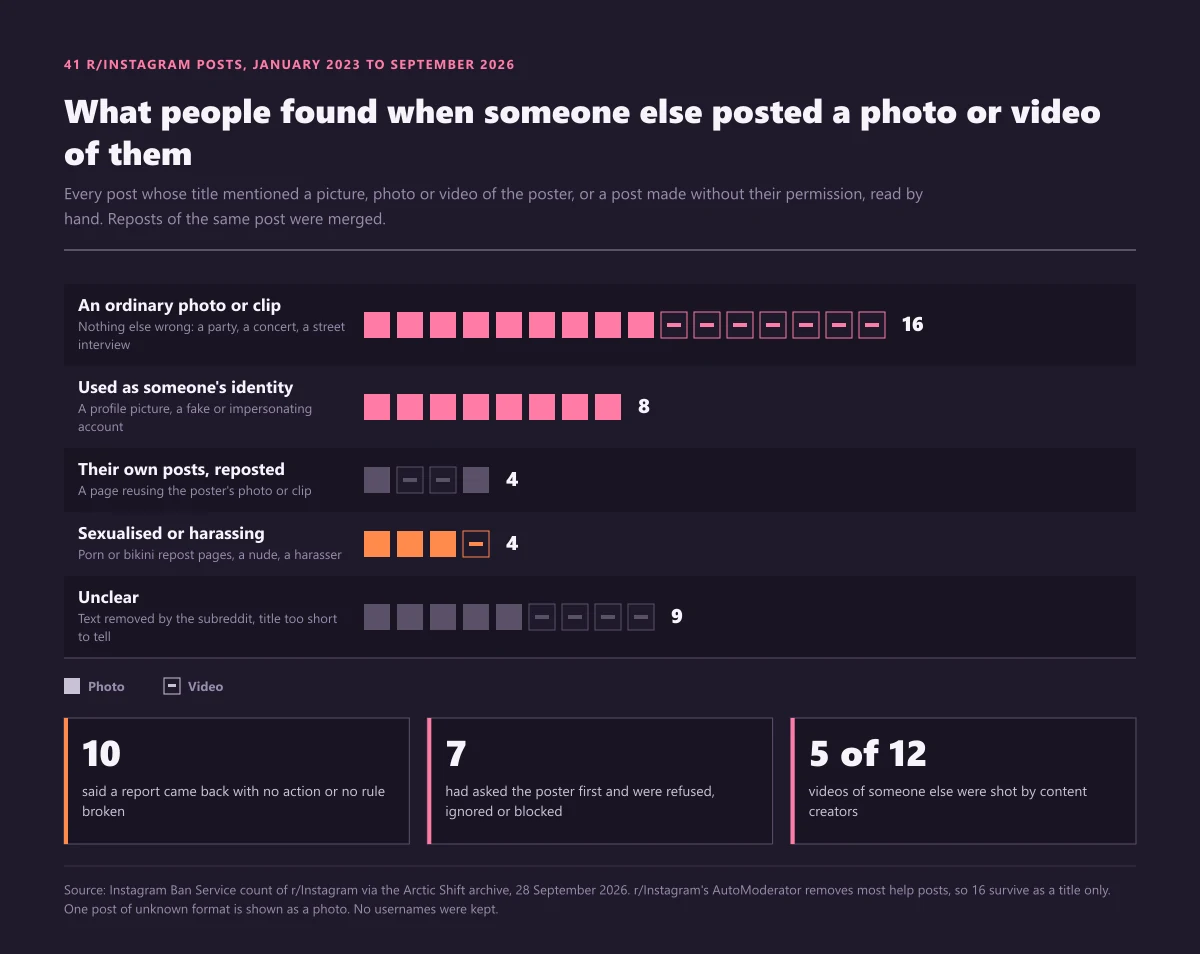
Sixteen, or 39%, were ordinary pictures: a group shot from a concert, an ex's grid, a graduation clip, a wedding photographer's portfolio. Those are exactly the cases the in-app report can't solve, because nothing in them breaks a Community Standard. Eight more, 20%, were identity cases where someone used the poster's face as a profile picture or a fake account, and those belong on the impersonation and fake account routes.
Ten posters, 24%, said they had reported and got "no action" or "not breaking any rules". Seven had asked the poster first and been refused, ignored or blocked. One had filed a copyright form for a video someone else had filmed, a route that only works for footage you own. The most telling case came from a poster in the EU, photographed through the window of the building where they work by a city page with more than 350,000 followers, with the building's exact location in the caption. Six months of in-app reports and requests for a second look came back clean each time. Those reports were judged against the Community Standards alone, and the post never mentions the privacy form, which is the one route that asks which country's law applies.
Video had a pattern of its own. Five of the 12 videos someone else had posted were shot by people making content: a street interview posted after the subject said no, a pick-up approach filmed on smart glasses, a clip from a random video-chat site, a documentary that named its subject in full, and a video posted after its subject begged the creator not to. A creator who films strangers for a living tends to refuse, which is why the form and the law matter more than the request.
How to report someone on Instagram for using your photos as their own
When an account uses your pictures to be someone, the rule is identity, not privacy. Report the profile for impersonation if it pretends to be you, and as a fake account if it uses your face to be somebody else.
These cases start with a stranger's message: "is this you?" The photos are yours, the name isn't, and the account is flirting, selling or asking for money. Instagram treats the profile as the problem, so report the profile rather than each photo, from the three dots on the profile page. Reporting the profile itself shows where that menu sits, and the fake account report covers the catfish that uses your face under another name. If it poses as you, the impersonator takedown asks for a photo of your ID.
Pick the route by what was taken. An account copying your identity is impersonation; an account posting photos you took, under its own name, is copyright. Impersonation form or DMCA notice compares the two, including the fact that the copyright form is the only one that reveals your name. Where the fake account is also asking your followers for money, file it as fraud too, because scam accounts using stolen photos fall under a separate policy. A shop or a giveaway using your face in its promotions is a commercial misuse, and a business or giveaway page using your photo lists the routes. If the copycat has also taken your old handle, getting a squatted username back is its own request.
When the fake profile is being used to threaten you, keep the two things separate: report the account, and treat the threat as evidence. Impersonation used for blackmail covers what to keep before you block.
When should you go after the account instead of the photo?
When the account exists to post you: a page of photos of one person, a "rate" or exposure page, or a profile that keeps posting new pictures after each removal. One photo is a post report; a pattern is an account report.
Instagram reviews what you point at, so a report on a single photo removes, at best, that photo. The account survives unless its record crosses Instagram's thresholds, which are never published as a number; what triggers a ban sets out the policy wording. Post first, account second explains why removals of individual posts are what builds that record, and taking down an account that targets one person covers exposure pages specifically.
Search phrases blur three different results. An account-level takedown is Instagram disabling the profile. A permanent ban is that disable once appeals are spent, and Instagram also removes new profiles made to get around it. Deleting someone else's account is something only its owner can do. Getting a whole profile deleted and report-and-disable requests both end at Instagram's review, and what gets a person banned is decided by the account's conduct, not by who files. If the photo of you sits on the profile of someone who has died, the account may be a memorialised account: nobody can sign in to delete anything, so a report is the only route.
Afterwards, you can only see so much from outside. Checking whether a reported account was banned lists the signs that mean something and the ones that don't.
Why more reports won't bring the photo down faster
Instagram says the number of reports does not decide whether content comes down. Getting ten friends to report a photo of you adds ten copies of the same review.
"Get everyone to report it" is the advice people hear first, and it is the least useful. A privacy request is decided on who filed and where they live, so a hundred reports from people who are not in the picture add nothing a reviewer can use. What the poster learns when you report also matters here: a sudden wave of reports from your friends tells them exactly who organised it, even though Instagram never names anyone.
Paying makes it worse. None of the mass-reporting offers we traced can do more than file reports that Instagram judges one at a time, and most want something from you first. The same goes for mass report bots, spam report bots and so-called reporter tools. Report apps and panels still end at Instagram's own Report button, piling reports onto one account is the kind of coordinated behaviour Meta discounts, and ban-as-a-service sellers ask for payment up front and deliver nothing checkable. A separate page tackles the report-count myth, because the question never goes away.
Only one number helps, and it is time. File the privacy form and the in-app report on the same day, keep the recording, and check your Support requests before re-filing.
What Instagram Ban Service does with a photo or video of you
It matches the post to the route that fits, files through Instagram's official channels, and tells you plainly when no route fits.
Instagram Ban Service works from the link and your recording. Its desk checks what the frame shows against Meta's policies, picks the privacy form, an in-app report or an identity route, and writes the explanation a reviewer needs: the timestamp in a video, the slide in a carousel, the reason the law of your country applies. What it will not do is report a lawful post of you as something it isn't, organise report waves or promise a result. Instagram makes every decision, and for an ordinary photo of an adult in the US that decision is usually no. The full list of reporting guides shows every case type the desk handles, and the r/Instagram takedown count shows what 194 other people asked Reddit to help remove.
Start tonight with the link and the recording, then file the route from the table, not the one that feels strongest. If you want it handled, what to send the desk lists the four things needed to open a file.
Sources
- Instagram Help CentreExposed private information: reporting photos and videos that violate your privacy
- Instagram Help CentreReport an image of your child that you want removed from Instagram
- Instagram Help CentreWhy an image of your child might be removed from Instagram
- Instagram Help CentreRemove yourself from a post that someone tagged you in
- Meta Transparency CentreCommunity Standards: Privacy violations, version of 1 May 2026
- Meta Transparency CentreCommunity Standards: Adult sexual exploitation, version of 5 March 2026
- Meta Transparency CentreInstagram DSA VLOP transparency report, January to June 2026
- gesetze-im-internet.deKunsturhebergesetz, section 22 (and sections 23 and 33)
- LegifranceCode civil, article 9
- LegifranceCode penal, article 226-1
- legislation.gov.ukSexual Offences Act 2003, section 67A
- legislation.gov.ukSexual Offences Act 2003, section 66B
- Federal Trade CommissionFTC Begins Enforcing the TAKE IT DOWN Act, 19 May 2026
- NCMECTake It Down
- StopNCII.orgStopNCII
Frequently asked questions
Someone posted a photo of me on Instagram years ago. Can I still get it removed?
Yes. The privacy form and the in-app report have no time limit, and an old post is judged by the same rules as a new one. Check that the link still opens before you file, because the form needs it and an old account may have changed its username since.
Someone posted a picture of me without my permission on Instagram from a private account. Can I report it?
Yes, but you need the link, and only approved followers can open the post. Ask someone who follows the account to copy it from the post's menu, or to report it from their own account. The privacy form never asks whether the account is public. It asks who is in the picture, and where they live.
Will the person who posted it know I reported it?
No. Instagram doesn't name the reporter for the privacy form or an in-app report; only copyright and trademark claims pass your name and email to the poster.
Someone posted a video of me on insta and tagged my workplace. Is that a privacy violation?
Naming where you work is not, on its own, private information under Meta's standard, which lists home addresses, non-public phone numbers and email addresses instead. A clip posted to get you in trouble with your employer is a different matter. Report it, and the comments piling on, as harassment. Keep a recording with the date showing, and tell your employer before they hear it from someone else.
How long does Instagram take to answer the privacy form?
Instagram publishes no deadline for it. Under the EU's Digital Services Act, Meta reported a median of 28.89 hours to act on legal notices it upheld in January to June 2026. Notices it declined are left out of that figure, and any reply goes to the email address you entered.
Can I sue someone for posting a picture of me on Instagram?
That turns on where you live and what the picture shows. France, Germany and Quebec protect your image directly, England relies on misuse of private information, and the US mostly limits claims to advertising use and intimate images. A local lawyer can say whether a letter is worth sending.
What if the photo of me is intimate?
Report it in the app under nudity or sexual activity, then use the hashing tool that fits your age: StopNCII if you are 18 or over, NCMEC's Take It Down if you were under 18 in the image. Both work on your device, so the image itself is never uploaded. In the US, platforms have had to act on valid requests within 48 hours since 19 May 2026.