Instagram impersonation report: who may file it, what the photo ID does, and where blackmail goes
Reviewed 8 August 2026 · 5,522 words · 22 min read
One form covers Instagram and Threads, only the impersonated person may use it, and the blackmail half of this problem belongs to the police.
An Instagram impersonation report is filed on Meta's official impersonation form, which covers Instagram and Threads and may only be submitted by the person being copied or their authorised representative. It asks for the fake profile link and a government photo ID. Blackmail is a separate, criminal matter: report it in-app and to the police.
If a cloned profile is wearing your face or your brand, send the handle and your evidence; we file only genuine violations through official channels, and blackmail goes to the police first.
- Meta acts on an impersonation report only from the impersonated person, a parent or guardian, or an authorised representative — a friend reporting on your behalf cannot make the claim.
- One form covers Instagram and Threads together, because a Threads profile is created from an Instagram login.
- The TAKE IT DOWN Act's platform duty took effect on 19 May 2026: covered services must remove reported non-consensual intimate imagery, including AI-made digital forgeries, within 48 hours of a valid request.
- Meta publishes no review deadline for impersonation reports, and no volume of reports forces a removal.
- Appeals Centre Europe reported disagreeing with Meta's decision in 59% of the account-suspension complaints it handled between April 2025 and March 2026.
Which Instagram report fits the problem in front of you?
Name the harm before you touch a form. A fake profile wearing your face is an impersonation matter. A copycat shop trading on your brand name is an intellectual-property matter. A demand for money against images someone claims to hold is a crime. Each has exactly one correct route, and using the wrong one is the usual reason a sound complaint dies quietly.
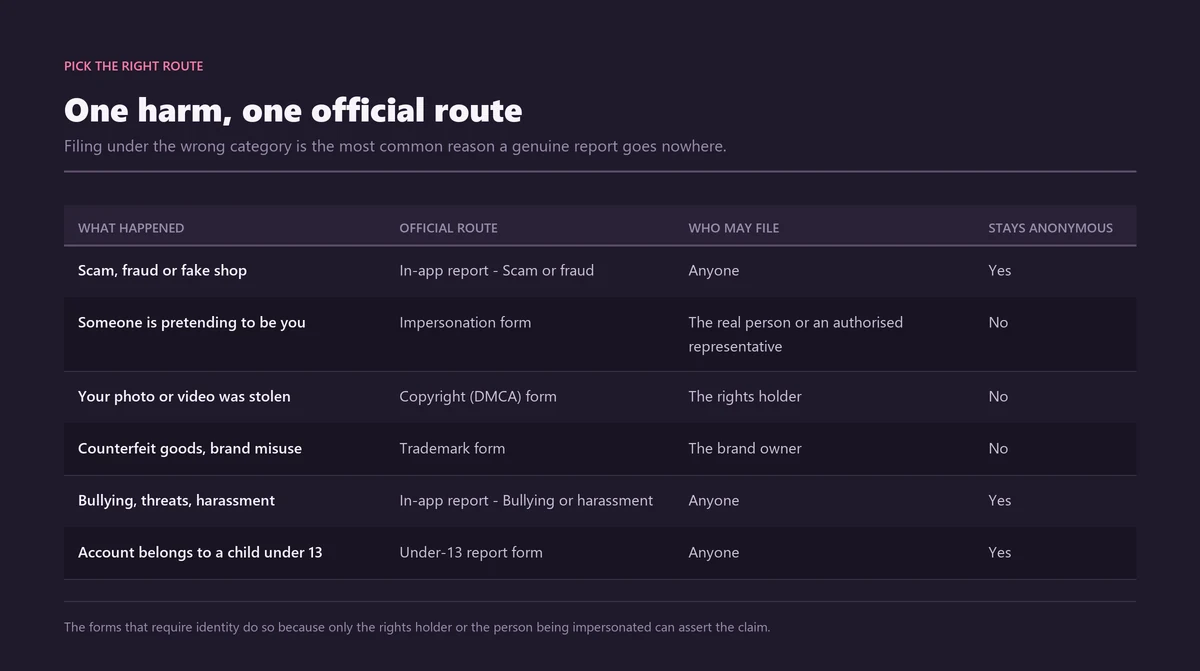
This page carries two problems that arrive together far more often than people expect. In the first, a stranger is wearing your photographs and messaging your friends. In the second, someone is demanding payment against pictures they say they hold. The opening move is identical for both — capture everything, change nothing. After that the routes separate completely.
| What has happened | Official route | Who is permitted to file | Does the account learn who filed? |
|---|---|---|---|
| A profile uses your face, name or biography to pass as you | Instagram impersonation form, which also covers Threads | The impersonated person, a parent or guardian, or an authorised representative | Not routinely — you identify yourself to Meta, not to the impostor |
| A fake shop or page trades on your registered brand | Trademark and intellectual-property report | The mark owner or an authorised representative | Yes — your name and contact details are passed on |
| The clone is reposting your photographs or videos | Copyright report | The creator or rights holder | Yes — the same disclosure applies |
| Someone threatens to publish material unless you pay | In-app report for threats, plus a police report | Anyone targeted, or anyone who was sent it | No |
| Intimate images, real or AI-generated, are shared or threatened | In-app report, plus StopNCII or Take It Down, plus police | The person depicted | No — a hash is submitted, never the picture |
| Your own account has been taken over | The instagram.com/hacked recovery flow | The account holder | Not applicable — this is recovery, not reporting |
| The account belongs to a child under 13 | Under-13 report form, which works logged out | Anyone | No |
Send a brand problem down the personal impersonation route and it stalls, because the reviewer is hunting for a government document a company cannot produce. Send a threat through the trademark form and nothing happens at all. The mismatch, not the merit, is what kills most filings. The wider comparison of which official form fits which harm lines the four routes up side by side.
Who is actually allowed to file an Instagram impersonation report?
Only the person being impersonated, their parent or guardian, or someone with written authority to act for them. That single rule explains most of the frustration in this subject. A friend who reports the clone on your behalf, however loudly, is filing something Meta will not treat as an impersonation claim, because they cannot prove whose identity has been taken.
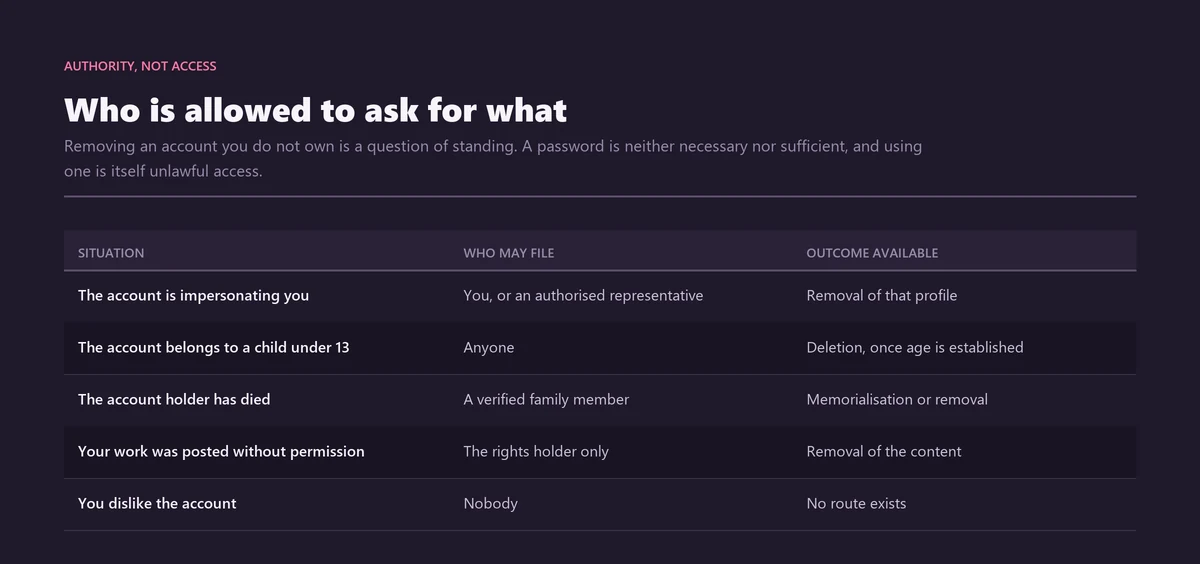
The restriction is not bureaucratic awkwardness. An impersonation decision turns on which of two profiles belongs to the real person, and only that person holds the document that settles it. A bystander can describe the deception in detail. They cannot verify it.
The awkward cases, and what to do in each
- A child is being impersonated. A parent or legal guardian files, using their own photo ID together with something showing the relationship. Where the fake account is itself run by a child under 13, the separate under-13 form is faster and needs no identity document at all.
- The person has died. A form filed in a dead person's name goes nowhere. The route is memorialisation or removal, requested by an immediate family member or a legacy contact, with a death certificate or an obituary attached.
- A business is being cloned. No manager should upload a driving licence for a company claim. The business route asks for proof that the business owns the name, which is a wholly different kind of evidence.
- You have an agent, manager or solicitor. They may file, should say so plainly in the form, and should attach written authority. Meta treats an authorised representative as standing in the impersonated person's shoes.
- You are reporting for a friend. Send them the form link and sit with them while they complete it. Your own useful contribution is an in-app report of the specific harm you saw — a scam message, harassment, a stolen photograph — which anyone may file.
What counts as impersonation, and what does Meta leave up?
Impersonation means an account uses your name, likeness or biography to be taken for you, and to mislead the people who see it. Deception is the whole test. A labelled parody, an openly unofficial fan page, or a critic naming you in order to argue with you are none of them impersonation, however much you would prefer them gone.
The Meta authentic identity policy is the rule a reviewer applies, and it draws the line in exactly that place: identities misused to trick people are removed, and clearly marked commentary stays up (Meta Transparency Center). Reading it before you file saves a rejection, because it tells you which sentence of your complaint is doing the work.
Two further situations get misfiled constantly. Someone who genuinely shares your name is not impersonating you, because a name is not exclusive. And an account that has simply taken the handle you wanted, with no attempt to pass itself off as you, is a username problem rather than an identity one — a different process, answered further down this page.
How do I file the Instagram impersonation report form, and what is the photo ID for?
Open Meta's dedicated impersonation form, say who is being impersonated, give the link to the fake profile, and attach a government photo ID in the name being copied. The document exists for one purpose: to prove which of the two profiles belongs to the real person. Without it, a reviewer has two accounts and one assertion.
- Copy the fake account's exact handle and profile URL as text. Handles differ by a full stop or a doubled letter, and a reviewer working from a screenshot alone may never find the account.
- Capture the deception in one frame. A screenshot showing the clone's username, its stolen photograph and the date together is worth more than a dozen crops of each.
- Open the official impersonation report form. It loads without a login. Choose whether the impersonated person is you, someone you are responsible for, or a business.
- Attach the photo ID. Name and photograph fully legible, nothing covered over, and the name matching the identity you say is being copied.
- Add your own profile link beside the fake one, so the comparison the reviewer needs has already been made for them.
- Keep the confirmation email. Every later message about the case threads from it, and it is how you tell a genuine Meta update from a phishing attempt aimed at people who have just reported something.
If you are logged in and can see the fake, the in-app path is the profile's three-dot menu, then Report, then the option for an account pretending to be someone else. It reaches the same queue. The form is the stronger version of the same complaint, because it carries the document a tap cannot.
Is the impersonation report anonymous?
Not in the way an ordinary in-app report is. A Community Guidelines report is confidential, and Instagram never tells the account who flagged it. The impersonation form works differently, because you hand Meta your legal name and an identity document. Meta does not routinely forward those to the impostor, but you are no longer an anonymous reporter to the platform.
The intellectual-property routes go further still. When you file a copyright or trademark notice, your name and contact details are passed to the account you reported so that they can answer the claim. If the person behind the clone already frightens you, that difference should shape which route you pick, and whether a police report comes first.
What does Meta do with the photo ID afterwards?
It verifies the claim, then goes. Meta's stated position across its identity-confirmation help pages is that a copy submitted for verification is held only as long as the review needs it and is then deleted, that it is never added to your profile, and that nobody outside the review sees it. The impostor is not shown your document.
Two practical protections cost nothing. Send the document only through the official form on help.instagram.com — never as a direct message, an email attachment to an address someone gave you, or an upload to a third-party verification portal. And where the form accepts it, cover the document number while leaving the name, photograph and expiry date visible.
The photograph of your passport is not a fee you pay Instagram. It is the only thing in the file that proves which of the two profiles is the real one.
Does one form cover Threads impersonation too?
Yes. A Threads impersonation needs no separate route, because a Threads profile is created from the Instagram login behind it and the same form handles both surfaces. Name the platform where the fake actually operates and attach that profile's link. If the same person has cloned you on both, file for the surface where people are being contacted and describe the other in the text.
Can I avoid uploading photo ID by using Meta's face-matching tools?
Sometimes, but not for an ordinary impersonation claim. Meta runs two opt-in facial-recognition features: a celeb-bait protection that compares a suspicious profile picture against a public figure's real photographs, and a video-selfie option for recovering an account you have lost. Neither replaces the identity document on the impersonation form.
The celeb-bait tool exists for the scam-advert problem, where a fraudster borrows a well-known face to sell something. Where the system matches an impostor's profile picture to the real person's Facebook and Instagram photographs, it can remove the fake without waiting for a report. Meta says the comparison data is deleted immediately and that the feature is opt-in.
It was extended to the United Kingdom, the European Union and South Korea during 2025 once regulators had signed off, which is why it arrived later there than in the United States (Meta Newsroom). The honest limit is obvious once stated: it protects people of whom Meta already holds a large public sample. For everyone else it does nothing.
The video-selfie route is more widely useful, but it belongs to account recovery rather than reporting. If you are locked out, Meta may ask you to record a short video turning your head, compare it with photographs already on the account, and delete the video afterwards. That proves an account is yours. It does not prove that someone else's account is a copy of you.
How do I report a cloned business or brand account?
A cloned business uses a different door from a cloned person. Where a fake page copies your brand name, logo or product photography, the filing is a brand clone trademark report rather than a personal identity claim: you prove you own the mark instead of proving your face. That is the legal basis Meta acts on for commercial impersonation.
Have the registration number, the class and the territory in front of you, and point at the precise element that misuses the mark — the handle, the profile picture, a line in the biography, a product listing. A complaint that says only that an account is using your brand gives a reviewer nothing to compare against the register. Specificity is the whole job here.
File through Instagram's intellectual-property report form as the rights holder or an authorised representative. If the clone is also reposting your photographs and videos, that is a separate copyright claim against the same account, and both can run at once. Where only a handful of individual items are the problem, reporting the specific post, photo or Story is quicker than pursuing the whole profile.
What if the brand has no registered trademark?
Then the trademark form is closed to you, and pretending otherwise wastes a fortnight. An unregistered business still has three usable routes, and they are worth working through in order rather than at random.
- The impersonation form, filed for a business. The form carries a business option, and it accepts company documents — incorporation papers, a utility bill in the trading name, a domain registration — in place of a personal photo ID.
- Meta Business Support, if you run a professional or business account. A support case attaches your verified business identity to the complaint, which a cold form cannot do.
- Brand Rights Protection, Meta's console for rights holders, which now accepts reports of scam adverts impersonating a business even where none of the brand's registered intellectual property is being used. That closes the gap which used to strand unregistered brands entirely.
The scam-advert lane matters more every year. Meta said in March 2026 that it removed 159 million scam adverts during 2025 and was extending advertiser verification in the highest-risk categories (Meta Newsroom). A clone that exists mainly to run a fake competition belongs in that lane too, and the channel comparison for reporting a bogus giveaway or business account sets out where those filings go.
What if the impersonation is AI-generated or a deepfake?
Then the ordinary impersonation form is often the wrong lane. An AI-generated intimate image of you is not merely a fake-profile complaint; in United States law it is a digital forgery, and the obligation attached to it is far more specific than anything in the Community Guidelines. Report the imagery first and the profile second.
The TAKE IT DOWN Act was signed into United States law in May 2025, and the duty it places on platforms took effect on 19 May 2026 (S.146, 119th Congress). From that date a covered service must remove reported non-consensual intimate imagery, and known identical copies of it, within 48 hours of a valid request by the person depicted.
The Act expressly reaches images created or altered with software, which is the part that closes the nudify-app loophole. A picture that was never taken is treated like one that was. Civil penalties for a non-compliant platform run to $53,088 per violation, and the Federal Trade Commission opened a complaint route for services that ignore a valid request.
Meta has been working the supply side as well. It sued Joy Timeline HK Limited in Hong Kong in June 2025 over the Crush AI nudify application, alleging that the operator kept evading advert review with fresh domains and new advertiser accounts, and in March 2026 it announced detection tools aimed specifically at celeb-bait and brand impersonation. Campaigners who counted nudify adverts afterwards reported thousands still running into 2026.
None of that replaces your filing. Enforcement at that scale finds patterns; it does not know that a particular face is yours. If a deepfake of you is intimate, use the intimate-image route below for the picture and the impersonation form for the profile carrying it. Two filings, not one.
How do I file an Instagram blackmail report without making it worse?
Stop replying, pay nothing, delete nothing, and report the account in the app before you block it. An Instagram blackmail report is filed from the chat or the profile through the three-dot menu, under threats, harassment, or someone threatening to share private images. Instagram's own guidance is to report it and contact local law enforcement.
- Stop the conversation. No refusals, no negotiation, no explanations. Silence gives them nothing new to work with.
- Do not pay. The FBI's sextortion guidance is blunt that complying rarely ends the demands, and a payment marks you as someone who pays.
- Capture the case before anything vanishes. The full thread with visible dates, the @username, the profile page, any payment details they gave you, and any linked accounts.
- Report the account in-app under threats or private-image sharing (Instagram Help Center). That report stays confidential.
- Then block, and lock down. Set the account to private for a while, and check who can message you and who can see your follower list.
- File with the police separately. A platform report removes an account; only law enforcement can investigate a person or pursue money.
- Tell one person you trust. Isolation is the pressure the whole scheme runs on, and it collapses the moment somebody else knows.
Deleting the chat feels like relief and destroys the only record an investigator can read. Deleting your own account does the same and does not reach the person threatening you. Keep both, and report the account doing the harm. The full escalation sequence, including what to hand the police, sits in the walkthrough on reporting Instagram extortion step by step.
They cloned me to blackmail my contacts — is that one report or two?
Two, filed in two different lanes, and trying to describe both in one filing is why this case so often stalls. The fake profile is an identity matter needing the impersonation form and your photo ID. The threats and any imagery are an unlawful-content matter needing an in-app report and, usually, the police.
The pattern is common enough to have a shape. A clone copies your photographs, follows your friends, opens a conversation in your voice, and then either asks for money or extracts images it can threaten someone else with. Your followers believe it because the account looks exactly like you.
Split the work deliberately.
- The profile goes on the impersonation form, with your identity document and a side-by-side comparison of the two accounts.
- Each threatening message is reported in-app from the conversation, by whoever received it. A recipient reporting a threat sent to them is a first-party report; you reporting it for them is not.
- Any intimate imagery goes to the hashing route described below, and to the police, whether or not the profile has already come down.
- The pattern — every handle, every date, every reference number — goes in one file you keep. That is what turns four separate complaints into a single case.
Warn the people the clone spoke to, in your own channel, plainly and without drama. A short post naming the fake handle and stating that you will never ask anyone for money or codes does more in an hour than a report does in a week. Where the same person keeps returning, the safety-first approach in the guide to reporting an Instagram stalker without escalating it applies here too.
How do I report sextortion on Instagram and reach the right authorities?
Report the account in-app under threats or private-image sharing, and file with your country's cybercrime authority at the same time — both in parallel, not one after the other. Instagram can remove an account and block matching images. Only law enforcement can investigate the person behind it or chase the money.
The scale is why the police lane exists at all. The National Center for Missing & Exploited Children recorded close to a hundred financial sextortion reports every day across 2024 (NCMEC), and CyberTipline financial sextortion reports had already more than doubled to 26,718 in 2023 from 10,731 the year before (Thorn).
- United States: the FBI's Internet Crime Complaint Center, and for anyone under 18 the NCMEC CyberTipline.
- United Kingdom: Report Fraud, the service formerly branded Action Fraud, plus the Revenge Porn Helpline for adults dealing with intimate-image abuse.
- Elsewhere: your national police cybercrime unit. Ask for a crime reference number, because it is the single most useful thing you can attach to any later escalation.
Bring the evidence pack you already saved to both filings, unchanged. Re-cropping screenshots for the police after Instagram has removed the account leaves you with nothing to crop. A platform report and a criminal report answer different questions, and neither substitutes for the other.
Can I remove intimate images with StopNCII or Take It Down?
Yes, and you can do it before anything has been posted. Both tools turn the picture into a hash — a digital fingerprint — on your own device, so only the fingerprint is ever sent. Participating platforms, Instagram among them, then block matching uploads without any human having seen the image.
- If you were 18 or over in the image, open a case at StopNCII.org, which was built with Meta and lists Instagram, Facebook and Threads among its partners.
- If you were under 18 in the image, use NCMEC's Take It Down, which hashes the file the same way and shares the fingerprint with participating services.
- Run it alongside your report, not instead of it. The in-app report removes what is visible now; the hash guards against the re-upload nobody is watching for.
- Keep the case reference. If the image surfaces on a platform that joins the scheme later, the existing hash covers it without you starting again.
Set expectations honestly. StopNCII's own site reports an over-90% removal rate across its partners and hundreds of thousands of images stopped, but that reach ends at the partner list. A copy already sitting on a site that never joined stays up, and no hash reaches it. Pair the hash with in-app reports wherever the image has actually travelled, and with a police report.
How do I report a hacked Instagram account and lock it back down?
To report a hacked Instagram account, go to instagram.com/hacked, choose the option saying your account was taken over, and reset the password. If the attacker changed the email address, look for Meta's message saying your email was changed, which carries a revert link. If you are fully locked out, request recovery and complete the video-selfie check.
Recovery comes before everything else when the threats are being sent from inside your own account, because every hour it stays open is another set of your contacts being messaged in your name. Work through it in order, and do not stop halfway.
- Reset the password from instagram.com/hacked, using a device that has never been shared.
- Revert the email change from the alert message, if one arrived, before the attacker's address becomes the account of record.
- Complete the video-selfie verification if the ordinary reset path is closed to you.
- Turn on two-factor authentication under Accounts Centre, choosing an authenticator application rather than text messages, which can be intercepted.
- Review logged-in devices and connected applications, and revoke anything you do not recognise.
- Post once, publicly, saying the account was compromised and that anything sent from it in that window was not you.
The fourth step carries most of the weight. SecurityWeek reported that roughly 20,225 Instagram accounts were potentially taken over after attackers abused an AI-assisted support tool that failed to check whether the person requesting a reset actually owned the email on file, and that it was accounts without two-factor authentication that fell (SecurityWeek, June 2026).
What if Instagram won't remove the impersonation account?
A refusal usually means the category or the evidence was wrong, not that the case is closed. Re-file once, cleanly, from the impersonated person's own account, with a fully legible photo ID and the impersonation category selected. If that fails and you are in the European Union, there is a formal appeal lane most pages never mention.
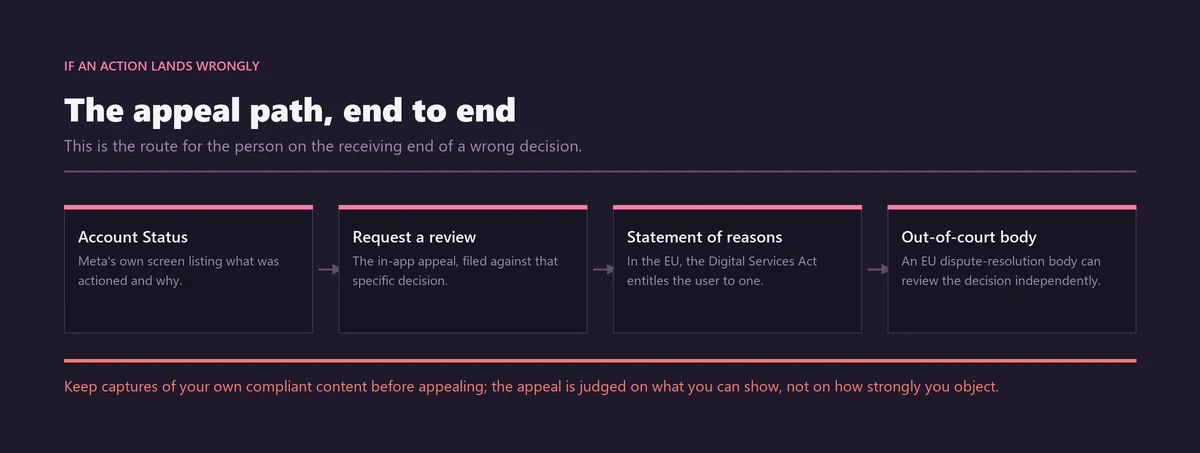
Check three things before resubmitting. Was the report filed by the person being copied, rather than by a friend? Was the identity document readable, unobscured and in the matching name? Was the category impersonation, rather than spam or a general dislike? Any one of those alone is enough to sink an otherwise sound complaint.
Do not fire duplicate reports from other accounts, and do not organise a group to file in parallel. That converts a legitimate complaint into a coordination signal, and the systems reading it are tuned to find exactly that shape. One clean resubmission beats twenty ragged ones.
The European appeal route
Under the Digital Services Act, an EU user is entitled to a written statement of reasons when a decision goes against them, and that document is what opens the next door (Regulation (EU) 2022/2065). With it, the dispute can go free of charge to a certified out-of-court dispute settlement body such as Appeals Centre Europe.
The numbers argue for using it. In its transparency report covering April 2025 to March 2026, Appeals Centre Europe recorded more than 4,600 account-suspension complaints from Facebook, Instagram and Threads users, said Meta supplied relevant evidence in fewer than a hundred of them, and disagreed with the platform's original decision in 59% of cases. A first refusal is frequently wrong.
Regulators have noticed the reporting flow itself. On 24 October 2025 the European Commission issued preliminary findings that Meta's Facebook and Instagram reporting mechanisms may use dark patterns, and that the appeals flow does not let EU users submit explanations or evidence (European Commission). These are preliminary findings rather than a final decision — but they explain why the process feels built to tire you out.
Outside the EU there is no equivalent. In the United Kingdom, Ofcom regulates how platforms run their complaint systems under the Online Safety Act rather than deciding individual disputes, so a UK escalation is a complaint about the process, not a request to remove a post. Beyond that the lever is legal: a solicitor's letter, or a claim in your own courts.
What happens after the clone is removed?
Less than most people expect. Removal takes the profile down; it does not undo what the profile did. The handle is not handed to you, your followers are not told what happened, and money anyone sent the impostor is not reversed by Meta. Three separate pieces of work begin the moment the account disappears.
The handle is not automatically yours
A removed username may be released back into the pool, may be held, or may be reassigned through a process nobody outside Meta can see. There is no form that asks for the handle from the account it just removed. Where the name genuinely matters, the realistic options are set out in the three honest routes to claiming an Instagram username, and none of them is instant.
Tell the people the clone spoke to
Meta does not notify the accounts a removed profile messaged. That work is yours, and it is the highest-value hour in the whole process. Post the fake handle, say plainly that you will never ask anyone for money or codes, and ask anyone who was contacted to tell you. This is usually how a second clone gets found.
Money already sent does not come back
A takedown is not a refund. Where followers paid a fake shop or sent a supposed friend money, they need their bank or card provider and a police report, quickly — chargeback windows and bank fraud rules run on their own clocks, and those clocks do not wait for Meta. Give them the removal reference and the dates, because it strengthens their claim.
The same clone is back under a new handle — now what?
Refile, and start keeping a dossier. Each new profile technically begins clean, so the removal you already won does not carry across by itself. What does carry is a documented pattern: every handle, every removal reference, every dated capture, in one file that shows the connection rather than asserting it.
Rebuilding after a removal is itself a violation, because Meta treats evading an enforcement action as a distinct breach. The platform can only apply that where the link between the old account and the new one is visible in your report, so say it explicitly. Give the previous handle, the previous reference number, and what is identical: the same photographs, the same biography, the same misspelling.
- One file, appended to. Handle, date first seen, date reported, reference number, outcome, and a full-frame capture. A spreadsheet is enough.
- Report each new handle on its own merits, through the same official form, referencing the earlier case rather than relying on it.
- Add the copyright angle where the rebuild reposts your photographs, because that is a second, independent ground against the same account.
- Do not chase them yourself. Messaging the clone, or asking followers to pile in, only tells them which detail to change next.
There is a point where a repeat operator stops being a reporting problem and becomes a legal one. A persistent network attached to real financial loss is a matter for the police and, if you want the person identified, for a lawyer. If you would rather someone else carried the documentation, tell us what has happened and you will get a straight answer about which route fits — including that you should file it yourself, when that is the truth.
Does flooding the report button get an impersonator banned faster?
No. There is no number of reports that forces a removal, and stacking them makes matters worse rather than faster. Instagram weighs whether an account genuinely breaks a rule, so one accurate, well-evidenced Instagram impersonation report outperforms a hundred vague taps, and coordinated flagging is detected and discounted as manipulation.
The people running the pile-on can end up restricted instead of the target, which is a poor trade for a case you were going to win on evidence anyway. Mass-report tools sold against this subject rest on the same misunderstanding: they cannot reach an endpoint you cannot reach yourself, and a fair number of them exist mainly to collect the logins of people desperate enough to try them.
What actually moves an impersonation case is unglamorous. The right form. The impersonated person filing it. A legible photo ID. Exact links. A dated capture showing the deception in one frame. Filed once, then left alone long enough for a human to read it.
If you would rather hand the documentation to somebody else, that is what a paid case-handling service honestly is — time and evidence discipline, not access. What such an engagement buys, and what it cannot, is set out plainly in the breakdown of what an Instagram ban service really involves. We act only on genuine Community Guidelines or legal violations, through official channels, and never against an account that has done nothing wrong. The rest of the cases handled here sit on the solutions index.
Sources
- Instagram Help CenterReport an account impersonating you (Instagram and Threads, works logged out)
- Instagram Help CenterReport intellectual property or trademark infringement
- Instagram Help CenterBlackmail and threats to share private images: what to do
- Meta Transparency CenterCommunity Standards: authentic identity representation
- U.S. CongressS.146 — TAKE IT DOWN Act, 119th Congress
- U.S. Federal Trade CommissionTAKE IT DOWN Act: reporting platforms that fail to remove intimate imagery
- Report Fraud (UK police)Report fraud and cybercrime in England, Wales and Northern Ireland
- Revenge Porn HelplineSupport for adults in the UK facing intimate image abuse
- InstagramHacked account recovery flow
- Appeals Centre EuropeCertified Article 21 out-of-court dispute settlement body for Meta decisions
- EUR-Lex, European UnionRegulation (EU) 2022/2065 — Digital Services Act, statement of reasons and redress
Frequently asked questions
Do I have to send my ID to report a fake Instagram account?
For a personal impersonation claim, yes. The reviewer has two profiles and no way to tell which belongs to the real person, and a government photo ID answers that. Meta uses the copy to verify the claim and then deletes it. A business reports differently, proving it owns the name rather than showing anyone's face.
Can I report an impersonation account if I don't have an Instagram account?
Yes. Meta's impersonation form loads without a login, which matters because the only profile in your name may be the fake one. You supply your name, an email address, the fake profile's link and a photo ID. Updates arrive by email, so use an address you actually check rather than one you abandoned years ago.
How long does Instagram take to remove an impersonation account?
There is no published answer, because Meta commits to no review deadline for impersonation reports. Clear cases with a legible identity document and exact links tend to move within days; vague or miscategorised ones wait longer or are declined outright. Resubmitting the same complaint repeatedly does not speed it up and can look like a campaign.
Does Instagram tell the impersonator who reported them?
Not for an impersonation report, and not for an ordinary in-app report either. Copyright and trademark notices are the exception: your name and contact details are forwarded to the account you reported so it can answer the legal claim. If being identified is a risk for you, weigh that before choosing an intellectual-property route.
Can my friend report the fake account for me?
They can report specific harm they have seen, such as a scam message or a stolen photograph, and that is genuinely useful. They cannot file the impersonation claim itself. Meta acts on an impersonation report only from the impersonated person, a parent or guardian, or an authorised representative, because only they can prove whose identity was taken.
What do I do if someone is blackmailing me with fake AI photos?
Treat the imagery and the profile as two filings. Report the pictures through the intimate-image route, because an AI-made image is covered as a digital forgery, and submit a hash to StopNCII so re-uploads are blocked. Report the profile separately on the impersonation form. Do not pay, do not reply, and do not forward the image to anyone.
Can I get my username back after a fake account is removed?
Not automatically, and there is no form that asks for it. A removed handle may be released, held, or reassigned through a process outside your view, and Meta makes no commitment either way. If the name matters commercially, a trademark claim is stronger than a request, and an unused-handle claim is a separate process with its own low odds.
Is impersonating someone on Instagram illegal?
It depends where you are and what the impersonation was used for. On its own it is a platform policy breach everywhere; it becomes criminal when attached to fraud, harassment, stalking or extortion, which is how most of these cases actually run. Report it to the platform and to the police in parallel rather than choosing between them.
Does one report cover both Instagram and Threads?
Yes. A Threads impersonation goes through the same Meta form, because a Threads profile is created from an Instagram login. Choose the surface where the fake account actually operates, attach that profile's link, and describe the other in the text if you have been cloned on both. There is no separate Threads-only impersonation form.