How to report Instagram extortion, in the order that works
Reviewed 8 August 2026 · 5,593 words · 23 min read
A crisis sequence for anyone being blackmailed on Instagram right now: what to do first, which images can still be blocked, and who has the power to act.
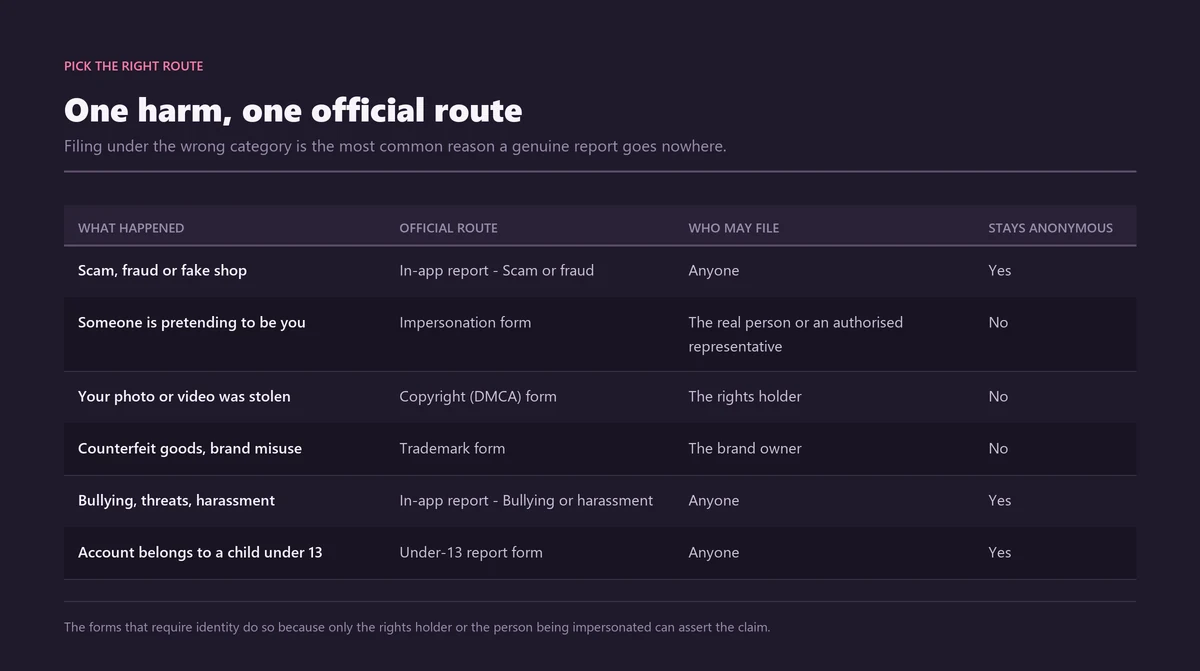
To report Instagram extortion, stop replying, screenshot the threats and the profile, then report the account in the app under the option for threats or shared private images. Do not pay and do not delete anything. Then hash the images through StopNCII or Take It Down and file with the police.
If an extortion or sextortion account is still live after you reported it, send us the handle and the screenshots — we file through Instagram's own forms, on genuine violations only.
- Since 19 May 2026 the FTC has enforced the TAKE IT DOWN Act: covered platforms must remove valid non-consensual intimate image reports, and known identical copies, within 48 hours.
- The Act expressly covers digital forgeries — intimate images created or altered with AI — on the same terms as a real photograph.
- StopNCII (adults) and Take It Down (under-18s) block matching uploads from a hash; the image itself never leaves your device.
- The FBI's published position is that paying rarely stops the blackmail, and it warns about for-profit sextortion assistance firms.
- In the United States the 988 Suicide and Crisis Lifeline is free and confidential, by call or text, at any hour.
What should you do in the first hour of an Instagram extortion threat?
Stop replying, stop paying, stop deleting. In the first hour only three things matter: the conversation survives as evidence, your money stays where it is, and the images get hashed so platforms can block them on sight. The countdown, the screenshot of your follower list, the threat to message your family — all of it is pressure engineering.
- Stop responding. Not a refusal, not a negotiation, not one last message. Silence removes the only raw material the extortionist has: your reaction.
- Do not pay. If money has already gone, the section on payments below sets out what can still be done and how fast it has to happen.
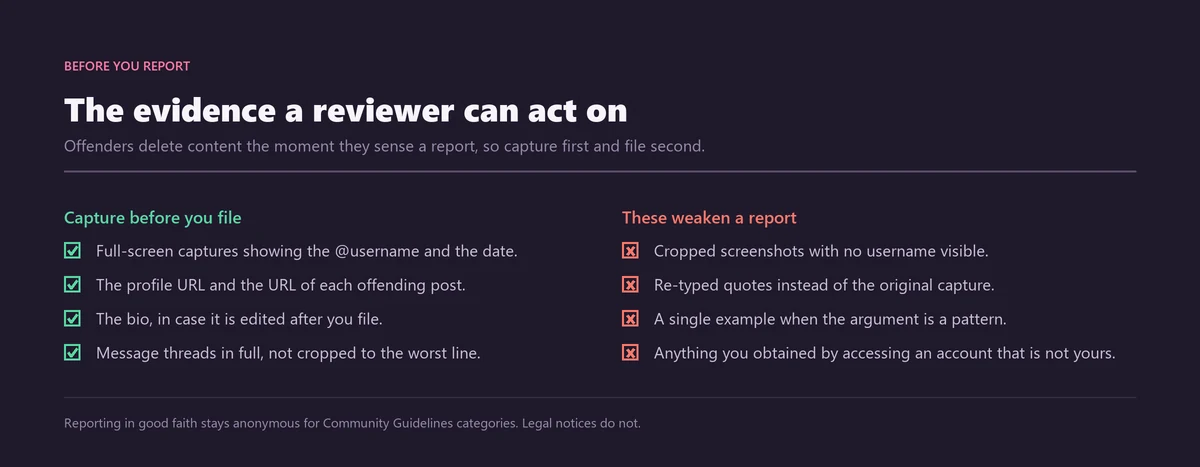
- Screenshot before you block: the @username, the whole profile, the bio link, every threat, the payment handles, any wallet address, and the deadline you were given.
- Do not delete the chat, the account or the app. Deleting your own profile destroys your evidence and removes nothing the other side already holds.
- Hash the images through StopNCII or Take It Down so participating platforms block matching uploads. The picture itself never leaves your device.
- Report the account inside Instagram under the threat or private-images option, then block it.
- Tell one person out loud — a parent, a partner, a friend, a teacher. Isolation is the mechanism the threat runs on, and a witness breaks it.
- File with the police or your national cybercrime body the same day, while the account is live and the payment trail is warm.
That order is deliberate. Evidence goes first because it is the only element that vanishes on its own. Hashing goes second because it starts working while everything else queues. Law enforcement is last in sequence and first in importance: Instagram removes content, only the police pursue a person.
The deadline you were given is not real. Every part of the script — ten minutes, a screenshot of your followers, a half-sent message to a relative — exists to stop you thinking long enough to do any of the eight steps above. Working out how to report Instagram extortion properly takes about twenty minutes. Take them.
Should you pay an Instagram extortionist, and what if you already have?
No. The FBI's published position on sextortion is that cooperating or paying rarely stops the blackmail, and a payment frequently produces a second demand within hours. If money has already left your account, the case is not lost — the payment method decides what is still recoverable, and some routes close within days.
It helps to know what you are dealing with. Meta said on 11 March 2026 that it removed 10.9 million Facebook and Instagram accounts linked to criminal scam centres during 2025, and that its investigators disabled more than 150,000 accounts tied to scam-centre networks in a joint disruption led by the Royal Thai Police Anti-Cyber Scam Center with the FBI and the US Department of Justice, contributing to 21 arrests.
That reframing matters. You are not being singled out by someone who knows you. You are one line in a script run against hundreds of accounts, and the script has a step for what happens after you pay.
Paying does not buy silence. It buys you a place on the list of people who pay.
If money has already left your account
- Bank transfer, Zelle, Cash App, Venmo or PayPal: call the provider's fraud line the same day, use the words "extortion" and "fraudulent transfer", and ask whether a recall is possible. Speed is the whole variable.
- Debit or credit card: ask your issuer about a chargeback, and freeze the card if the details were entered on a page the extortionist sent you.
- Gift cards: keep the physical card, the receipt and the redemption code, then call the retailer's fraud team. Unspent balances are occasionally frozen.
- Cryptocurrency: the transfer cannot be reversed, but record the receiving wallet address and the transaction hash. Exchanges do freeze addresses at law-enforcement request, and only a report puts an address on that list.
Report the payment even if the amount embarrasses you. Fraud teams work on patterns, and a wallet address appearing in five complaints becomes actionable in a way it never is in one.
How do you stop the images spreading before anything else happens?
Hash them. Two free services turn an intimate image into a digital fingerprint on your own device and share only that fingerprint with participating platforms, so matching uploads are blocked automatically. You never upload the photograph, and the hash cannot be turned back into a picture. Which service you use depends on the age of the person depicted.
| Who is depicted | Service to use | What it does | Who operates it |
|---|---|---|---|
| An adult, 18 or over | StopNCII.org | Creates a hash on your device and shares it with participating platforms, including Instagram, so matching uploads are blocked | Revenge Porn Helpline (UK), with industry partners |
| Anyone under 18 when the image was taken | Take It Down | The same hash-and-block mechanism, built for minors, usable by the young person or a parent | National Center for Missing and Exploited Children |
| A child being sexually exploited, any country | NCMEC CyberTipline | A criminal report that triggers law-enforcement referral, not only a block | National Center for Missing and Exploited Children |
| An image built with AI from your face | Either service, by the age of the person depicted | Treated identically; a "digital forgery" falls under the same removal law as a real photograph | As above |
Do this before any deadline the blackmailer invents. Hashing takes minutes, needs no account, and keeps working whatever the platform report does. It is the only step here that starts protecting you immediately.
One honest limit: hash matching blocks re-uploads at participating services. It cannot reach a private phone, a closed group chat or a site that has joined nothing. It shrinks the blast radius rather than eliminating it.
Where can you get help right now if the fear is unbearable?
Free, confidential help is available at any hour, and using it does not weaken your report or tell anyone what happened. In the United States the 988 Suicide and Crisis Lifeline answers by call or text. In the United Kingdom, Samaritans answers on 116 123. Both are staffed by people who have heard this exact situation before.
The shame is the weapon. Extortion works because the victim believes being found out would be worse than paying, and that belief is manufactured by someone who has said the same sentences to hundreds of people. Saying it aloud collapses most of that power.
- United States: 988 Suicide and Crisis Lifeline — call or text 988. The Crisis Text Line answers texts to 741741.
- United Kingdom: Samaritans on 116 123, free, day or night. Under-19s can reach Childline on 0800 1111, which runs Report Remove with the Internet Watch Foundation.
- Non-consensual images, UK: the Revenge Porn Helpline supports adults and can chase removals across platforms on your behalf.
- Anywhere, for a minor: a parent or carer can file the CyberTipline report and run Take It Down. The young person does not have to do it alone.
Reporting and getting support are not competing choices. You can text a crisis line while the screenshots save and an adult you trust reads the messages beside you. Nothing here requires you to hold this alone.
Who do you report Instagram extortion to outside the platform?
The body that handles online crime where you live. A platform report and a criminal report do different jobs and should be filed the same day: Instagram can remove an account, while only law enforcement can identify a person, compel disclosure from a payment provider, or trace money. Neither replaces the other.
| Where you are | File the crime with | Immediate danger |
|---|---|---|
| United States | The FBI's Internet Crime Complaint Center at ic3.gov | Call 911 or your local police department |
| United Kingdom | Report Fraud, which replaced Action Fraud in December 2025, or call 101 | Call 999 |
| Australia | The eSafety Commissioner, which can order removal of intimate images | Call 000 |
| Canada | The Canadian Anti-Fraud Centre, plus your local police service | Call 911 |
| Anyone under 18, any country | NCMEC's CyberTipline, alongside local police | Local police, plus Take It Down |
The criminal filing is the half of how to report Instagram extortion that people skip, and the scale of what gets filed is worth seeing. The FBI IC3 2025 Annual Report, published in April 2026, recorded more than 75,000 sextortion-related submissions during 2025, roughly 11,000 from people under 20, and referred more than 5,700 submissions involving minors to NCMEC. Extortion was the primary crime type reported by minors that year, with 5,151 incidents.
Two things follow. Nothing about your case is unusual to the people who read these complaints, which removes any reason to feel exposed by filing. And a foreign-looking account is a reason to report, not an excuse not to: IC3 aggregates across borders, and pattern-matching is what dismantles a whole operation.
How do you report sextortion on Instagram inside the app?
Open the profile, tap the three-dot menu, choose Report, and select the reason describing a threat or someone sharing private images. To report a single message rather than the whole account, press and hold that message in the chat and choose Report. The category you pick decides which review queue receives the case.
- Screenshot first. Reporting can lead to the account being removed, which takes your evidence with it.
- Open the extortionist's profile and tap the three dots at the top right. On the web the same menu sits beside the follow button, though the app offers the fuller list of reasons.
- Choose Report, then work down to the category naming the real harm: a threat to share private images, blackmail, harassment, or a scam.
- Use the free-text box whenever one appears. Two sentences naming the demand, the amount and the deadline give a reviewer context a dropdown label cannot carry.
- Report the message thread separately from the profile if the threats are in DMs. They are different objects and reviewers see different things.
- Block only after both reports are filed and the screenshots are saved somewhere outside the app.
Reporting is confidential. Instagram does not tell an account who reported it for threats, harassment or a scam; the reported user sees a notice about their own content, never your name. The single exception is a copyright or trademark claim, a legal notice the other side is entitled to answer.
Instagram runs defences aimed at this crime: nudity protection blurs suspected intimate images in direct messages by default, Teen Accounts restrict who can contact younger users, and adults are limited in messaging teenagers who do not follow them. Those measures cut the odds of a first approach landing. They do nothing about an attacker who already holds an image.
If the harm sits in one Story, post or comment rather than the whole profile, the per-surface walkthrough in reporting an Instagram Story, post, profile or DM shows where each menu hides. Unsure which category fits? Describe the account to us and we will tell you which official route applies, including when the honest answer is that only the police route will move.
Does Instagram have to remove the images, and how quickly?
In the United States, yes, and there is now a clock. Since 19 May 2026 the FTC has enforced the notice-and-removal section of the TAKE IT DOWN Act, which requires covered platforms to remove reported non-consensual intimate imagery, and known identical copies, within 48 hours of a valid request. Instagram is a covered platform.
This changes the character of the request. Before the Act, an intimate-image report appealed to a policy the platform wrote for itself and could read as it liked. It is now a statutory right with a deadline and a regulator behind it.
The obligations are specific. Covered platforms — social media, messaging and image or video-sharing services — must provide a clearly identified process for requesting removal, must act within 48 hours of a valid request, and must make reasonable efforts to remove identical copies they know about. The FTC treats failures as unfair or deceptive practices, with civil penalties running up to $53,088 per violation.
Two honest caveats. The Act is United States law, so the 48-hour duty is what a covered platform owes in that jurisdiction; readers elsewhere have separate levers, covered further down. And a clock only starts once a request is valid — which is why the next section is a checklist rather than a paragraph.
The statute, S.146 of the 119th Congress, was signed on 19 May 2025 and gave platforms a year to build the process. The legislative history is set out in Orrick's analysis of the Act becoming law, and the enforcement position in the FTC's May 2026 announcement.
What makes a removal request valid under the TAKE IT DOWN Act?
A valid request identifies you as the person depicted, identifies and locates the image precisely enough for the platform to find it, includes a good-faith statement that it was shared without consent, and gives the platform a way to contact you. Vagueness is the commonest reason a request never starts the clock.
- Say who you are and that you are the depicted person. A request filed by a friend on your behalf is weaker; if someone else must file, say plainly that they are an authorised representative and why.
- Locate the image exactly. Give the direct URL to the post, Story or profile, the @username hosting it, and the date and approximate time you saw it. "Somewhere on his account" is not a location.
- Describe the image well enough to identify it without attaching it. You are not obliged to send the picture again to the platform already holding it.
- State that it is non-consensual in explicit terms: you did not consent to its publication or distribution. If it was created or altered with software, say that too.
- Give a working contact method, and a signature or electronic equivalent if the form asks for one.
- Keep a copy of everything, plus the confirmation screen, the reference number and the timestamp. Your 48 hours begins at that timestamp, and you cannot argue about a clock you did not record.
Write it in plain sentences and keep it short. A reviewer opening a request that names the person, the URL, the date and the absence of consent in its first four lines can act on it. One that opens with three paragraphs of background has buried those facts.
What can you do if a platform ignores a valid removal request?
Complain to the regulator. Alongside enforcement of the Act, the FTC has stood up TakeItDown.ftc.gov specifically for reports about covered platforms that fail to act on valid removal requests. It is a genuine escalation lever, and it did not exist before May 2026.
Used properly it carries weight, because the exposure on the other side is financial rather than reputational. Penalties for non-compliance run to five figures per violation, which makes a documented, ignored, plainly valid request an expensive thing for a platform to be holding.
- Wait out the 48 hours from your timestamped submission. Filing early undermines the complaint.
- Gather the evidence pack: the original request, the confirmation or reference number, the date and time, and proof the image is still live.
- File at TakeItDown.ftc.gov, naming the platform, the request date and what has not happened.
- Keep reporting the image itself in parallel: the regulator complaint is about the platform's conduct, the takedown request about the image.
Outside the United States the lever differs but the pattern is constant: the platform first, the regulator when the platform does not move. Those routes are set out further down.
What if the images are AI-generated and not really you?
They are covered anyway. The TAKE IT DOWN Act expressly reaches "digital forgeries" — intimate images created or altered with software, including AI — and treats them on the same terms as a real photograph. A threat built from a face swap sits inside the identical removal regime, with the identical 48-hour clock.
This has become the fastest-growing version of the crime. So-called nudify apps can build a convincing fake from an ordinary holiday photograph lifted off a public profile, so an extortionist no longer needs you to have sent anything at all. Plenty of victims freeze because they know the image is fake and assume that makes it unreportable. The opposite is true.
Report it the same way and say the same things, with one addition: state in the request that the image is a digital forgery of you. That sentence tells a reviewer which policy applies and stops the request being triaged as an ordinary nudity complaint you might have posted yourself.
Hashing works on forgeries too: StopNCII and Take It Down fingerprint whatever file you hold, however it was made. If the extortionist sent you the fake, that file is both your evidence and your hash source — save it before you block.
How do you save evidence when the threats are designed to disappear?
Assume nothing will still be there in an hour. Extortion threats routinely arrive as vanish-mode messages, one-time-view photos or posts deleted seconds after you read them, and the account may be abandoned the moment you stop paying. Capture at the moment of reading, not at the moment you feel ready.
Screenshotting a one-time-view image may notify the sender. The answer is almost always to capture anyway: a threat you can prove is worth more than a moment of surprise you have already lost. Where possible, photograph the screen with a second device — same content, no in-app signal.
- Capture the @username and profile URL in the same frame as the threat, so the two cannot be separated later.
- Include visible timestamps. A screenshot with no date is far weaker to a police officer than one with a date.
- Record payment identifiers verbatim: wallet addresses, Cash App tags, PayPal emails, bank details, the exact amount demanded.
- Save a copy off the phone, by email or cloud storage, so losing or resetting the device does not lose the case.
- Note the account's follower count and creation date if visible. Throwaway accounts change fast, and these details date your report.
One further wrinkle. Several outlets, including MacRumors, The Register and Euronews, reported on 8 and 9 May 2026 that Instagram ended support for end-to-end encrypted direct messages. If accurate, that changes what Meta itself can review in a reported thread and what may later be obtained by legal process. Check Meta's own help pages for the current position before relying on it either way.
What are the warning signs that an Instagram contact is an extortionist?
The approach follows a script, and the script is short. An attractive new follower, unusually fast intimacy, a push towards a video call or an image exchange, then the turn: a demand for money backed by a threat to send something to your contacts. Recognising the pattern early is the cheapest protection available.
- Speed. A stranger who moves from first message to flirtation to "send me a photo" inside a day is running a funnel, not forming a relationship.
- A push to another app. Requests to continue somewhere with fewer safety tools are about reducing your protection, not about convenience.
- A screen-recorded video call. Anyone who insists on video and then produces a recording had the recorder running from the start.
- A brand-deal or verification DM asking for a login code, a "release fee" or your email password. This is phishing wearing a marketing hat.
- An engineered deadline. Ten minutes, one hour, "before I press send". Manufactured urgency exists to beat your judgement, and it is the clearest single tell.
Profile forensics take thirty seconds and settle most cases. A new account, a handful of posts uploaded the same day, followers who are themselves new accounts, photographs that reverse-image-search to somebody else — any two of those is enough to stop replying.
Commercial variants use the same architecture. A giveaway demanding a fee to release a prize, or a shop that takes payment and never ships, runs the same pressure model with a different cover story, and the channel split for those complaints is set out in our guide to reporting an Instagram giveaway or business account through the right channel.
How do you report a phishing email pretending to be Instagram?
Forward it to [email protected] and delete it without tapping anything inside. Before you panic about it, check whether it is genuine at all: Instagram keeps a list of every security email it has actually sent you in the past 14 days, and anything absent from that list is fake by definition.
- Do not tap the link and do not open an attachment. The whole message exists to get one tap.
- In the app, open Settings, then Accounts Centre or Security, and find "Emails from Instagram". Compare what you received against what is listed there.
- If it is not listed, forward the message to [email protected], then delete it.
- If you already entered your password on the linked page, change it immediately on Instagram and anywhere you reused it, then turn on two-factor authentication.
- If you are locked out, use Instagram's account recovery flow rather than any link in the email.
Knowing how to report a phishing email pretending to be Instagram matters because phishing and extortion are frequently the same operation at two stages. The credential theft comes first; the private photographs it exposes become the threat a week later. Stopping it at the email stops it before there is anything to extort you with.
The tells are consistent: a sender address that is not Instagram's own domain, a threat that your account will be deleted within hours, a login page whose URL is a near-miss of the real one. Instagram's guidance on phishing and scam emails lists the reporting address and the red flags.
Is there an Instagram report bot that can ban the extortionist?
No. No Instagram report bot removes an account, and the panels advertised on Telegram and code-sharing sites are actively dangerous to a person in your position. Instagram decides on whether content breaks a rule, not on how many complaints arrive, so a tool that multiplies complaints is scaling the one input that has no effect.
The pitch is built for this exact moment: you are frightened, you want the account gone tonight, and someone is offering to do it for a fee. Nobody selling a panel is telling you how to report Instagram extortion — they are selling you a way to avoid doing it. Enforcement follows a policy assessment, and a policy assessment has no volume dial.
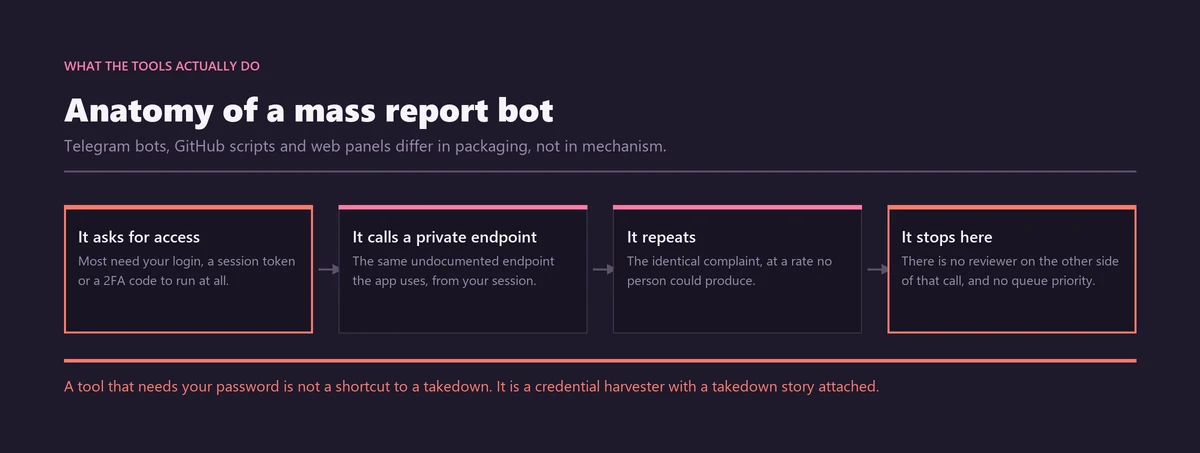
Two harms come built in. Coordinated false reporting is itself misuse of the system, so a campaign can rebound onto the people running it. And most of these panels ask for your Instagram login, which is the actual product — handing credentials to a stranger mid-crisis turns one crisis into two.
The full demolition is in our breakdowns of the Instagram mass report bot claim and of what a coordinated mass-report campaign actually achieves. If what you want is the account gone for good, the honest mechanics are in what actually makes an Instagram ban stick, and none of them involve a bot.
Does reporting more times get the account removed faster?
No. Instagram's Help Center states that the number of times something is reported does not determine whether it is removed; whether it breaks a rule does. One precise report with the username, the dated threats and the payment demand outperforms a thousand duplicates, because a duplicate adds no new information to a review.
Reports are evidence handed to a reviewer, not votes in a poll. That distinction explains almost every disappointment people have with the system, including the belief that a report was ignored when it was read and declined.
Severity is what moves a case. A credible threat to distribute intimate images is a different category of harm from an unpleasant comment and is triaged differently — not because more people flagged it, but because of what it is. The realistic mapping of violation type to outcome is laid out in how a genuine violation, the right evidence and the right route lead to a ban.
Removal is also not the same as deletion. An account Meta disables for enforcement is not an account somebody deleted, and the difference decides what happens to the content afterwards — unpacked in the four official routes to getting an Instagram account deleted and in who actually holds the power to delete someone else's Instagram account.
How do you report cyber crime on Instagram and know the report landed?
Knowing how to report cyber crime on Instagram means understanding that there are three separate filings, not one: the in-app report to Instagram, the criminal complaint to your national body, and the hash submission to StopNCII or Take It Down. Only the first produces a status you can check inside the app.
Instagram keeps a log of your own complaints. Open Settings, then Help, then Support Requests, then Reports, and each case appears with a status attached. Most people never look, and read the silence as the report vanishing.
| What you see | What it means | What to do next |
|---|---|---|
| In Review | Queued or being assessed. No decision has been made. | Wait. A second identical report creates a duplicate, not a priority. |
| Action Taken | A policy breach was found and something was removed or restricted. | Screenshot the outcome in case the same person returns on a new handle. |
| No Action Taken | It was reviewed and declined. Somebody looked and disagreed. | Request a review once, adding the context the first report lacked. |
| Nothing listed at all | You filed through a logged-out web form, which does not appear in this log. | Rely on your own copy of the confirmation and reference number. |
Do not expect a phone call. Instagram operates no public support line, only in-app reporting and the Help Center, and any "Instagram support" number you find advertised is itself a scam aimed at people in your situation.
Meta publishes no service-level commitment for reviewing reports. The "24 to 48 hours" figure repeated across blogs and AI-written pages is not a Meta standard, and nobody quoting it can show where it came from. The one published deadline anywhere in this process is the 48 hours the TAKE IT DOWN Act imposes on valid intimate-image removal requests in the United States, which is a different thing entirely.
What are the reporting routes outside the United States?
Different lever, same structure. EU users can report content as unlawful rather than merely rule-breaking, which triggers Digital Services Act obligations including a written statement of reasons and an appeal route. UK users have a dedicated helpline for non-consensual images and an independent escalation service when a platform does not respond.
European Union
Reporting content as illegal is a separate lane from reporting it as a Community Guidelines breach, and it produces a different paper trail. Under the DSA a platform must tell you what it decided and why in a statement of reasons, and must keep an internal complaint route open for at least six months after that decision. The European Commission's overview of the Digital Services Act sets out the framework.
If Meta's internal appeal fails, an EU user can take the decision to a certified out-of-court dispute settlement body free of charge. Its ruling does not bind Meta the way a court order would, but it produces an independent written assessment of whether the platform applied its own rules correctly — a document you did not previously have.
United Kingdom, Australia and elsewhere
The Revenge Porn Helpline supports adults whose intimate images have been shared or threatened and can pursue removals across platforms for you. Report Harmful Content is the escalation route once a platform has been reported and has not acted. The criminal report goes to Report Fraud or 101, and to 999 in immediate danger.
Australia's eSafety Commissioner holds statutory power to require removal of intimate images shared without consent, which makes it one of the strongest regulators here. Elsewhere, find your national cybercrime portal and file locally as well — cross-border cases still begin with a local complaint.
How do you secure your account once the evidence is saved?
Only after the screenshots exist, not before. Locking the account down first can cost you access to the very thread you need to prove the crime. Once the evidence is off the device and safe, close the doors: two-factor authentication, a private profile, and message controls that filter strangers out entirely.
- Turn on two-factor authentication using an authenticator app rather than SMS where you can, and store the recovery codes off the phone.
- Change the password, and change it anywhere you reused it. Extortionists frequently arrive through a reused password rather than a conversation.
- Switch the account to private, and review the follower list for accounts you do not recognise.
- Restrict message requests so people you do not follow cannot reach your main inbox.
- Check Settings for active login sessions and remove any device you do not recognise.
- Hide your follower and following lists if the threat was to contact the people on them.
Resist the urge to delete the account. It feels like closing the wound and does the opposite: it destroys your evidence, ends your ability to track the report, and removes nothing already downloaded. Go quiet by going private, not by going away.
If the same person keeps returning on new handles after the account is removed, the problem has shifted from extortion to persistent targeting, and the safety-first sequence in reporting an Instagram stalker without escalating the situation is the right next read. Where the case is a genuine Community Guidelines or legal violation and you would rather not assemble the evidence pack alone, that is the work we do through official channels only — the full set of Instagram reporting and takedown solutions sets out what each route can and cannot achieve, and how to report Instagram extortion fits alongside them.
Sources
- Federal Trade CommissionFTC begins enforcing the TAKE IT DOWN Act, May 2026
- Federal Trade CommissionTakeItDown.ftc.gov — report a platform that fails to act on a valid removal request
- Instagram Help CenterPhishing and scam emails: how to report them
- Report Fraud (UK)National reporting service for fraud and cybercrime
- Revenge Porn HelplineSupport and removals for non-consensual intimate images
- Report Harmful ContentEscalation route when a platform does not act
- eSafety Commissioner (Australia)Report image-based abuse and serious online abuse
- Canadian Anti-Fraud CentreReport extortion and online fraud in Canada
- 988 Suicide and Crisis LifelineFree, confidential crisis support by call or text
Frequently asked questions
Should I pay an Instagram extortionist to make the threat stop?
No. The FBI's guidance on sextortion is that cooperating or paying rarely ends the blackmail, and a payment usually signals that further demands will be met. Stop replying, keep every message as evidence, hash the images through StopNCII or Take It Down, report the account in the app, and file a criminal complaint. Paying makes a leak more likely, not less.
How long does Instagram have to remove intimate images once I report them?
In the United States, 48 hours from a valid request. Since 19 May 2026 the FTC has enforced the TAKE IT DOWN Act, which requires covered platforms to remove reported non-consensual intimate imagery and known identical copies inside that window. Outside the US there is no equivalent statutory clock, and Meta publishes no general review-time commitment for ordinary reports.
Will the extortionist find out that I reported them?
No. Reports about threats, harassment, blackmail and scams are confidential, and Instagram never shows the reported account who filed one. They may see a notice about their own content being removed, which is not the same as being told your name. The only non-anonymous route is a copyright or trademark claim, where the other side is entitled to respond.
What do I do if the blackmailer already has my photos?
Hash them so they cannot spread. Adults use StopNCII; anyone under 18 in the image uses Take It Down. Both create a fingerprint on your own device and share only that fingerprint, so participating platforms block matching uploads without you sending the picture anywhere. Then report the account, file with the police, and preserve every message you already hold.
Should I delete my Instagram account to escape the blackmail?
No. Deleting the account destroys the evidence Instagram and the police will ask for, ends your ability to track the report you filed, and removes nothing the extortionist has already downloaded. Switch to private instead, turn on two-factor authentication, and filter message requests from people you do not follow. Do all of that after the screenshots are saved off the phone.
Does an Instagram report bot make the account come down faster?
No. Instagram's Help Center states that the number of times something is reported does not determine whether it is removed. A bot multiplies the one input that has no effect on the decision, coordinated identical reports are detected and discounted, and many of these panels ask for your login, which is the actual product being sold.
How do I report sextortion to the FBI?
File at ic3.gov, the FBI's Internet Crime Complaint Center, with the username, the screenshots, the payment details and the dates. If the person depicted is under 18, file with NCMEC's CyberTipline as well. The FBI IC3 2025 Annual Report logged more than 75,000 sextortion-related submissions during 2025, so nothing about your case will be unfamiliar to the people reading it.
What if the images are AI-generated fakes rather than real photographs?
They fall under the same rules. The TAKE IT DOWN Act explicitly includes digital forgeries — intimate images created or altered with software, including AI — so the 48-hour removal duty applies identically. State clearly in your report that the image is a digital forgery of you, and avoid posting a public denial, which spreads the fake further.
Where can a teenager or a worried parent get help?
In the United States, call or text the 988 Suicide and Crisis Lifeline, and use Take It Down for images of anyone under 18. In the United Kingdom, Childline answers on 0800 1111 and Samaritans on 116 123. NCMEC has linked these schemes to teenage suicides, so the emotional side is as urgent as the reporting side.