How to get someone banned on Instagram: what decides the verdict
Reviewed 8 August 2026 · 5,610 words · 22 min read
Instagram bans accounts that break its rules, not accounts that attract complaints — so here is what a report must contain, and what to do when it is refused.
To get someone banned on Instagram, report the specific Community Guidelines rule the account breaks, through the route built for that harm, with dated evidence attached. Nobody outside Meta can issue a ban. Report volume changes nothing; a confirmed violation and legible proof are what remove an account.
If an account is scamming, impersonating or harassing you and your reports have gone nowhere, send us the handle — we file genuine violations through official channels only, never a compliant profile.
- Instagram states the number of times something is reported does not determine whether it is removed.
- The numbered strike ladder Meta publishes — a warning, then limits from two to six strikes — applies to Facebook accounts, not Instagram.
- Meta publishes no review deadline, so the widely quoted 24-to-48-hour ban window is folklore rather than policy.
- Since January 2025 Meta has aimed proactive automated scanning at illegal and high-severity harm, leaving lower-severity categories to user reports.
- In the EU, the person who submitted a report can use Instagram's internal complaint route for at least six months under Article 20 of the Digital Services Act.
What does getting someone banned on Instagram actually mean?
Getting someone banned means persuading Meta that a named account broke a named rule. You do not cast a vote and you do not decide anything. You submit a report; a classifier or a human reviewer reaches a verdict; that verdict settles the case. Everything you control happens before the report leaves your phone.
So the useful version of how to get someone banned on Instagram is small and practical. Make it effortless for a stranger with forty seconds to see the breach. That stranger has no context and no interest in your dispute. If the violation is not visible inside the report you filed, it does not exist as far as the decision is concerned.
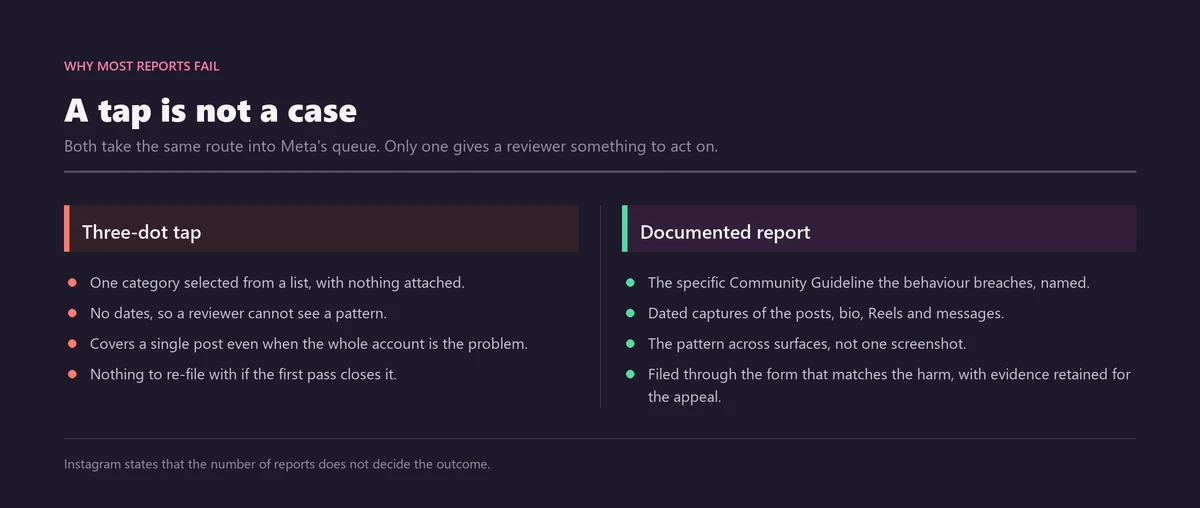
Almost every failed attempt is one of two things. Either the account broke no rule, so there was nothing to find however many times it was reported. Or a real breach was reported so thinly that the reviewer could not see it. Only the second one is fixable, and this page is mostly about fixing it.
Is a ban the same as blocking, restricting or a shadowban?
No. Five different things get called a ban and only one of them takes an account off Instagram. Blocking and restricting are private controls you apply to your own experience; they change nothing about the other account's standing. A disable is platform-level. Knowing which one you actually want stops you filing for the wrong outcome.
| What people call it | What it actually is | Who triggers it | Effect on the other account |
|---|---|---|---|
| Block | A private severance: you and they stop seeing each other | You, from your own settings | None whatsoever |
| Restrict | Their comments show only to them; their messages move to requests | You, silently | None; they are not notified |
| Action block | A temporary limit on following, liking or commenting after spam-shaped activity | Instagram's automated systems | Lifts by itself, usually within hours or days |
| Shadowban | Not an official state at all; reduced distribution for borderline content | Ranking systems, not enforcement | Reach falls; the account stays live |
| Ban, properly a disable | The account is removed and stops loading for everyone | Meta, after a confirmed violation | The only outcome that is a removal |
When an account is disabled, everything attached to it goes with it: posts, Reels, Stories, tags and the follower graph stop being publicly visible. After a permanent disable the handle can eventually become available again, but Meta publishes no timetable and nobody can promise you the name.
The line between a disable that is reversible and one that is not is where most of the confusion lives, and it is worth reading before you set your expectations. Our page on what actually makes an Instagram ban permanent works through the enforcement states one by one and shows which of them have a route back.
Which Instagram violations actually get an account banned?
Only conduct Instagram already prohibits. Scams and phishing, fake shops, impersonation of a person or a business, counterfeit selling, targeted harassment, sexual exploitation, credible threats and child-safety material are all removable. Disliking someone is not a category. The first job is naming the written rule the account broke, in a single sentence.
Matching what you have seen to an Instagram Community Guidelines violation is not a formality. It decides which policy the content is measured against and which queue the report joins. File a payment scam under "bullying" and it is assessed as bullying, found not to be bullying, and closed — with the fraud never examined at all.
Everyone searching how to get someone banned on Instagram arrives with a specific account in mind, and this is where a good number of those searches quietly end. A rival, an ex, a critic: none of that is enforceable. Reviewers are not assessing whether an account deserves to exist. They check one behaviour against one rule.
There is also a scale question people skip. A single violating post normally costs the post, not the profile. Profile-level action needs the breach to sit in the profile itself — an impersonating display name, a scam link in the bio — or a run of confirmed violations underneath it. Our breakdown of the four removal jobs hiding behind the word "delete" separates those outcomes.
Which report categories still get actioned in 2026, and which quietly stopped?
Not every category still leads somewhere. Meta rewrote its approach in January 2025: third-party fact-checking was retired in the United States in favour of Community Notes, and the Hateful Conduct policy was narrowed. Scam, impersonation, counterfeit, child-safety and threat reports remain fully live. Misinformation reports largely are not.
| Report category | Where it stands in 2026 | What to do with it |
|---|---|---|
| Scam, fraud, phishing, fake shop | Fully live and a proactive detection priority | File it, with the payment trail and the link captured |
| Impersonation of you or your business | Fully live, with a dedicated web form | Use the form, not the three-dot menu |
| Counterfeit goods, stolen photos and video | Fully live through the intellectual property routes | The rights holder files; ownership proof required |
| Child safety, credible threats, terrorism | Highest priority; can be actioned on one occurrence | Report, and contact the police or a hotline as well |
| Bullying and harassment | Live, but the volume actioned has fallen sharply | Evidence the pattern across time, not one comment |
| Hateful conduct | Live under a narrower definition since 2025 | Check the current wording still covers what you saw |
| False information | Largely a dead end in the US since fact-checking ended | Report the harm underneath it instead — the scam, the impersonation |
The shift shows up in Meta's own numbers. Hateful-conduct content actioned across Facebook and Instagram fell to 3.4 million pieces in January to March 2025, against 7.4 million in the same quarter of 2024, while bullying and harassment actioned fell to 5.1 million from 7.9 million, per Meta's Community Standards Enforcement Report.
Does your report carry more weight now than it did in 2024?
For lower-severity harm, yes. In January 2025 Meta narrowed its proactive automated scanning to illegal and high-severity categories — terrorism, child exploitation, drugs, fraud and scams. Everything below that line now waits for a person to report it. Your report stopped being a backstop and became the trigger.
That cuts both ways. A compliant account is less likely to be caught by a machine on a bad day, which is good news if it is yours. A genuinely harmful account below the severity line is less likely to be caught at all unless somebody reports it properly. A weak report is no longer a second opinion. It is a case that never opens.
The oversight of all this is under pressure too. In June 2026 Meta's Oversight Board upheld a permanent disable in its first account-level case while finding systemic human rights concerns, criticising the transparency and consistency of Meta's approach and noting that many users receive no meaningful explanation and no clear appeal path (Oversight Board).
How many reports does it take to get someone banned on Instagram?
There is no number. Instagram states that how often something is reported does not determine whether it comes down; whether it breaks the Community Guidelines does. So the honest answer to how many reports to get someone banned on Instagram is one, when the breach is real, and none at all when it is not.
Fifty flags on one profile do not produce fifty assessments. They produce one, because the question being asked — does this break a rule — returns the same answer no matter how many people ask it.
A burst of near-identical complaints from accounts with no posting history reads as coordination, and coordination is a signature Meta's systems strip out before review. What that does to the batch, and to the senders, is set out in our analysis of whether report volume ever bans anyone.
None of this means several people should stay silent. If a fake shop took money from nine customers, all nine should file their own report describing what happened to them, in their own words. That is nine witnesses, not a campaign. What fails is one panel pasting one sentence from twenty accounts registered that afternoon.
Why does one report remove a new account when a thousand bounce off an old one?
Because the review weighs the account as well as the report. A profile created last Tuesday, carrying one scam post and no history, has nothing to set against a confirmed breach. A ten-year-old account with a clean record and genuine engagement gets its context read carefully before anything is applied to it.
People call this a trust score. Meta publishes no such number and nobody outside the company can read one, so treat any page that quotes your target's "score" as inventing it. What Meta does describe is history: prior confirmed violations change what the next confirmed violation costs, and an account with none starts somewhere different from an account with three.
A clean history is the strongest defence an Instagram account has, and no volume of reports can manufacture a breach that is not there.
Read your own case against that asymmetry before spending a week on it. If the target is established, compliant and simply unpleasant, the honest forecast is nothing, indefinitely. If it is a two-week-old burner running a giveaway scam, one clean report with the payment request attached is genuinely enough.
What evidence makes an Instagram report stick?
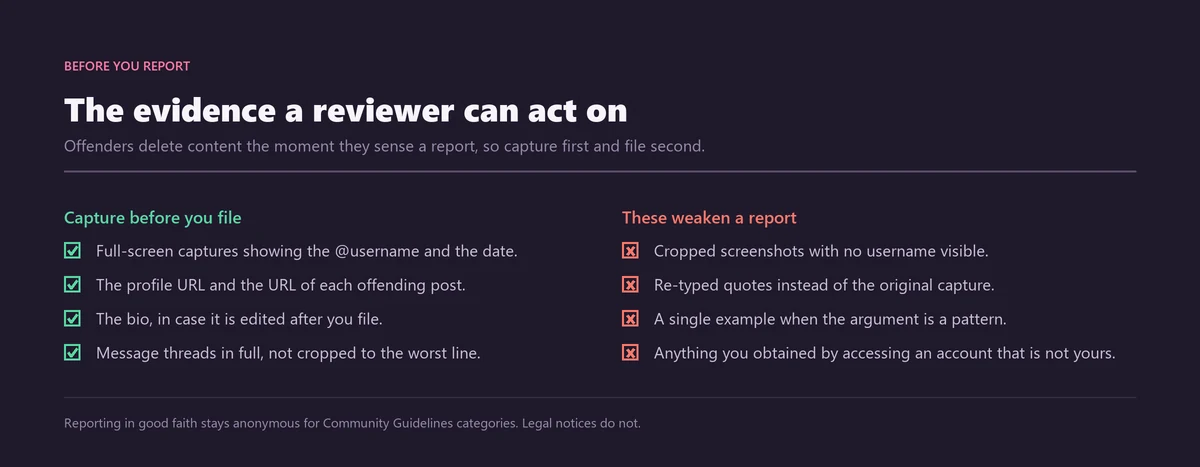
Evidence that survives the account deleting it. Dated screenshots of the violating posts, Stories, comments and messages, with the username and the post URL visible in frame, plus whatever proves the harm — the payment request, the phishing link, your own profile beside the clone. Capture first. Report second.
- Scam or fake shop — the offer, the payment handle or link, the messages asking for money, and the date each of them appeared
- Impersonation — your real profile and the clone side by side, your photo ID ready, and the earliest date the clone was visible
- Counterfeit or stolen photographs — proof you own the mark or the original file, with the infringing post URLs listed one by one
- Harassment — the comment and message history in sequence, because the pattern is what gets assessed, not the single worst line
- A photo or video of you posted without consent — the URL, and a clear statement that you are the person shown
Put plainly, the honest answer to how to get someone banned on Instagram is mostly a documentation answer. Assembling the file is the unglamorous part and the part that decides the outcome. If you would rather not build it yourself, describe the account to us and we will tell you whether there is a case at all.
Which official route should you use, and can you get someone banned on Instagram immediately?
Use the channel built for the specific harm, and set expectations honestly: you cannot get someone banned on Instagram immediately, on demand or by paying. The removals that happen within minutes come from Instagram's own detection reaching severe content, before any report is read. That speed is not for sale.
| The harm | Official route | Who may file | Anonymous to the account? |
|---|---|---|---|
| Scam, phishing, fake storefront | In-app report, "Scam or fraud" | Anyone who saw it | Yes |
| Someone impersonating you or your brand | The Instagram impersonation form | The person or business impersonated, or a representative | Yes |
| Your photos or video reposted without permission | Copyright report form | The rights holder or an authorised agent | No — your details go to the poster |
| Counterfeit goods or brand misuse | Trademark report form | The registered rights holder | No |
| An account belonging to a child under 13 | Under-13 report form | Anyone | Yes |
| A photo or video of you posted without consent | Privacy violation form | The person shown, or a parent | Yes |
| Harassment, threats, hateful conduct | In-app report under the matching reason | The target or a witness | Yes |
The specialist forms are not a slower version of the three-dot menu. They route to teams handling one issue, they let you attach files, and they ask the questions a general reviewer would otherwise have to guess at. For impersonation and intellectual property, the in-app menu is much the weaker path.
Choosing the wrong form is the most common way a strong case stalls before anyone weighs the proof. Our page on picking the takedown form that fits the harm maps each official route against the situation it was designed for, including the ones with no in-app equivalent at all.
Do Reels, Stories and direct messages get reported differently?
Yes, and the difference costs people cases. Each surface has its own entry point, and Stories carry a clock: they vanish after twenty-four hours, taking the evidence with them. A Story nobody captured is, for reporting purposes, a violation that never happened.
- Feed post — the three-dot control above the post itself
- Reel — the three dots on the control stack at the right of the screen, while the Reel is playing
- Story — the three dots at the bottom of the Story, and only before it expires
- Comment — swipe left on the comment on iOS, or press and hold on Android, then choose the report control
- Direct message — press and hold the message, or open the conversation's information panel to report the sender
- The whole profile — the three dots at the top of the profile, which is the account-level report
Direct messages are the odd one out. You are reporting a private exchange, so the review looks at the conversation rather than at something anyone can open. Screenshot it regardless: if the sender deletes their side, your capture may be the only surviving record.
How do you report an Instagram account, step by step?
The in-app flow is four decisions long and only one of them is hard: choosing the category that genuinely matches. Everything else is navigation. Do the evidence capture before you start, because the flow gives you no way to attach files and no second pass at the wording.
- Capture first. Dated screenshots or a screen recording of every violating item, with the profile URL and the username in shot.
- Write the breach down in one sentence: which rule, broken how, on which dates. If you cannot write that sentence, the case is not ready to file.
- Open the offending profile, post, Reel or Story and tap the three-dot menu. On desktop at instagram.com the same control sits beside the username or above the post, and offers identical categories.
- Choose Report, then decide whether you are reporting one item or the whole account. Item-level for a single post; account-level when the profile itself is the breach.
- Pick the category that matches the written rule rather than the nearest convenient label. "Spam" and "I just don't like it" are the widest buckets on the menu and they get the loosest look.
- Submit once. Note the entry that appears in Support Requests, then leave it alone.
- Where the harm has a dedicated web form — impersonation, copyright, trademark, privacy, under-13 — use that instead of steps three to six.
In-app reporting is anonymous. The account is told that a report was received about it, never who filed. Intellectual property claims are the exception, and it is a large one: copyright and trademark notices are formal legal complaints, so your name and the substance of the claim are passed to the person you reported.
How do you file a copyright or trademark takedown for stolen content?
Through Instagram's intellectual property forms rather than the report menu. A copyright claim runs as a formal notice under the US notice-and-takedown framework, and it has required elements. Miss them and the notice is invalid; state them dishonestly and you take on personal legal exposure no other report route carries.
- Identify yourself as the rights holder or an authorised agent, with real contact details.
- Identify the original work — a link to your own post, the source file, or a registration.
- List the exact URLs of the infringing posts, individually rather than as "their whole profile".
- State in good faith that the use is not authorised by you, your agent or the law.
- State under penalty of perjury that the information is accurate and that you are the owner or authorised to act for them.
- Sign it, physically or electronically.
Trademark works differently, turning on a registered mark rather than an original file, so the form asks for the registration number and the goods it covers. A logo you designed but never registered is a copyright question, and filing it in the wrong lane wastes your strongest evidence.
Intellectual property claims are the most reliable route precisely because ownership is provable rather than a matter of judgement. They are also the least private. Your identity goes to the account you reported, and a counter-notice can put the content back while the dispute moves to a court that Meta plays no part in (US Copyright Office).
How long does Instagram take to ban an account?
Nobody outside Meta can say, because Meta publishes no review deadline. It publishes prevalence, proactive detection rates, appeal volumes and how much content it restored — and nothing whatever about speed. In practice severity and evidence quality set the pace: hours for the blatant and dangerous, weeks for anything needing context.
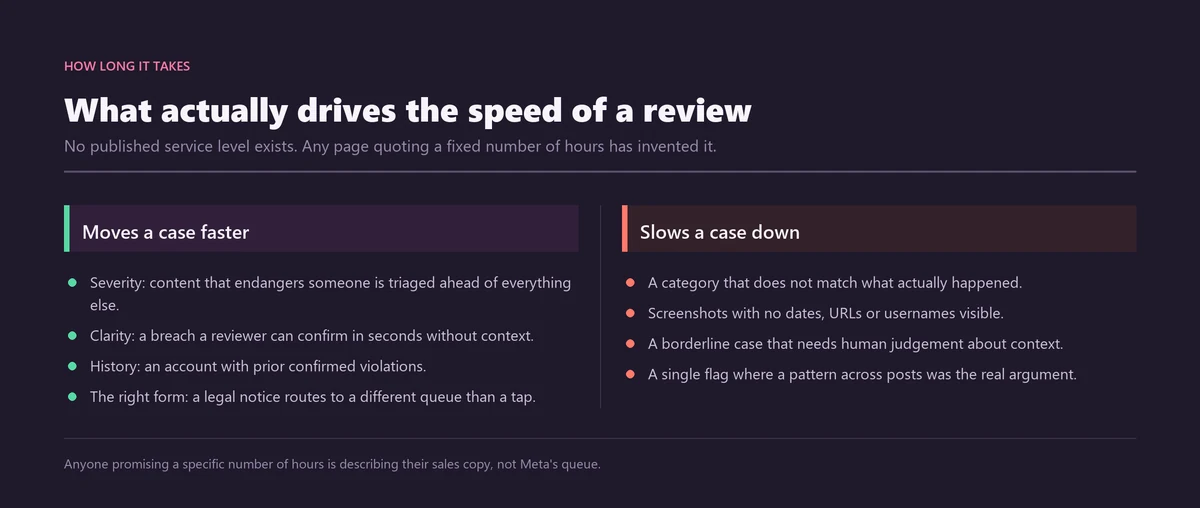
Four things move the clock: how severe the category is, whether the breach is establishable from the report alone, whether you used the route built for that harm, and whether the account already carries confirmed violations. None of those is a queue position, which is why an older report does not get served first.
The question underneath how long does Instagram take to ban an account is usually a narrower one — has anything happened at all. That part you can check yourself, and it takes about a minute.
What is the Meta strike system, and when does one violation disable an account?
The Meta strike system counts confirmed violations against an account and escalates as they accumulate: a warning, then feature restrictions, then removal. Strikes expire after a year. The severe categories skip the ladder altogether — Meta states a single occurrence can be enough where the content is child sexual exploitation.
Because strikes age out after a year, a slow drip of reports spread over eighteen months does not quietly accumulate into a removal (Meta Transparency Center). Patience is not a strategy here. Density of confirmed violations inside a window is what escalates an account, and you cannot manufacture that from outside.
The first-occurrence categories — child safety material, credible threats of violence, terrorism — are mostly caught by automated detection, which is why action against them can look instantaneous and often has nothing to do with your report.
If what you are looking at sits in that band, report it in-app and then take it to the police or a national hotline. A disabled profile does not stop a person, and your evidence is worth more to an investigator than to a moderation queue.
What happens after you file, and how do you read a rejection?
Your report gets an entry in Support Requests — Settings, then Help, then Support Requests — with a state attached: in review, action taken, or no action taken. "No action taken" is a decision, not a queue position. Reading it as "still waiting" is why people refile, and refiling is the move that hurts.
- Open Settings, then Help, then Support Requests, and find the report. Its state is shown against it (Instagram Help Centre).
- Where the outcome is "no action taken", use the request-a-review control on that decision. A reporter can ask for a second look, not only the account that was reported.
- Read what the decision names. It tells you which policy was applied, and that is usually where a mis-categorised report went astray.
- If the category was wrong, refile once under the correct one with the evidence attached. That is a new case, not a repetition of the old one.
- Watch for the account reappearing under a modified handle. A new profile is a new report, and evading enforcement is itself a violation.
- Do not send the same complaint again unchanged. It adds nothing to the record and it looks like brigading.
A rejection is more useful than it feels. It tells you which rule Instagram thought you were invoking, which is often not the rule you meant — and a mis-categorised report is recoverable by refiling correctly.
What can EU and EEA reporters do when Instagram refuses?
Escalate, in three defined stages. The Digital Services Act gives rights to the person who submitted a report, not only to the person reported. Article 16 governs the notice itself, Article 20 opens Instagram's internal complaint process to you, and Article 21 lets you put the decision to a certified body outside Meta.
- File the notice properly under Article 16: identify the content, give its exact location, explain why it is illegal or violating, and be accurate about who you are.
- Keep the statement of reasons. Every decision on a notice comes with one, and it names the ground the platform relied on.
- If the decision goes against you, use the internal complaint route under Article 20. It is open to the person who submitted the notice for at least six months from the decision (Regulation (EU) 2022/2065).
- If the internal complaint fails, take the decision to a certified out-of-court dispute settlement body under Article 21.
- Keep every reference number. The external body assesses the decision that was made; it does not re-run your report from scratch.
Two honest caveats: those decisions are not legally binding on the platform, and the Centre's own reporting notes that platforms sometimes fail to supply the content needed for review. Even so, a majority overturn rate beats any second round of reporting.
Outside the EU and EEA there is no equivalent statutory ladder, and the Oversight Board hears too few cases to serve as one. For most reporters elsewhere, the internal review is the last formal step available.
Why do "instant ban" tools and report bots never work?
Because there are only two products such a seller can ship, and both fail you. The harmless one takes your money and fires reports from disposable accounts that get filtered out before review. The dangerous one produces a real ban by filing fabricated reports, which is a crime in most of the places it happens.
The credential problem is worse. A panel that asks for your login, your session cookie or a two-factor code is not a reporting tool at all. Instagram's own flow never requires a third party to hold your credentials, and handing them over converts you from the person filing the report into the next target.
Some software here is genuinely real — scheduling suites, brand-monitoring dashboards, moderation APIs — and none of it files bans. Our review of which Instagram reporter tools are real and what they actually do separates the working products from the panels.
Searches for how to get someone banned on Instagram lead straight into that market, and it is worth knowing why a panel sometimes appears to work. Scam accounts get caught by detection on their own schedule. Paying someone the week before that happens buys a coincidence, and the invoice arrives either way.
How does the paid ban-as-a-service racket actually get accounts banned?
By abusing the two categories that trigger the fastest automated action: impersonation and self-harm. The impersonation attack is the neat one. The operator copies the victim's profile photo, display name and bio onto their own account, then reports the genuine account for impersonating theirs.
It works because a fast check comparing two near-identical profiles has to decide which came first, and that is the judgement automation is worst at. The real account gets restricted while its owner is asleep, and everything after that is a recovery problem rather than a reporting one.
The second half of the business explains the first. The same operators sell restoration to the people they had banned. Vice documented services advertising bans for under sixty dollars, and ProPublica traced an operator who fabricated impersonation and self-harm reports and then charged victims thousands of dollars each to undo the damage (ProPublica).
The pricing, the legality and the tells are worked through in our page on what an Instagram ban service is really selling. The short version: a seller who promises removal is making a confident claim about a stranger's judgement, and charging you for the confidence.
What legal exposure does the person filing the report carry?
More than most people expect, and it concentrates in the copyright route. A knowingly false takedown notice carries statutory liability in the United States. Misusing the report tools carries platform consequences. And repeating an allegation publicly while campaigning for a ban carries defamation risk that involves Meta not at all.
Section 512(f) of the US Copyright Act makes anyone who knowingly and materially misrepresents that material is infringing liable for the damages and legal costs the other side incurs (17 U.S.C. § 512). It applies to copyright notices only, not to ordinary reports, and it is why the form asks you to sign under penalty of perjury.
Instagram carries its own consequences for the same behaviour. Its help pages set out that submitting fraudulent copyright or trademark reports can cost you access to the intellectual property reporting tools and can lead to action against your account (Instagram Help Centre). Using an IP form to settle a non-copyright grievance is the usual way people fall into this.
Campaigning publicly adds a separate risk. Repeating an allegation in a Story, a caption or a group chat can be actionable in its own right across most common-law jurisdictions, whether or not you originated it. In England and Wales, sustained targeting of one person can also engage the Protection from Harassment Act 1997.
If the honest description of what you are doing is "making this person's life difficult", no framing rescues it.
What if your own account is disabled by a false report?
You have a defined route back, and you should not pay anyone to walk it for you. Account Status — Settings, then Account, then Account Status — lists what Meta believes you violated and carries a request-review control. Identity verification is the step a fabricated impersonation claim cannot survive.
- Open Account Status and read exactly which policy was applied. Do not guess at it, and do not argue with a policy you were not accused of breaking.
- Request a review of every action listed, promptly. The control is easiest to reach while the notification is still live.
- If the account was disabled, use the in-app review request inside the window Instagram allows before deletion becomes permanent — normally thirty days.
- Verify your identity when asked, with photo ID or a video selfie. This is the step that defeats a false impersonation claim outright.
- Keep the explanation short and factual. A reviewer reads a paragraph, not a case file.
- Do not open a replacement account while the appeal is open. Evasion is its own violation and can turn a reversible action into a permanent one.
Harden the account before any of this happens rather than after. Turn on two-factor authentication, keep the recovery email and phone number current, and save dated evidence of your posting history. A well-documented account is harder to take down with a fabricated claim and faster to restore.
What if the account you want gone breaks no rule at all?
Then nothing removes it, and accepting that early saves both money and risk. Instagram enforces its Community Guidelines and the law. It does not adjudicate breakups, business rivalries or reputations, and no number of reports converts a compliant account into a removable one.
It is worth knowing who genuinely holds the power to end an account, because the list is shorter than people assume: the owner, Meta, a court, and in narrow circumstances an immediate family member after a death. Our page on who really holds the authority to delete someone else's Instagram account works through each of them and what each one requires.
Where the problem is simply that an unpleasant person exists in your feed, the tools that solve it sit on your side of the app, need nobody's permission, and work precisely because they do not require the other person to have broken anything.
- Restrict — their comments become visible only to them and their messages move to requests, with no notification sent
- Limits — temporarily hides comments and requests from accounts that do not follow you, which is built for a pile-on
- Hidden Words — filters comments and message requests containing words, phrases and emoji you choose, including a custom list
- Block — severs the connection entirely, and can be extended to new accounts the same person creates
If you came here asking how to get someone banned on Instagram and the account genuinely does break a rule, that is the case we take: read the profile, name the guideline, build the evidence file, file through the official channel, and appeal if it is refused.
Send us the handle and what the account is doing and you will get a straight answer about whether it is worth filing — the same standard we apply across every takedown we handle. A compliant account is never something we will touch, and we will say so plainly.
Sources
- InstagramCommunity Guidelines
- Instagram Help CentreReport an account impersonating you (official form)
- Instagram Help CentreCopyright report form
- Instagram Help CentreTrademark report form
- Instagram Help CentreReport a child under the age of 13
- Instagram Help CentrePrivacy violation report form for an image of yourself
- Instagram Help CentreCheck the status of something you have reported to Instagram
- Instagram Help CentreConsequences of submitting fraudulent copyright or trademark reports
- Meta Transparency CenterTaking action: disabling accounts
- Meta Transparency CenterTaking action: counting strikes
- Meta Transparency CenterCommunity Standards Enforcement Report
- Meta NewsroomMore Speech, Fewer Mistakes (7 January 2025)
- Appeals Centre EuropeTransparency report, April 2025 to March 2026
- Legal Information Institute, Cornell Law School17 U.S.C. § 512 — notice, counter-notification and misrepresentation liability
- U.S. Copyright OfficeSection 512 of Title 17: the notice-and-takedown framework
- ProPublicaThe Instagram ban-and-restore fraud
- legislation.gov.ukProtection from Harassment Act 1997
Frequently asked questions
Does reporting someone on Instagram actually get them banned?
It can, but only when the account has genuinely broken a rule and the report makes that breach easy to see. Reporting is a request for a decision, not the decision itself. A well-evidenced report filed under the correct category is the single most effective thing an ordinary user can do; a vague report about an account you dislike achieves nothing at all.
How many reports does it take to get an Instagram account banned?
There is no threshold number. Instagram states that how often something is reported does not determine whether it is removed; whether it breaks the Community Guidelines does. Duplicate flags about the same profile collapse into a single assessment, so one accurate report with dated evidence outweighs hundreds of empty ones filed from throwaway accounts.
Can you get someone banned on Instagram immediately?
Not on demand, and not by paying. The removals that happen within minutes come from Instagram's automated detection reaching severe content such as child-safety material or credible threats, before any report is read. An ordinary report joins a review process with no published deadline, so any tool advertising an instant ban is selling something that does not exist.
What gets someone banned on Instagram fastest?
The gravest and most clearly illegal categories move fastest, because they can be actioned on a single confirmed occurrence: child sexual exploitation material, credible threats of violence and terrorist content. Scams and phishing follow once the payment trail is attached. An account you simply find unpleasant trips none of these and will stay online.
Is reporting on Instagram anonymous, and can they tell it was me?
In-app reporting is anonymous. The reported account is told a report was received but never who filed it. Copyright and trademark claims are the exception, and it is a significant one: those are formal legal notices, so your name and the substance of the claim are passed to the person you reported.
What happens after you report an account on Instagram?
The report appears in Support Requests, under Settings then Help, with a state against it: in review, action taken, or no action taken. Instagram also notifies you when a decision lands. Treat \u201cno action taken\u201d as a decision rather than a queue position — you can request a review of it, and refiling the same complaint achieves nothing.
Can you get in trouble for falsely reporting someone on Instagram?
Yes. Meta treats knowingly false or coordinated reporting as inauthentic behaviour and can restrict or disable the accounts driving it rather than the target. Fraudulent copyright or trademark notices carry more: Instagram can withdraw access to its intellectual property tools, and US law makes a knowing misrepresentation of infringement a source of legal liability.
Do Instagram ban services and mass report bots actually work?
Report bots do not, because submissions from disposable accounts are filtered as coordinated activity before review. Some paid operators do produce real bans, by fabricating impersonation or self-harm reports, and several then sell restoration to the same victims. An honest service sells documentation and correct routing, never a guaranteed removal.
Is the \u201c24 to 48 hour\u201d Instagram ban time accurate?
No. Instagram has never published a review window, so the figure is folklore repeated by pages with nothing to cite. Real outcomes range from a few hours for blatant, severe breaches to several weeks for context-heavy cases such as harassment. Severity, evidence quality and the route you used set the pace, not a timer.