An Instagram ban service is a paid reporting desk: it establishes how an account breaks Instagram's Community Guidelines or the law, assembles dated evidence, and files it through Meta's own report routes. Instagram alone decides the outcome, so an honest service sells documented filing and refusal, never a guaranteed ban.
- Instagram states that the number of reports filed against an account does not decide whether it is actioned.
- Meta says it removed 159 million scam adverts and 10.9 million accounts linked to scam centres in 2025, with 92% of those adverts taken down before any user report.
- Meta publishes no review time and no success rate for Instagram reports, so any promised turnaround is a sales figure.
- Meta's Oversight Board found in June 2026 that account-level enforcement lacks due process, consistency and transparency.
- Meta has replaced its quarterly Community Standards Enforcement Reports with semiannual Integrity Reports.
What does an Instagram ban service actually do?
An Instagram ban service is a paid reporting desk. It works out which rule an account has broken, gathers evidence that survives the account deleting its own posts, picks the official Meta route matching the harm, and files. What it sells is investigation and correct filing. What it cannot sell is the decision.
That sounds thin until you have tried the alternative. Most people who reach this page have already tapped the three dots, chosen the closest-sounding reason, and watched the report close overnight with nothing changed. The tap was not a mistake. It was a one-line flag with no evidence behind it, dropped into a queue holding millions more.
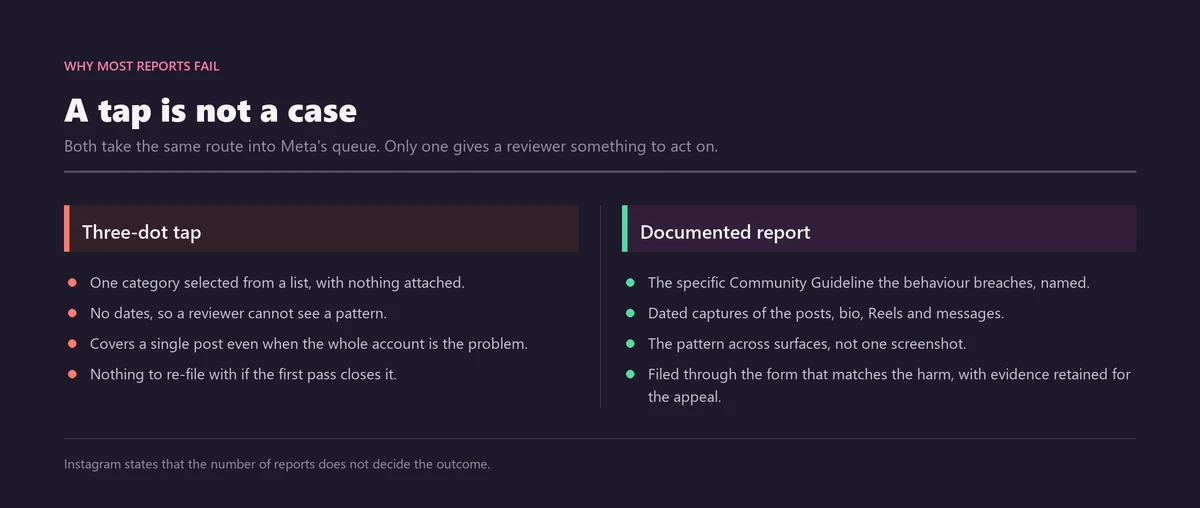
The work sits in four decisions the tap never lets you make. Which rule the behaviour breaks. Which of Meta’s separate routes covers it, since each carries its own rule about who may file. What evidence shows a pattern rather than one bad afternoon. And whether the account is reportable at all, which is the question a seller taking your money never asks.
Which Instagram accounts can this desk actually get removed?
Only accounts doing something Meta already enforces against. That is a narrower band than most buyers expect, and it is the difference between a report and a wish. Six categories cover nearly every genuine case, and each has its own route, its own evidence bar, and its own rule about who may file.
- Scams and financial fraud. Shops that take payment and ship nothing, giveaway and investment cons, phishing links in a bio or a DM. Which channel a fake giveaway or business account belongs in covers the routing people get wrong.
- Impersonation and cloned profiles. An account presenting itself as you, your company or a public figure — the one category with a dedicated form, described in the impersonation report and the photo ID it demands.
- Harassment, stalking and threats. Sustained targeting of one person across comments, DMs and Stories. The safe way to report an Instagram stalker explains what to preserve before you block.
- Counterfeit goods and intellectual property. Copycat storefronts, trademark misuse, and your photographs or Reels reposted without permission. A separate legal track, with a real penalty for filing badly.
- Spam and inauthentic engagement. Bot networks, bought followers, comment floods — most of it removed by detection rather than by report, as why a spam report bot removes nothing sets out.
- Intimate-image abuse, sextortion and illegal material. Treated first as a safety matter, and taken to the authorities wherever a minor or a crime is involved. Reporting Instagram extortion step by step is the practical version.
Routes are not interchangeable, and the wrong one wastes the best evidence you have. A counterfeit seller reported as spam lands in a queue never built to weigh a trademark. Which takedown form fits which harm maps the full set, and the index of reporting guides works through them one by one.
Why does a single Instagram report so often go nowhere?
Because a report is a claim, and a claim with nothing attached is hard to act on. The in-app flow gives you a category and a send button. It does not let you attach a dated screenshot, describe a pattern running across six weeks, or point at the clause you say was broken.
That is the most expensive misunderstanding in this market. Sellers price on the assumption that a hundred complaints outrank one, and buyers pay for it. A hundred identical flags from accounts registered in the same week is a coordination signal, not a stronger case.
Good reports also stall for a duller reason: they were filed on the wrong surface. A Story, a Reel, a comment, a profile and a DM each have their own Report control, and the one you use decides which team ever sees it. The exact Report control for every Instagram surface goes through each. A documented case fixes both problems, which is the only advantage an Instagram account banning service can honestly claim.
How is a case built here, from first message to filing?
In five stages, and the first is a filter rather than a service. Nothing is filed until the behaviour has been matched to a specific Community Guideline or law, because a report that cannot name what was broken is the report that quietly fails. Screening is unpaid, and it often ends in a refusal.
- Screen. You send the @username and what the account is doing. We check it against the rule it appears to breach and say plainly whether a route exists. If none does, it stops there, at no cost.
- Scope. We agree what the case is: one account or a cluster, one incident or a pattern, a Community Guidelines matter or a legal claim only you may bring. That decides the form and the price.
- Document. Dated captures of the bio, posts, Reels, payment requests, DMs and URLs, taken before the account clears its history. A capture showing the handle and the date beats a crop showing only the words.
- File. The report goes through the official route matching the harm, under the correct category, with evidence attached wherever the form accepts it. Where only you may bring the claim, we prepare it and you submit it.
- Follow. We track the decision through your Support Inbox and Account Status, refile with more material where a first pass stalls, and watch for the same operator returning under a new handle.
You receive the clause cited, the route used, the evidence pack and the platform’s answer — the only honest proof of work in this trade, and exactly what a guaranteed-ban seller cannot produce. For one clear violation you hold the evidence for, doing it yourself is genuinely better: every official route to getting an account taken down is written out for that, and the contact page carries the direct routes for a second opinion first.
What actually happens to a report once Meta has it?
It joins an automated triage queue, not a human inbox. Classifiers sort by category and severity, clear-cut cases are actioned without anyone reading them, and the rest is routed for review. Where a report lands in that sort depends on what it contains, which is why contents matter more than count.
Enforcement at Meta is detection-led rather than complaint-led, and the company’s own figures say so. Meta reported removing 159 million scam adverts and 10.9 million Facebook and Instagram accounts tied to criminal scam centres during 2025, and said 92% of those adverts came down before any user reported them (Meta Newsroom, March 2026).
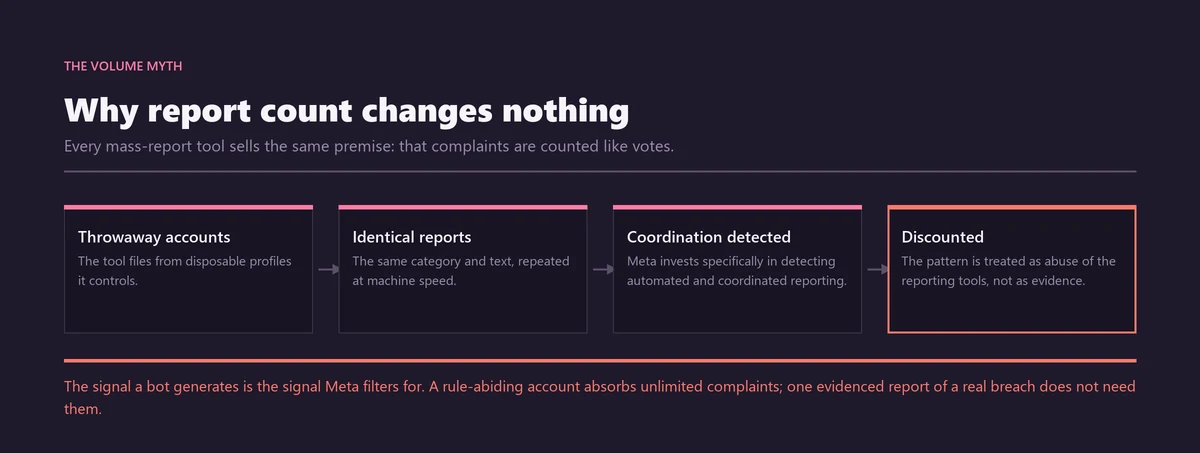
So coordinated volume backfires, and the accounts sending it are the ones actioned. Whether mass reporting an Instagram account ever works takes the claim apart, and what a mass report bot really does with your login covers the tools sold to automate it. Meta has also moved from quarterly enforcement reports to semiannual Integrity Reports, so a crisp quarterly removal statistic quoted in 2026 is stale, or invented.
How does Instagram decide to disable an account?
Through graduated actions rather than one verdict. A post can be removed while the account carries on. Features can be restricted for a period. An account can be disabled, and a disabled account can later be permanently disabled. Severity decides where a case starts on that ladder, repetition decides how fast it climbs.
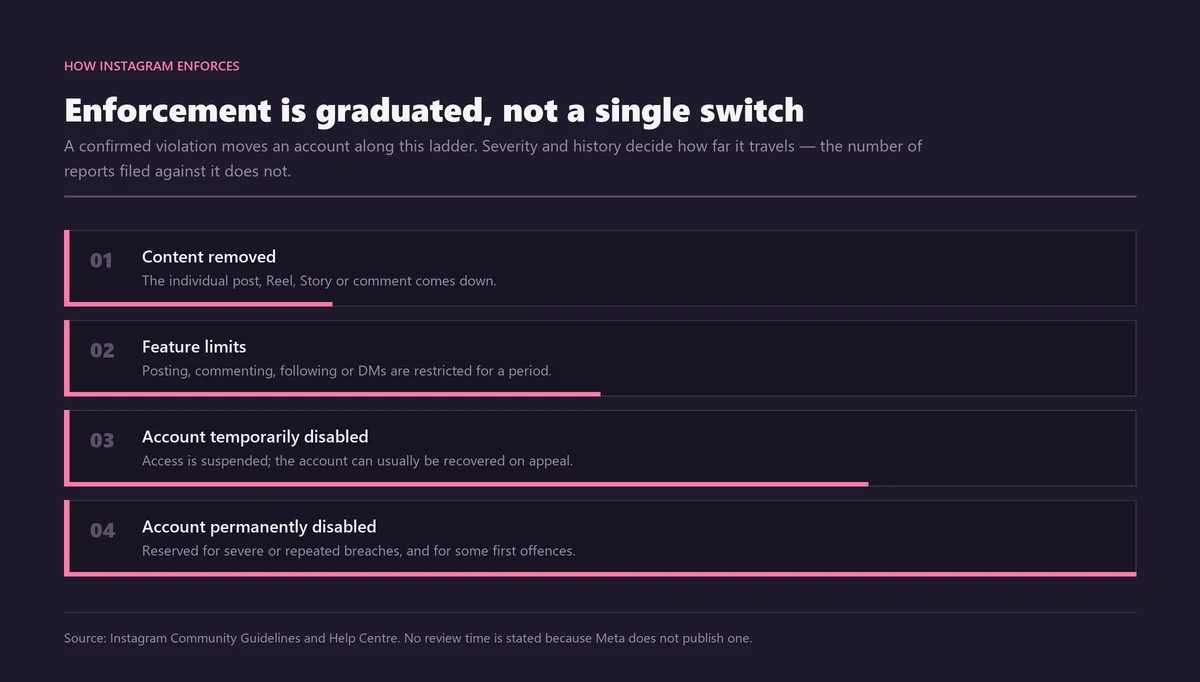
Each confirmed violation behaves like a strike, which is why a documented pattern outweighs one dramatic screenshot. Six instances of the same behaviour across two months, each dated and linked, tell a reviewer something a single post cannot. That is why evidence gathering is the slowest part of the job for any Instagram banning service.
Severity can skip the ladder. Content that is illegal, or that puts somebody in immediate danger, does not wait for a third strike. Most cases are not that, and the ordinary path runs through removals and feature limits first. What makes a permanent Instagram removal stick covers where the ladder ends.
A reporting desk, a guaranteed-ban seller, or doing it yourself?
Three genuinely different things are sold under one search term, and they differ in what they demand from you as much as in what they produce. The table scores them on inputs and outputs rather than on promises, because promises are the one commodity the dishonest option holds in unlimited supply.
| Measured on | Documented reporting desk | “Guaranteed ban” seller | Filing it yourself |
|---|---|---|---|
| What it needs from you | The username, what happened, whatever you kept | A username and a payment; nothing else | Everything: evidence, route, follow-up |
| Who it acts against | Only accounts screened against a named rule or law | Anyone, including accounts that broke no rule | Whoever you choose, at your own risk if the claim is false |
| Where the report goes | The official Meta form matching the harm | Disposable accounts firing identical in-app flags | The official form, once you find it |
| What you get in writing | Clause cited, route used, filing record, decision | A screenshot of somebody’s banned profile | Instagram’s notice in your Support Inbox |
| What counts as success | A correct filing and Meta’s decision, either way | A ban, promised by a date, verified by nothing | The action Instagram takes, or does not |
| Worst realistic outcome | A refusal, with the reason explained | Money gone, your own account actioned, a fraud in your name | A rejected report you can refile |
The second row decides everything. A desk that screens targets will sometimes tell a paying customer no, and that only works as a business if what it sells is filing. A seller who never asks what the account did is not being efficient; it has nothing to screen, because the report it intends to file is fiction.
Doing it yourself is not the weak column. If you are the affected person, hold the evidence, and the harm maps onto one category, your report carries the same weight as ours and costs nothing. Pay for help when a case is contested, spread across accounts, or resting on a legal claim.
A fourth option sits outside the table. Where you need money back, disclosure of who was behind an account, or an injunction, that is a solicitor’s work. A takedown ends the exposure; it does not compensate you for it. How ban-as-a-service is sold, and the con inside it examines the market itself.
How do you check that any Instagram ban service is honest, including this one?
By applying a fixed list instead of reading the sales page. Nine signals separate a filing service from a fraud, and every one is observable before you pay. The list is written so that a dishonest version of this desk would fail it, because a checklist nobody can fail is only marketing.
- It guarantees a ban. Meta decides, so the guarantee is either a lie or a plan to file something false.
- It quotes a turnaround. Meta publishes no review time, so a stated deadline was invented by whoever quoted it.
- It prices by follower count. Filing effort does not scale with an audience. Damage does, which tells you what is priced.
- It never asks what the account did. A provider taking a handle and a payment without one question has nothing to screen.
- It insists on irreversible payment. Cryptocurrency, gift cards and friends-and-family transfers are chosen for the absent chargeback.
- It exists only as a messaging handle. No named operator, no site, no written terms, nothing that survives the account vanishing.
- Its evidence is a screenshot gallery. Before-and-after images prove nothing about causation and take minutes to fabricate.
- It wants your login. No public report form needs a password, a two-factor code or a session on your device.
- It sells both directions. An operation that removes accounts and also restores them bills the same event twice.
That last signal is the documented core of the trade rather than a hypothetical. Security reporting from Avast, Kaspersky, Vice and Tripwire has described the loop for years: a low fee to have an account removed, then a far larger fee charged to that account’s owner to restore it. Those investigations cluster entry prices around $60 a ban, with tiers roughly between €5 and €30 by follower count — figures spanning several years of coverage rather than a 2026 survey.
Applied here the answers run: no guarantee, no quoted deadline, price by complexity, every target screened, filing records instead of trophy screenshots, never your login, no restoration business. Two of the checks on that list this desk does not yet pass: it publishes no written terms and no registered trading identity. Hold that against it, and ask before you pay. The tools half of this market fails the same list — see the official toolkit set against third-party report tools.
What does an Instagram ban service cost, and what if Meta says no?
It is quoted per case after screening, and it tracks labour rather than outcome. One clearly documented violation with evidence you already hold is cheap. A contested trademark claim, a cluster of linked accounts, or a case rebuilt after a refusal is not. There is no price list, because there is no product to list.
- Screening, which is unpaid and sometimes ends in a no.
- Evidence collection, before the account clears its history.
- Route selection and the filing, including forms only a rights holder or the affected person may submit.
- Follow-up: tracking the decision, refiling, watching for the operator’s return.
What the fee is not is payment for a ban. Honest providers say that awkwardly, because dishonest ones say something far better. Nobody can sell an outcome they do not control, and Meta publishes neither a success rate nor a review time, so there is no benchmark anyone could promise against.
The refusal position follows. A case declined at screening is not charged for. Where Instagram reviews a filing and declines it, the work has still been done, so the answer is a rebuild with stronger evidence or an honest statement that the route is closed — not an invoice for a second run at the same thing.
What does this desk decline, and what can it never promise?
Refusals come first because they are the most useful thing on this page. The categories below are exactly what a service that only wanted your money would accept, and they are the quickest way to tell an evidence-led desk from a guaranteed-ban seller. None has a price at which the answer changes.
- An account that has broken no rule, however badly you want it gone.
- An ex-partner, a rival business or a former employee, where the dispute itself is the reason.
- A profile whose offence is criticising you, or posting something unflattering that happens to be true.
- A username you want released — holding a handle is not a violation, and the three honest routes to a taken username covers what exists.
- Anything needing access to an account that is not yours.
- Coordinated or mass reporting of any kind, which Meta detects, discounts and acts against.
- Any request arriving with a demand for a guaranteed outcome, since agreeing would mean lying to you or to Meta.
Declining costs work, and it remains the right call, because a fabricated report does not simply fail. It marks the account that filed it. Meta treats misuse of the reporting tools as a breach in its own right under the Inauthentic Behavior standard, and the intellectual property forms warn that a false claim can end the reporter’s own account.
Authority is the other limit, and it catches people out. Most official routes are open only to a defined person: the individual impersonated, the rights holder, a legal representative. Who holds the authority to delete someone else’s account sets out that list, and what a serious attempt to get someone banned on Instagram involves covers the evidence side.
The only promise worth taking from any ban service for Instagram is the promise to tell you when there is no case.
So the two things never promised here are the outcome and the date. Instagram’s reviewers decide the first. Meta publishes nothing that would let anyone forecast the second. A provider quoting a 24-hour removal or a success percentage has copied it from another marketing page, or invented it.
Does it matter where you or the account is based?
It changes what exists beyond the in-app form. Inside the European Union the Digital Services Act gives a notice legal footing, entitles you to a reasoned decision, and opens an independent appeal outside Meta. In the United Kingdom the Online Safety Act regulates the platform’s systems rather than your complaint. Elsewhere, the form is usually the whole route.
The Digital Services Act part is practical rather than theoretical. A notice submitted under it obliges the platform to act on illegal content and to issue a statement of reasons explaining what it decided and why, which turns a silent rejection into something you can argue with.
The Online Safety Act 2023 works differently, and the distinction saves wasted effort. Ofcom supervises whether platforms run adequate systems for illegal content and child protection. It will not adjudicate your individual takedown. Outside both regimes the realistic escalations are local: a police report where the conduct is criminal, a solicitor’s letter, or a court order for disclosure.
What if it was your account, and you think someone paid for this?
Then you are the other half of this search, and the ladder back is free at every rung. Recovery starts inside the app at Account Status, moves through the Support Inbox, and in the European Union continues into a statement of reasons and an independent dispute body. Nobody outside Meta can shorten it.
- Account Status. Settings, then Account Status, shows what was actioned and on what ground. The review request attached to that notice is the primary route back.
- Support Inbox. Decisions and identity-document requests arrive here rather than by email. Answer quickly: an unanswered request looks identical to an abandoned appeal.
- Statement of reasons. Users in the European Union are entitled to a written explanation of a restriction, which forces a named ground instead of silence.
- Out-of-court dispute settlement. A certified body reviews eligible Facebook and Instagram disputes independently of Meta.
The escalation works, but it is slow and the evidence problem is real. In its first transparency report, covering April 2025 to March 2026, Appeals Centre Europe said it disagreed with the platform in 59% of cases, and that across more than 4,600 eligible Facebook and Instagram suspension disputes Meta produced the disputed content in fewer than 100 (The Register, 28 May 2026; Appeals Centre Europe).
If the restriction followed a wave of complaints, document that rather than assume it. Keep the notice, the date, and anything showing a coordinated push, because a review reads better with a pattern attached. What each of the five things people call deleted actually means helps you identify which state your account is in before appealing the wrong one.
Frequently asked questions
What is an Instagram ban service?
An Instagram ban service is a paid reporting desk. It identifies which Community Guideline or law an account breaks, gathers dated evidence, chooses the official Meta route that fits the harm, and files the report. Instagram alone decides what happens next, so what is really being sold is investigation and correct filing rather than an outcome.
Is an Instagram ban service legal?
Reporting an account that genuinely breaks the Community Guidelines or the law is legal, and paying an agent to file that report for you is legal too. Filing a complaint you know to be false is not. It breaches Meta's rules, it can end your own account, and in several jurisdictions it creates civil or criminal exposure.
How much does an Instagram ban service cost?
There is no list price. Legitimate work is quoted per case and tracks how contested the violation is and how much evidence gathering it needs. Security reporting on the criminal side of this market has put entry prices around $60 a ban, followed by far larger sums to restore the same account. Those figures span several years of coverage rather than a current survey.
Can you get any Instagram account disabled?
No. Only accounts doing something Meta already enforces against can be reported with any prospect of action, and a profile that has broken no rule is declined here at any price. That includes ex-partners, rival businesses, and people whose only offence is criticism. A report filed against a compliant account tends to mark the person who filed it.
How long does Instagram take to act on a reported account?
Meta publishes no review time for reports, so any provider quoting 24 or 48 hours has invented it. In practice the wait turns on severity, on whether the case was routed correctly, and on whether a classifier or a person handles it. Clear, well-evidenced cases move faster than thin ones, but no date can honestly be promised.
Do you guarantee the account is banned?
No, and nobody honest can. Instagram's reviewers make the decision, so a guaranteed ban is either a lie or a plan to file something false. What is controllable is the strength of the filing: the exact clause, dated evidence, the correct route, and a follow-up when a first review stalls. The outcome stays with the platform.
Can someone pay to get my Instagram account banned?
It happens, and the documented methods do not involve hacking. An attacker clones a profile and reports the real owner for impersonation, or files a fabricated safety report that triggers an automatic protective restriction. Verification, a current recovery email and regular Account Status checks all make the attack harder to land and much faster to reverse.
How do I tell if an Instagram ban service is a scam?
Check nine things before paying anyone: a guaranteed ban, a quoted deadline, pricing by follower count, no question about what the account did, payment rails with no chargeback, a messaging handle with no site behind it, screenshots offered as proof, any request for your login, and an offer to restore accounts as well as remove them.
How do I start?
Send the profile link and a short account of what it is doing, through Telegram or WhatsApp. The case is screened against the specific guideline or law it appears to breach before anything is filed, and you are told plainly which official route fits, what evidence it needs, or that no route exists. Screening costs nothing.