How to get an Instagram account taken down: every official route
Reviewed 8 August 2026 · 4,779 words · 20 min read
One target, one grievance, one route — the forms Instagram actually acts on, the report-count myth taken apart with data, and the escalation ladder when the answer is no.
How to get an Instagram account taken down: report it through Instagram's own channels for a specific Community Guidelines or legal breach, using the form built for that harm. A reviewer decides, not you. Report volume changes nothing. Impersonation, copyright and trademark claims each have dedicated forms, and two of them identify you to the account you report.
Send the profile link and the one rule you can show it breaks, and we will file the takedown on the correct official form, genuine violations only, never a legitimate account.
- Instagram states that the number of reports an account receives does not determine whether it is removed.
- Meta says 92% of the 159 million scam adverts it removed across 2025 came down before any user reported them.
- Copyright and trademark claims are not anonymous: Instagram passes the claimant's name and email to the reported account.
- Meta publishes no service-level commitment for Instagram report reviews, so any quoted 24-to-48-hour figure is invented.
- Appeals Centre Europe overturned platforms' decisions to leave reported content online in 63% of cases in its first year.
What does "taking down" an Instagram account actually mean?
On Instagram, "taken down" covers three separate machines. Content removal pulls a single post, Story or comment. Account disablement switches off a whole profile after severe or repeated breaches. Deletion is something only the owner can do, from their own settings. Pointing the wrong mechanism at your problem is the commonest reason a takedown attempt quietly fails.
The three run on different fuel. Content removal needs one item and one rule. Account disablement usually needs a pattern, or a single breach serious enough to end a profile outright. Deletion needs a password. No quantity of reporting converts the first into the third, and no reporting at all produces the third. Anyone asking how to get an Instagram account taken down is aiming at the middle machine, though the first one often solves the actual problem faster.
Instagram sits inside Meta's strike system, which escalates from a warning through feature restrictions to a permanent disable as violations accumulate, with strikes ageing out over time (Meta Transparency Center). That ladder explains a result people find maddening: the scam profile you reported on Monday loses one post, and the same profile disappears entirely a month later.
| What you want gone | Who is allowed to file | Where it is filed |
|---|---|---|
| A scam, clone or abusive profile, in full | Anyone who can see it | The report menu on the profile |
| One post, Reel, photo or comment | Anyone who can see it | The report menu on that item |
| A Story that is playing right now | Anyone who can see it | The report menu during playback |
| Your own account, post or Story | The owner, and nobody else | Settings, then Accounts Centre |
| Your photo, video or artwork, reposted | The rights holder or an authorised agent | Instagram's copyright form |
| A profile pretending to be you | The person being impersonated | The impersonation form, with photo ID |
| Your brand name or logo, used to deceive | The trademark owner or agent | Instagram's trademark form |
Which route should you use for your situation?
Choose one route before you touch anything. Two facts decide it: what the account did, and who you are in relation to it. Impersonation, copyright and trademark each have a dedicated form with its own eligibility rules. Everything else goes through the in-app report, filed under the policy clause that genuinely fits the behaviour.
Filing under every available category feels thorough. It is the opposite. Submitting one target under spam, then hate speech, then nudity, then impersonation in a single sitting produces four weak reports rather than one strong one — and a burst of contradictory categories from one source is exactly the pattern integrity systems are built to spot.
- Is the account pretending to be you, or a business you own? Use the impersonation form. It asks for photo ID and, in most cases, only the person or brand being impersonated may file it.
- Is it using your photograph, video, artwork or design? That is a copyright claim, filed on Instagram's copyright form by the rights holder or an authorised agent — not a Community Guidelines report.
- Is it using your brand name or logo to mislead people? That is a trademark claim, which is a separate form again, and it needs your registration details.
- Is it threatening, extorting or sexually coercing you? Report in-app under the threat or harassment category, preserve everything first, and report to the police in parallel. Do not wait for Instagram before you do the second part.
- Is it a scam, a fake shop or a paid-entry giveaway? Report the profile under fraud or scam and include the post that shows the money changing hands.
- Is it abusive, but aimed at someone other than you? Report it in-app. Some categories, particularly bullying and privacy violations, carry more weight when the person targeted files them, so encourage them to file as well.
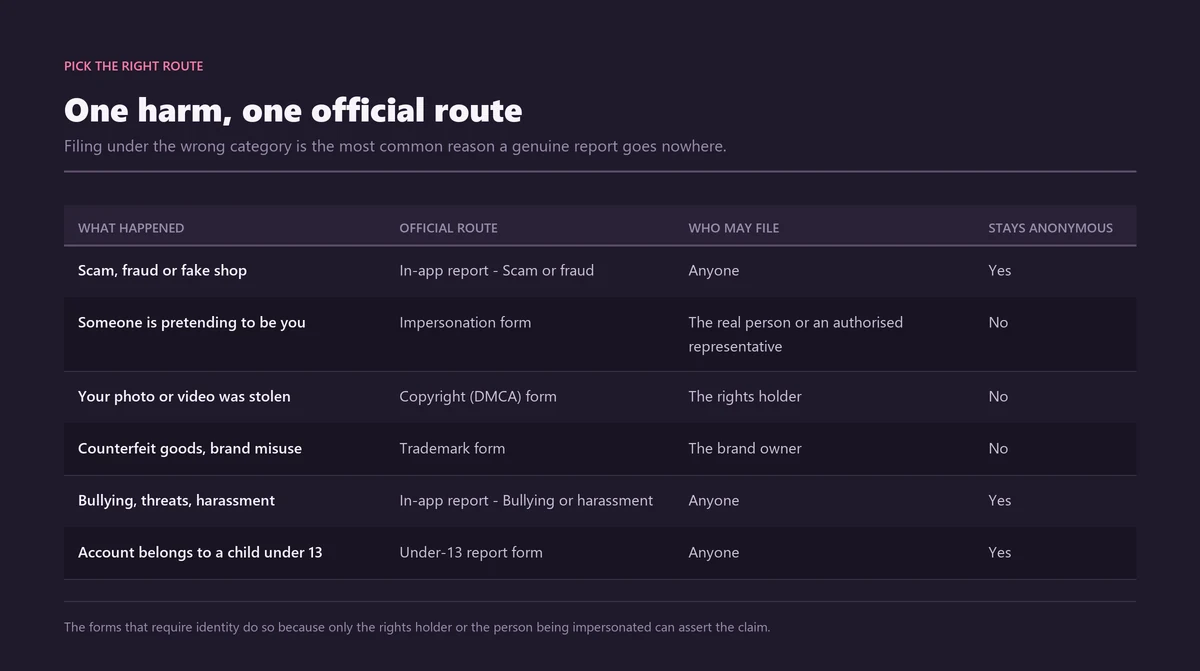
If your case sits in more than one row, file the strongest one first and keep the others in reserve. The form-by-form breakdown, including what each one asks for and what it can and cannot achieve, is set out in our guide to picking the Instagram takedown form that fits the harm. If money or images are being used to threaten you, start instead with reporting Instagram extortion step by step.
How do you get someone else's Instagram account taken down?
Report the profile, name one specific breach, and give the reviewer something to look at. That is the entire procedure. Where people go wrong is the middle step: a report saying "this account is awful" hands a reviewer nothing, while one saying "this shop takes payment and never ships, here is the post" hands them a decision they can actually make.
- Open the profile, tap the three-dot menu at the top right, and choose Report.
- Choose to report the account rather than a single post, but only if the whole profile is the problem — a clone, a scam shop, an account created to follow you around.
- Pick the one category that best describes the breach. Fraud, hate speech, bullying, threats, nudity, selling restricted goods. Closest fit, not widest net.
- Answer the follow-up questions plainly and submit. Do not inflate the claim. A reviewer who opens the profile and finds nothing resembling your category closes the case, and that closure makes the next report harder.
- Find the submission again under Settings and activity, then Help, then Support Requests. That entry is the thing you will need if you have to escalate later.
Fraud dominates this queue, and it is the commonest reason people report an Instagram account at all. American consumers reported losing around $2.1 billion to social-media scams during 2025, roughly eight times the 2020 figure, according to the Federal Trade Commission. Meta says it removed more than 159 million scam adverts across 2025 and disabled roughly 10.9 million accounts linked to scam centres in the same period (Meta Transparency Center).
So the honest version of how to get an Instagram account taken down is unglamorous: one accurate report, correctly categorised, with the evidence attached. What a paid service adds is triage and persistence, not influence — the economics of that are set out in what you are really buying with an Instagram ban service. If you would rather have the route mapped for you, send us the profile link and we will tell you which form applies, including when the answer is that none does.
Should you report inside the app or use one of Instagram's web forms?
Both are real channels, and they behave differently. The in-app report is fast, anonymous and best for Community Guidelines breaches. The standalone web forms are slower, identify you in some cases, and are the only route for impersonation, copyright and trademark. The web forms also produce an email trail, which matters enormously if the first answer is no.
People often report in the app, get a "we didn't remove it" notice, and stop — because it feels like a wall rather than a stage. It is a stage. But the record you can escalate depends on where you filed, so this choice is worth thirty seconds of thought before you tap.
| Feature | In-app report | Standalone web form |
|---|---|---|
| Built for | Community Guidelines breaches: scams, abuse, hate, nudity, spam | Impersonation, copyright, trademark, and cases needing identity proof |
| Are you identified | No; the reported account is not told who filed | Copyright and trademark filings pass your name and contact details on |
| What you can submit | The item plus the category you select | Free-text description, URLs, ID documents, proof of ownership |
| The record you keep | An entry in Support Requests inside the app | An email acknowledgement with a reference you can reply to |
| How you escalate | Request a review in Support Requests or Account Status | Reply on the thread; EU users can then use the DSA routes |
How long either takes is the question nobody can answer honestly, because Meta publishes no service-level commitment for report reviews on Instagram. Any guide quoting you a firm "24 to 48 hours" has invented it. What can be said from observation is that automated categories such as nudity and spam resolve fastest, contextual ones such as bullying take longest, and identity-document cases wait on the document check.
How do you take down a post, photo, Reel or comment?
Aim at the item, not the profile. One post is far easier to remove than a whole account, and you rarely need the account gone to solve the actual problem. A single stolen photograph, a caption naming your child's school, a comment thread of abuse — each of those is one report against one object, and that is the report most likely to succeed.
- Open the item. A post or Reel: the three-dot menu above it. A comment: press and hold it, then choose the report option. One image inside a carousel: report the post that contains it.
- Choose Report, then select the category that names the real harm rather than the one nearest the top.
- Add the detail the flow asks for and submit. Standard reports of this kind stay anonymous.
- Block or restrict the account afterwards if the content was aimed at you. Blocking does not withdraw the report.
- Check the outcome in Support Requests, and screenshot the outcome notice before it scrolls away.
Comment spam and bot replies are their own species and rarely respond to individual reports; the mechanics of how those networks actually come down are in how spam accounts really get removed from Instagram. For everything else, the tedium is the method. Reporting fifteen posts individually is dull work, and it removes more content than any single dramatic attempt at the profile.
One category outruns all of this. If an intimate image of you has been shared without consent, use StopNCII.org, which builds a fingerprint of the image on your own device so the picture itself never leaves it. Since May 2026 the US TAKE IT DOWN Act has also obliged covered platforms to remove valid requests within 48 hours (Congressional Research Service). If the person in the image is under 18, use NCMEC's Take It Down service and contact the police.
Can you take down an Instagram Story before it expires?
Yes, by two different routes depending on whose Story it is. Your own Story you delete outright from its three-dot menu, and it goes immediately rather than waiting out its 24-hour life. Someone else's Story you report during playback, and Instagram can pull a rule-breaking Story before the clock runs out on it.
The 24-hour window is the practical problem. A Story that expires before anyone reviews it is a report with no exhibit, and reviewers cannot act on a description of something they cannot see. Capture first, report second.
Screenshot or screen-record the Story with the handle, the timestamp and the offending content all visible in one frame. If it names you, includes your address, or shows your photograph, that single frame is the difference between a report that gets actioned and one that gets closed for insufficient information. Stories used in a sustained campaign are worth logging in a dated folder, because the pattern is what eventually moves enforcement from content level to account level.
Does Instagram take down posts with copyrighted music or video?
Frequently, and without anyone reporting it. Every upload passes through audio and video fingerprinting, so a Reel, post or Story carrying music the account is not licensed to use is typically muted, blocked at upload, or removed after the fact, with repeat matches restricting the account (Instagram Help Center).
Muting the track yourself before posting does not help, because the fingerprint still matches the original recording. Business and professional accounts collide with this far more often, since Meta's music licences exclude commercial use and route those profiles to a smaller royalty-free catalogue. Reused video footage behaves the same way and can be pulled on a copyright claim from the owner.
This quiet automation explains a lot of celebrity speculation. When a well-known artist's post vanishes overnight, the usual cause is a label filing on the audio, not an organised fan campaign. When a public figure's whole profile disappears, the usual cause is the owner deactivating it. Different mechanisms, one lesson: posts rarely vanish because of how many people complained about them.
Can you get an Instagram account taken down anonymously?
It depends entirely on which route you use, and this is the single most consequential detail for anyone reporting a harasser. Ordinary in-app reports are anonymous — the reported account is never told who flagged it. Copyright and trademark claims are not: Instagram passes the claimant's name and contact email to the person reported.
| Route | Does the account learn who filed | What that means in practice |
|---|---|---|
| In-app report of a profile, post, Story or comment | No | The safe default for harassment, stalking and scam cases |
| Impersonation form | You prove your identity to Meta; there is no published practice of passing it to the reported account | Usable when someone is pretending to be you, but expect to submit photo ID |
| Copyright (DMCA) claim | Yes — name and email are shared with the reported account | Never use it as a workaround for a harassment case |
| Trademark claim | Yes — the same disclosure applies | Only sensible when you already trade openly under that mark |
| Police report or court order | Handled outside Instagram entirely | The right route when the conduct is criminal, not merely against the rules |
The trap is obvious once stated. Someone being stalked finds that the stalker has reposted their photograph, files a copyright claim because it is the strongest-looking form on the page, and hands over their legal name and email address to the person they are hiding from. If you are in that position, report in-app under harassment and read the impersonation report process, photo ID requirements and blackmail routes before you file anything that carries your name.
How many reports does it take to take down an Instagram account?
There is no number, and there is no threshold hiding behind one. Instagram states plainly that how many times something is reported does not determine whether it is removed; whether it breaks a rule does (Instagram Help Center). Volume is not an input to the decision, and organised volume is treated as abuse in its own right.
The data settles it more convincingly than the policy page does. Of the 159 million scam adverts Meta removed across 2025, the company says 92% came down before any user reported them at all (Meta Transparency Center). If reports were the engine, that number would be impossible.
Instagram removes content because a rule was broken, not because a crowd arrived.
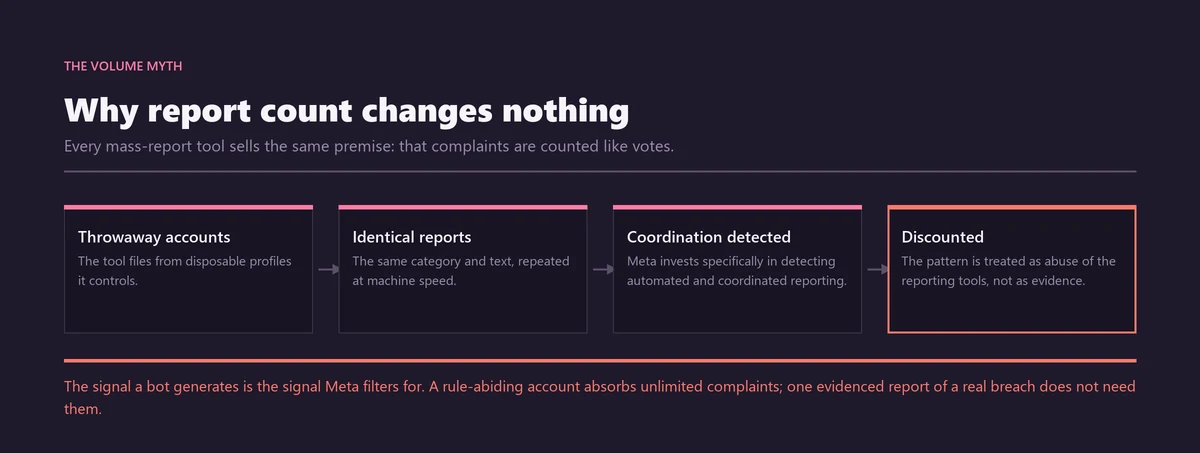
This is the wall every coordinated scheme hits. A group of throwaway accounts filing the same wording against the same target looks, from the inside of the system, exactly like the coordinated inauthentic behaviour it is designed to catch — which is why the participants sometimes get restricted while the target does not. The full teardown of the tooling sold for this is in whether Instagram mass report bots work or simply harvest your login.
The same applies to the shortcuts people hunt in forum threads: there is no method that takes an account down instantly, none that works without the owner's password, and no leaked internal panel. Anyone selling one of those is selling either nothing or your credentials. This is precisely why how to get an Instagram account taken down never resolves into a number of clicks or a number of reporters.
Why didn't Instagram remove the account you reported?
A "we didn't remove it" notice usually means one of three things: the reviewer disagreed, the report was filed under a clause that did not fit, or an automated pass closed it without human eyes. Only the second is your fault, and only the second is quick to fix. All three are escalatable, in a fixed order.
- Read the outcome properly. Instagram usually names the policy it assessed the report against. If that policy is not the one the account actually broke, you have found your problem.
- Request a review where the flow offers one. Support Requests and Account Status both carry a review option on recent decisions. This is a genuine second look, not a formality.
- Re-file once under the clause that fits better, with the specific post attached. Once. Re-filing the same complaint repeatedly is the coordinated-reporting signal again, applied to a single person.
- Switch channel if a dedicated form exists. An impersonation or intellectual-property case that failed in-app should go to its proper form, where a different queue and different evidence rules apply.
- In the EU or EEA, request the statement of reasons. The Digital Services Act obliges platforms to explain moderation decisions, and those explanations are logged in the European Commission's DSA Transparency Database.
- Then take it to a certified out-of-court dispute settlement body. This is the step almost nobody uses, and it is the one with the best published record.
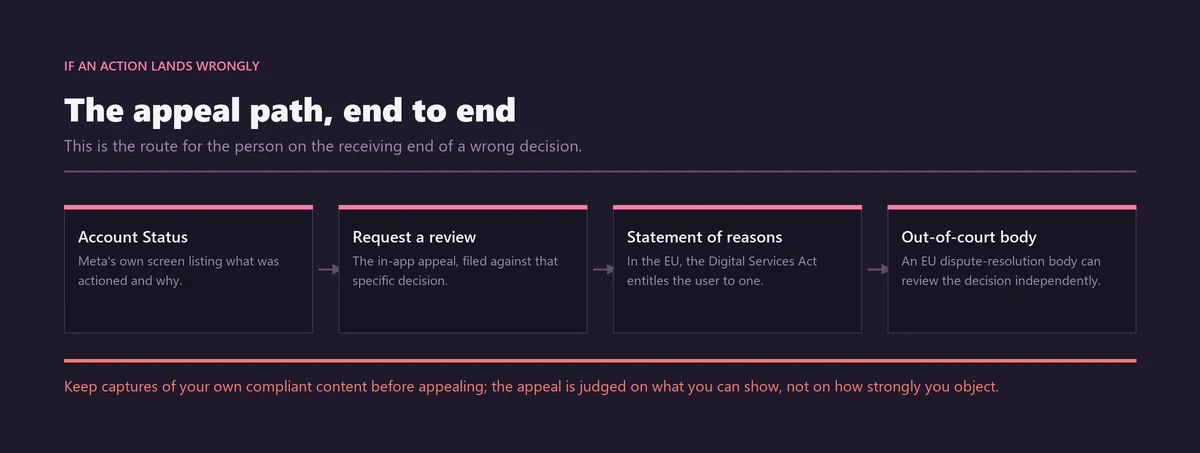
That final step is worth taking seriously. In its first transparency report, covering April 2025 to March 2026, Appeals Centre Europe — a certified out-of-court body under the DSA — overturned platforms' decisions to leave reported content online in 63% of cases, and overturned Instagram in 74% of the hate-speech disputes it reviewed. A rejection from Instagram is not the end of the road for EU-based reporters.
Pressure is arriving from the other direction too. In June 2026 the Oversight Board published its first review of Meta's account-level enforcement, recommending that appeals let users submit a written explanation, that human review be prioritised for permanent account disablement, and that Meta publish the total number of accounts it disables for policy breaches — a figure it does not currently release. In the UK, Ofcom wrote in 2026 to the services children use most, Instagram among them, setting deadlines for evidence on how they assess and mitigate risk.
Why did the account come back after it was taken down?
Because a disabled account and a stopped person are different things. Registering again takes a new email address and five minutes, and the returning profile usually rebuilds the same followers within days. Ban evasion is its own policy breach, but enforcement against it depends on somebody linking the new account to the old one — and that somebody is normally you.
The returning account rarely hides well. It reuses the display name, the bio phrasing, the same stolen profile picture, or it immediately follows the same small cluster of accounts. Those repetitions are what turn a fresh report from a content-level complaint into an account-level one.
- Record the old username, the approximate date it was disabled, and any confirmation notice you received.
- Record the new username and the date it appeared, with a screenshot of the profile in full.
- Note every carried-over signal: identical bio text, the same photograph, the same link, the same followers approached in the same order.
- Keep the messages. If the same person resumes contact from the new account, that continuity is the strongest evidence available to you.
When you report the new profile, say explicitly that it is a re-registration of a previously disabled account and give the old handle. Reviewers can act on evasion when it is pointed at; they will not usually reconstruct it for you. If the returning account is impersonating you rather than merely returning, go straight to the impersonation form instead of the general report.
What can you not get taken down, whatever you file?
A great deal, and this is the section most guides on this query skip. Instagram enforces its own rules, not your preferences. If the content is unpleasant but not against a stated policy, no form, no persistence and no paid service will remove it — and being told that early saves you weeks.
Knowing how to get an Instagram account taken down includes knowing when you cannot. Here is the honest list of what stays up:
- Opinions about you that you disagree with. Criticism, mockery and low ratings are not rule breaches, even when they are unfair.
- Truthful but unflattering posts. Accuracy is not a defence Instagram requires the poster to prove, and it is not grounds for removal either.
- Reposts of content you published publicly, unless you own the copyright and file as the rights holder, which is a different claim with different consequences.
- Accounts that blocked you, unfollowed you or muted you. None of that is reportable conduct.
- Old accounts that simply sit unused. Instagram's terms allow it to reclaim long-dormant accounts, but it rarely does and publishes no deadline (Instagram Help Center).
- A competitor doing better than you. Business rivalry is not a policy category, and dressing it up as one is how reporters get restricted.
If your real goal is a username sitting on a dormant profile rather than the removal of the person behind it, that is a separate problem with three legitimate solutions, none of them a report; they are set out in the three honest routes to claiming an Instagram username.
How do you take down your own Instagram account, post or Story?
Your own content is the only takedown you fully control, and there are three settings rather than one. Deactivation hides the profile temporarily and reverses when you log back in. Deletion is permanent after a grace period. Archiving hides a single post from everyone while keeping it for you. All three live in Settings.
If you want the profile back later, deactivate it: that removes your photos, comments and likes from view while preserving everything, and you restore it by signing in, which Instagram permits once a week. If you want to delete your Instagram account for good, use the deletion page instead — you get roughly 30 days to change your mind by logging in, and full removal can take up to 90 days after that (Instagram Help Center).
Both options sit under Settings, then Accounts Centre, then Personal details, then Account ownership and control. For a single item you need neither: delete the post or Story from its three-dot menu, or archive the post to take it out of public view without losing it. The question we are asked most in this area is really about reversibility, and deactivation is the reversible one.
How do you take down an old, inactive, hacked or fake account?
These four cases look alike and behave nothing alike. Only one of them is a genuine takedown. An old account of your own is a recovery job, an inactive stranger's account is usually immovable, a hacked account is an emergency, and a fake account impersonating you is the one a report can actually resolve.
Your own old account. Deleting requires signing in, so recovery comes first. Start at Instagram's "Get help logging in" flow, work through the email addresses and phone numbers you might have used, regain access, then delete it deliberately from Settings.
A stranger's inactive account. Being idle is not a policy breach. Instagram's terms permit reclaiming long-unused accounts but set no timetable and it rarely acts, so treat "report it for inactivity" as folklore rather than procedure.
A hacked account. Use the hacked-account flow immediately for a login link or security code, remove unfamiliar sessions and devices, change the password, and switch on two-factor authentication. Speed matters more than tidiness here — every hour the intruder holds the account is another hour of messages sent in your name.
A fake account using your identity. This is the real takedown of the four. File the impersonation report, submit the photo ID it asks for, and be precise about which account is yours and which is the copy. Reviewers reject a surprising number of these because the two handles were described ambiguously.
What is an "Instagram take down notice", and is that email real?
A genuine Instagram take down notice is the message that follows an intellectual-property claim: either your content was removed because someone filed against it, or a claim you filed was actioned. Real notices arrive inside the app or from a Meta address tied to the form. They never carry a countdown and a login button.
That distinction matters because an entire phishing genre imitates it. The "your account will be permanently deleted in 24 hours for copyright infringement" email, complete with a timer and an urgent Appeal button, is a credential harvest. The link goes to a convincing copy of the login page, and the moment you type your password the account is genuinely gone.
Real copyright enforcement is also not anonymous, and it runs both ways. Instagram passes the rights holder's name and email to the account reported, and a wrongly targeted account can file a counter-notice. Under the US framework, content is restored roughly 10 to 14 business days later unless the claimant files a lawsuit (U.S. Copyright Office). That is a deliberate check on abusive claims, and it is why a fabricated claim is a poor weapon.
All of which brings the answer to how to get an Instagram account taken down back to one sentence: find the rule the account genuinely broke, file on the form built for that rule, keep the record, and escalate in order if the first answer is no. Everything else on offer is either the same process with someone else doing the typing, or a story. The rest of our Instagram reporting and takedown guides take each route apart in detail, and if you would rather talk it through first, our contact page is where to start.
Sources
- Instagram Help CenterReporting: how it works and why report volume does not decide removal
- Instagram Help CenterCopyright and music on Instagram
- Instagram Help CenterDeactivating or deleting your Instagram account
- Instagram Help CenterInactive accounts and usernames
- Meta Transparency CenterIntegrity Reports, H1 2026
- Meta Transparency CenterTaking action: how strikes work
- Federal Trade CommissionNew FTC data show people have lost billions to social media scams
- U.S. Copyright OfficeSection 512 of Title 17: notice and counter-notice
- Congressional Research ServiceThe TAKE IT DOWN Act and platform removal duties
- Appeals Centre EuropeFirst transparency report, April 2025 to March 2026
- European CommissionDSA Transparency Database of statements of reasons
- Oversight BoardReview of Meta's account-level enforcement
Frequently asked questions
How many reports does it take to take down an Instagram account?
No fixed number exists, and none is hiding behind the scenes. Instagram states that how often something is reported does not decide whether it is removed; whether it breaks a rule does. Coordinated volume is treated as abuse and discounted, and the accounts behind it can be restricted instead. One accurate, evidenced report on the correct form does more than a hundred duplicates.
How long does Instagram take to review a report?
Meta publishes no service-level commitment for Instagram report reviews, so any guide quoting a firm 24 to 48 hours has made it up. Automated categories such as nudity and spam usually resolve quickest, contextual judgements like bullying take longer, and cases requiring photo ID wait on the document check. Track it in Support Requests rather than refreshing the profile.
Can I get someone's Instagram taken down anonymously?
In-app reports are anonymous: the reported account is never told who flagged it. Copyright and trademark claims are not, because Instagram passes the claimant's name and contact email to the person reported. If you are reporting a harasser or a stalker, use the in-app route and avoid intellectual-property forms unless you are willing to be identified.
Does Instagram take down posts with copyrighted music?
Often, and without any report. Audio fingerprinting scans every upload, so unlicensed music is muted, blocked at upload, or removed afterwards, and repeat matches restrict the account. Muting the track yourself beforehand does not help, because the fingerprint still matches the original recording. Business and professional accounts hit this more often, as their licences exclude commercial use.
What is the difference between deactivating and deleting your Instagram account?
Deactivating hides your profile temporarily and reverses the moment you log back in; Instagram allows it roughly once a week. Deleting is permanent: you get about 30 days to cancel by logging in, after which full removal can take up to 90 days. Only the account owner can do either, and no report substitutes for it.
Can you get an inactive Instagram account taken down?
Not for being inactive. Instagram's terms let it reclaim long-unused accounts, but it rarely does and publishes no deadline, so reporting a dormant profile for idleness goes nowhere. If it is your own old account and you cannot get in, recover the login first, because deleting an account requires signing into it.
Is the copyright email saying my account will be deleted in 24 hours real?
Almost certainly not. Genuine notices appear inside the app or come from a Meta address tied to the reporting form, and they never include a countdown with a login button. That email is a credential harvest. Do not click it, do not type your password anywhere it sends you, and check Account Status in the app instead.
Can I get an account taken down for harassing me?
You can report it, and sustained harassment is a genuine Community Guidelines breach. Whether the outcome is a removed post, a feature restriction or a disabled account depends on severity and the account's history, not on how bad the situation feels to describe. Capture dated screenshots first, report in-app, and involve the police if there are threats.
Does mass reporting work on Instagram?
No. Report volume is not an input into removal decisions, and bursts of identical reports from linked accounts resemble the coordinated behaviour integrity systems are built to detect. The likeliest outcome is that the reporting accounts get restricted while the target stays up. One well-evidenced report filed on the right form remains the working method.