Instagram account takedown: which form, what evidence, what really happens
Reviewed 8 August 2026 · 4,073 words · 16 min read
Four official routes, four different evidence bars, and one honest answer about timing — how an Instagram account takedown is actually filed and what follows it.
An Instagram account takedown is the removal of a profile, post or photo through one of Meta's official routes: a copyright report, a trademark report, an impersonation report, or a Community Guidelines report. The route follows the harm, and one well-evidenced filing does more than any volume of reports.
If a fake profile, a counterfeit storefront or a stolen photo is the problem, send us the link and the proof — we file only against genuine violations, through official channels.
- Four official routes handle a takedown: copyright, trademark, impersonation and Community Guidelines — the form must match the harm.
- Copyright and trademark notices are not anonymous; Meta passes your name and contact details to the account you reported.
- Meta publishes no review deadline; a July 2026 MarqVision benchmark puts clear trademark cases at one to five business days.
- Every Facebook and Instagram strike expires one year after it is applied, per Meta's Transparency Center.
- Appeals Centre Europe overturned platforms' decisions to leave reported content up in 63% of cases in its first transparency report.
Which official form matches your Instagram account takedown?
Name the harm first, because the form follows it. A stolen photo or video is copyright. A misused brand name or logo is trademark. A profile posing as you is impersonation. Scams, harassment, hate and spam go through a Community Guidelines report. Picking the wrong category is the most common reason a sound complaint dies quietly.
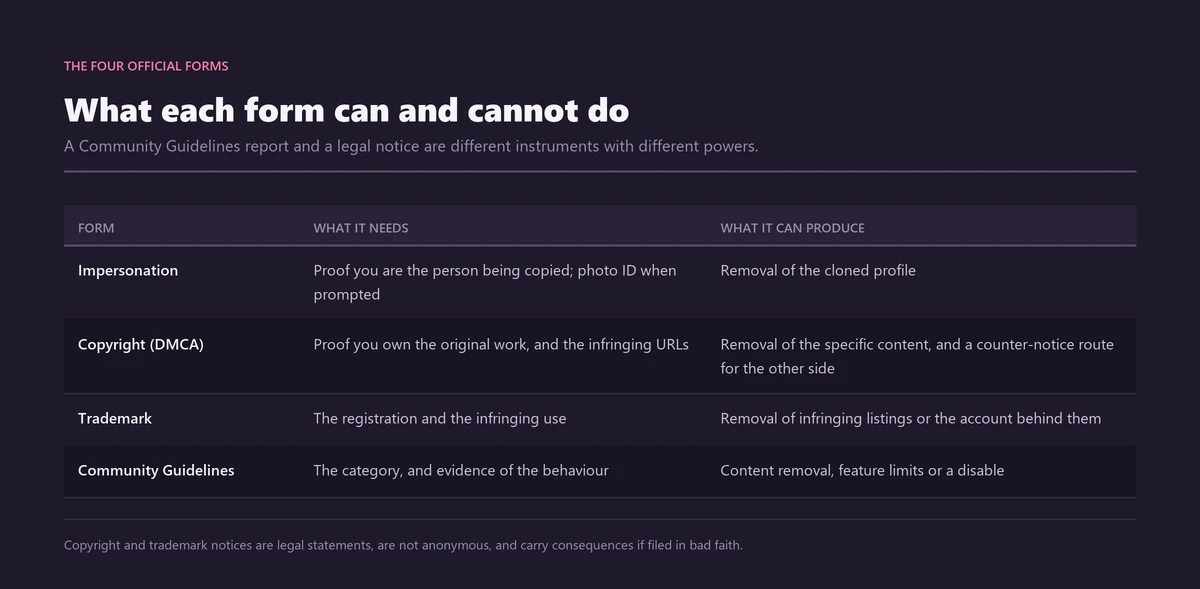
An Instagram account takedown has no single removal button and no back channel. What exists is a small set of official routes, each tied to a different kind of harm, each with its own filing rules. The table below pairs the grievance with its route, says who is permitted to file it, and — the part almost every vendor page skips — says whether the account you report gets to see your name.
| The harm | Official route | Who may file | Does the target learn who filed? |
|---|---|---|---|
| Your photo, video, artwork or writing reposted | Copyright report form | Rights holder or an authorised agent | Yes — your name and contact details are passed on |
| Your registered mark, logo or brand name misused | Trademark report form | Mark owner or an authorised representative | Yes — the same disclosure applies |
| An account posing as you personally | Impersonation report | The person impersonated, a parent, or an authorised representative | You identify yourself to Meta, not routinely to the target |
| A fake "official" page or storefront for your company | Brand Rights Protection Manager | A verified representative of the business | Yes on IP notices; the business is named |
| Scam, harassment, hate speech, threats, spam | Community Guidelines report | Anyone who sees it | No — these reports stay confidential |
| An account run by a child under 13 | Under-13 report form | Anyone, including logged-out | No |
| Intimate images shared without consent | StopNCII hash submission plus a platform report | The person depicted | No — hashes are submitted, not images |
Send a brand problem down the impersonation route and it stalls, because the reviewer is looking for a government ID that a company cannot produce. Send a stolen photograph through a Community Guidelines report and nothing happens, because no guideline covers it. The mismatch, not the merit, is usually what kills a filing. If you are unsure whether your case is even a policy matter, the breakdown of the four official routes to getting a profile removed sorts it out before you commit to a form.
Does an Instagram account takedown reveal who reported it?
It depends entirely on the route. A Community Guidelines report is confidential; Instagram does not tell the account who flagged it. Copyright and trademark notices work the opposite way — Meta forwards your name and contact details to the person you reported, because they are entitled to know who is making a legal claim and to answer it (Instagram Help Center).
That single difference reshapes a lot of cases. Someone being harassed by a stranger can report the behaviour without exposure. A photographer reclaiming a stolen image cannot. If the person behind the account already frightens you, weigh the intellectual-property route carefully, and consider whether a police report should come first.
An impersonation report sits in the middle. You must prove to Meta that you are the person being copied, which means uploading identity documents, but that verification is between you and the platform rather than a disclosure to the impostor. Meta states it keeps the identity copy only for as long as the review needs and then deletes it.
What evidence does an Instagram takedown actually need?
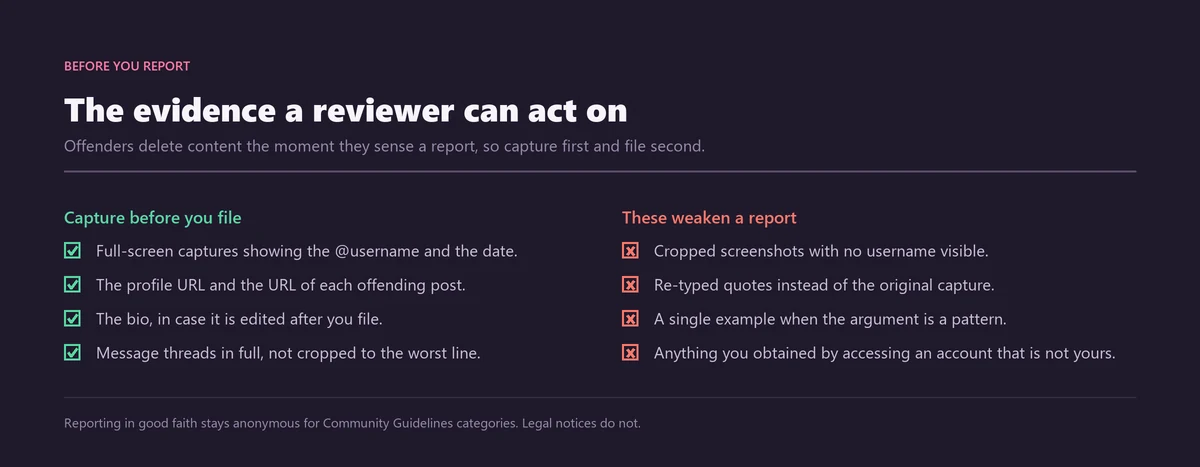
A reviewer sees your filing for a minute at most, so everything supporting an Instagram account takedown has to be on the page in front of them. The dossier that survives review is specific: exact links, exact timestamps, a clear statement of which rule or right is broken, and proof that you are the person entitled to complain about it.
The core file, whichever route you use
- The account handle exactly as written, including full stops and underscores, plus the profile URL.
- Direct permalinks to each offending post, Reel, Story or comment — not a link to the profile with a note saying "see the third post".
- Full-screen captures showing the username, the content and the date visible in the same frame.
- Dates and times of each capture in a single time zone, kept in the order you took them.
- One sentence per item naming the rule or right breached, in plain words.
What each route adds on top
- Copyright: the original file with its metadata, a higher-resolution master, or a first-publication date that predates the infringing post.
- Trademark: the registration number, the class it covers and the jurisdiction it covers — a pending application is weaker than a granted mark.
- Impersonation: a government-issued identity document, and for a representative, written authority to act.
- Scam or fraud: the payment trail, the messages that made the offer, and any police or bank reference number you already hold.
How do you report an account impersonating you on Instagram?
Use the impersonation report, which only the impersonated person, their parent or an authorised representative may file, and which requires a government-issued identity document. There are two ways in — from inside the app, or from a browser if you have no Instagram account of your own — and both end at the same review queue.
- Open the fake profile, tap the three-dot menu and choose Report, then "It's pretending to be someone else", then "Me" or the person or business being copied.
- If you have no account, use Instagram's logged-out impersonation report form instead, which collects your name, email address and a photograph of your identity document.
- Attach the identity document Meta asks for, and make sure the name on it matches the name you are claiming is being copied.
- Add the real account's handle alongside the fake one, so the reviewer can compare them without hunting.
- Keep the confirmation email. Every later message about the case threads from it, and it is how you tell a genuine update from a phishing attempt.
Detection now runs partly ahead of you. Meta announced in March 2026 that it had rolled out artificial-intelligence tools aimed at brand and celebrity impostors, along with in-chat warnings that alert people when they may be talking to a fraudulent account (Meta Newsroom). That helps at scale. It does not replace your filing, because automated systems find patterns while you supply the one thing they lack — proof of who the real person is.
How do you file an Instagram DMCA copyright takedown, step by step?
An Instagram DMCA copyright takedown is a sworn legal notice, filed through Instagram's dedicated copyright form by the owner of the work. United States law sets out exactly what a valid notice must contain, and a notice missing an element can simply be ignored. No lawyer is required. Accuracy is.
- Confirm the work is yours. You need to be the creator or the rights holder — being first to repost something is not ownership.
- Assemble proof of authorship. The camera original with its metadata, a project file, a higher-resolution master, or a datestamped first publication elsewhere.
- Open the copyright form. Use Instagram's copyright report form. The in-app three-dot menu does not route to the copyright team.
- Include every statutory element. Identify your work, link each infringing post, give your contact details, add the good-faith statement and the declaration under penalty of perjury, and sign it — the list is set out at 17 U.S.C. §512(c)(3).
- File one notice per work, and log it. Save the reference number and the date. If a dispute follows, that log becomes your timeline.
The U.S. Copyright Office publishes the framework and a model notice if you would rather draft it yourself (copyright.gov/512). One warning about scope: a copyright notice removes the infringing posts, not automatically the account. Accounts come down when the violations repeat and the platform's own record turns against the owner.
How do you report trademark abuse on Instagram?
To report trademark abuse on Instagram you use the dedicated trademark form, which is separate from both copyright and impersonation. It covers counterfeit sellers, bogus "official" storefronts, and accounts squatting on a registered name or logo. Only the mark owner or an authorised representative may file, and the registration details do the heavy lifting.
Have the registration number, the class and the territory ready before you start, and point to the precise element that misuses the mark — the handle itself, the profile picture, a bio line, a product listing. Vagueness is fatal here. "This account is using our brand" gives a reviewer nothing to compare against the register.
Instagram suggests contacting the account directly first where that is safe and realistic, and in ordinary squatting cases it sometimes works. Where it does not, file through the trademark report form. Filing brand misuse as impersonation is the classic error: same annoyance, different legal basis, entirely different evidence, and a claim that sits unresolved for weeks as a result.
If the real goal is recovering a handle that someone else parked on, a takedown is only one of the ways there, and often not the fastest. The honest comparison of the three routes to claiming an Instagram username sets out what each one can and cannot deliver.
What do Meta Rights Manager and Brand Rights Protection add?
Both are for rights holders policing infringement repeatedly rather than once. Meta Rights Manager matches copyrighted audio and video across Facebook and Instagram and applies your chosen action automatically. Brand Rights Protection Manager handles trademark, counterfeit, copyright and business-impersonation complaints from a single console, with search running across ads, commerce listings, accounts and posts.
Access is not automatic. Meta approves applicants, and approval turns on being a genuine rights holder with a real enforcement need. For a business fighting a stream of counterfeit storefronts, the difference is significant: one saved search replaces a fortnight of manual hunting, and reports go in as a batch rather than one form at a time.
There is also an IP Reporting API built on the Graph API for organisations that want filing wired into their own systems. Treat all of this as established tooling rather than a recent change — the feature set has been documented across several years — and remember that it changes the speed and scale of filing, never the standard the claim has to meet.
What gets a rule-breaking account taken down, and what does not?
A Community Guidelines report succeeds when it points a reviewer at a specific piece of content that breaks a specific rule. Scams, credible threats, targeted harassment, hate speech and spam networks all qualify. Disliking someone does not. Nor does a bad review, a parody, an unflattering opinion or an argument you lost in the comments.
The most persistent myth in this whole subject is that volume works. It does not. Instagram states plainly that the number of times something is reported does not determine whether it is removed — only whether it genuinely breaks a rule (Instagram Help Center). Coordinated pile-ons are visible to the systems that score reports, and they get discounted rather than boosted.
One report that shows the rule being broken outperforms a hundred that only show that a hundred people are annoyed.
The Telegram bots and "mass report" panels sold against this subject are built on the myth. They cannot reach any endpoint you cannot reach yourself, they frequently ask for a login, and the pattern they generate is exactly the pattern abuse detection is tuned to find. If your problem is a single post, a photograph or a Story rather than a whole profile, the narrower walkthrough of reporting a specific post, photo or Story is the better starting point.
Two categories should never go through the ordinary form. Anything involving a child goes to the police and to the NCMEC CyberTipline at report.cybertip.org. Non-consensual intimate images go to StopNCII.org, which creates a hash of the image on your own device so the picture itself never leaves it.
How long to get an Instagram account taken down?
There is no published answer to how long to get an Instagram account taken down, because Meta commits to no review deadline. What can be described honestly is the spread: clean, single-account cases with strong proof move in days, and anything contested, coordinated or evidentially thin runs much longer, sometimes indefinitely.
| Route | What a clean case tends to look like | What stretches it out |
|---|---|---|
| Community Guidelines report | Hours to a few days for an obvious, visible breach | Context-dependent harm: sarcasm, disputed harassment, evidence sitting in private messages |
| Impersonation report | Days once identity is verified | An appeal by the target, or a public figure surrounded by lookalike fan accounts |
| Copyright notice | Days for an unambiguous claim | A counter-notice, contested ownership, or an old licence nobody can find |
| Trademark notice | One to five business days for clear infringement, on one vendor's July 2026 benchmark | Repeat offenders and coordinated inauthentic behaviour, past two weeks in that same benchmark |
| Network of re-registering accounts | No honest estimate exists | Every new handle restarts the evidence work from zero |
The one to five day figure is a July 2026 benchmark published by the brand-protection vendor MarqVision, which also puts repeat-offender and coordinated-inauthentic-behaviour cases beyond two weeks. It is a vendor's observation of its own caseload, not a Meta commitment. Treat it as a rough shape, and treat any provider quoting you a firm deadline as someone selling certainty they do not own.
Speed tracks evidence quality far more than urgency. A complete notice filed once tends to beat a week of resubmissions, and repeated filing of the same complaint can make the case look like a campaign. If timing is your main worry, the detailed clock in how a violator actually gets banned, and how fast breaks the stages down further.
How many strikes does it take to get an Instagram account removed?
No published threshold exists, and that is deliberate. Removal runs on the Meta strike system, where each confirmed violation adds a strike, strikes bring escalating restrictions, and severity counts for more than tally. One severe violation can disable an account immediately. Milder breaches accumulate first.
Enforcement climbs a ladder rather than jumping: a single piece of content removed, then feature limits, then a temporary suspension, and only at the end a permanent disable. Most accounts stop somewhere in the middle, which is why a reporter who expects instant deletion so often reads a partial action as no action at all.
One detail matters more than the rest for anyone reporting a persistent offender: strikes do not last forever. Meta's Transparency Center states that a strike applied on Facebook or Instagram expires one year after it is applied (Meta Transparency Center, Counting strikes). An account that breaks the rules slowly enough can sit below the threshold indefinitely.
This is also why report volume achieves nothing under the Meta strike system. Strikes come from confirmed violations, not from complaints received. Fifty reports about one post produce, at most, one confirmed violation. What actually accumulates against an account is a documented pattern over time, which is the argument set out in what makes an Instagram ban permanent rather than temporary.
What happens after you file, and can the account come back?
Filing is the middle of the process, not the end. The account owner has appeal rights, a copyright removal can be reversed by a counter-notice, and a determined operator can register again within minutes. An Instagram account takedown holds only for as long as the claim behind it holds up.
If the person you reported believes your copyright claim is wrong, they can file a DMCA counter-notification. The statutory clock then runs against you: unless you begin a court action, the material may be restored. Should you ever be on the receiving end of a wrongful claim, a counter-notice needs four things.
- Your legal name, postal address, telephone number and email address.
- A description of the removed material and the location where it appeared before removal.
- A statement, under penalty of perjury, that it was removed by mistake or misidentification, together with consent to the jurisdiction of a United States federal court.
- Your physical or electronic signature.
The same statute cuts both ways. Anyone who knowingly and materially misrepresents that material is infringing is liable for the resulting damages under 17 U.S.C. §512(f). That provision covers copyright claims specifically, and it is a real exposure, not a theoretical one.
Then there is the repeat problem. Fake shops and impersonators rebuild under a near-identical handle, sometimes the same day, and each new profile technically starts clean. The answer is a running dossier: every handle, every removal reference, every capture, held in one file so the connection between them can be shown rather than asserted. That pattern evidence is what separates a nuisance report from a case, and it is the same material that matters when people ask whether anyone can delete another person's Instagram account.
What can EU and UK reporters do when Instagram says no?
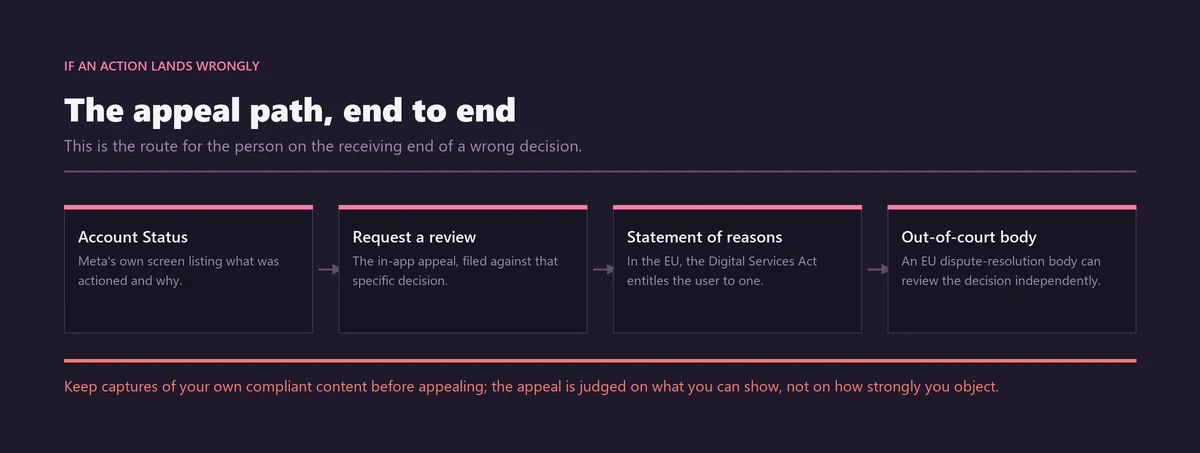
A rejection inside the app is not the last word in Europe. The Digital Services Act gives EU users a notice-and-action right, a written explanation when a decision goes against them, and access to an independent dispute-resolution body that can review the platform's call — outside any court, at negligible cost to the user.
- Article 16 notice-and-action: a platform must offer accessible mechanisms for flagging illegal content and must act on a properly-made notice (Regulation (EU) 2022/2065).
- Article 17 statement of reasons: you are entitled to a written explanation of the decision, which is also the document you need to escalate.
- Out-of-court dispute settlement: certified bodies such as Appeals Centre Europe review disputes independently of the platform.
- UK route: Ofcom regulates platform complaint systems under the Online Safety Act rather than individual disputes, so a UK reporter escalates by complaining about the process, not by asking Ofcom to remove a post.
The escalation is worth taking seriously because the numbers are not marginal. In its first transparency report, Appeals Centre Europe overturned platform decisions to leave reported content up in 63% of cases overall, and for Instagram it disagreed with the platform in 74% of the hate-speech disputes it reviewed. A "no" at the first review is frequently wrong.
Regulators have noticed the reporting flow itself. The European Commission issued preliminary findings that Meta may have breached the DSA's notice-and-action and appeal obligations, citing interface designs that discourage users from completing reports (European Commission press release). These are preliminary findings, not a final decision — but they explain why the flow feels obstructive, and why patience is part of the method.
There is a point beyond which no web form helps. Defamation, extortion, a court-ordered disclosure of who is behind an anonymous account, or damages for a fake storefront that took real money — these are matters for a solicitor or a lawyer, and a well-drafted letter or a court order carries weight no report ever will.
What does an Instagram takedown service cost, and can you do it alone?
Every route on this page is free to file yourself. What an Instagram takedown service sells is time, case selection and evidence discipline — not access. Nobody has a channel into Meta, and any provider claiming one is describing something that does not exist.
Competitor pages in this market almost universally hide pricing behind a form. Here is the plain version. Paid work is priced one of three ways: a flat fee for a single defined case, a monitoring retainer where re-registration is expected, or hourly professional fees once lawyers are involved. Which one applies depends on the work, so a fixed public price would be a fiction.
What pushes cost up is predictable: the number of accounts, whether a network keeps rebuilding, whether the evidence must be gathered rather than handed over, whether translation or a foreign jurisdiction is involved, and whether an appeal or escalation follows the first filing.
Doing it yourself is entirely realistic for one clear-cut case with the proof already in hand. Bringing someone in makes sense when there are several clones, when a first filing has already been rejected, when an EU escalation is on the table, or when you simply cannot face documenting a harassment campaign aimed at you. What that engagement really involves, in cost and in limits, is set out in what an Instagram ban service actually buys you.
Send the profile link and whatever you already have through our contact page, and you will get a straight answer about which of those two your case is — including "file this yourself, it will take twenty minutes", when that is the truth. We act only on genuine Community Guidelines or legal violations, through official channels, and never against an account that has done nothing wrong. The wider set of cases we handle sits on the solutions index.
What if the report is rejected or nothing happens at all?
Silence usually means a fixable gap rather than a final refusal. Before refiling, check three things: that the route matched the harm, that the evidence names exact URLs and shows the breach with usernames and dates visible, and that any ownership claim carries real proof of authorship behind it.
Repair the weakest element and submit once more through the same official form. Do not fire duplicates from other accounts, and do not recruit a group to report in parallel. That converts a legitimate complaint into a coordination signal, and the systems reading it are looking for exactly that shape.
If you are in the EU and the second attempt also fails, request the written statement of reasons and take the dispute to a certified out-of-court body. Elsewhere, the next lever is usually legal rather than procedural: a letter from a lawyer, or a claim in your own jurisdiction.
One last honesty check before you refile. An Instagram account takedown needs a genuine violation behind it — a Community Guidelines breach, an impersonation, a copyright or trademark right, or another real legal ground. An account that is merely rude, competitive, critical or unwelcome is not a case, and pursuing it wastes review capacity that people in real trouble need.
Sources
- Instagram Help CenterReport copyright infringement on Instagram (official form)
- Instagram Help CenterReport trademark infringement on Instagram (official form)
- Instagram Help CenterReport an account impersonating you (logged-out form)
- Instagram Help CenterReporting content: why the number of reports does not decide removal
- Instagram Help CenterIntellectual property reports are not anonymous
- Instagram Help CenterConsequences of submitting fraudulent copyright or trademark reports
- Meta Transparency CenterTaking action: counting strikes
- Legal Information Institute, Cornell Law School17 U.S.C. §512 — notice, counter-notification and misrepresentation liability
- U.S. Copyright OfficeSection 512 of Title 17: notice-and-takedown framework
- EUR-Lex, European UnionRegulation (EU) 2022/2065 — Digital Services Act, Articles 16 and 17
- Appeals Centre EuropeAppeals Centre publishes first transparency report
Frequently asked questions
How do I get an Instagram account taken down?
Match the harm to the official route, then file once with complete evidence. Copyright goes through the copyright form, brand misuse through the trademark form, a fake profile of you through the impersonation report, and scams or harassment through a Community Guidelines report. Removal is Meta's decision, so no route can guarantee an outcome.
Can you pay to have an Instagram account removed?
You can pay someone to prepare and file the case, and that is legitimate work. You cannot pay for the decision. Every official route is free to file yourself, and nobody sells access to Meta's review teams. A guarantee, a password request or a claimed insider contact all mean the same thing: a scam.
Is an Instagram takedown request anonymous?
Only some of them. A Community Guidelines report stays confidential, so the account never learns who flagged it. Copyright and trademark notices are not anonymous — your name and contact details are passed to the person you reported. An impersonation report identifies you to Meta for verification, not routinely to the impostor.
How long does an Instagram takedown take?
Meta publishes no deadline. Clear single-account cases with strong proof often move within days, while contested claims, coordinated networks and thin evidence take far longer, and some never resolve. The only fixed period is legal: after a valid DMCA counter-notification, removed material may return in ten to fourteen business days unless court action begins.
What is the difference between reporting an account and filing a takedown request?
A report flags content to moderators against the Community Guidelines and stays anonymous. A takedown request is a legal notice — copyright or trademark — asserting a right you own, sworn to be accurate, and it names you to the other side. Reports are quick to lodge; notices carry legal consequences if they are false.
What evidence do I need for an Instagram impersonation report?
A government-issued identity document in the name being copied, the fake account's exact handle and profile URL, your own handle for comparison, and dated screenshots showing the copied photographs or biography. A representative filing for someone else also needs written authority to act. Without the identity document the report will not proceed.
What happens if the account comes back under a new username?
Each new profile technically starts clean, so you refile — but keep one running dossier of every handle, removal reference and screenshot. That record is what turns repeated nuisance reports into a demonstrable pattern, which is the only thing that moves a persistent operator from single removals towards a network-level action.
Can Instagram permanently delete someone else's account?
Instagram can permanently disable an account, which is not the same as deleting it at the owner's request. That follows a severe violation or repeated confirmed ones under the Meta strike system. No outside person or service can trigger it, and no volume of reporting forces it — the decision belongs to Meta alone.
How do I file a DMCA counter-notification to restore content?
Send a counter-notice carrying your legal name, address, telephone number and email, a description of the removed material and where it appeared, a statement under penalty of perjury that it was removed by mistake, consent to United States federal jurisdiction, and your signature. Restoration follows in ten to fourteen business days unless the claimant sues.