Instagram ban as a service: the cost, the law, and the con behind it
Reviewed 8 August 2026 · 4,061 words · 17 min read
One name covers two products: documented reporting filed through Meta's own forms, and a fraud market that sells bans and then sells the restoration.
Instagram ban as a service is paying a third party to get an account removed. The legitimate version documents a genuine Community Guidelines or legal breach and files it through Meta's official forms for a per-case fee. The grey-market version sells fabricated reports, is illegal, and usually doubles as extortion.
If a scammer, impersonator or counterfeit seller is targeting you, send the username and your evidence: we file genuine violations through official channels and turn down accounts that broke no rule.
- Instagram states that the number of reports does not determine whether an account is actioned.
- Meta says it removed 159 million scam ads and 10.9 million Facebook and Instagram accounts tied to scam centres during 2025, with 92% of those ads removed before any user report.
- Meta's Oversight Board found in June 2026 that account disablement lacks due process and transparency.
- Across more than 4,600 eligible Facebook and Instagram suspension disputes to March 2026, Appeals Centre Europe says Meta produced the disputed content in fewer than 100 cases.
- Meta publishes no review time and no success rate for Instagram reports, so any quoted turnaround is a sales claim.
What are you actually buying when someone sells Instagram ban as a service?
Instagram ban as a service means paying a third party to get an account removed for you. An honest provider sells investigation and correct filing: it confirms a genuine rule breach, documents it, and submits it through Meta's own reporting routes. The grey market sells fabricated complaints aimed at whatever handle you name.
Two entirely different products share the name, and the difference is method, not marketing. One is unglamorous online-safety work: screenshots, dates, the right form, a paper trail. The other is a fraud business that security journalists have been documenting for years. Everything else on this page follows from that split, including price, legality, and what happens to you personally if you buy the wrong one.
On the honest side the fee buys judgement. Somebody has to decide whether the behaviour genuinely breaches the Community Guidelines, which of Meta's several report routes fits it, what evidence will survive the offender deleting a post, and when to refile. None of that is a delete button. Nobody selling it has a line into Meta, and Instagram's review team makes the decision every time.
Is it legal to get someone banned on Instagram?
Reporting a profile that genuinely breaks the Community Guidelines or the law is legal, and paying an agent to file that report for you is legal too. Filing a complaint you know to be false is not. That single distinction, true report or fabricated one, decides whether you are a complainant or an offender.
Delegation is not the problem. You are allowed to hire someone to write a letter, chase a debt or submit a form, and a report to a platform is no different in principle. The hinge is truth. A knowingly false impersonation claim against a person who is obviously themselves is a lie, submitted in writing, to a company that acts on it.
Meta treats misuse of the reporting tools as a breach in its own right under the Inauthentic Behavior Community Standard, and Instagram states plainly that the number of reports does not determine an outcome (Instagram Help Center). Coordinated flagging from thrown-together accounts is a pattern Meta looks for. It is not a lever you can pull.
Enforcement is also detection-led rather than complaint-led, which undercuts the whole premise of buying report volume. Meta says it removed 159 million scam ads and 10.9 million Facebook and Instagram accounts tied to criminal scam centres during 2025, and that 92% of those ads came down before any user reported them (Meta Newsroom, March 2026).
What legal exposure does the buyer carry, not just the seller?
Buyers assume the seller absorbs the risk. They do not. Commissioning fabricated reports can terminate your own Instagram account, expose you to civil claims for defamation or tortious interference, and, in the United Kingdom, place you inside a criminal harassment statute. The buyer is usually the one with a name, a business and assets.
Start with the platform consequence, because Meta states it outright. Its intellectual property reporting route warns that submitting a false claim can result in the removal of the reporter's own content or the termination of the reporter's account (Instagram copyright and trademark form). Buy a fake counterfeit claim against a rival and you have handed Meta a reason to close your own shop.
Then the civil side. A fabricated impersonation or fraud report is a false statement of fact, published to a third party, about an identifiable person, with reputational and financial consequences that land immediately. Depending on the jurisdiction that maps to defamation, malicious falsehood, or tortious interference with a business relationship. Damages track lost income, and creator income is documented income.
UK buyers carry an extra layer. A course of conduct that amounts to harassment is an offence under the Protection from Harassment Act 1997, which carries criminal penalties alongside a civil claim for damages and an injunction. Instructing someone else to carry out the conduct does not put you outside it. It simply adds a paper trail with your payment on it.
How do scammers actually ban an Instagram account?
Almost every documented case runs on one of two abuses: a cloned profile used to file a reversed impersonation claim, or a fabricated self-harm report that triggers an automated protective restriction. Neither needs your password. Both exploit report categories Meta deliberately treats as urgent, which is precisely why they sometimes work.
The impersonation clone
The attacker copies the target's display name, profile photo and bio onto a fresh or stolen account, occasionally one already carrying a badge. Then they report the real person for impersonating the clone. A reviewer sees two profiles that look identical, and the account with the weaker corroborating signals loses. It is a documentary trick rather than a technical one, which is why identity proof is the defence.
The false self-harm report ban attack
The second vector is the false self-harm report ban attack, and it works because Meta cannot afford to be slow about a genuine crisis. Kaspersky's researchers describe Instagram taking the cautious route and restricting an account on a self-harm flag before anyone reads the content (Kaspersky). The safety design that protects people in real distress is the same door the attacker walks through.
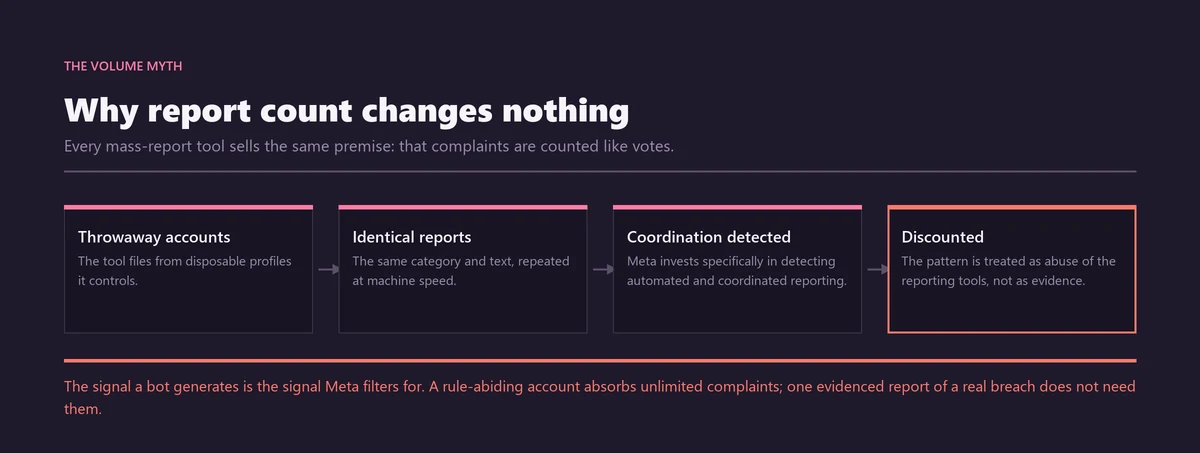
What neither method proves is that volume works. A pile of identical complaints from accounts registered in the same week is a coordination signal, and Instagram is explicit that reports are weighed rather than counted. The attacks that land do so by picking a category with an automated trigger, not by buying a thousand taps on a menu.
What has changed about the attack surface?
The core trick has not changed, but the packaging has. Sellers now bundle stolen session cookies alongside the report attack, so a "ban" order can quietly become an account takeover. And a second operator, often the same one, arrives after the ban posing as a recovery agent who can undo it for a fee.
Session-token theft matters because it sidesteps the password entirely. A stolen cookie can carry an active login without triggering a reset prompt, which means two-factor authentication alone is not the whole defence. If a "ban panel" asks you to install anything, sign in to anything, or paste a token, the product being sold is your session, not somebody else's removal.
The recovery upsell is the more profitable half of the trade. A ban-attack victim is highly motivated, freshly locked out, and searching for anyone who claims access to Meta. That is the exact moment a stranger appears in the inbox offering restoration for a deposit. Nobody outside Meta can reverse an enforcement decision, and a demand for payment up front is the tell.
How does the ban-then-restore loop actually make money?
The attack and the cure are sold by the same people. One side of the operation takes a modest fee to remove an account. The other charges that account's owner a far larger fee to bring it back. The removal is the marketing cost; the restoration is the actual product.
- A buyer pays a low flat fee to have a named account removed.
- The operator files a fabricated impersonation or self-harm report and the account is restricted.
- The owner is locked out publicly, in front of an audience and usually a revenue stream.
- A "recovery specialist" contacts the owner, sometimes claiming to work at Meta, and quotes four figures.
- Payment moves through a rail with no chargeback, and one account has paid the same crew twice.
ProPublica's investigation into Instagram ban fraud remains the clearest documented example: an operator known as OBN who claimed to have made roughly $300,000 banning and un-banning pages, while posing as Meta staff and billing the people he had taken down (ProPublica). That reporting predates 2026, so read it as a case study of the model rather than a current price list.
Security coverage from Avast, Kaspersky, Vice and Tripwire has repeatedly placed entry prices around $60 per ban, with tiers roughly in the €5 to €30 range scaled by the target's follower count. Those figures come from reporting spread across several years rather than a 2026 market survey, so treat them as an order of magnitude and nothing more precise.
The payment rail is the most reliable signal of all. A crypto ban scam prices in a currency with no chargeback, and the same logic drives the requests for gift cards or friends-and-family transfers. A provider doing lawful work has no reason to insist on an irreversible payment method for a service it is willing to describe in writing.
What should an Instagram ban service cost, and what is a red-flag price?
There is no list price for Instagram ban as a service, because there is no product to list. Honest work is quoted per case and tracks the labour involved: one clearly documented violation is cheap, a contested claim or a cluster of linked accounts is not. A flat fee bolted to a guaranteed removal is the reliable scam signature.
Instagram ban service cost, on the legitimate side, is the cost of four separate pieces of work. None of them is a bribe, a bot, or an insider.
- Triage. Reading the profile against the actual guideline, and saying no when it does not breach one. Most of the value sits in this step.
- Evidence. Capturing dated, complete screenshots of the bio, the DM, the payment request or the listing, before the offender deletes them.
- Correct filing. Matching the harm to the right route, including the Instagram impersonation form, which only the affected person or an authorised representative may submit.
- Follow-up. Tracking the decision, refiling with stronger evidence when the first pass stalls, and watching for the account returning under a new handle.
Price should rise with contestability, not with the target's follower count. A seller who quotes by audience size is pricing the damage they can inflict, which is the economics of an attack rather than a filing. If you want to see the shape of the work before paying anyone, our guide to getting an Instagram post, photo or Story taken down walks the same route for free.
Is a paid Instagram ban service safe to use?
It is safe under two conditions and no others: it never asks for your login, and it never files against an account that has not broken a rule. Everything else, from reviews to response times to a convincing website, is decoration. Those two refusals are the entire safety test.
A provider working through Instagram's public forms has no use for your password, your two-factor code, or a session on your device, because none of those is required to submit a report. A request for credentials is not a workflow requirement that got out of hand. It is the point of the exercise.
- Guarantees a ban, on any account, by a stated date.
- Insists on cryptocurrency, gift cards or friends-and-family transfers.
- Claims contacts, insider access, or a panel inside Meta.
- Asks for your login or recovery codes, or asks you to install software.
- Accepts a target without ever asking what the account did.
- Offers to restore an account it, or an associate, had removed.
The last one deserves a pause. A business selling both directions of the same transaction is not a service with an unusually broad product line. If you are unsure which side a seller sits on, describe the case to us through the contact page and we will tell you whether it is a genuine violation, a free filing you can make yourself, or a target nobody should touch.
Legit takedown vs scam: which side is the seller on?
Legit takedown vs scam stops being a judgement call once you know where to look. The two markets advertise almost identically and diverge sharply on six specifics: who they will act against, what they need from you, how they take payment, what they promise, which route they file through, and what they do after a removal.
| Signal | Documented-reporting service | Fake-report operation |
|---|---|---|
| Target screening | Declines accounts that have not broken a rule | Accepts any handle; never asks what the account did |
| Your login | Never requested; every filing uses public forms | Asks for a password, a 2FA code or a session token |
| Payment | Quoted per case after a review, reversible methods | Flat fee up front in crypto or gift cards |
| The promise | Instagram decides; no guaranteed outcome | Guaranteed ban, frequently with a stated deadline |
| Filing route | The route that matches the harm: impersonation, intellectual property, fraud, harassment | Whichever category triggers the fastest automated action |
| Evidence | Dated captures tied to a named guideline | None; the report itself is the fabrication |
| After a removal | Points a wrongly hit account to the free appeal | Sells the removed account its own restoration |
The filing-route row carries most of the weight. A documented-reporting service picks the channel that matches the harm, because the channel determines who may file and what evidence is accepted. A fake-report operation picks whichever category trips the fastest automatic action, regardless of what actually happened to anyone.
Should you file it yourself, pay a service, or instruct a lawyer?
Most cases do not need Instagram ban as a service at all. If you are the affected person, you hold the evidence, and the harm maps cleanly to one report category, filing it yourself costs nothing and carries identical weight. A service earns its fee on complexity. A lawyer earns theirs when the platform is not the only remedy you need.
| Consideration | Grey-market ban seller | Documented-reporting service | Filing it yourself | Instructing a lawyer |
|---|---|---|---|---|
| Typical cost | Low flat fee, then a four-figure "restore" bill | Quoted per case by complexity | Free | Hourly or fixed fee; the highest of the four |
| Legality | Fraud, and often harassment | Lawful when the violation is genuine | Lawful when the report is true | Lawful |
| Evidence burden | None, which is the point | Carried by the service, assembled with you | Entirely yours | Yours, to a court-ready standard |
| What counts as proof of success | Nothing is offered; coincidence is claimed | Filing records plus the platform's decision | The in-app decision notice | A settlement, an order or a judgment |
| When it fits | Never | Contested, repeat or multi-account harm | A single clear violation you can document | When you need damages, disclosure or an injunction |
Try it yourself first if the case is simple. Reporting a fake giveaway, a cloned profile or an abusive message takes a few minutes once you know which control to use. Our guide to reporting an Instagram story, post, profile or DM covers each surface, and which channel a giveaway or business scam belongs in prevents the most commonly wasted filing.
Escalate to a lawyer when you need something a platform cannot give you: money back, an injunction, a court order for identifying information, or a criminal complaint. A takedown ends the exposure. It does not compensate you for it, and it does not tell you who was behind the account.
Why does a fake report bot sometimes look like it worked?
Because Instagram restricts accounts for reasons that have nothing to do with your purchase. Temporary action blocks, automated false positives and login-security holds all appear within days and often clear on their own. A buyer who paid on Tuesday and sees a restriction on Thursday credits the seller, and the seller keeps the money.
A fake report bot is sold as software that fires hundreds of complaints from disposable accounts. Two things happen to that traffic. Most of it is discarded as coordinated behaviour, and the accounts sending it get actioned themselves. What the buyer notices is the occasional coincidence, and coincidence is enough to sustain the whole market.
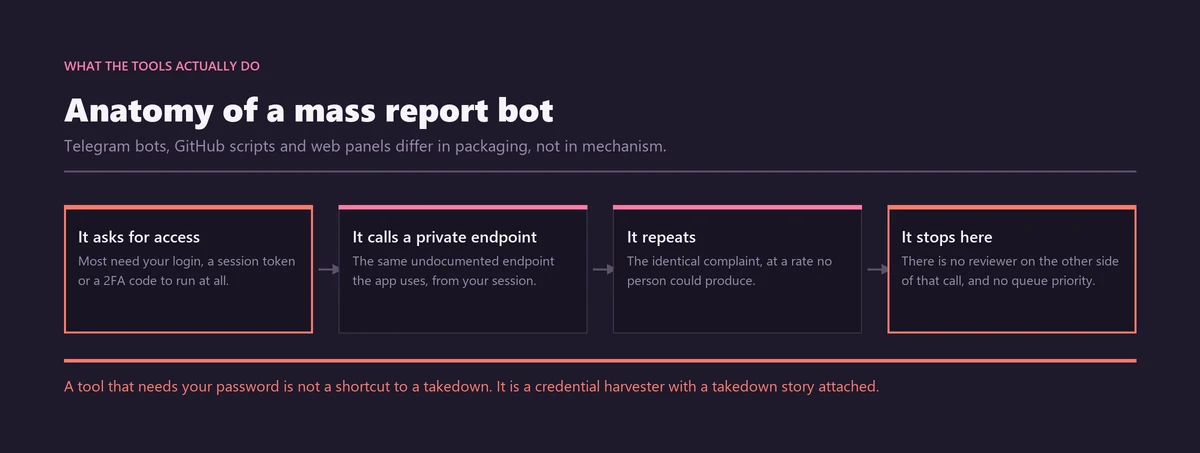
That ambiguity is the business model rather than a flaw in it. Deniability lets a seller take payment for an outcome they did not cause, and refuse a refund for one nobody can disprove. Ask a seller what evidence of causation they will provide, and the conversation usually stops there.
A large share of ban-buying is not about harm at all. It is about a handle somebody wants. Instagram does not release a username because an account was removed, and the routes that do work are narrow: our guide to the three honest routes to an Instagram username sets out what is genuinely available.
How do you protect an Instagram account from a ban attack?
Hardening is cheaper than recovery, and it blunts both attack vectors. The measures that protect Instagram from ban attack attempts are unglamorous: prove who you are before anyone disputes it, keep your recovery routes current, and check Account Status often enough that a strike is caught while it is still appealable.
- Two-factor authentication, with trusted devices reviewed. It stops a report attack tipping into a takeover, and the device list shows you a stolen session.
- Verification or business verification. A badge collapses the impersonation-clone trick, because the authentic account has already been identified.
- A registered trademark and Brand Rights Protection enrolment. Rights holders get a faster, evidenced route against counterfeit and clone pages instead of arguing case by case.
- Current recovery email and phone number. This is what makes the free appeal route work at the moment you are locked out and cannot fix it.
- Routine Account Status checks. Strikes and restrictions are visible there before they escalate, and an early appeal is a much stronger appeal.
- Off-platform corroboration. A matching website, business listing or verified profile elsewhere gives a reviewer a signal that outlives a screenshot.
- Think about the profile photo. A recognisable face is easier to clone convincingly than a wordmark or a graphic identity.
None of this makes an account immune. It changes what a reviewer sees when two profiles claim the same identity, and it shortens the window in which a fabricated report can do damage unopposed. That is the realistic goal here: not invulnerability, but a fast and well-documented recovery.
What should you do if your account was banned by a ban attack?
Work the official ladder in order, and pay nobody. Recovery starts inside the app with a review request from Account Status, moves to the Support Inbox, and for users in the EU continues into a statement of reasons under the Digital Services Act and then an out-of-court dispute body. Every step is free.
- Account Status. Open Settings, then Account Status, to see exactly what was actioned and on what ground. The Instagram Account Status appeal attached to that notice is the primary route back, and the one Meta actually processes.
- Support Inbox. Decisions and follow-up requests land here rather than in your email. Check it before assuming nothing has happened, and answer any identity-document request quickly.
- Statement of reasons. Users in the EU are entitled under the Digital Services Act to a statement of reasons for a restriction, which forces the platform to name the ground it acted on instead of leaving you guessing.
- Out-of-court dispute settlement. Appeals Centre Europe, a certified DSA body, takes eligible Facebook and Instagram disputes and decides them independently of Meta.
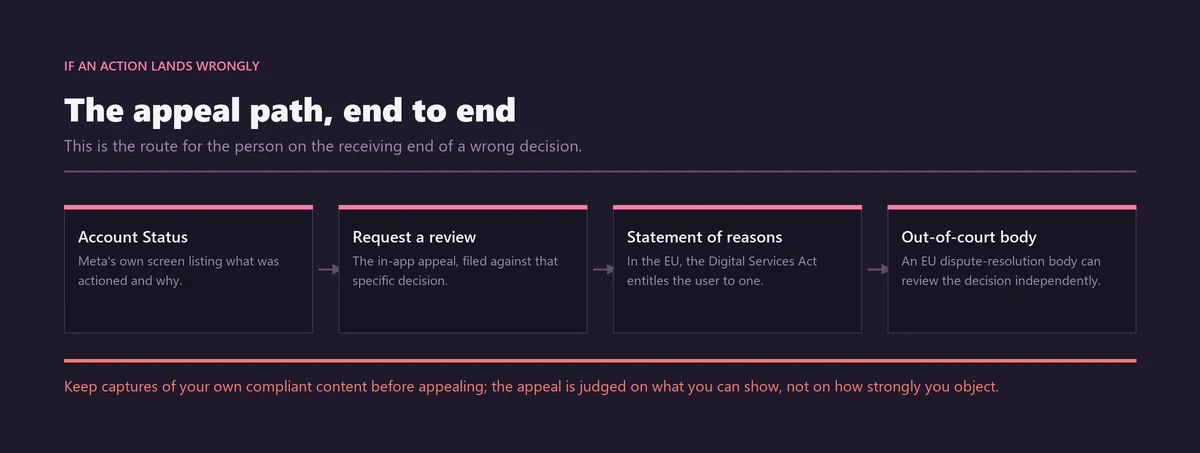
The escalation is not theatre, but it is not fast, and the evidence problem is real. In its transparency report covering April 2025 to March 2026, Appeals Centre Europe said that across more than 4,600 eligible Facebook and Instagram suspension disputes, Meta produced the disputed content in fewer than 100 cases (The Register, 28 May 2026; Appeals Centre Europe). Where a platform fails to supply the material within 30 days, the decision defaults in the user's favour.
One practical caveat. Several 2026 recovery guides report that Instagram's older standalone appeal forms have largely been replaced by in-app review requests through Account Status, the violation notice, or the Support Inbox. Meta has published no notice confirming that, so treat it as widely reported rather than official policy, and start in the app either way.
What kind of cases can an honest service actually win?
Only cases anchored to a genuine violation, which is a narrower band than most buyers expect. If a profile is doing real harm, it almost always maps to a category Meta already enforces, and those are the situations a documented filing can carry through to a decision.
- Scams and financial fraud. Fake shops, investment and giveaway cons, and phishing links planted in bios and direct messages.
- Impersonation of you or your brand. Clones and bogus "official" pages, filed through the route reserved for the affected party or their representative.
- Counterfeiting and trademark abuse. An Instagram copyright trademark report is a separate filing from impersonation, submitted through the intellectual property form and open to the rights holder or an authorised agent.
- Harassment, threats and stalking. Sustained targeting, doxxing, or coordinated pile-ons aimed at one person.
- Clearly illegal material. Escalated to the relevant authorities, and never handled as a routine takedown.
What a provider refuses is as diagnostic as what it accepts. Nobody honest moves against a profile for criticising you, disagreeing with you, competing with you, or being an ex-partner. If you are unsure whether your situation qualifies, our guide to picking the Instagram takedown form that fits the harm maps each category to its route, and the safe way to report an Instagram stalker covers the cases where preserving evidence matters most.
What can no Instagram ban service ever promise you?
Two things: the outcome and the date. Meta's reviewers decide whether an account comes down, so no provider can promise a removal without inventing that certainty. And Meta publishes no review time for reports, which means any stated turnaround is a sales figure rather than a service level.
The absence of a published timeline deserves saying plainly, because competitors fill the gap with numbers. There is no official 24-hour review window, no 48-hour guarantee, and no published success rate for Instagram reports. Anyone quoting one has either copied it from another marketing page or made it up on the spot.
A guarantee bolted to a deadline is the one combination that does not exist in honest takedown work, which is exactly why it appears in every scam advert.
Three questions to ask before you pay anyone
- Which specific Community Guideline or law does this account breach, and which form matches it?
- What will you send me as evidence that the filing was actually made?
- What happens if Instagram declines: a refund, a refiling with better evidence, or an honest no?
A provider who answers all three in writing is doing documented reporting. One who answers none of them is selling a guaranteed ban, and a guaranteed ban is either a lie or a crime. Instagram ban as a service is only worth buying in the first sense: someone builds the case you cannot, files it correctly, and tells you honestly when the answer is no.
Sources
- InstagramImpersonation report form
- Meta Transparency CenterInauthentic Behavior Community Standard
- Appeals Centre EuropeTransparency report and impact data
- UK Government (legislation.gov.uk)Protection from Harassment Act 1997
Frequently asked questions
Is Instagram ban-as-a-service illegal?
It depends entirely on what is filed. Paying someone to report an account that genuinely breaks the Community Guidelines or the law is lawful, and so is doing it yourself. Paying for fabricated impersonation or self-harm reports is fraud, is frequently harassment, and in the United Kingdom can fall under the Protection from Harassment Act 1997, which carries both criminal penalties and a civil claim.
How much does it cost to get someone banned on Instagram?
There is no list price for legitimate work, because it is quoted per case according to how contested the violation is and how much evidence gathering it needs. Security reporting on the criminal market has put entry prices around $60 per ban, with four-figure sums charged afterwards to restore the same account. Those figures span several years of coverage rather than a current survey.
Is a paid Instagram ban service safe to use?
Only if it passes two tests. It must never ask for your password, your two-factor code or a session on your device, because public report forms require none of those. And it must refuse targets that have not broken a rule. A provider failing either test can cost you your money and your own account at the same time.
Can someone really pay to get my Instagram account banned?
Yes, and the documented method is not hacking. An attacker clones your profile and reports you for impersonating the clone, or files a fabricated self-harm report that triggers an automatic protective restriction. Neither needs your password. Verification, a current recovery email and regular Account Status checks all make the attack harder to land and much faster to reverse.
What should I do if my account was banned by a ban attack?
Start in the app and pay nobody. Open Settings, then Account Status, read what was actioned and on what ground, and submit the review request attached to that notice with your evidence. Check the Support Inbox for the decision. If you are in the EU, request a statement of reasons and then take the dispute to a certified out-of-court body.
Can Instagram detect coordinated or paid reporting?
It is built to. Instagram states that the number of reports does not determine an outcome, and identical complaints arriving from recently created accounts read as a coordination signal rather than a stronger case. Meta also says the overwhelming majority of its scam enforcement happens before any user report, which means report volume is not the lever sellers claim it is.
Do accounts banned this way get restored?
Often, but neither automatically nor quickly. A restriction forced by a fabricated report can be reversed on appeal, because the underlying content never broke a rule. The obstacle is evidence: Appeals Centre Europe reported that Meta produced the disputed content in fewer than 100 of more than 4,600 eligible suspension disputes in the year to March 2026.
Who do I contact if Meta will not reinstate my account?
After the in-app review request and the Support Inbox, users in the EU can escalate to Appeals Centre Europe, a certified out-of-court dispute settlement body under the Digital Services Act. It handles eligible Facebook and Instagram disputes independently of Meta. Nobody offering paid restoration from outside Meta can reverse an enforcement decision, whatever they claim about contacts.
Is ban-as-a-service the same thing as an Instagram account takedown?
The honest version is the same work under a blunter name. A takedown documents a real violation and submits it through the route that matches the harm, which is exactly what a legitimate provider does. The dishonest version the phrase usually describes is fabricated reporting, and no reputable takedown provider will touch it, because it puts the client at risk as well as the target.