Report an Instagram giveaway or business: a route for every case
Reviewed 8 August 2026 · 5,518 words · 23 min read
A directory for the scammed: the official channel for each Instagram problem, what your report can and cannot do, and where the money actually comes back from.
To report an Instagram giveaway or business, match the problem to its channel: flag a fake giveaway or scam shop from the post's three-dot menu as scam or fraud, and use the separate impersonation, copyright, trademark or under-13 forms where those apply. Instagram cannot refund you; your bank or payment provider handles that.
Send us the fake giveaway post, the shop that took your money, or the cloned brand profile, and we file through Instagram's official forms on genuine violations only.
- The FTC reported $2.1 billion lost to scams that began on social media in 2025, with about $234 million attributed to Instagram.
- Meta says 92% of the 159 million scam adverts it removed in 2025 came down before any user reported them.
- Impersonation, copyright, trademark and under-13 complaints use standalone web forms, not the in-app Report button.
- Card scheme rules commonly allow around 120 days to raise a chargeback; cryptocurrency payments cannot be reversed.
- Meta publishes no review-time commitment, so no page can honestly promise a 24 to 48 hour turnaround on a report.
Which report channel handles each Instagram problem?
Match the harm to the queue that was built for it. A prize-draw scam, a shop that never posted your order and a hijacked profile look alike from the outside, but Meta handles them through three separate pipelines. Report an Instagram giveaway or business through the wrong one and your file lands somewhere with no authority to act on it.
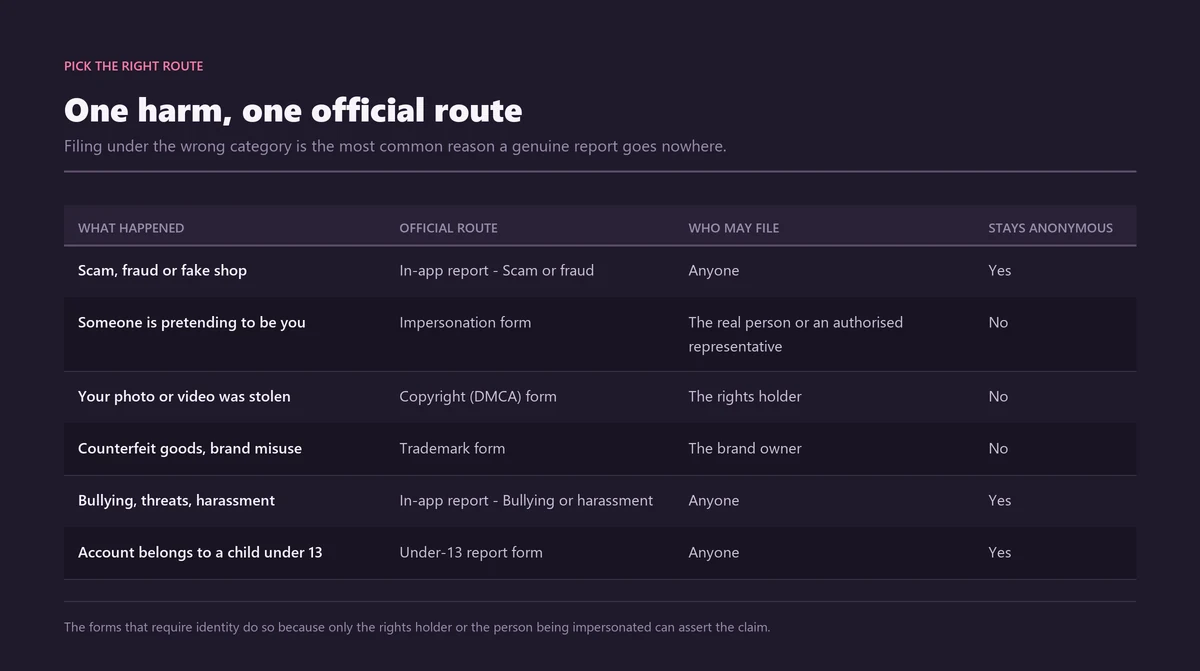
The in-app three-dot menu covers most everyday harm: scams, fraud, spam, bullying, hate speech, restricted goods. Four cases sit outside it entirely, on standalone web pages that load whether or not you are signed in, because they ask for proof the in-app button was never built to collect.
| What went wrong | The official route | Who may file it | Anonymous? |
|---|---|---|---|
| Fake giveaway, or a "you have won" DM | Three-dot menu on the post or message, then Report, then Scam or fraud | Anyone | Yes |
| The giveaway arrived as a sponsored post | Report ad from the ad's own menu, and check the advertiser in the Meta Ad Library | Anyone who saw it | Yes |
| A shop took payment and never shipped | Report the profile as a scam, then open a dispute with whoever moved the money | Anyone can report; only the buyer can dispute | Yes on Instagram |
| Counterfeit goods trading on a real brand | Instagram trademark form | The brand owner or its representative | No |
| Your photographs, Reels or artwork reposted | Instagram copyright form | The rights holder only | No |
| A profile pretending to be you or your business | Instagram impersonation form | The person copied, or an authorised representative | No |
| Your own account was taken over | instagram.com/hacked recovery flow | The account holder | Not applicable |
| The account holder appears to be under 13 | The under-13 report web form | Anyone | Yes |
| Money is already gone | reportfraud.ftc.gov, FBI IC3 ic3.gov, or your national fraud body | The person who lost it | No, these are named filings |
Read the third column before you start. It is the rule that quietly kills more complaints than any other. A friend cannot file an impersonation claim for you, and a shopper cannot file a trademark claim for the brand being copied. Both get closed with little explanation, and both look exactly like Instagram ignoring a report.
How can I tell a fake Instagram giveaway from a real one before I report it?
A genuine promotion never charges you to collect a prize and never asks for a login credential. Fake ones almost always do both, usually in that order: a small "shipping" or "processing" fee first, then a code sent to your phone that you are asked to read back. That code is normally the last step of an account takeover.
Run the checks below before you file anything. Reporting a legitimate brand promotion because it looked odd wastes a reviewer's time and does nothing for you.
- Entry or collection costs money. Any fee, tax, customs charge or courier payment to release a free prize is the whole scam in one sentence.
- You are asked for a password, a six-digit code, or a "verification" login on a page that is not instagram.com.
- You won a draw you never entered, and the win arrived by DM rather than a public announcement.
- The handle is a near-miss of the real one, padded with extra full stops or a swapped letter, and the account is new.
- There are no published rules, no closing date and no named promoter, and the claim link is a shortener or a look-alike domain.
- The urgency is artificial: claim within the hour, or the prize passes to someone else.
Two of those firing together is enough. Cross-check the brand's real profile from search rather than from the link you were sent, and look for the same giveaway announced there. If it is not on the verified account, it is not the verified account running it.
The money involved is not marginal. In April 2026 the Federal Trade Commission reported that US consumers lost $2.1 billion to scams that began on social media during 2025, eight times the 2020 total. About $234 million was attributed to Instagram and $794 million to Facebook, and shopping scams were the most-reported category.
How do you report a fake Instagram giveaway?
To report a fake Instagram giveaway, open the post, Story or message that pitched it, tap the three-dot menu, choose Report, and select the scam-or-fraud reason. Then report the profile itself as a separate action, and block the organiser so the same account cannot pitch you again while the review is running.
- Screenshot first, submit second. Capture the post, the profile header showing the @username, and the full DM thread. Scam pages delete their own content within hours of being flagged.
- Report the content. Three-dot menu, Report, then the scam or fraud category rather than the vaguer "I just do not like it" option.
- Report the account separately. A content report can only remove the content; the profile is a distinct target with a distinct outcome.
- If it arrived as a sponsored post, use the ad's own report control too, because ad enforcement runs on a different pipeline.
- Block the organiser. That stops the re-pitch and the follow-up "you nearly won, try again" message that usually arrives a day later.
- Warn whoever else was tagged. Prize scams recruit through comment tags, and the people tagged under you are next.
Three patterns cover almost everything: the unsolicited win from an account you never followed, the brand clone offering free product if you cover postage, and the counterfeit "verified contest" ending on a login page built to harvest your password and two-factor code.
Where the giveaway ran as a Story that has since expired, or as a single grid post you can no longer find, the per-surface walkthrough in our guide to reporting an Instagram Story, post, profile or DM shows where each report control hides, because they are not in the same place twice.
How do you report the ad rather than the account?
Most scam giveaways are paid advertising, not organic posts, and advertising is policed by a completely separate system. Reporting the account leaves the ad running. Reporting the ad puts the creative, the advertiser and the payment method in front of a team that can suspend all three, which is a far larger outcome than removing one post.
The control sits on the ad itself. Tap the three-dot menu on a sponsored post and you get options the organic menu does not carry, including a scam or misleading-content reason and, separately, "Why am I seeing this ad?" Open that before you report: it names the advertiser and shows the targeting that put the ad in front of you.
Then go wider. The Meta Ad Library is a public archive of every advert currently running across Facebook and Instagram. Search the advertiser's page name and you can see the full set of creatives, and whether the same operation is running a dozen fake giveaways under slightly different brand names.
Record the Library ID for each advert you find. It is a stable reference that survives the advert being deleted, and it is the single most useful thing you can hand a bank, a regulator or the brand being impersonated. A screenshot of a post that no longer exists proves far less.
The ad route matters more than most people assume. Reporting on the FTC's 2026 figures, TechCrunch noted that more than 40% of people who lost money to a social-media scam in 2025 said it began with an advert. If your loss started with a sponsored post, the advert is the part of the chain with payment details attached.
How do you report an Instagram business that scammed you?
To report an Instagram business that scammed you, flag the storefront profile and the specific listing as a scam, use the seller-reporting option if the account has a shop attached, and then treat the platform report as one of three filings rather than the only one. Instagram can remove the seller. It cannot return your money.
Scam shops fall into recognisable types. The one that takes payment and never ships. The counterfeit seller passing knock-offs off as the real thing. The advertising storefront that bounces you to a spoofed site on a look-alike domain. And the deep-discount subscription trap that bills again next month.
A scam or fraud report against the storefront costs nothing and stays anonymous, so report the smallest thing that genuinely breaks a rule, then the profile if the profile itself is the problem. The difference between those two outcomes, and why the first often looks like nothing happened, is set out in our guide to reporting an Instagram account and what disable, delete and ban actually mean.
What happens next is undramatic. There is no confirmation that a seller was investigated and no notification when a shop comes down, so check the profile yourself a few days later rather than waiting for a message that is not coming.
Keep everything before you do any of it: the order confirmation, the payment reference, the DM thread, the profile URL and the advert. Every body you are about to file with wants the same evidence pack, and the account may be gone by the time the second one asks.
Can you get your money back after an Instagram scam?
Sometimes, and it depends almost entirely on how you paid rather than on what you bought. Card payments have a formal dispute mechanism behind them. Bank transfers, instant peer-to-peer apps, gift cards and cryptocurrency have progressively less, and by the bottom of that list recovery is realistically nil. Speed matters more than persistence.
Instagram can take the shop down. Only the company that moved your money can take the money back.
| How you paid | Realistic chance | The route | The clock |
|---|---|---|---|
| Credit card | Good | Chargeback through your issuer; in the UK, Section 75 of the Consumer Credit Act also makes the issuer jointly liable on purchases over £100 | Scheme rules commonly allow around 120 days; issuers vary |
| Debit card | Moderate | Chargeback through your bank, which is a card-scheme rule rather than a statutory right | Similar window, entirely issuer-dependent |
| Bank transfer | Moderate in the UK, poor elsewhere | Your bank's fraud team; UK reimbursement rules for authorised push payment fraud have applied since 7 October 2024 | Hours, not days, if funds are to be frozen downstream |
| PayPal Goods and Services | Good | Open a dispute in the Resolution Centre, then escalate it to a claim if the seller stalls | 180 days from the payment date |
| PayPal Friends and Family, Zelle, Cash App | Poor | Report to the app and to your bank, and ask specifically about imposter-scam reimbursement | Immediately |
| Gift card or voucher code | Poor, but not always zero | Telephone the card issuer with the card number and the till receipt; unspent balances are sometimes frozen | Within hours of realising |
| Cryptocurrency | Effectively nil | File with IC3 or your national fraud body so the wallet is on record; the transaction cannot be reversed | Immediately, for the investigation rather than the refund |
Card disputes are the lane worth understanding. Ask your issuer for a "goods or services not received" chargeback, quote the merchant descriptor exactly as it appears on the statement, and attach the evidence pack. Report an Instagram giveaway or business by all means, but the clock that decides a refund is your issuer's, and it starts at the transaction or the promised delivery date.
UK bank transfers are the outlier. Since 7 October 2024, reimbursement rules set by the Payment Systems Regulator have required sending and receiving firms to share the cost of reimbursing victims of authorised push payment fraud, within a capped limit and with an optional excess. Tell your own bank first, the same day.
What is the fastest way to recover after a fake giveaway took your details?
If a prize scam pulled a password, a verification code or a card number, the reporting can wait ninety seconds. Close the access route first, in a fixed order, because the person on the other end is working through your account right now and every minute of delay is a minute they are using.
- Change your Instagram password, then change it anywhere you reused the same one. Email first, because email is how every other reset is confirmed.
- Open Settings, then Accounts Centre, then Password and security, then "Where you are logged in", and remove every session you do not recognise.
- Turn on two-factor authentication using an authenticator app rather than SMS, so a stolen password alone is not enough.
- Check the linked email address and phone number. Takeovers swap these first, and a swapped recovery address locks you out permanently.
- Report the giveaway post and the account, and report the advert separately if it ran as a sponsored post.
- Block the organiser, so the profile cannot re-open contact from the same handle while the review runs.
- If a card number or bank detail was given, ring the issuer's fraud line and freeze the card before anything else on this list.
The six-digit code causes the most damage. It is usually the final step of a two-factor takeover, and handing it over converts a phishing attempt into a completed account theft. If you sent one and can still log in, assume the attacker is logged in too until you have cleared the sessions.
How do you report a hacker on Instagram?
Where you report a hacker on Instagram depends on whose account was taken. If it is yours, an ordinary report achieves nothing, because reports are for content that breaks the rules and a stolen account has not broken any. You need the recovery flow instead. If it is someone else's, the report route is the right one.
For your own account, go straight to Instagram's hacked-account recovery. It can send a login link or a security code, and where you are fully locked out it will offer identity verification, usually a short video selfie rather than a document scan. Once you are back in, clear every unfamiliar session and re-secure the linked email.
For an account belonging to somebody you know, report the profile under the hacked or scam reason and warn the real owner through a channel the attacker does not control. A phone call, not a DM. Hijacked profiles get reskinned into investment or giveaway scams within hours, and the followers list is the target.
Speed matters here. A hijacked account carries real followers and real history, which makes its scam posts far more effective than a throwaway profile could manage. Pushing early for removal is covered in our walkthrough of how a cloned Instagram profile is actually removed.
How do you file an Insta fake account report for impersonation?
An Insta fake account report for impersonation does not go through the in-app button. It goes through the Instagram impersonation form, which loads while you are logged out and asks for a photograph of government-issued identification, because Meta will only act at the request of the person being copied.
Prepare the evidence first, because it is a single pass with no draft to return to. You want the impostor's exact @username rather than its display name, your own username, screenshots of the copied photographs or bio text, and any messages the impostor has sent to your contacts.
The authorisation rule is what fails most of these claims. Only the person being impersonated, a parent filing for a child, or a documented representative can file through the Instagram impersonation form. A colleague reporting a clone of your account is filing as a bystander, and a bystander cannot prove whose face has been taken.
Where the fake profile has moved from copying you to threatening you, demanding payment or threatening to contact your followers, the order of operations changes and evidence preservation comes first. That sequence is set out in our guide to the impersonation form, photo ID and reporting blackmail.
How long does Instagram take to review a reported fake or impersonation account?
Nobody outside Meta knows, because Meta publishes no service level for this. There is no official fake account review timeline, no queue position and no committed turnaround. Straightforward automated categories such as spam tend to clear in days; context-heavy cases such as impersonation or harassment can take weeks and sometimes resolve silently.
You can at least see your own case. Reports filed inside the app appear under Settings, then Help, then Support Requests, with a status attached. "No Action Taken" means a reviewer read the report and disagreed, which is a different problem from being ignored and needs a different response: better framing and clearer evidence, not a resubmission of the same words.
Reports filed from a logged-out web form never appear in that log, so keep the confirmation email and any reference number. If the fake account is still live after a week, resubmit through the same form once, adding anything new the impostor has done since. Once.
What does not help is volume, and that is the gap the tooling market exists to exploit. Subscription products promising to accelerate a queue have no mechanism to do so, as we set out in our review of which Instagram reporter tools are real and what actually removes an account.
Which violations need a special form instead of the in-app button?
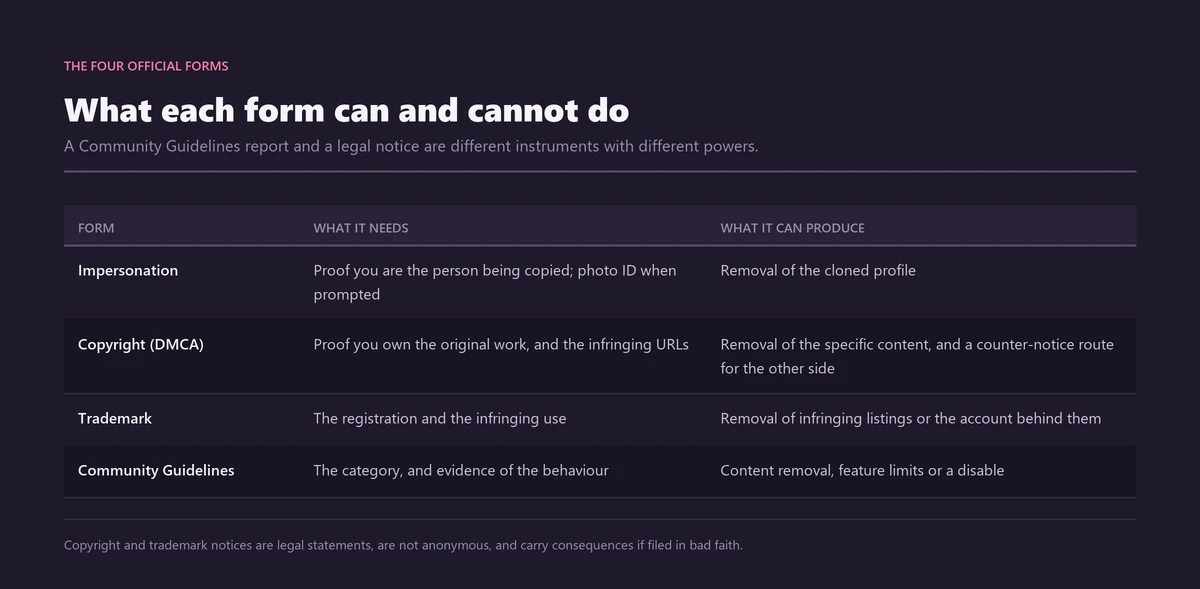
Four do, and they are the four the in-app button cannot verify: impersonation, copyright, trademark, and an account holder below the minimum age. Each has a standalone web form that works logged out, and each collects evidence the three-dot menu has no field for. Everything else stays in the app.
Copyright and trademark
Stolen creative work goes through the Instagram copyright form: your photographs reposted, your Reels re-uploaded, your product shots lifted onto a counterfeit storefront. A misused brand name, logo or trading style goes through the trademark form instead.
Both are legal notices rather than Community Guidelines complaints. Only the rights holder or an authorised agent may file, your identity is disclosed to the person you reported, and a knowingly false claim exposes you to liability. Choose the route that matches what you actually own.
Under-13 accounts
Instagram's minimum age is 13. An under-13 report can be filed by anyone, stays anonymous, and asks for the username plus whatever indicates the age, such as a school year in the bio. Where Meta cannot confirm the holder is old enough, the account is removed rather than restricted.
Everything else
Hate speech, threats, bullying, self-harm content, restricted goods and every flavour of scam stay in the app, filed against the specific post, comment, Story or profile carrying them. Those need no verification: Meta assesses the content itself, not your standing to complain.
If you cannot work out which of these fits, that is a reasonable place to be, and getting it wrong costs a week. Describe the account to us and we will tell you which route applies, including the cases where the honest answer is that none of them do.
Should you report an Instagram scam to the FTC, the FBI or the police?
All of them, where they apply, and on the same day you report an Instagram giveaway or business to the platform. A moderation report asks Instagram to remove content. Only a regulator or law-enforcement filing creates a record that can be aggregated, investigated, or used to support a bank dispute.
In the United States there are two live filing routes and they are not alternatives. ReportFraud.ftc.gov takes consumer fraud reports and feeds the FTC's enforcement data. For the financial-crime side, file with the FBI IC3 ic3.gov complaint centre, which routes reports to investigators and, in fast-moving wire cases, can attempt to freeze funds.
The scale of that second channel is worth knowing. The FBI's 2025 Internet Crime Report, released in April 2026, recorded 1,008,597 complaints to IC3, the first time it has passed one million in twenty-five years, alongside $20.877 billion in reported losses, up 26% on 2024. Phishing and spoofing, extortion and investment schemes led the complaint types.
In the United Kingdom, fraud goes to Report Fraud, the City of London Police service that replaced Action Fraud in December 2025. Elsewhere, use your national cybercrime body. The platform report is the same either way; the fraud report carries the money question.
Some cases are not fraud at all. Persistent targeted contact from an account that keeps returning under new handles is a harassment problem with its own escalation path, covered in our guide to reporting an Instagram stalker safely. And material that sexualises a minor never belongs only in an in-app report: file with your police force and, in the United States, the NCMEC CyberTipline.
Does your single report actually trigger the takedown?
Usually not, and the honest version of this is more useful than the flattering one. Meta's own 2026 figures show automated detection doing nearly all the work on scam content, with user reports catching what the classifiers miss. Your report still matters, but for reasons other than pulling the trigger on enforcement.
In an announcement dated 11 March 2026, Meta said it removed more than 159 million scam adverts during 2025 and took down 10.9 million Facebook and Instagram accounts linked to criminal scam centres. It also said 92% of those scam adverts came down before any user reported them.
So what does it achieve? Three things. People who report an Instagram giveaway or business create a timestamped record they can cite to a bank, which materially helps a dispute. It adds a human signal on content the classifiers scored as borderline. And where many unconnected people report the same operation, it contributes to a pattern.
That pattern point is where the volume myth comes from, and it is a misreading. Independent reports from people who genuinely met the same scam are useful data. Identical reports from accounts that never saw the content are the opposite, a distinction unpacked in our piece on whether report volume actually bans anyone on Instagram.
If the scam is obvious, why is Instagram still showing it to me?
Because scam advertising is paid inventory, and the systems that sell it and the systems that police it are not the same systems. That tension is documented rather than theoretical, and it is the honest answer to the question most people actually have after their third fake giveaway in a week.
In November 2025, Reuters reported on internal Meta documents dated between 2021 and 2025. According to that reporting, the company projected that roughly 10.1% of its 2024 revenue, around $16 billion, would come from advertising for scams and banned goods, and estimated users were shown in the region of 15 billion higher-risk scam adverts a day.
Meta disputed the framing, calling the 10% figure "a rough and overly-inclusive estimate" and pointing to its enforcement record. Both things can be true: the enforcement numbers are real, and so is the volume of scam inventory reaching users before enforcement catches it.
US lawsuits followed during 2026, which is where the story sits. The practical takeaway is narrow. Do not read the survival of an obvious scam advert as proof your report was ignored, and do not assume the platform will find it without you.
The same logic explains why tools sold to "force" removals cannot work. They target report volume, which is not the input that decides anything, as the mechanics in our piece on the Instagram spam report bot myth and how spam accounts really come down set out in detail.
Are Instagram giveaways legal, and is yours compliant?
Legal giveaways exist and are common. What makes one unlawful is not the platform but the structure: charge people to enter a draw decided by chance and you are running a lottery, which almost always requires a licence. Meta layers its own promotion rules on top of that, and breaching them costs you the account.
Meta's promotion rules are short and widely ignored. A promotion run on Facebook or Instagram must carry its own official rules, set out eligibility and offer terms, and comply with the law wherever it runs. It must also include a complete release of Meta and a statement that the promotion is not sponsored, endorsed or administered by Meta.
The mechanic rules are the ones brands break without noticing. Meta's Pages, Groups and Events Policies prohibit administering a promotion through personal timelines and personal connections, which rules out three of the most popular entry mechanics.
- "Share this to your story or timeline to enter" is not a permitted entry mechanic.
- "Tag yourself in this photograph to enter" is not permitted either, and inaccurate tagging is its own violation.
- Requiring entrants to post on a friend's profile is administering the promotion through personal connections.
Liking, commenting and following are the mechanics that survive. Ask for those, publish the rules, name the promoter, state the closing date and the draw method, and the promotion sits inside the policy.
None of that is exotic. The Gambling Commission publishes the distinction between a lottery, a free prize draw and a prize competition, and it is the first thing to check before a campaign goes live rather than after a complaint arrives.
What can the real brand do that a customer cannot?
Considerably more, and handing the case to the brand is often the fastest thing a scammed consumer can do. Rights holders have access to reporting tools that operate at a different scale from the consumer forms, covering adverts, posts, shops and accounts in a single sweep rather than one URL at a time.
Meta's Brand Rights Protection is the mechanism. It began as an intellectual-property tool for finding and reporting counterfeits, and during 2026 was reported to have expanded so that enrolled rights holders can report scam advertising at scale even where the advert does not use the brand's own trademarks. Eligibility terms change, so confirm current access on the Meta Business Help Centre rather than assuming.
For a consumer, the practical move is simple: tell the brand. Send the cloned profile's @username, the Ad Library ID if the scam ran as an advert, and your screenshots to the brand's real support channel. A brand-protection team that sees fifty of these a week has a route to Meta that you do not, and a commercial reason to use it.
Where the scam invented its own storefront and no brand exists to tell, the consumer forms are what you have, and an accurate report plus a card dispute plus a regulator filing beats any campaign against a profile.
What is changing in 2026?
The most consequential shift is who is allowed to advertise at all. Meta has said it is pushing advertiser verification in its highest-risk categories, with a stated target of having verified advertisers account for 90% of its advertising revenue by the end of 2026, up from roughly 70%.
If that lands, the economics of the throwaway scam advertiser get harder. Verification adds friction to the part that currently costs nothing: spin up a page, buy a small budget, run a fake giveaway, abandon it when caught, repeat. Friction at account creation beats takedowns after the fact.
Meta has also described new detection aimed at "celeb-bait", where a public figure's face sells an investment or a prize draw, and at brand impersonation in advertising. Both are the exact shapes a fake giveaway takes, which is why they were singled out.
Treat all of it as direction, not a delivered outcome. It changes nothing about this week: report the advert as well as the account, dispute the payment through whoever moved it, file with your fraud body. A system improving next year does not recover your money this year.
Will mass-reporting a scam page get it banned faster?
No. There is no report threshold that removes an Instagram account, and organising a pile-on makes the outcome worse rather than better. Enforcement turns on whether the content breaks a rule and how severely, not on how many people pressed the button. Coordination is a pattern detection systems are built to find.
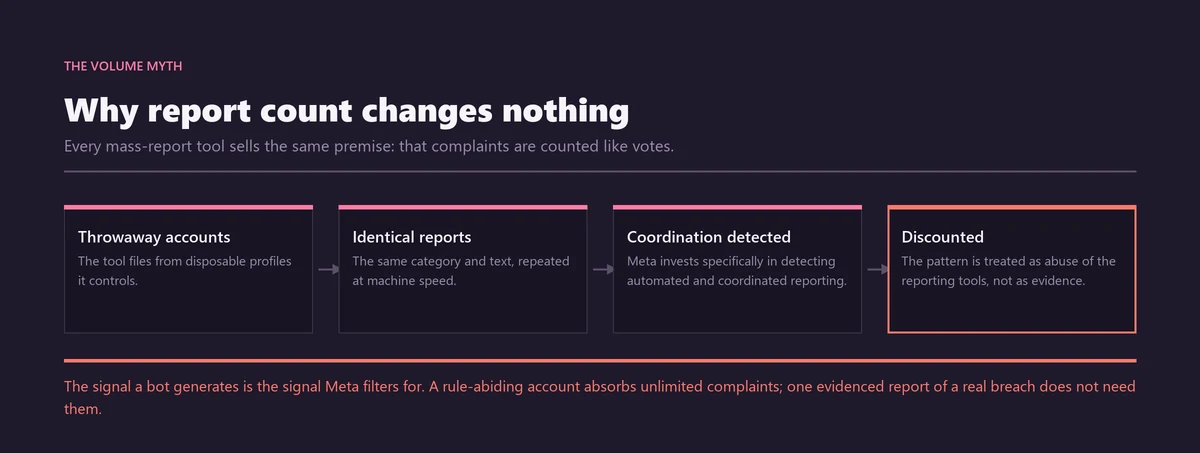
The failure is mechanical. A hundred identical reports inside an hour, from accounts with no follower overlap and no history of viewing the content, is a coordination signal, and coordination signals cause reports to be weighted down. The operation meant to remove the target marks the reporters instead.
That is the flaw in every product sold on this promise. A subscription Instagram mass report bot scales the one input that does not decide anything, and a large share of these tools want your Instagram login as the price of entry, which is the actual business model. The account you lose is your own.
What works is unglamorous. Report an Instagram giveaway or business once, accurately, in the right queue, with evidence attached and the money question routed to your bank and your fraud body in parallel. If you are unsure whether what you are looking at genuinely crosses a line, tell us what happened for a straight read before anything is filed, or work through the full set of Instagram reporting and takedown routes.
Sources
- Federal Trade CommissionData Spotlight: Reported losses to scams on social media eight times higher than in 2020
- Federal Trade CommissionReportFraud.ftc.gov, the US consumer fraud reporting service
- Meta Business Help CentreBrand Rights Protection for rights holders
- Instagram Help CenterReport an account that is impersonating you
- Instagram Help CenterCopyright infringement report form
- Instagram Help CenterTrademark infringement report form
- Instagram Help CenterReport an account belonging to someone under 13
- Instagram Help CenterHacked account recovery
- Payment Systems RegulatorAuthorised push payment fraud reimbursement requirement
- Report Fraud (City of London Police)UK national reporting service for fraud and cybercrime
- Gambling CommissionLotteries, free prize draws and prize competitions
Frequently asked questions
How do I report a fake Instagram giveaway?
Open the post, Story or DM that pitched it, tap the three-dot menu, choose Report, and pick the scam or fraud reason. Then report the profile as a separate action, because a content report can only remove content. Screenshot everything before you submit, and block the organiser so the same account cannot pitch you again.
Can you get your money back after an Instagram scam?
It depends entirely on how you paid. Credit and debit card payments have a chargeback route through your issuer, and PayPal Goods and Services has a dispute process behind it. Bank transfers are harder, though UK reimbursement rules have applied since October 2024. Gift cards and cryptocurrency are usually gone. Instagram itself cannot refund anyone.
How do I report an Instagram ad rather than the account?
Use the three-dot menu on the sponsored post itself, which carries reporting options the organic menu does not. Advertising policy is enforced separately from Community Guidelines, so reporting the account leaves the advert running. Check the advertiser in the Meta Ad Library first and record the Library ID, because it survives the advert being deleted.
Is reporting a fake account on Instagram anonymous?
Scam, fraud, hate speech, bullying and under-13 reports are anonymous: the account is never told who filed one. Copyright and trademark notices are not. Those are legal claims, only the rights holder may file them, and your name and contact details are passed to the person you reported so they can answer the claim.
Are Instagram giveaways legal?
Yes, when they are structured correctly. A prize combined with chance and a payment to enter is a lottery, which normally needs a licence, so compliant promotions use free entry or a genuine element of skill. Meta also requires official rules, a release of Meta, and a statement that the promotion is not associated with Meta.
Should I report an Instagram scam to the FTC, the FBI or the police?
File with all of them that apply, on the same day as the platform report. In the United States, consumer fraud goes to ReportFraud.ftc.gov and financial crime to IC3. In the United Kingdom, fraud goes to Report Fraud, which replaced Action Fraud in December 2025. Instagram removes content; only these bodies can investigate the money.
What should I do if I already paid a fake Instagram giveaway?
Close the access route first. Change your password and any reuse of it, remove unrecognised login sessions, turn on two-factor authentication, and check the linked email and phone were not swapped. Then ring your card issuer or bank and freeze the card. Report the post, the account and the advert afterwards, and ignore anyone offering paid recovery.
Should I block the account after I report a fake giveaway?
Yes, and reporting first is the right order. Reporting asks Meta to assess the account and changes nothing you can see. Blocking is instant and certain: it stops the re-pitch and the follow-up message claiming you nearly won. The two protections do different jobs, and in a live scam you want both of them.
Does reporting more times get an Instagram account banned faster?
No. There is no report threshold, and coordinated identical reports are detected and weighted down, which can mark the reporters instead of the target. Meta says 92% of the scam adverts it removed in 2025 came down before anyone reported them. One accurate, evidenced report in the right queue does more than any pile-on.