How to Get Someones Instagram Deleted, Route by Route
Reviewed 8 August 2026 · 4,907 words · 20 min read
Five different things get called "deleted" on Instagram, and only one route fits each — here is which form to use, who may file it, and what happens next.
How to get someones Instagram deleted has no self-service answer: only the owner can delete a profile, and only Meta can disable one, after a report evidences a genuine Community Guidelines or legal breach. Match your goal to the correct official form, because the wrong route stalls.
If what you want deleted is a scam profile, a clone of you or an image posted without consent, send us the link — we file only genuine violations, through Instagram's own forms.
- Only the account owner can delete an Instagram profile; only Meta can disable one, and only on evidence of a violation.
- Instagram states that the number of times something is reported does not determine whether it is removed.
- Since 19 May 2026 the FTC has enforced a 48-hour removal duty for valid non-consensual intimate image requests, including known identical copies.
- Impersonation reports are accepted only from the impersonated person or their representative, and require a photo of that person holding government-issued ID.
- Meta publishes no processing timeline for memorialising or permanently removing a deceased person's account.
Can you delete someone else's Instagram account yourself?
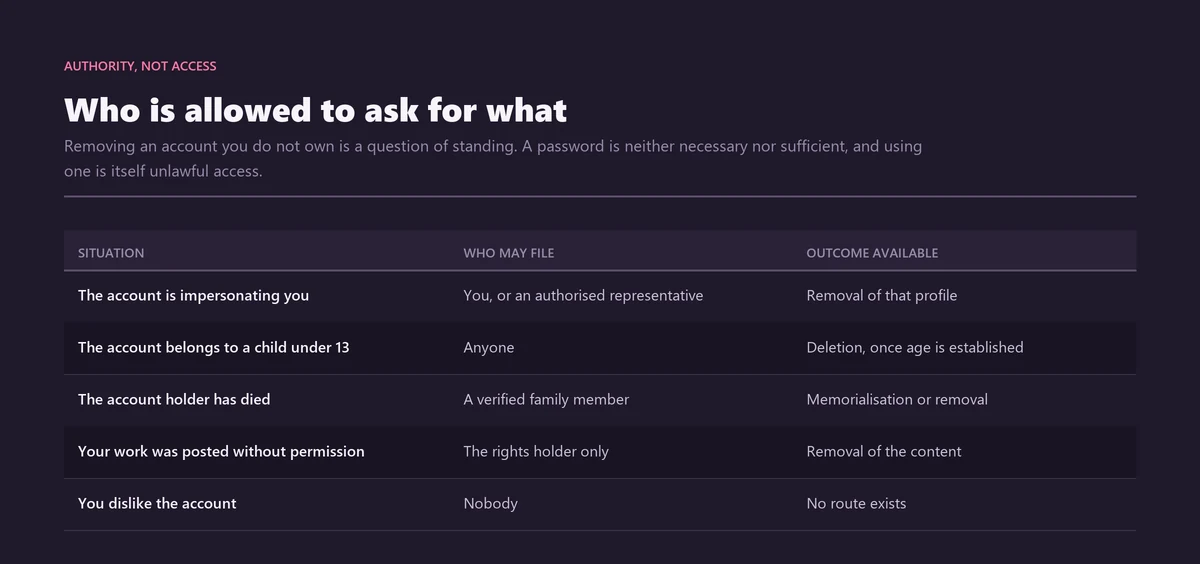
No. The delete control sits inside that account's own settings, behind its password, and only the person holding that password can use it. What an outsider can do is report a genuine Community Guidelines or legal breach and let a reviewer decide. Every honest answer to how to get someones Instagram deleted starts at that limit.
There is no administrator you can appeal to, no hidden form, no support tier that switches off a stranger's profile because you asked. Only Meta can disable Instagram account access, and it does that on evidence of a violation rather than on request. Understanding that split — owner deletes, platform disables — saves you from most of the scams built around this search.
The confusion is worth taking seriously, because it is where money gets lost. People who have just been scammed, cloned or threatened assume the profile is the problem and go looking for a delete button. The profile is rarely the unit of enforcement. A single post, a single photo, a single false claim is usually what breaks a rule, and that is what a reviewer will act on first.
Before you file anything, it is worth reading a plain account of who actually holds the power to delete someone else's Instagram account, because the answer determines whether you are filing a report, a legal notice, or nothing at all.
Deleted, disabled, deactivated or banned — which one do you actually mean?
These words are not interchangeable at Meta. "Deleted" is the layperson's word for something only an owner can do; Meta's word for enforcement is "disabled". Choosing correctly is not pedantry, because the word that describes your goal decides which form you open, who may file it, and whether the result can be reversed.
Most reports fail at this step rather than at the evidence step. Someone wanting a fake shop gone files a privacy complaint. Someone wanting a photo removed asks for the whole account to be banned. The queue reads the mismatch, applies the policy you named, finds no breach, and closes the case. Then the person assumes Instagram ignored them. The table below separates the five states Meta actually distinguishes between.
| What people say | What Meta is actually doing | Who can cause it | Can it be undone? |
|---|---|---|---|
| "Deleted" | Account deletion, performed by the owner inside Settings | Only the account owner, with the password | Yes, during the grace period before deletion completes |
| "Deactivated" | Temporary deactivation — the profile is hidden, not destroyed | Only the account owner | Yes, by logging back in |
| "Disabled" or "banned" | Disable Instagram account — an enforcement action against the profile | Meta, after a policy or legal breach | Sometimes, through the appeal window |
| "Removed" | Content removal — one post, reel, comment or Story comes down | Meta, after a policy breach | Sometimes, by requesting a review |
| "Memorialised" | Memorialisation of a deceased person's account | Meta, on a request supported by proof of death | It is a permanent state, not a removal |
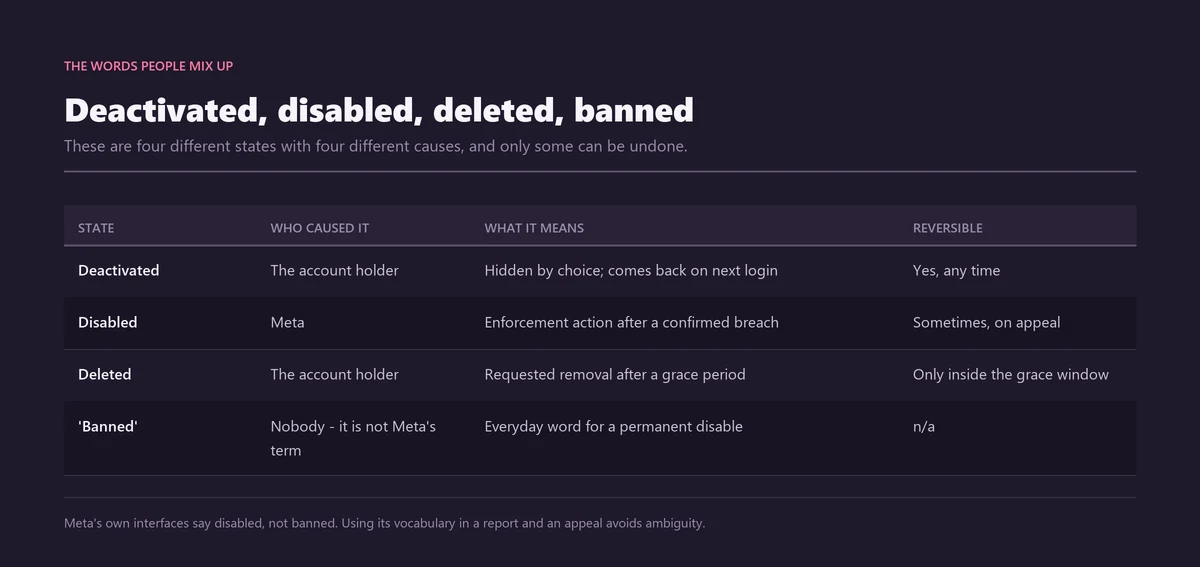
So the single most useful thing to do before searching how to get someones Instagram deleted again is to name the end state. Do you want a post gone? A photo gone? A clone of you gone? Or the whole profile switched off? Each answer points at a different door, and some of those doors only open for one named person.
What are the four removal jobs hiding behind the word "delete"?
Sort your problem into one of four jobs and the route falls out almost by itself: remove a whole account, remove a single post, remove a photo of or by you, or free a username someone is squatting on. Each travels its own channel, and several channels accept a filing from one specific person only.
This is the practical heart of the query. Almost everyone asking how to get someones Instagram deleted is really asking one of those four questions without knowing it, and the mismatch between the question they ask and the form they open is why so many reports die silently. The table below maps the common situations to the official pathway and to who is permitted to lodge it.
| The job | Official pathway | Who is permitted to file |
|---|---|---|
| A whole account: scam, fake shop, repeat abuse | In-app Report on the profile, naming the specific rule | Anyone who can see it |
| A cloned or impersonating profile | The dedicated impersonation form | The impersonated person or their representative only |
| One post, reel, comment or Story | The three-dot menu on that item, then Report | Anyone who can see it |
| A photo of you shared without consent | The privacy violation form for images of yourself | The person pictured, or a parent for a child |
| Your own copyrighted photo or video | The copyright (DMCA) report form | The rights holder or their authorised agent |
| An intimate image of you | StopNCII or Take It Down, plus an in-app report | The person in the image |
| A username squatting on your brand | The trademark report form | The trademark owner or their agent |
| The account of someone who has died | Memorialisation or permanent removal request | Anyone with proof of death; removal needs family or a lawful representative |
If your situation is not on that list, the solutions hub breaks the remaining cases down by harm type rather than by form. Work from the harm backwards. The form is the last decision, not the first.
How do you get a whole Instagram account removed?
Report the profile itself and name the precise policy it breaks. The rule you cite does the work, not the act of reporting. Accounts come down for fraud, counterfeit selling, impersonation, coordinated harassment or child-safety breaches — categories where the account exists mainly to break the rules, not where it occasionally does.
- Open the profile, tap the three dots at the top right, and choose Report.
- Select the category that genuinely describes the harm. Do not pick the most severe option available; pick the accurate one, because reviewers check the item against the policy you named.
- Capture evidence before you file: screenshots showing the username, the date, and the offending content in one frame.
- File once. Then track it in Settings, under Help or Support, in the Support Requests area.
- If the account also breaks a law — extortion, stalking, fraud — report it to the police in parallel, not instead.
Fraud is the category that moves fastest, because it is the category Meta gets most complaints about. Americans reported losing roughly $2.1 billion to social-media scams in 2025, with about $1.1 billion of that from investment cons, according to the Federal Trade Commission. Fake crypto profiles, cloned storefronts and prize-draw accounts are removed routinely for exactly that reason.
Commercial accounts have their own quirks — a real shop that behaves badly is judged differently from a shell account built to take deposits. If that is your case, the breakdown of which channel to use for a fake giveaway or business account will save you filing under the wrong policy.
Why does removing posts almost never remove the account?
Because Meta's enforcement ladder treats content and accounts as separate rungs. A removed post is a strike against an account, not a slice taken out of it. Disabling follows either from an accumulation of strikes against the same profile or from one violation grave enough to skip the ladder entirely.
That arithmetic explains a result people find maddening. You report five posts, all five come down, and the account carries on. Nothing has gone wrong. Each removal was judged on its own merits, the account's record now carries five marks, and whether that crosses the disabling threshold depends on severity, recency and what else sits on the record — none of which you can see.
Five removed posts and one disabled account are not the same outcome reached at different speeds; they are two different decisions with two different bars.
The practical consequence is that you should report the worst item first, in full detail, rather than reporting twenty mild ones. Severity carries the case. If your goal really is the profile rather than the content, the mechanics of what makes a permanent Instagram ban stick are worth understanding before you file, because the evidence a disable decision needs is heavier than the evidence a post removal needs.
There is also a timing effect nobody warns you about. Meta narrowed its proactive enforcement in 2025, and bullying and harassment content actioned across Facebook and Instagram fell to 5.1 million pieces in the first quarter of 2025 from 7.9 million a year earlier, per the Meta Transparency Center. Less proactive detection means user reports carry more of the load, and thin reports get thinner results.
Which Instagram report forms bypass the in-app queue?
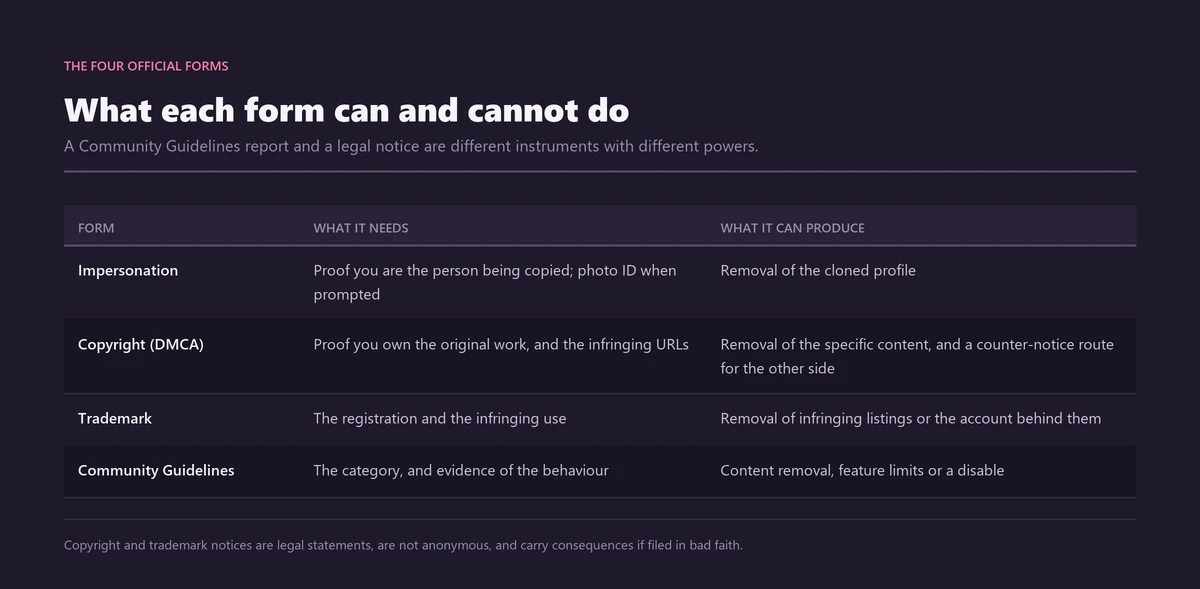
Instagram runs a set of web forms that route to specialist review teams rather than the general in-app triage. They ask for more from you — identity, documentation, a legal claim — and in exchange they are read by people trained on that one problem. For serious cases they are almost always the better door.
| Your problem | The form to use | Who may file it | Does it stay anonymous? |
|---|---|---|---|
| Someone is pretending to be you | Impersonation report form | The impersonated person or their representative | No — it needs photo ID of the impersonated person |
| A photo or video of you posted without consent | Privacy violation form | The person pictured, or a parent on a child's behalf | Not guaranteed |
| A false factual claim published about you | Defamation reporting form | The person or business defamed | No |
| Your copyrighted photo or video reused | Copyright (DMCA) report form | The rights holder or their agent | No — your name and email go to the poster |
| Your brand name, logo or handle misused | Trademark report form | The trademark owner or their agent | No |
| The account holder appears to be under 13 | Under-13 report form | Anyone | Yes |
The defamation form is the one almost nobody knows about. If someone has published a false statement of fact about you — not an insult, not an opinion, a checkable claim that is untrue and damaging — that form exists specifically for it, and it is a better fit than a generic bullying report. Meta may still tell you the claim needs a court's determination, but the case lands with the right team.
What if the account is a clone of you?
Then the route changes completely, and it narrows. To report Instagram impersonation you must be the person being impersonated or their authorised representative — a parent filing for a child is Instagram's own example. A bystander who spots a clone of a friend cannot file this form, which is why so many well-meaning reports stall.
The form asks for something that surprises people: a photograph of the impersonated person holding a government-issued ID. It is not bureaucratic theatre. The whole decision turns on proving which of two accounts belongs to the real human, and a document photo is the only thing that settles it quickly. If you are filing on someone's behalf, you need their cooperation before you start.
- Screenshot the clone profile, its follower list if it is targeting your contacts, and any messages it has sent in your name.
- Tell your own followers the account is fake, in a Story or a pinned post. It limits the damage while the report runs.
- File the impersonation form as the impersonated person, with the ID photo ready.
- Report the clone in-app as well. The two routes do not cancel each other out.
- If the clone is demanding money or threatening to publish anything, treat it as extortion and involve the police.
Cloning very often shades into blackmail, and the sequence changes when it does. The walkthrough of the impersonation form, the photo ID it needs, and reporting blackmail covers the version where the clone is being used as a threat against you rather than simply for engagement.
What happens after you report, and how long does it take?
Your report enters a review queue where either an automated classifier or a human checks the flagged item against the exact policy you named, and returns a decision. You can see the outcome in the app: Settings, then Help or Support, then Support Requests, where the Reports tab lists everything you have filed.
The timing question sits underneath every search for how to get someones Instagram deleted, and the honest answer is that Meta publishes no service-level commitment for ordinary reports. Anyone quoting you a review time — 24 hours, 48 hours, three days — has invented it. What is real is that different categories move at different speeds, and severity is the main lever.
Non-consensual intimate imagery and credible threats to life are treated as emergencies. A well-evidenced scam report on a profile that already carries strikes moves quickly. A borderline harassment case with three blurred screenshots and no dates can sit for weeks and then be closed without action. Nothing about that ordering is arbitrary; it follows the harm.
How do you get someones Instagram post deleted on its own?
Report the single item rather than the profile behind it. You rarely need an account gone to remove one harmful photo, reel or comment, and a report aimed at the one violating item is both faster and far more likely to succeed than a vague complaint about the whole account.
- Open the post, reel, comment or Story and tap the three dots on that item — not on the profile.
- Choose Report, then select the reason that names what is actually wrong with it.
- Add detail if the form allows it. One clear sentence explaining the breach beats a paragraph of anger.
- Screenshot the item first, with the date and username visible, in case it is edited rather than removed.
Here is the line the Help Centre is unusually blunt about: "The number of times something is reported doesn't determine whether or not it's removed." A post that is merely embarrassing, unflattering or rude survives, because bad taste is not a violation. A post that harasses, doxxes, sells a con or reuses your copyrighted image is the one that comes down.
How do you get an account removed for harassment or doxxing?
Report the harassment or bullying directly, name doxxing as a separate breach if private details are being published, and build the evidence pack before anything gets deleted in the heat of the moment. Sustained, targeted abuse against one person is one of the few patterns that genuinely reaches the account level.
Doxxing deserves its own label in the report. Publishing someone's home address, phone number, workplace or identity documents is treated by Meta as sharing private information, which is a distinct violation from insults or mockery. If you file it as "bullying" and the reviewer sees an address, the case may be judged against the wrong standard. Say plainly what has been published.
What wins these cases is the pack, not the anger:
- Screenshots of every message and post, each showing the date and the username in the same frame.
- A short timeline: what started it, what escalated, how many separate incidents, over what period.
- Links to the specific posts or comments, not just the profile.
- Evidence of contact after you asked them to stop, if that applies — it converts "unpleasant" into "targeted".
- Any police reference number, if you have reported it offline.
Where the behaviour has crossed into following, watching or repeated unwanted contact, the harassment route is not the strongest one available. The guide to the safe way to report an Instagram stalker sets out the order to do things in, including the steps that protect you before you file rather than after.
How do you get a photo of you taken down on Instagram?
Match the route to your stake in the image, because two different rights are in play. If you took the photograph, you own the copyright. If you are simply in it, you do not — you have a privacy claim instead. Filing under the wrong one of those is the most common reason a photo takedown fails.
Being pictured does not grant you copyright. The person who pressed the shutter holds it. So the DMCA copyright report Instagram operates is the right door only if the file is yours: your photograph, your video, your design. File as the rights holder and Instagram removes infringing reposts on that basis alone, without any judgement about whether the post was kind or fair.
If you did not take the picture, use the privacy violation form for images of yourself instead. That route asks a different question — not "who owns this?" but "was this shared without consent, and does it expose you?" It is the correct door for a candid shot, a screenshot of you, or a photo lifted from a private account. And if you are only tagged in something unwanted, "Remove Me From Post" detaches your account with no complaint at all.
How do you remove an intimate image fast?
This is the one situation where "fast" is honest, and since 19 May 2026 it is the fastest legally compelled removal route in US law. Platforms covered by the TAKE IT DOWN Act must offer a removal request process and must remove valid-request intimate images, plus known identical copies, within 48 hours.
The Federal Trade Commission began enforcing that duty on 19 May 2026 and launched TakeItDown.ftc.gov the same day, so that people can report platforms which fail to act. That is a genuine change in the balance of power. For the first time, a takedown request of this kind carries a statutory clock rather than a hope.
Alongside the legal route there is a technical one. If you were 18 or over when the image was made, StopNCII.org generates a digital fingerprint from the file on your own device and shares only that hash with member companies. A StopNCII hash match lets Meta detect and block the image across Instagram and Facebook without anyone at Meta ever seeing it. As of November 2025 the service was protecting over 2 million images and had supported more than 785,000 cases, a 97% rise on the previous year, according to the UK Safer Internet Centre.
If you were under 18 in the image, use Take It Down, the free service run by the National Center for Missing & Exploited Children, which works the same hash-matching way. Report the post inside Instagram too, and screenshot it with the date visible first. No legitimate tool ever asks you to upload the image itself.
Very often this arrives as a demand for money rather than as a post that already exists. If someone is threatening to publish, the sequence is different and the first hour matters most; the step-by-step on how to report Instagram extortion covers what to preserve, what never to send, and who to tell first.
Are there routes that remove an account without any report at all?
Yes — two of them, and neither involves a violation. Meta's User Requests Community Standard covers removal of accounts at the owner's request, and removal of an account belonging to someone who is incapacitated when an authorised representative asks. Neither route is available to anyone else, and neither is quick by design.
How do you get a deceased person's Instagram account deleted?
Two options exist and they are not the same. Memorialisation can be requested by anyone who can supply proof of death, such as a link to an obituary or a news article; the account is preserved in a locked state. Permanent removal is narrower: Instagram requires a verified immediate family member, or a lawful representative of the deceased or their estate, with proof of authority under local law.
Both are handled through the Instagram Help Centre's deceased-account routes. Instagram publishes no processing timeline for either, so treat any figure you read elsewhere as invented. Prepare the documentation properly the first time — an incomplete submission is the main cause of delay you can actually control.
What about an account belonging to someone who is incapacitated?
Meta's User Requests Community Standard states that it honours removal of accounts belonging to an incapacitated individual when requested by an authorised representative with Proof of Authority and medical documentation confirming the incapacitation. This is a documented, non-report deletion path, and it is one that virtually no article on this subject mentions.
What can you do to contain the harm while you wait?
You are not powerless during the wait. Instagram ships several controls that cut the contact immediately, without requiring anything to be removed at all. They do not touch the other account, but they change what that account can reach, and in most harassment cases they are the fastest relief available.
- Restrict is the quiet option. It hides that person's comments from everyone except them, and routes their messages to a request folder. They are not notified, which matters when notification would escalate things.
- Block is the hard cut — they cannot find, message or view your profile.
- Switching to private removes a stranger's access to everything in one move, and is worth doing on day one of a serious case.
- Remove Me From Post detaches your account from a tag without any formal complaint.
- Tag and mention settings let you limit who is allowed to tag you at all, which prevents the next incident rather than cleaning up the last one.
Use these first and report second if the case is emotionally raw. Containment costs nothing, takes a minute, and does not weaken your report — with one caveat: capture your evidence before you block, because blocking can cut off your own view of the threads you will need.
What if Instagram refuses, or the wrong account is removed?
A refusal is not the end of the process, and a wrongly disabled account is usually recoverable. Many decisions now carry a "Request a review" option that sends the case back for a second look, and content decisions can be escalated further to the independent Oversight Board.
Work the appeal on the same principle as the original report: name the policy, show the evidence, keep it short. A second reviewer reading "you got this wrong" has nothing to act on. A second reviewer reading "this post publishes my home address, which is private information under Meta's policy, screenshot attached with date" has a decision to make.
The mirror case matters just as much. If your own account, or the legitimate account you were trying to protect, is caught by enforcement, the appeal window is limited and starts when the notice appears. Act on the day you see it. You can escalate content decisions to the Meta Oversight Board once Meta's own review is exhausted, and in the EU a statement of reasons and an out-of-court dispute body are also available under the Digital Services Act.
This machinery is the strongest practical argument for honest reporting. A well-documented report survives a second reviewer. A brigaded or exaggerated one rarely does, and the appeal trail is exactly where the exaggeration shows.
Does reporting more times delete an account faster?
No. Instagram states plainly that the number of reports does not determine removal. Volume is the first thing people try when they look up how to get someones Instagram deleted, and it is the one thing that reliably achieves nothing — sometimes worse than nothing.
Meta's integrity systems are built to detect coordination. A burst of near-identical complaints from accounts with no history, filed within minutes of each other, looks exactly like what it is, and the whole cluster gets discounted. That is the wall every mass-reporting scheme runs into, and it is structural rather than a gap someone will eventually find a way around.
There is a sharper edge to it. Filing reports you know to be false is a misuse of Meta's tools in its own right, and the accounts pushing a coordinated campaign can themselves be actioned. The people who organise a pile-on sometimes end up the only ones penalised by it. One accurate, dated, correctly-routed report outperforms a hundred angry flags, every time.
Can you get someone to delete their own Instagram account?
Only by asking, or through the law. There is no third option, because the delete control sits behind their password. Between exes, former friends and relatives, a calm written request settles more cases than people expect — and it settles them faster than any report queue.
Where the content is defamatory or amounts to harassment, the legal route is real. A solicitor's letter often produces deletion within days, because most people do not want the argument. In serious cases a court order can compel it. That is slower and costs money, but it produces an outcome Instagram's own process cannot: removal of material that breaks the law without breaking Meta's policies.
What you must not do is pressure, threaten or blackmail someone into deleting. Coercing a person into removing an account is an offence in most jurisdictions, and it converts you from complainant to defendant. If you want to get someone to delete their own Instagram and asking has failed, the next step is a lawyer, not coercion. A parallel report still runs if the profile breaks Instagram's rules too.
Why do "delete any account" panels and bots always fail?
Because they are selling access that does not exist. Search how to get someones Instagram deleted and a paid panel will find you within a day, promising a flat fee and a guaranteed result. There are two versions of that pitch, and neither one does what it claims.
The cheap version simply burns your money. It fires a volley of complaints from disposable accounts, Meta's filters recognise the pattern, and nothing reaches a human reviewer. You are paying for a shape that the system is specifically designed to ignore. When the account survives, the panel blames Instagram and offers you a bigger package.
The uglier version is a removal-and-restore racket: the operator gets an account suspended with fabricated reports, then approaches the owner and charges to reinstate it. If that sounds like a service run by people who will happily sell your details to the other side, it is, and buyers of the first version routinely become targets of the second.
The legitimate alternative is duller and slower to describe. You identify the actual policy or law that has been broken, you assemble evidence a stranger could verify, and you file it on the route that accepts your kind of claim. That is the whole method, and it is the same one behind the violation, evidence and route that get someone banned on Instagram. If you would rather have someone map your case to the right form, describe the profile and the harm to us and we will tell you which door it goes through — including when the honest answer is that no route applies.
Sources
- Federal Trade CommissionFTC Begins Enforcing the TAKE IT DOWN Act
- Federal Trade CommissionNew FTC Data Show People Have Lost Billions to Social Media Scams
- Meta Transparency CenterUser Requests Community Standard
- Meta Transparency CenterCommunity Standards Enforcement Report — Bullying and Harassment (Instagram)
- Meta Transparency CenterTaking Action — Disabling Accounts
- Meta Transparency CenterTaking Action — Taking Down Violating Content
- Instagram Help CentreReporting — the number of times something is reported does not determine removal
- Instagram Help CentreReport a post or profile (reporting is anonymous)
- Instagram Help CentreDeceased account requests: memorialisation and permanent removal
- InstagramReport an impersonation account
- InstagramDefamation reporting form
- InstagramCopyright (DMCA) report form
- Instagram Help CentreAppeal a decision to the Meta Oversight Board
- StopNCII.orgHash-based removal of intimate images for adults
- National Center for Missing & Exploited ChildrenTake It Down — for images of people under 18
- UK Safer Internet CentreStopNCII.org being used to protect 2,000,000 images online
Frequently asked questions
Can you delete someone else's Instagram account?
No. The delete control lives inside that account's own settings and needs its password, so only the owner can use it. An outsider's only route is to report a genuine Community Guidelines or legal breach and let Meta decide whether to disable the profile. Any service claiming otherwise is selling access that does not exist.
How do I get someones Instagram post deleted on its own?
Report the item, not the account. Open the post, reel, comment or Story, tap the three dots on that item rather than on the profile, choose Report, and pick the reason that names the actual breach. Instagram judges that one item against its policies, so a violating photo or caption can come down while the rest of the profile stays.
How long does it take to get someones Instagram deleted?
There is no published answer, because Meta does not commit to a review time for ordinary reports. Anyone quoting you 24 or 48 hours has invented it. Severity is the real lever: intimate-image and credible-threat cases are treated as emergencies, while a thin harassment report can sit for weeks and then close without action.
Does Instagram delete accounts if enough people report them?
No. Instagram states the number of times something is reported does not determine whether it is removed. Coordinated bursts of near-identical complaints from accounts with no history are detected and discounted, and organising one can itself be treated as misuse of Meta's tools. A single dated, correctly-routed report carries far more weight.
How do I get a photo of me taken down on Instagram if I did not post it?
Use the privacy violation form for images of yourself. Being in a photograph does not give you copyright over it, because that belongs to whoever pressed the shutter, so the copyright route is the wrong door unless you took the picture. For an intimate image, use StopNCII or Take It Down instead.
Who is allowed to file an Instagram impersonation report?
Only the impersonated person or their authorised representative; Instagram gives a parent filing for a child as its example. The form asks for a photograph of the impersonated person holding a government-issued ID, because the decision turns on proving which of two accounts belongs to the real human. A bystander cannot file it.
Does the person know who reported them on Instagram?
In-app reports do not identify you to the reported account. The exception is intellectual property: a copyright or trademark complaint forwards your name, email and the substance of the claim to whoever posted the content, because they have the right to counter-notify. If anonymity matters to your safety, avoid that route.
How do I get a deceased person's Instagram account deleted?
Two different requests exist. Memorialisation can be asked for by anyone who supplies proof of death, such as an obituary or news article link, and it locks the account rather than removing it. Permanent removal is narrower: Instagram requires a verified immediate family member or lawful representative with proof of authority under local law.
How do I report an account of someone under 13, or an image of my child?
Instagram runs separate forms for both. The under-13 report form handles an account whose holder appears to be below the minimum age, and anyone may file it. A different form exists for asking Instagram to remove an image of your child posted by someone else, and a parent or guardian files that one.