How to ban an Instagram account permanently, and what makes a removal stick
Reviewed 8 August 2026 · 3,171 words · 14 min read
Only Meta can end an Instagram account for good. Here is what permanence means in its own vocabulary, what triggers it, and what survives an appeal.
You cannot ban an Instagram account permanently yourself; only Meta can, and only when a violation is severe or repeated enough for its reviewers to verify it. So the real question is how to file the official report that matches the exact policy breached, so the decision survives the appeal.
If an Instagram account is impersonating, extorting or scamming you and you want the removal to hold, send us the profile and dated evidence — genuine violations only, never a compliant account.
- Only Meta can permanently disable an Instagram account — no panel, bot or paid service holds that power.
- Meta states that the number of times something is reported does not determine whether it is removed.
- All strikes on Facebook and Instagram expire one year after they are applied.
- Meta's published strike ladder — warning at one strike through 30 days at ten — applies to Facebook accounts, not Instagram.
- An owner-requested Instagram deletion becomes permanent after 30 days; Meta publishes no equivalent timetable for enforcement removals.
What does "permanently banned" actually mean on Instagram?
It means Meta has disabled the account and shut the normal route back. Instagram's own policies never say "ban" — they say restrict, disable and delete. A permanent disable sits at the end of that sequence, and Meta reserves it for severe or repeated Community Guidelines breaches it has verified for itself.
There is no ban button anywhere. Not on a reseller panel, not inside a bot, not behind a subscription with a countdown clock on the sales page. Anyone searching for how to ban an Instagram account permanently is assuming a control that exists only inside Meta's review queues, which is why so much of the advice written for this query is fiction.
What you can influence is narrower, duller and considerably more effective: which policy your report is filed under, how much verifiable proof travels with it, and whether the decision survives the appeal that follows. Instagram runs several distinct enforcement states. Only the last one is what people picture when they type this search.
| Enforcement state | What triggers it | How long it lasts | Route back |
|---|---|---|---|
| Warning | A first strike on a lower-severity policy | No functional effect | Nothing to reverse |
| Feature restriction | Repeat strikes, or spam-shaped activity | Hours up to 30 days | Lapses by itself |
| Content removal | One post, Reel, Story or comment breaching a rule | Permanent for that item | The profile stays live |
| Disabled, review open | Accumulated strikes, or a case-by-case decision | Until the review closes | A successful appeal restores it |
| Permanently disabled | High-severity breaches, or a failed final review | Indefinite | Only if Meta reverses itself |
Most people who set out to report an account and get it disabled land in the middle rows and read that as failure. Usually it is not. A removed post is the entry that opens a strike history, and strike histories are what push an account towards the bottom row. The mistake is expecting the bottom row from a single tap, then walking away when a reported Story, post or profile quietly comes down on its own.
Restricted, disabled, permanently disabled, deleted: which word means what?
Four different things, used as synonyms by almost everyone writing about this. Deactivated is the owner pressing pause. Disabled is Meta acting against the account. Permanently disabled is Meta acting with no route back through ordinary review. Deleted is the data going, which happens at the end of the process rather than at the start.
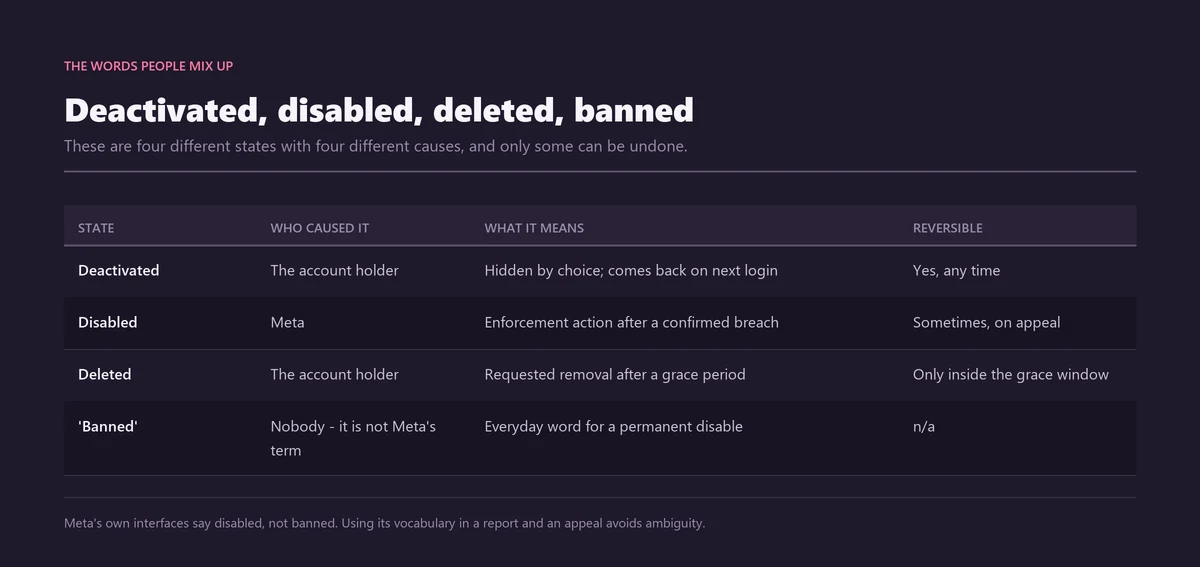
| Word | Who causes it | Profile visible? | Reversible? |
|---|---|---|---|
| Deactivated | The account owner | No | Yes — signing back in restores it |
| Disabled | Meta enforcement | No | Yes, through the appeal in Account Status |
| Permanently disabled | Meta enforcement, final | No | Only if Meta reverses its own decision |
| Deleted | Owner request, or the end of the enforcement sequence | No | No |
The order matters if you are the person reporting. An account that has vanished from search and from your followers list has been disabled, not deleted; the underlying data survives while an appeal is live. Only once every avenue closes does the record come off Meta's primary systems. A profile that reappears eight days later was never permanently disabled at all. It was disabled, appealed, and restored.
How many reports does it take to ban an Instagram account permanently?
None, by themselves. Meta states that the number of times something is reported does not determine whether it is removed. A reviewer, human or automated, holds the reported material against a written policy. Ten thousand complaints about a compliant profile produce ten thousand dismissals and nothing else.
That one sentence dismantles the entire paid-panel market. It also carries a corollary worth acting on: a single report can be enough, when the breach is serious and the proof is sitting right there in the post. The question was never how many people you can persuade to tap Report. It is whether the one report you file names the correct policy and carries evidence a reviewer can confirm in seconds.
Organised reporting carries its own hazard. Meta's Account Integrity policy treats coordinated false flagging as inauthentic behaviour, so a campaign run against a compliant account can end with the campaign actioned instead of the target. And if your aim is a whole profile rather than one item, the mechanics differ enough that we set them out separately in the guide to getting an Instagram account taken down.
Do Instagram strikes expire, and can a slow drip of reports add up?
They expire, so no. Meta counts strikes against an account and acts on the total, but confirms that all strikes on Facebook and Instagram expire after one year. An account collecting two or three a year never reaches a removal threshold, because the earliest ones fall off the clock before the latest ones land.
Run that arithmetic and the patient strategy collapses. Time is not on your side here. It is the mechanism working against you. What escalates an account is density rather than duration — several verified breaches close together, on policies Meta ranks as serious.
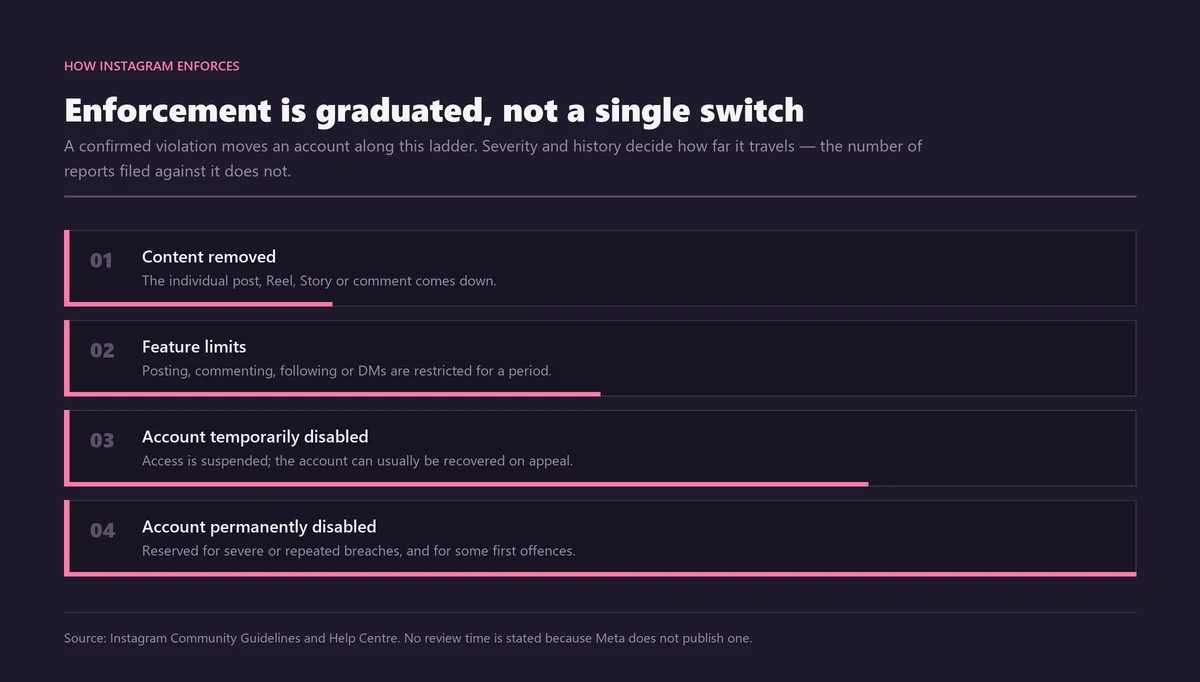
There is a second detail nearly every guide gets wrong. The published strike ladder belongs to Facebook. Meta's page on restricting accounts sets out a warning at one strike, feature limits from two to six, a one-day content restriction at seven, three days at eight, seven at nine and thirty days at ten or more — then notes that although strikes are counted on both platforms, those restrictions apply to Facebook accounts.
Instagram's own threshold is looser and vaguer. Meta's guidance on disabling accounts says that after five strikes an account may face further 30-day content restrictions, or Meta may remove the account, depending on the severity and frequency of the violations. So anyone quoting a seven-strike or ten-strike number at you for Instagram is reading the wrong column.
Severity and frequency decide whether a removal becomes permanent. Report volume decides nothing at all.
What gets an account permanently banned from Instagram instantly?
A single violation in the categories Meta treats as high severity. Child sexual exploitation is Meta's own stated example of a breach grave enough to disable an Instagram account on one occurrence. Dangerous individuals and organisations, convicted sex offenders, and accounts built to evade an earlier removal sit on the same track. Nothing has to accumulate.
Meta narrowed that shortlist in public. Its January 2025 announcement, More Speech, Fewer Mistakes, said proactive automated systems would be refocused on illegal and high-severity violations "like terrorism, child sexual exploitation, drugs, fraud and scams", with lower-severity policies waiting on a user report instead. That is, in practice, the working list of what still triggers fast and decisive action.
The Oversight Board gave outsiders their first real benchmark for permanence this year. Meta referred a case involving an Instagram account with more than 70,000 followers, disabled under the Account Integrity policy after posts that included visual threats against a named journalist. The Board upheld the permanent disable, agreeing the severity of the threats justified it.
Read that as a bar rather than a headline. Credible threats of violence against an identifiable person cleared it. Insults did not. Rudeness did not. If you are documenting stalking, impersonation used for extortion, or an organised fraud, you are working inside the categories where permanence is realistic, and your evidence should say so in the opening line rather than leaving a reviewer to infer it. The same standard governs every route in the guide to getting someone's Instagram deleted.
Why does it matter which enforcement track an account sits on?
Because it decides whether a human being ever reads your report. In its June 2026 statement on that first account-level case, the Oversight Board described Meta operating two different systems for disabling accounts — an ordinary, largely automated one and a separate escalated track — and treated the inconsistency between them as a systemic human rights concern.
The practical consequence is unglamorous. You cannot move a case from one track to the other by pushing harder, sending more messages, or filing the same complaint from six throwaway accounts. What moves it is the policy category the report is filed under, because assessed severity is what routes a case to escalated review in the first place.
So the useful work happens before you submit, not after. Decide which single policy the account most clearly breaches, then build the report to prove that one thing beyond argument. An account filed as "harassment" with fifteen screenshots of rude comments sits in a different queue from the same account filed as "threats of violence" with two dated posts naming a person.
How do you get an Instagram account banned fast, and what does fast actually mean?
Fast is a property of the queue your report lands in, not of how quickly you press send. Severe-harm categories are triaged as urgent; a bullying complaint against an established account is not. Meta publishes no review time for reports, so any 24-hour or 48-hour promise you have read was invented by whoever was selling it.
- Screenshot before you report, with the date, the handle and the post URL visible. Offenders delete the evidence the moment a report lands, and a review of content that no longer exists usually closes with no action taken.
- Name the policy, not the feeling. "Scam or fraud", attached to a payment screenshot and a transfer receipt, beats "harassment" attached to the same post.
- Use the dedicated form wherever one exists: impersonation, copyright, and the under-13 report, which needs nothing more than a username and works while logged out. In-app reporting is the fallback, not the default.
- Report the pattern rather than one item. Four dated posts on the same policy read as frequency, and frequency is half of Meta's stated test.
- Escalate off-platform in parallel where the harm justifies it — police, a bank's fraud team, a domain registrar — because platform review is slow and those routes often are not.
- Track the case under Settings, then Help, then Support Requests, and keep the reference number for the follow-up.
None of that is a way to ban an Instagram account permanently on demand. It is a way to make Meta's decision hold once it goes your way, which is a smaller claim and a far more honest one. The same spine runs through the longer walk-through of getting someone banned on Instagram for a genuine violation.
Can you sue, or get a court order, to have an Instagram account taken down?
Not as a route to getting somebody banned. United States courts have repeatedly held that Meta may enforce its own rules as it sees fit, which is what protects the bans it hands out — and, by exactly the same logic, means no judge is going to order Meta to remove an account on your behalf.
April 2026 produced the clearest recent example. A federal judge in the Northern District of California dismissed Andrew and Tristan Tate's suit over Meta's termination of six Instagram accounts, holding the claims barred by Section 230, the First Amendment and Instagram's terms of use. Permanent terminations, put plainly, are contractually defensible.
The counterweight is money rather than principle. Meta agreed to pay $25 million to settle Donald Trump's lawsuit over the suspension of his Facebook and Instagram accounts following January 2021, without admitting liability. Settlements follow the politics of a case. They do not create a user right to reinstatement, and they certainly do not create a right to have somebody else removed.
Courts still matter, just at a different point in the process. A defamation judgment, a harassment injunction or a police reference number is evidence you can attach to a report, and it converts a contested allegation into a documented one. That is a materially different submission from a screenshot and an accusation.
Can someone just make a new account after being permanently banned?
Yes, and most do, often within days. Permanence attaches to an account record and the signals tied to it, not to the person holding the phone. Meta's Account Integrity policy covers accounts created or repurposed to evade a previous removal, including ones assessed to have common ownership.
Which makes the replacement reportable on its own terms — and this is where most people quietly give up. It should be the opposite. A report that names the connection does work no in-app tap can do on its own: it turns a fresh complaint into the continuation of a case Meta has already decided.
Say the dead handle out loud in the report. List the reused profile photograph, the copied bio text, the identical payment link, the same three hashtags, the followers who migrated across within a day. We have handled cloned-shop cases where the third filing was the one that held, purely because it stopped presenting the new profile as a new problem and started presenting it as evasion.
Why do permanent bans get reversed?
Because the account holder gets an appeal, and appeals work more often than the word "permanent" implies. Meta conceded in January 2025 that one to two out of every ten of its enforcement actions may have been mistakes. A thin report against a genuine violator is precisely the sort of decision an appeal overturns.
The odds moved again in 2026. Meta widened the role of automated systems in account enforcement and cut moderation staff; New York Times reporting published on 26 July 2026 set out the company's own claim of 13% fewer mistakes than human reviewers alongside 10% more violations caught. More of the first decision and more of the appeal are now machine-read, and machines reverse cleanly when a file is thin.
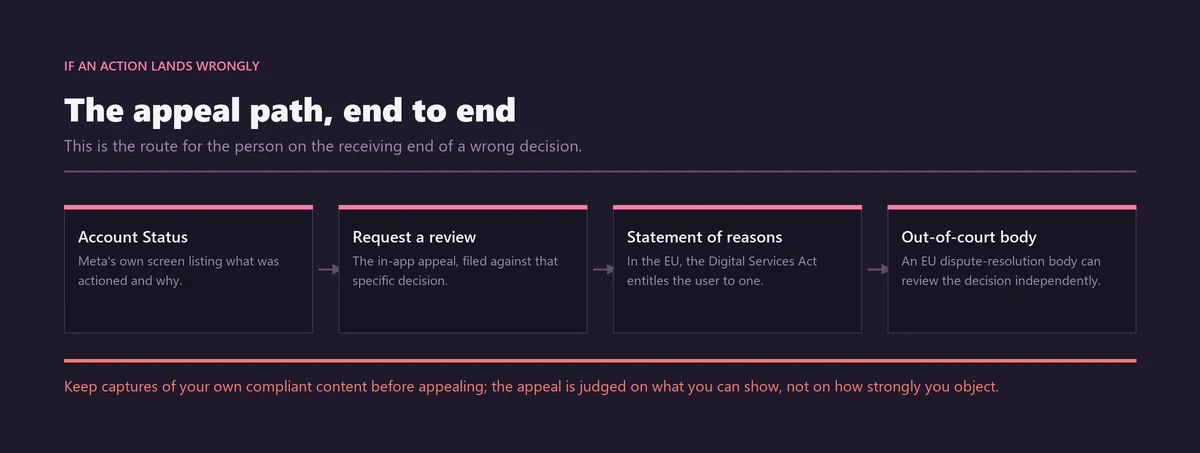
Inside the European Union there is a further layer. The Digital Services Act requires platforms to issue a statement of reasons for enforcement decisions, to run an internal complaint-handling system, and to let users take a dispute to a certified out-of-court settlement body. None of that is a lever you can pull against somebody else's account. It is a reminder that your evidence has to survive every stage, not merely the first one.
Is there a permanent-removal route that has nothing to do with rule-breaking?
There is one, and no page competing on this query mentions it. Meta's User Requests Community Standard commits it to removing an account when the account owner asks, and to removing the account of a medically incapacitated individual when an authorised representative supplies Proof of Authority together with medical documentation confirming incapacitation.
Read the limits carefully, because a lot of desperate searching is really looking for this. It is not a lever against a stranger. It exists for the owner, for a legally authorised representative, and for the narrow situation in which somebody can no longer manage their own account. Meta reviews each request and can reject it or ask for more.
It still matters here, for two reasons. If the account causing harm belongs to a family member who wants out, this is faster and cleaner than any enforcement report. And if somebody has told you that a third party can request removal of an account they neither own nor represent, the existence of this documented, tightly bounded route is the clearest evidence that they cannot. We set out who genuinely holds that power in the piece on deleting someone else's Instagram account.
How do I permanently delete my own Instagram account?
Through the dedicated deletion page, not the app's ordinary settings. Instagram's help centre routes deletion to a Delete Your Account page on the web, reachable through Accounts Center. The profile disappears at once and the information is permanently deleted after 30 days. Log back in inside that window and the request is cancelled.
Deactivation is the other option and a very different one. It hides the profile, keeps everything intact, and reverses the moment you sign in again. Deletion does not. Export a copy of your information before you confirm, because the export tool goes with the account.
One consequence catches people out. Instagram states that once an account is deleted you cannot sign up again with the same username, nor attach that username to another account. A handle does not return to the pool because its owner walked away, which is why claiming an Instagram username runs through three narrow official routes rather than through waiting.
When is a permanent ban not the goal worth chasing?
When the harm runs past what a platform can repair. A disabled account does not return money, does not stop somebody who knows your address, and does not delete material already copied elsewhere. Child sexual abuse material belongs with NCMEC's CyberTipline and the police first. A credible threat belongs with law enforcement the same day.
There is also the case where a restriction serves you better than a removal. A restricted account leaves the evidence in place and stays traceable. A deleted one takes its own posts with it, which matters a great deal if you are heading towards a defamation claim or a criminal complaint and have not yet preserved what was said.
So the committed version, if you want to ban an Instagram account permanently in the only sense the phrase can honestly carry. Pick the single most serious policy the account breaks. Gather three or four dated items proving that one policy. File through the dedicated form rather than the in-app menu. Report every replacement handle as evasion instead of as a fresh problem.
If you would rather hand the paperwork to people who assemble these files daily, send the profile link and your evidence through our contact page, or work through the rest of the Instagram reporting solutions and file it yourself. Either way the rule does not move: genuine Community Guidelines or legal violations only, filed through Instagram's official channels, and never a legitimate account.
Sources
- Meta Transparency CenterCounting strikes
- Meta Transparency CenterRestricting accounts
- Meta Transparency CenterDisabling accounts
- Meta Transparency CenterAccount Integrity Community Standard
- Meta Transparency CenterUser Requests Community Standard
- Meta NewsroomMore Speech, Fewer Mistakes (7 January 2025)
- Instagram Help CentrePermanently delete or deactivate your Instagram account
- The Star (New York Times reporting)What happened when Meta used AI to ban accounts on Facebook and Instagram
- NCMECCyberTipline
Frequently asked questions
Can an Instagram account be banned permanently?
Yes, but only Meta can do it. Meta permanently disables accounts for high-severity breaches such as child sexual exploitation, dangerous organisations, or repeated verified violations of the Community Guidelines. No third party, panel or bot has that power. What a reporter controls is the policy the report names and the evidence attached to it, which is what makes the decision hold.
What is the difference between disabled and permanently disabled on Instagram?
A disabled account has been actioned by Meta with an appeal still available through Account Status, so it can come back. Permanently disabled means the ordinary route back is closed and only Meta reversing its own decision restores it. Deleted is a third thing again: the data itself going, which happens at the end of the sequence.
Can one report get an Instagram account permanently banned?
For the severe categories, yes. Meta says a violation can be grave enough — child sexual exploitation is its own example — that a single occurrence disables the account. For ordinary rule-breaking the first report usually produces a warning or a content removal instead, and it is repetition on the same policy that escalates matters.
How long does a permanent Instagram ban take to become final?
There is no published timetable, and any service quoting one has invented it. Meta does not publish a review time or an appeal deadline for enforcement cases. A removal becomes final when the review avenues close without a successful appeal, which is why severe-harm cases resolve fastest and borderline harassment cases can drift for weeks.
Can a permanently disabled Instagram account be recovered?
Sometimes, which is the part most guides leave out. Meta admitted in January 2025 that one to two out of every ten enforcement actions may have been mistakes, and its appeal flow exists to reverse them. In the European Union the Digital Services Act adds a statement of reasons and an out-of-court dispute route. A well-documented report is far harder to overturn.
Can someone just make a new account after being permanently banned?
Yes, and most do within days. Permanence attaches to the account record rather than to the person. Meta's Account Integrity policy covers accounts created or repurposed to evade an earlier removal, including ones assessed to share common ownership, so the replacement is reportable in its own right. Name the old handle, the reused photos and any copied bio text.
Does Instagram tell someone who reported their account?
Standard in-app reports stay confidential, so the account never sees your name. Intellectual property claims are the exception: the copyright and trademark forms pass your contact details to the person you reported, because the other side has a right to answer the claim. The impersonation form asks for photo identification before it will proceed.
How do I permanently delete my own Instagram account?
Use the Delete Your Account page on the web, reached through Accounts Center rather than the app's ordinary settings. The profile hides immediately and the information is permanently deleted after 30 days; signing back in before then cancels the request. Export a copy of your information first, and note that the username cannot be reused afterwards.
Is paying an Instagram ban service worth it?
Only where the work is evidence handling rather than report volume. Anyone selling guaranteed bans, mass-reporting panels or a fixed turnaround is selling something Meta does not sell them. What a legitimate service adds is choosing the right official form, assembling proof that survives an appeal, and refiling when a replacement handle appears.