Claim Instagram Username: the three honest routes to a taken handle
Reviewed 8 August 2026 · 3,861 words · 17 min read
Instagram assigns handles first-come first-served and runs no claim button, so only three narrow routes exist — this page maps which one is open to you and what it costs.
Searches for claim Instagram username have three honest answers: register a handle that is genuinely free, file a trademark report against an account infringing your registered mark, or file an impersonation report against one posing as you. Instagram runs first-come first-served handles and publishes no general claim form.
If a fake profile or a mark-infringing account is sitting on the handle you need, send us the profile and we file through Instagram's official forms only.
- Instagram states that usernames are provided on a first-come, first-served basis and may not be reserved.
- The trademark report is the only official Instagram form that carries a request-the-username option.
- Using someone's trademark for goods or services unrelated to the registration is not a trademark policy violation, per Instagram.
- Meta publishes no review-time target for username trademark reports, so any 24- or 48-hour figure is unsourced.
- A successful report removes or renames the infringing account; it never transfers the handle to the reporter.
What does Instagram actually say about claiming a username?
Instagram answers this in one line of its Help Centre: handles are handed out in the order people register them, and they cannot be held in reserve. That is the entire policy. There is no waiting list, no reservation fee, no brand priority lane, and no page anywhere on the service where you type a handle and ask to be given it.
Most claim Instagram username searches begin from a false premise: that somewhere behind the app sits a queue, a request form, or a reviewer who releases dormant names to whoever wants them most. No such mechanism exists. A handle belongs to the account that registered it, and it stays there until that account is deleted by its owner or removed by Instagram for breaking a rule. Nothing else detaches a name from a profile.
The rule cuts both ways, which is the part worth holding on to. First-come first-served handles mean nobody can outbid you, out-lawyer you or pull rank on a name you took first. A company founded next year does not get to seize a handle you have used honestly since 2016 because it now has the larger budget. The same rule that frustrates you today is the one protecting your own handle.
Which of the three routes is open to you?
One of three, and which one depends entirely on who holds the name and why. Route one is plain registration, open to anyone when the handle is genuinely free. Route two is the trademark report, open only to the owner of a registered mark being infringed. Route three is the impersonation report, open only to the person or business being impersonated.
Outside those three there is no mechanism at all. Wanting a handle badly is not a route. Having a bigger following is not a route. Being first to ask is not a route, because there is nobody to ask. That vacuum is exactly where the paid market lives, and it is why the table below is worth more than any vendor's sales page.
| Route | Who qualifies | Cost | What it actually produces |
|---|---|---|---|
| Register a free handle or variant | Anyone, when the name is unregistered | Free, instant | The handle, immediately and for as long as you keep the account |
| Trademark report | The owner of a registered mark, or an authorised representative | Free to file | Removal or forced rename of the infringing account — never a direct transfer to you |
| Impersonation report | The person or business being impersonated | Free to file | Removal of the fake profile; the handle may then return to open registration |
| Ask the current holder to release it | Anyone, if the holder agrees | Free; paying for it breaches the Terms of Use | Nothing enforceable — goodwill only |
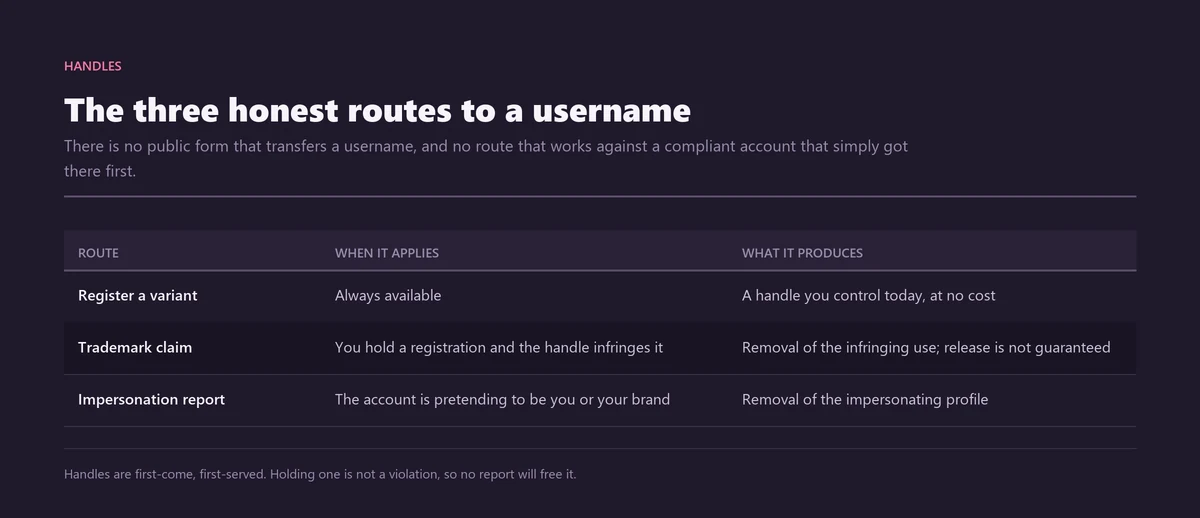
Every claim Instagram username route in that table is free to file. Hold that against any quote you are given, because the fee a vendor charges buys drafting and chasing, not access. If the harm you are dealing with is broader than a handle dispute, the guide to Instagram account takedown and picking the form that fits the harm maps the other official routes.
Can you claim an inactive Instagram username?
Almost never, because Instagram does not release dormant handles on request and its Help Centre says plainly that there is no way to take an inactive username. A profile that last posted in 2013 still owns its name. Existing is enough. There is no dormancy clock, no abandonment threshold, and nothing to file.
This is the single biggest gap between what people expect and what the platform does. An account can be private, unused, follower-less and last active a decade ago, and the handle is still fully held. Occasional logins do not matter either way. To Instagram's systems, "looks abandoned" and "is available" are unrelated states, and only the second one matters (Instagram Help Centre, inactive usernames).
So there is no claim Instagram username queue to join, and the honest answer to how you claim an inactive Instagram username is that you watch, or you move on. A dormant name only opens by accident: the owner deletes the account themselves, or Instagram removes it for a rule breach that had nothing to do with you. Neither is something you can trigger, and neither is something a paid service can trigger on your behalf.
One more honest gap: Meta publishes no timetable for whether or when a deleted account's handle returns to the pool. If you read a specific number of days somewhere, that figure has no primary source behind it. Watch the signup field yourself rather than trusting a countdown someone invented.
How do you claim a username that is already taken on Instagram?
If the current holder has broken no rule, you cannot take it — you work around it. To claim a username that is already taken on Instagram when the holder is legitimate, the realistic options are a close variant, a courteous request to the owner, or patience. Reporting a compliant account is not a fourth option. It fails, and it leaves a trail.
Reaching a real owner is easier than people assume. Many link a website, a business email, a Facebook page or a LinkedIn profile in their bio, and a short, specific message to a real inbox performs far better than a direct message into a stranger's requests folder. Say who you are, say which handle you mean, and make it easy to say no.
Something like: "I run a small bakery in Leeds and we would love the handle you registered in 2015 and have not posted from. Would you consider releasing it? Happy to help you move everything to a variant first." Keep it that short. Accept a refusal the first time it is given, and never follow it with an offer of money.
The reason to avoid money is not squeamishness. Instagram's Terms of Use say you may not buy, sell, license or transfer any part of your account, including your username (Instagram Terms of Use). A paid handle deal is a policy breach even when both sides are delighted with it, and the account that ends up holding the name carries that risk indefinitely.
How do you check if a username is free, and pick a variant worth owning?
Type it into the signup or username-edit field. If the field accepts it, the handle is free; if it errors, it is held by somebody. Searching for the name proves nothing, because deactivated, restricted and mid-deletion accounts all keep their handles while being invisible in search results.
When the exact name is gone, the fastest win is a variant that still reads as unmistakably yours. The patterns that survive contact with a real audience are short, pronounceable and consistent across platforms:
- A single dot or underscore: brand.name, brand_name.
- An ownership tag: brandofficial, brandhq, thebrand.
- A product or action prefix: getbrand, shopbrand, brandapp.
- A place tag, when you are genuinely local: brand.leeds, brandnyc.
Pick the shortest one that is obvious the moment somebody reads your bio, then register the identical string on every other platform the same afternoon. A handle you control everywhere beats a handle you are still waiting for, and it beats spending a year and a five-figure fee chasing one the platform was never going to move.
How do you claim an Instagram username with a trademark?
Through Instagram's trademark report, which is the only official form carrying a request-the-username option. To claim an Instagram username with a trademark you need a registration Meta recognises, an account using that mark as its handle, and a use that is likely to confuse people about who runs the profile. Only the rights holder or an authorised representative may file.
The form is free and takes minutes to complete, but it is not a complaint box — it is a legal declaration, submitted under your name, about rights you say you own. Assemble everything before you open it, because a half-filled report is the most common reason a genuine claim goes nowhere.
- Confirm the registration is live and in your name, or that you are formally authorised to act for the owner.
- Note the registration number, the issuing office or jurisdiction, and the classes of goods or services it covers.
- Copy the full URL of the infringing profile, plus the URLs of any specific posts that show the confusion.
- Capture dated screenshots of the profile and of your own use of the mark in commerce — a shop page, packaging, invoices, a live website.
- Open the Instagram trademark report form, choose the username option, and tick the box asking to claim the username.
- Submit once. Then watch the handle in the signup field, because if it frees, it frees quietly.
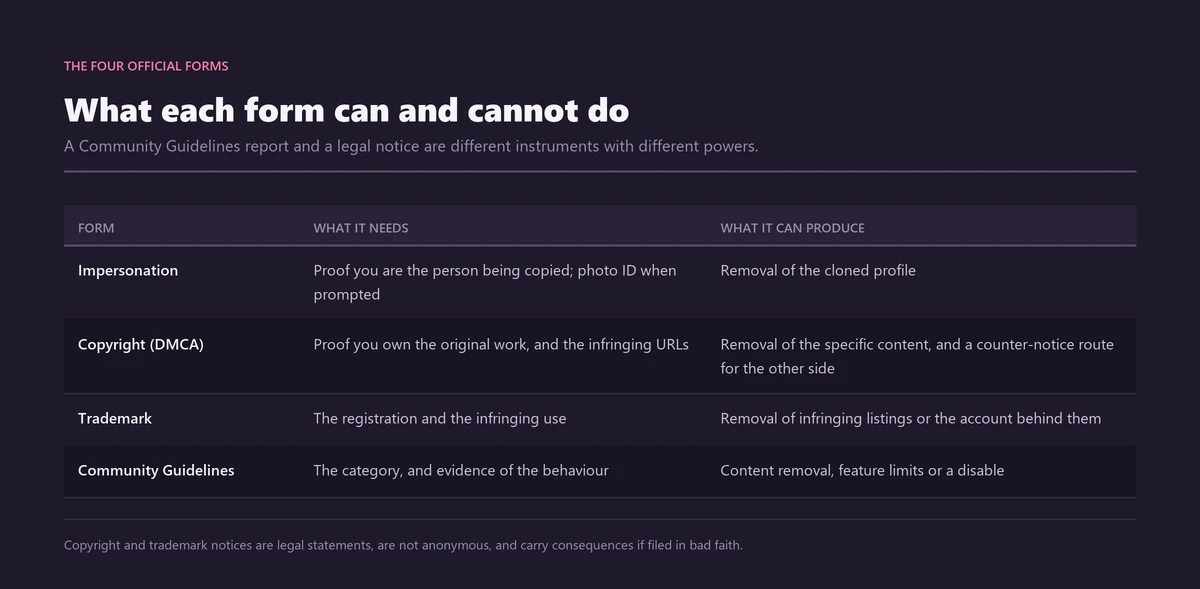
Ticking that box is a request, not an entitlement. Instagram evaluates the infringement first and the username request second, and a great many valid reports end with the account actioned and the handle untouched. Saying so plainly is the difference between preparing you and selling you a fantasy (Instagram Help Centre, accounts using a registered trademark as a username).
When does a real registered trademark still lose?
More often than brand owners expect. Instagram states that using someone else's trademark in a way that has nothing to do with the product or service the mark was granted for is not a violation of its trademark policy. A registration is a key to one specific door, not a master key to every account carrying the word.
That carve-out is the reason a strong mark can lose to a weak-looking account. If you registered the word for accounting software and the handle belongs to a dog groomer, there is no confusion for the policy to remedy. The same applies to commentary, fan and parody accounts that never pretend to be you, and to accounts using a dictionary word in its ordinary sense.
| Situation | Does the trademark route apply? |
|---|---|
| Handle uses your mark and sells competing or counterfeit goods in your registered class | Yes — this is the case the form was built for |
| Handle uses the same word for goods or services unrelated to your registration | No — Instagram's stated carve-out covers it |
| You hold unregistered common-law rights only | Weak — the form asks for a registration number |
| Handle is a common dictionary word and your registration is narrow | Usually no |
| Fan, commentary or clearly labelled parody account | No — and filing anyway damages your position |
| Handle is your personal name and nobody is impersonating you | No — a name is not a mark |
This is not a niche reading. Attorney answers on Justia's Ask A Lawyer threads about Instagram handles have said the same thing repeatedly through 2025 and 2026: holding a registered mark does not entitle you to a particular handle, and inactivity alone will never force a transfer. Those threads are evidence of how common the question is, not legal advice — take your own.
What happens to the handle if the claim succeeds, and how long does it take?
Meta typically disables the infringing account or requires it to change its name. It does not lift the handle out of one account and drop it into yours. There is no transfer step in the process, which means a successful report clears an obstacle rather than delivering a prize.
Once the blocking account is gone or renamed, the handle behaves like any other unregistered name: first come, first served, to anyone typing it into the signup field at that moment. Nobody notifies you. Nobody holds it for the reporter. If you have spent months on a claim and then check back a week later, you may find a stranger sitting on it.
On timing, be sceptical of every number anyone shows you. Meta publishes no review-time target for username trademark reports, and the twenty-four and forty-eight hour figures that circulate on vendor sites have no primary source. Plan in weeks, keep your evidence pack current, and treat any promised turnaround as a sales device.
When does an impersonation report free up the name?
Only when the account holding your handle is genuinely pretending to be you or your business — not merely using a name you also use. The impersonation report is the route for victims, it is free, and Instagram asks for photo identification to confirm you are who you say you are before it will act.
The distinction matters more than any other on this page. A fan account with your name in the handle is not impersonation. A profile using your photographs, your biography and your name to solicit money from your followers is. The first will be cleared on review and the report will count against you; the second is exactly what the form exists to remove.
File it yourself through the Instagram impersonation report form, or have someone document it for you. Speed matters here in a way it does not for trademark disputes, because impersonation is usually the front end of a fraud. The FTC's 2026 data spotlight records that reported losses to scams starting on social media are around eight times their 2020 level (FTC Data Spotlight, April 2026).
If the harm is broader than one profile — a stolen photo set, a defamatory Story, a coordinated pile-on — start with the guide to getting an Instagram post, photo or Story taken down, and read how violation, evidence and the right route fit together before you file anything. An impersonation report is not a claim Instagram username shortcut; it is a victim's remedy that occasionally has a side effect, and the harm is the justification, never the handle.
Does Instagram sweep inactive usernames in March and September?
There is no evidence that it does. Handle-broker blogs state that Instagram runs recycling sweeps roughly twice a year, usually naming March and September, and that Meta retired a public inactive-username request form in 2019. Neither claim has a Meta source behind it. Both should be read as community folklore repeated until it sounded official.
The pattern is easy to spot once you know it. A dated sweep gives a broker something to sell you a place in the queue for, and a retired form explains why you cannot find the queue yourself. Two unverifiable claims that happen to support the same sales pitch deserve more scepticism than they usually get.
The 2026 cleanup coverage has been folded into the same story. Press reporting in May and June 2026 described Instagram removing large volumes of fake, inactive and spam accounts, and stripping fake followers from prominent profiles. Meta has published no official total for that operation, and there is no evidence that any of the removed handles were made claimable. The idea that a purge frees up names is an inference, not a documented outcome.
What are the risks of buying a handle from a broker?
Three, and they compound. The handle may be stolen property, the purchase itself breaches Instagram's Terms of Use, and you have no title to anything afterwards. Short, memorable handles are the most trafficked category on the platform precisely because they are the ones worth stealing.
Provenance is the risk nobody selling a handle will discuss. Desirable one-word usernames have long circulated through OGUsers-style forums, and the routine acquisition methods are SIM-swap attacks and credential theft against the original owner. Deccan Herald reported, in coverage that now predates 2025, that Instagram banned accounts found to be holding stolen single-word usernames. If the platform later traces the chain, the account holding the name is the one that loses.
Then there is the paperwork problem. Because the Terms of Use forbid transferring any part of an account, there is no contract, no escrow that means anything, and no dispute process. You are paying a stranger for a promise the platform explicitly does not recognise. If the seller reclaims the account through password recovery a month later, you have no route back.
Why do mass reports and "handle release" panels never deliver a handle?
Because Instagram weighs the violation, not the number of complaints, and no external panel sits above first-come ownership. A hundred reports against a compliant account produce the same outcome as one: nothing, plus a coordination signal on the accounts that filed them.
Coordinated reporting is something the platform actively looks for. Batches of identical complaints arriving from throwaway accounts in a short window are the easiest abuse pattern to detect, and detection means the reports are discounted rather than escalated. The mechanics are set out in full in the analysis of whether mass reporting an Instagram account changes anything.
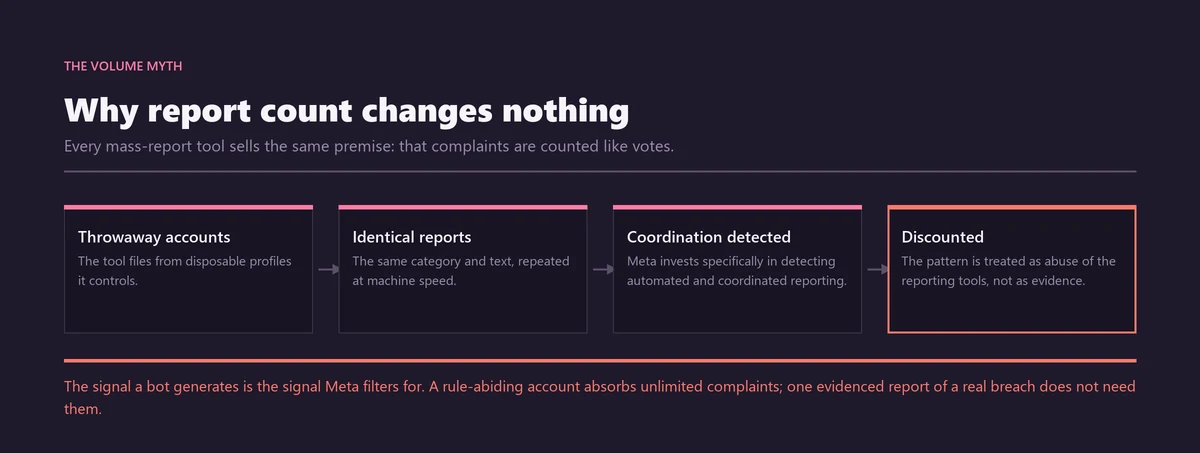
The "handle release" panels sold alongside the bots are a separate fiction. No third party holds a switch that frees a username, because no such switch exists inside Instagram either. The review of which Instagram reporter tools are real and what actually removes an account works through what these products do and do not touch. One well-documented report against a genuine breach outperforms every panel on the market, because it is the only input the review process was built to read.
Is an "Instagram username claim service" real, or a scam?
Mostly a scam, with one narrow honest exception. Search instagram username claim service and you will meet vendors promising to release any handle for a fee. They cannot, because Instagram decides and Instagram sells nothing. The honest version of the work is documentation: building an evidence pack for a real breach and filing it through the official forms.
That is the only thing we do, and it is worth being precise about the limit. We act when a registered mark is being infringed, when the Community Guidelines are genuinely being broken, or when a person is being impersonated — and only through Instagram's own official forms. We do not act against an account that simply registered a name first, because the review clears them, the attempt is recorded, and the person who filed it is worse off than when they started. If you are weighing a paid provider generally, the breakdown of what an Instagram ban service is really selling, and what it costs applies here without modification.
What do paid username claim services charge and promise?
Knowing the pitch is most of the defence. Every claim Instagram username package sold online runs the same template: a percentage success rate, a "Meta Media Partner" badge or similar, a "no password needed" placeholder-account model so the transaction feels safe, and four figures for a branded handle rising into five for a single dictionary word. Those price bands come from vendors' own marketing pages. No independent data supports any of them.
Apply one question to any provider: do you guarantee this specific handle for this fixed price? A yes means they are selling a decision that belongs to Meta. If you hold a genuine claim, send us the profile and the registration details and we will tell you which route fits — including, often, that no route does. If you do not hold one, no fee will invent it.
What can you do when you have no trademark and nobody is impersonating you?
You have four legitimate moves left, and none of them involves a form. Ask the holder without offering money. Build a variant you own everywhere. Monitor the signup field yourself. Or decide the name is not worth the year you would spend on it — which, for most people reading this, is the correct answer.
A negotiated release is the only path to the exact handle, and it fails far more often than it works. Even when it succeeds, insist the current holder changes their own username so the name simply becomes free, rather than handing you logins. Taking over someone's account to inherit their handle imports their entire history, including any strikes on it.
Two special cases come up constantly. Memorialised accounts keep their usernames indefinitely and are not released to anyone; verified immediate family can request removal of a deceased person's account through Meta's own process, but that is a bereavement right, not a handle strategy, and Meta does not publish what happens to the name afterwards. Banned accounts are the same story from the other direction — the handle stays locked to the removed profile unless and until it quietly is not.
A handle you can register this afternoon is worth more than the one you might be given in a year.
If you do have a real claim — a live registration being infringed, or a profile posing as you to your own followers — that is a documentation job with a defined route, and the rest of the Instagram reporting and takedown guides cover the adjacent cases. If you do not, the guardrail is not a formality: reporting a compliant account for holding a name you want is the one move on this page that can leave you worse off than doing nothing.
Sources
- Instagram Help CentreAn account is using my registered trademark as its username
- Instagram Help CentreReporting intellectual property infringement on Instagram
- InstagramTrademark report form
- InstagramReport an account impersonating you
- Instagram Help CentreInactive usernames on Instagram
Frequently asked questions
Does Instagram have a username claim form?
There is no general claim form. The only official route with a request-the-username option is the trademark report, which just the rights holder or an authorised representative may file. Everyone else registers a free variant or, if they are being impersonated, files an impersonation report. No public button transfers a name to whoever asks first.
Can I claim an inactive Instagram username?
Not on request. Instagram's Help Centre states there is no way to take an inactive username, and there is no dormancy clock, abandonment threshold or waiting list behind the app. A profile that has not posted in a decade still owns its handle. The name only opens if the owner deletes the account or Instagram removes it.
How do I get an Instagram username that is already taken?
If the holder has broken no rule, you cannot take it. Register a close variant, or message the owner through the website or business email in their bio and ask them to release it. Never offer money: Instagram's Terms of Use forbid buying, selling or transferring any part of an account, including the username.
Can I claim an Instagram username with a trademark?
Only if you own a registered mark and an account is using it as a handle in a way likely to confuse people about who runs the profile. Instagram's trademark report carries a box asking to claim the username. Using the same word for goods or services unrelated to your registration is not a policy violation.
How long does an Instagram trademark username claim take?
Nobody outside Meta knows, because Meta publishes no review-time target for these reports. The twenty-four and forty-eight hour figures repeated on vendor pages have no primary source. Plan in weeks rather than days, keep your evidence current, and treat any guaranteed turnaround as a sales tactic rather than a schedule.
Is it legal to buy or sell an Instagram username?
Whatever your local law says, it breaches Instagram's Terms of Use, which prohibit buying, selling, licensing or transferring any aspect of an account. There is no contract the platform recognises and no dispute route if the seller reclaims the account. Desirable short handles are also the ones most often stolen through SIM-swap and credential attacks.
What happens to a username when an account is deleted?
Meta publishes no timetable for whether or when a deleted account's handle returns to the pool, so any specific number of days you read elsewhere is unsourced. If a name does become free, it is free to whoever types it into the signup field first. Nobody is notified, and nothing is reserved for a previous reporter.
Can I get the username of a banned or memorialised account?
No. Memorialised accounts keep their usernames indefinitely and are not released to anyone. Verified immediate family can ask Meta to remove a deceased person's account, but that is a bereavement process, not a handle strategy, and Meta does not publish what happens to the name afterwards. Banned accounts keep their handles locked in the same way.
Can an Instagram username claim service guarantee a handle?
No, and the guarantee is the warning sign. Instagram alone decides, so a fixed price for a specific handle sells a decision the vendor does not control. An honest provider documents a genuine trademark infringement or impersonation and files it through the official forms, and says so when no route exists. None of them needs your password.