Mass report Instagram account: does volume actually get anyone banned?
Reviewed 8 August 2026 · 4,308 words · 18 min read
Instagram counts confirmed violations, not arriving reports — so here is what volume really does, what removes an account, and where to appeal when a report is refused.
You cannot mass report Instagram account profiles into a ban. Instagram says the number of reports does not decide removal; a confirmed Community Guidelines breach does. Duplicate flags collapse into one review, and coordinated bursts get discounted. One accurate, well-evidenced report beats a thousand identical ones.
If the profile you want removed genuinely breaks Instagram's rules or the law, send us the handle and evidence; we file through official channels and never touch a compliant account.
- Instagram states the number of times something is reported does not determine whether it is removed.
- Duplicate reports about one profile are grouped into a single assessment against the Community Guidelines.
- Meta publishes no review-time commitment, so no vendor can honestly promise a 24-to-72-hour outcome.
- Appeals Centre Europe overturned 63% of platform decisions to leave reported content up, across more than 2,100 disputes.
- Meta assesses roughly 4% of its three-billion-plus monthly users as fake accounts.
Can you mass report an Instagram account into a ban?
No. Instagram states plainly that the number of times something is reported does not determine whether it comes down; only a confirmed Community Guidelines breach does. Asked directly — does report volume ban an account — the answer is no. Volume measures effort. Reviewers are looking for evidence.
Two situations make the point. A thousand flags land on a profile that breaks no rule, and a reviewer finds nothing wrong a thousand times over. One flag lands on a profile selling stolen card details, and that single report is enough. The count never entered either decision. What mattered was whether a specific rule was broken, and whether the report made that breach easy for a stranger to see in under a minute.
This is why people who mass report Instagram account profiles for weeks often get nowhere, while someone who files once — dated screenshots attached, correct category chosen — gets an answer in days. The labour that pays is documentation. Everything else is effort wearing the costume of progress.
What does Instagram do with all those duplicate reports?
It collapses them into a single review. A report is not a vote dropped in a ballot box; it is a request to check one item against one rule. Fifty flags on the same profile produce one assessment, because the question "does this break a guideline?" returns the same answer however many times it is asked.
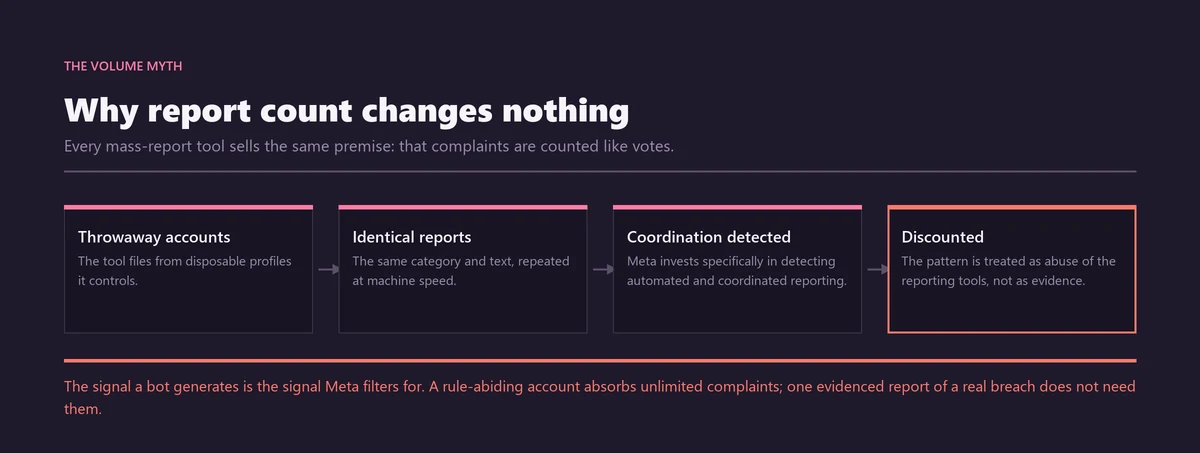
There is a second effect, and it runs backwards. Meta has told AlgorithmWatch that it invests heavily in technology built to spot accounts engaged in coordinated or automated reporting. Identical wording, identical categories, submissions seconds apart from profiles with no posting history: that is a machine signature, and it is cheap to detect.
So the stack does not add weight. It adds a second question — who sent all this, and why does it look scripted? — and that question is now about you rather than about the profile you reported. A discounted batch is not a neutral outcome. It is a worse one than filing nothing at all.
Is one person filing many reports the same as many people filing one?
No, and the difference decides the outcome. Independent reports from people genuinely affected, written in their own words, filed on the right form, are ordinary signal. One person or one panel firing repeated identical submissions is coordinated false reporting, and that pattern is exactly what abuse detection exists to strip out before review.
Picture a cloned business profile taking deposits from customers. Nine of those customers each report the scam they personally experienced, using different words, some through the in-app flow and some through the impersonation form. That is nine separate accounts of a real harm. Nothing about it is coordinated in the sense Meta polices, and nothing about it should be discounted.
Now picture the same nine reports sent from nine accounts registered the same afternoon, with the same sentence pasted into each. The content of the complaint is identical. The credibility is not. One is a body of evidence; the other is one voice wearing nine masks, and platforms have spent a decade learning to tell them apart.
How does Instagram actually decide an account comes down?
By the severity and repetition of confirmed breaches, climbed like a ladder rather than counted like a tally. A first upheld report normally removes the offending post. Continued violations bring feature limits, then suspension, then a disabled account. Severe categories skip the rungs and can end a profile immediately.
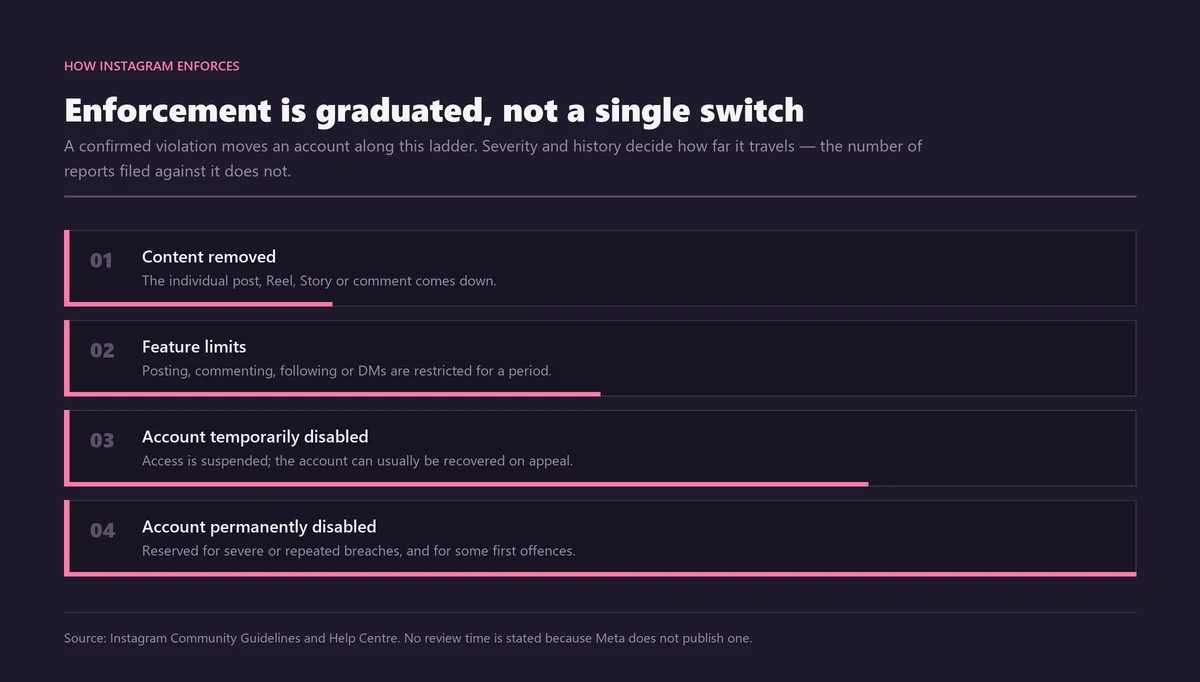
Underneath sits the Instagram strike system, operated at Meta level. Where someone keeps posting violating content despite warnings and restrictions, Meta disables the account, with removal triggered once strikes accumulate inside a set window (Meta Transparency Center). Child safety and credible threats do not wait for a pattern.
People often ask about an Instagram account trust score, imagining a hidden number that enough reports could drag downward. No such score is published and no outsider can read one. What Meta does describe is history: a record of prior confirmed violations changes what the next confirmed violation costs. A years-old account with a clean record and a burner registered on Tuesday are not treated as equals.
A clean posting history protects a profile far better than any wording you can put in a report form.
It also helps to know what the possible outcomes even are, because "banned" is a folk term rather than a product state. If you want the precise difference between a post being pulled, a profile being restricted and an account being permanently removed, our breakdown of what disable, delete and ban actually mean on Instagram sets each one against the action that causes it.
| What the panels imply | What the mechanics are |
|---|---|
| Enough reports force a decision | Duplicates are grouped into one assessment; the count carries no weight of its own |
| There is a threshold number to reach | No threshold is published or implied; one confirmed breach can be decisive, zero confirmed breaches never are |
| Reports from a panel reach a reviewer | Submissions from disposable accounts are filtered as coordinated activity before review |
| Reporting costs the sender nothing | Coordinated false reporting is itself a violation and can be actioned against the reporters |
| Speed can be bought | Meta publishes no review-time commitment, so nobody outside Meta can sell one |
Which report reason gets Instagram to act on it?
The one that matches the actual rule being broken. Category is not a formality; it decides which policy the content is measured against and which queue the report joins. A precise category on weak evidence still fails, but the right evidence filed under the wrong category fails just as reliably, and far more frustratingly.
Impersonation is the most clear-cut, because a reviewer can hold the fake beside the real account and see the copy. Harassment is slower, since the interaction history between two accounts has to be read before anyone can judge intent. Scam and fraud reports trigger checks for financial-abuse patterns and can restrict a target's messaging and advertising rather than just removing one post.
The generic options are where reports go to die. "Spam" and "I just don't like it" are the widest buckets on the menu, and the widest bucket gets the loosest look. If the profile is a bot farm or an engagement scam, our guide to how spam accounts really come down on Instagram explains which specific policy to file under instead of reaching for the spam catch-all.
- Impersonation of you, your business or a public figure — the dedicated form, with ID
- Payment or investment scam — scam or fraud, with the payment trail captured
- Threats, stalking or sustained abuse — bullying and harassment, with the message history
- Counterfeit goods or stolen photographs — the intellectual property routes, not the report button
- Fake giveaway run by a trading account — see which channel to use for an Instagram giveaway or business, because the commercial routes differ from the personal ones
Report a specific post vs whole account: which one actually lands?
Start with the specific item. A report on one post, Reel, Story or comment gives a reviewer a single object to hold against a single rule, which is a decision that can be made in seconds. A whole-account report asks someone to form a judgement about a person in the abstract.
Where a profile breaks rules repeatedly, report each violating item separately so a documented pattern builds. Then report the account itself, once, if the breach is genuinely profile-level: an impersonating bio, a scam link in the handle, a display name copying a real business. Pick the clearest violation as your anchor rather than spreading the report across borderline posts that invite a "no action" outcome.
Stories complicate this, because they expire and take the evidence with them. If the violation is in a Story, a Reel or a direct message, the capture has to happen before the clock runs out — the mechanics for each surface are set out in our walkthrough of how to report an Instagram story, post, profile or DM.
How long does Instagram take to review a reported account?
Nobody outside Meta knows, because Meta publishes no review-time commitment. It publishes prevalence, proactive detection rates, appeal volumes and how much content it restored — but no service-level promise on how fast a report is read. Any page quoting you a fixed window has invented it.
What can be said honestly is that the review picture changed in 2025. Meta's "More Speech, Fewer Mistakes" announcement of 7 January 2025 narrowed automated scanning to illegal and high-severity categories: terrorism, child sexual exploitation, drugs, fraud and scams. Everything else now leans harder on user reports, which is precisely why filing accurately matters more than it did.
Meta subsequently said it had cut enforcement mistakes in the US by roughly half, having estimated that one or two of every ten enforcement actions in December 2024 may have been errors, while reporting small rises in bullying and violent-content prevalence on Facebook as the trade-off (Meta Community Standards Enforcement Report).
On accuracy rather than speed, Meta's Q3 2025 integrity data, summarised by Social Media Today on 11 December 2025, put enforcement precision above 87% on Instagram, with under 1% of content removed globally for policy breaches and under 0.1% removed in error. Meta also reports its enforcement figures on a semiannual cadence now, starting with the H1 2026 integrity report, aligned with the EU Digital Services Act.
Which mass-report statistics should you refuse to believe?
The specific ones. Several pages selling a mass report Instagram account service quote a "92% enforcement success within 24 to 72 hours", a "median enforcement time of 24 to 72 hours after Meta's Q1 2026 moderation upgrade", and a tally of "47 client cases from January to June 2026". None of the three traces to Meta, a regulator, or any named study.
They circulate only among each other. Search the exact phrase and you find the same sentence on four sites, each presenting it as established fact, none citing an origin. There is no Meta moderation upgrade published for Q1 2026 that carries those numbers, and there is no dataset in the Transparency Center from which a 92% figure could be derived.
The test takes thirty seconds and works on any claim, including ours. Ask three questions: who published it, on what date, and using what method? If the answer is "a service page said so", the number is decoration. Meta's own Transparency Center reports are free to read, and anything genuinely drawn from them can be checked there in a couple of clicks.
Is a GitHub or Telegram Instagram mass report bot worth the risk?
No. Every GitHub or Telegram Instagram mass report bot fails at the same two points: the reports come from disposable accounts that get filtered before review, and the tool usually wants a login it has no business holding. The second failure costs far more than the first.
The filtering problem is structural. Meta assesses roughly 4% of its three-billion-plus monthly users as fake and blocks millions of account-creation attempts daily, frequently within minutes of sign-up (Meta Transparency Center). A report fired from an account inside that population is discarded long before a human sees it.
The credential problem is worse, and it is documented. AlgorithmWatch traced criminal groups running simple mass-reporting scripts to fire hundreds of false reports at a target — sometimes under fabricated self-harm categories to force a fast suspension — then reclaiming the locked profile through the photo-ID recovery route and reselling it. One tool its investigators examined listed around 400 targets across 40 countries.
If you are weighing up a specific panel or script, the anatomy of these products is set out in more detail in our teardown of the Instagram mass report bot and what it really does with your login, and the wider market of paid dashboards is covered in our review of which Instagram reporter tools are real and what actually removes an account.
Should you pay for an Instagram mass report service?
Only if what you are buying is documentation, not volume. An Instagram mass report service that sells report counts is selling something with no established effect. A service that reads the profile, identifies the exact guideline broken, assembles the evidence and files it correctly is selling labour that genuinely changes the odds.
The difference shows up in what the seller promises. Anyone guaranteeing removal is either bluffing or quietly picking cases that were already heading that way. The decision belongs to Meta's reviewers, and no vendor can override it, so a guarantee is a claim about someone else's judgement dressed up as a product feature.
The questions worth asking before paying anyone are unglamorous. Which specific guideline do you say this breaks? What evidence will you file, and can I see it? Which official route are you using? What happens if the report is rejected — do you appeal, and how? A vendor who cannot answer those is selling a mass report Instagram account package, whatever the landing page calls it.
Our own position is the same one we would give a friend: if the profile does not break a rule, we will tell you so and take nothing, and if it does, the work is evidence and routing rather than volume. You can describe the profile to us and get a straight answer about whether it is worth filing at all.
What can you do when Instagram takes no action on your report?
Appeal it rather than repeat it. This is the step almost nobody documents, and it is the one that works. A report marked "no action taken" is a decision, and decisions can be reviewed — first inside Instagram, then, for users in the EU, outside it entirely through a certified dispute settlement body.
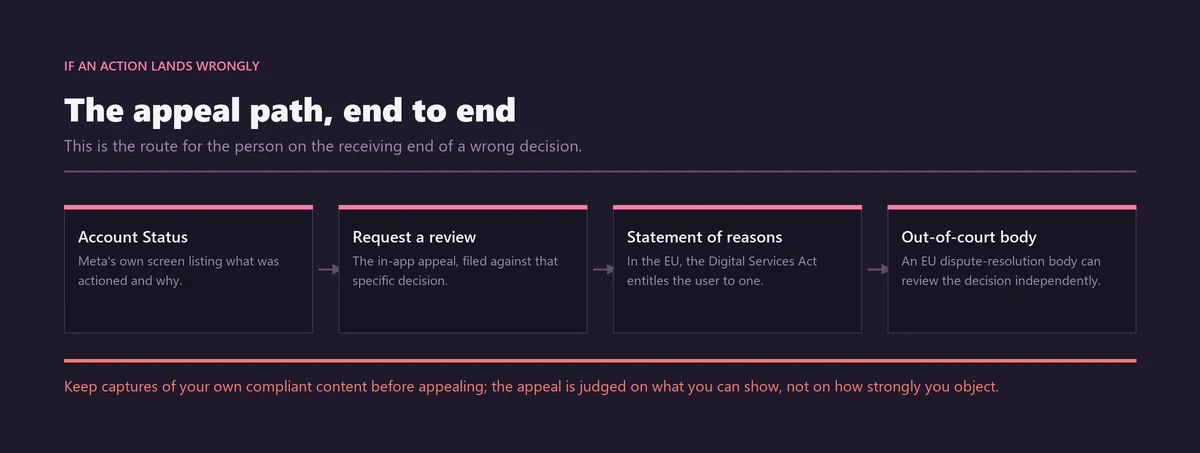
- Open your Support Requests in the app: Settings, then Help, then Support Requests. Each report you filed shows a state — in review, action taken, or no action taken.
- Where the outcome was "no action taken", use the request-a-review option on that decision. Reporters can ask for a second look, not only the account that was reported.
- Keep the notification or reference. In the EU this decision comes with a statement of reasons under the Digital Services Act, and it is what an external reviewer will want to see.
- If the second review still refuses, and you are in the EU, take the decision to a certified out-of-court dispute settlement body under Article 21 of the Digital Services Act.
- File a fresh report only if you have genuinely new evidence — a new violating post, a new payment, a new victim. Refiling the same complaint achieves nothing and looks like brigading.
That last figure is the whole argument of this page in one number. Appealing a refusal is measurably more productive than filing again, and it is free. Its decisions are not legally binding on the platform, and its own data shows platforms often fail to supply the relevant content for review — but a 63% overturn rate on leave-up decisions is a better prospect than any report stack has ever produced.
Can mass reporting someone backfire onto your own account?
Yes, and it is the risk the panels never print. Meta classifies coordinated, bad-faith reporting as inauthentic behaviour and acts against the accounts driving it. The reporting system is a policy surface like any other, and misusing it is a violation with its own consequences.
Organising a group to mass report Instagram account profiles you simply dislike can therefore mark you as the abuser, with a feature limit, a strike, or a disabled profile at the end of it (Meta's Inauthentic Behavior policy). The asymmetry is uncomfortable: in a false-report campaign, the account most likely to be lost is the one that started it.
There is also the practical cost. Every dismissed report you file is a data point about the reliability of your reporting, and the one time you need a report taken seriously — a genuine clone, a genuine threat — you would rather not arrive with a history of rejected complaints behind you.
Is mass reporting an Instagram account illegal?
Filing accurate reports about genuine violations is lawful, however many people do it. Organising a false-report campaign is a different act. It breaches Meta's rules outright, and depending on where you and the target live, it can also fall within general harassment law rather than any specific social media statute.
In England and Wales, the Protection from Harassment Act 1997 turns on a course of conduct that causes alarm or distress, which does not require a bespoke online-brigading offence to apply. The direction of travel is toward more coverage, not less: a new offence of intentionally harassing, alarming or distressing someone because of their sex came into force on 1 April 2026 under the commencement regulations for the Protection from Sex-based Harassment in Public Act 2023.
The workable rule is simpler than the case law. If you would be comfortable explaining your report to the person you reported, with the evidence in front of you both, you are on the right side of it. If the honest description of what you are doing is "making this person's life difficult", no framing rescues it.
Falsely mass reported Instagram recovery: what to do when you are the target
Falsely mass reported Instagram recovery starts with a fact that should lower your pulse: report counts do not disable a compliant account. False reports are dismissed once a reviewer looks at the content. The danger is not volume; it is an automated action taken before a human checks.
- Open Account Status — Settings, then Account, then Account Status — to see exactly what, if anything, was actioned and under which policy.
- Request a review of every action listed. Do this promptly; the option is easiest to use while the notification is live.
- If the account was disabled, use the in-app review request within the window Instagram gives before deletion becomes permanent, normally 30 days.
- Save the statement of reasons if you are in the EU. It names the policy relied on and is what an Article 21 body will assess.
- Do not create a replacement account while the appeal is open. Ban evasion is its own violation and it can turn a reversible action into a permanent one.
Where the campaign is coming from someone who has been targeting you for months rather than a stranger with a grudge, the reporting is usually one symptom of a larger pattern. Our guidance on reporting an Instagram stalker safely covers evidence preservation and the point at which the matter belongs with the police rather than with a report form.
What if the account you want removed breaks no rules at all?
Then nothing will remove it, and the sooner that is accepted the less money gets wasted. Instagram enforces its Community Guidelines and the law. It does not adjudicate grudges, business rivalries or breakups, and no volume of reports converts a lawful account into a removable one.
This is the point where most people buy a panel out of frustration, and it is precisely the moment to stop. The account survives, the money is gone, and the reporting pattern now sits against your profile. If the real problem is that someone unpleasant exists in your feed, the tools that solve it are on your side of the app, not theirs.
- Restrict — their comments become visible only to them, and their messages move to requests, without them being notified
- Limits — temporarily hides comments and requests from accounts that do not follow you or followed recently, useful during a pile-on
- Hidden Words — filters comments and requests containing terms and emoji you specify, including a custom list
- Block — removes the connection entirely, and can extend to new accounts the same person creates
None of these require the other person to have broken a rule, which is exactly why they work where reporting cannot. They are also instant, reversible and invisible, which is more than any panel selling removals can honestly claim.
How do you report an Instagram account the right way?
Report an Instagram account the right way by building one properly evidenced case and filing it through Instagram's own tools. Nobody who searches for how to mass report Instagram account profiles finds a hidden bulk panel, because none exists. What exists is the report flow on your phone, a set of dedicated forms, and an appeal route behind both.
- Capture dated screenshots and screen recordings of every violating post, Story or message before you do anything else, including the profile URL and username in frame.
- Identify the single clearest violation and the specific guideline it breaks. Write it down in one sentence; if you cannot, the case is not ready.
- Open the offending post or profile, tap the three dots, choose Report, and select the category that actually matches — not the nearest convenient label.
- For impersonation of you or your business, switch to Instagram's dedicated impersonation report form and attach photo ID when prompted.
- For trademark or counterfeit issues, use the intellectual property route instead; these are handled under different rules and are not anonymous.
- Submit once, note the entry in Support Requests, and wait. Reporting through the in-app flow stays anonymous — the reported account is never shown who filed.
- If the outcome is "no action taken", appeal it rather than refile, and escalate under Article 21 if you are in the EU.
The harm behind these profiles is not abstract, which is why the routing matters. The FTC's April 2026 data spotlight put reported losses to scams that began on social media at roughly eight times their 2020 level. Every one of those started with a profile somebody could have reported into the right queue.
If you would rather not run the process yourself, that is what we do: read the profile, name the guideline, build the evidence file, submit through the official channel, and appeal if it is refused. Send us the handle and what the account is doing through our contact page. Genuine Community Guidelines or legal violations only — a compliant account is never something we will touch, and we will say so plainly if that is what you have.
Sources
- InstagramCommunity Guidelines
- Instagram Help CentreReport an account impersonating you
- Instagram Help CentreHow do I report trademark infringement on Instagram?
- Meta Transparency CenterTaking action — disabling accounts and the strike system
- Meta Transparency CenterInauthentic Behavior policy
- Meta Transparency CenterCommunity Standards Enforcement Report
- Meta Transparency CenterFake accounts enforcement data
- Meta Transparency CenterIntegrity Reports, H1 2026
- Appeals Centre EuropeAppeals Centre publishes first transparency report
- AlgorithmWatchInvestigation into Facebook and Instagram mass-reporting
- Federal Trade CommissionData Spotlight, April 2026 — reported losses to social media scams eight times higher than 2020
Frequently asked questions
How many reports does it take to delete an Instagram account?
There is no number, and anyone quoting one is guessing. Instagram judges the content against a specific guideline rather than counting arrivals, so a single confirmed breach in a severe category can disable an account while thousands of flags against a rule-abiding profile remove nothing. The count is not an input to the decision.
Does mass reporting an Instagram account actually work?
Rarely, and not for the reason people assume. Duplicate reports about one profile are grouped into a single assessment, so the second report through the door adds no weight to the first. What works is one accurate report, filed under the correct category, with dated evidence attached, followed by an appeal if it is refused.
Can Instagram tell that reports are coordinated?
Yes. Meta has said it invests heavily in technology built to detect accounts engaged in coordinated or automated reporting. Identical wording, identical categories and submissions seconds apart from accounts with no posting history form an obvious machine signature. Batches matching that pattern are discounted, and the accounts sending them can be actioned.
Is mass reporting on Instagram illegal?
Filing accurate reports about genuine violations is lawful no matter how many people do it. Organising a false-report campaign is different: it breaches Meta's inauthentic behaviour rules outright, and in England and Wales a sustained course of conduct causing alarm or distress can engage the Protection from Harassment Act 1997 regardless of the medium.
What happens if you falsely report someone on Instagram?
The report is dismissed once a reviewer checks the content, and the pattern is recorded. Meta treats using the reporting system to harass someone as a violation in its own right, so a coordinated campaign can bring a feature limit, a strike or a disabled account for the people filing rather than the person reported.
How do I know if Instagram acted on my report?
Check Support Requests in the app: Settings, then Help, then Support Requests. Each report you have filed shows its state, typically in review, action taken, or no action taken. Instagram also sends a notification when a decision is reached. Reporting stays anonymous throughout; the reported account is never shown who filed.
What can I do if Instagram says my report did not violate their guidelines?
Appeal rather than refile. Use the request-a-review option on that decision, which reporters can use and not only reported accounts. In the EU, a refusal that survives review can be taken to a certified out-of-court dispute settlement body under Article 21 of the Digital Services Act. Only file again with genuinely new evidence.
How long does Instagram take to review a reported account?
Meta publishes no review-time commitment, so no honest figure exists. It publishes prevalence, proactive detection rates, appeal volumes and restored-content data, but nothing on speed. Any page promising a 24-to-72-hour outcome has invented it, because no third party can see inside Meta's review queue or influence how quickly it moves.
What should I do if someone is mass reporting me?
Report volume alone does not disable a compliant account, so start by checking Account Status under Settings, then Account. Request a review of anything that was actioned. If the account was disabled, use the in-app review request inside the window before deletion becomes permanent, normally 30 days, and do not open a replacement account meanwhile.