How to report an Instagram stalker without destroying your own evidence
Reviewed 8 August 2026 · 5,514 words · 23 min read
A calm order of operations for a frightening situation: what to capture, what to switch off, what Instagram can act on, and when it stops being a moderation problem.
To report an Instagram stalker, capture dated evidence first, block the account, then use the in-app Report button on their profile, post or DM and choose Harassment or bullying. No report panel or bot bans a stalker faster, and credible threats belong with the police as well as with Instagram.
If a stalker's account is still up after you reported it, send us the handle and the dates, and we will file through Instagram's official channels on genuine violations only.
- Instagram's Help Center states the number of times something is reported does not determine whether it is removed.
- A successful report deletes the account and your proof with it, so capture full-screen shots, URLs and timestamps before you file.
- Instagram Map launched in the US in August 2025; sharing is off by default and takes two separate confirmations to switch on.
- 18 U.S.C. § 2261A carries up to five years, with a one-year mandatory minimum where a protective order was being violated.
- SPARC states there is no dedicated national stalking hotline and no stalking crisis centre in the United States.
What are the signs someone is stalking you on Instagram?
The signs someone is stalking you sit in the repetition, not in any single event. One profile is first to every Story within seconds. Blank accounts with no posts follow you days after you blocked a real one. Photographs from four years ago collect likes overnight. Contact continues after you have said stop.
Write the pattern down before you interpret it. A single visit to a public profile breaks no rule, and Instagram will not act on a complaint that someone keeps looking at you, because there is nothing there to review. What a reviewer can act on is documented, repeated, unwanted contact: messages after a block, comments that follow you from post to post, threats, or private details published to intimidate. That distinction decides what happens when you report an Instagram stalker, because a reviewer needs conduct to assess rather than a feeling of being watched.
You are not overreacting, and the scale of this is not unusual. The Stalking Prevention, Awareness and Resource Center puts stalking at roughly 1 in 3 women and 1 in 6 men in the United States, and points out that there is no dedicated national stalking hotline and no stalking crisis centre. That absence is precisely why so many people end up reading a page like this one instead of speaking to somebody.
Can you see who viewed your Instagram profile?
No. Instagram has never exposed profile viewers to anybody, in the app or through its interfaces, and no hidden setting turns it on. Every product built on that promise is selling a capability that does not exist. That is the who viewed my Instagram profile scam in a single line: the data is not there to sell, so what is being sold is something else.
The mechanics are worth understanding, because the fix is identical every time. The site asks you to sign in, or to install a profile-tracking app, or to authorise a third-party connection. What it collects is your session. Some of those tools then follow you home, which turns a frightening situation into a compromised one.
One genuine signal does exist, and it is narrow. Story viewers are listed, so a person sitting at the top of that list within seconds of every post, day after day, is a real data point for your log. It shows attention, not intent, and on its own it will never register in a report as a violation.
Why should you secure the evidence before you report or block?
Because a report that works destroys your proof. When Instagram disables an account, the profile, its posts and often the message thread go with it, and you are left describing something an officer can no longer see. Capture first, then block, then file. That order costs a quarter of an hour and protects everything after it.
Screenshots on their own are weak. What makes a capture usable months later is context: the handle visible in the same frame as the content, the full profile URL, the date and time from your device, and enough of the surrounding screen to show which surface it came from. A tight crop of a threatening sentence proves very little. The people who report an Instagram stalker successfully are almost always the ones who captured the material before anything moved.
- Photograph the whole screen rather than a crop. Include the handle, the timestamp and the navigation bar so the surface is identifiable later.
- Record the exact username character by character. Burner accounts use lookalike characters, a zero standing in for an o or a capital I for an l, and a mistyped handle sends your report to a stranger.
- Copy the full profile URL and the URL of each post or Reel. If you can reach the account's numeric ID through a share link, note that too, because usernames change and IDs do not.
- Export the message thread where Instagram allows it, and start a Download Your Information request so your own side of the conversation survives independently of the app.
- Store everything outside Instagram. Email it to yourself or put it in cloud storage, so no part of your case depends on an account staying live.
- Log each incident the same day: date, time, handle, what happened, and anyone else who saw it.
That last step has a name and a standard format. SPARC publishes a free Stalking Documentation Log, a dated incident record designed to be handed to police and read in court. A stalking documentation log is the difference between a folder of images and a chronology that somebody else can follow without you in the room.
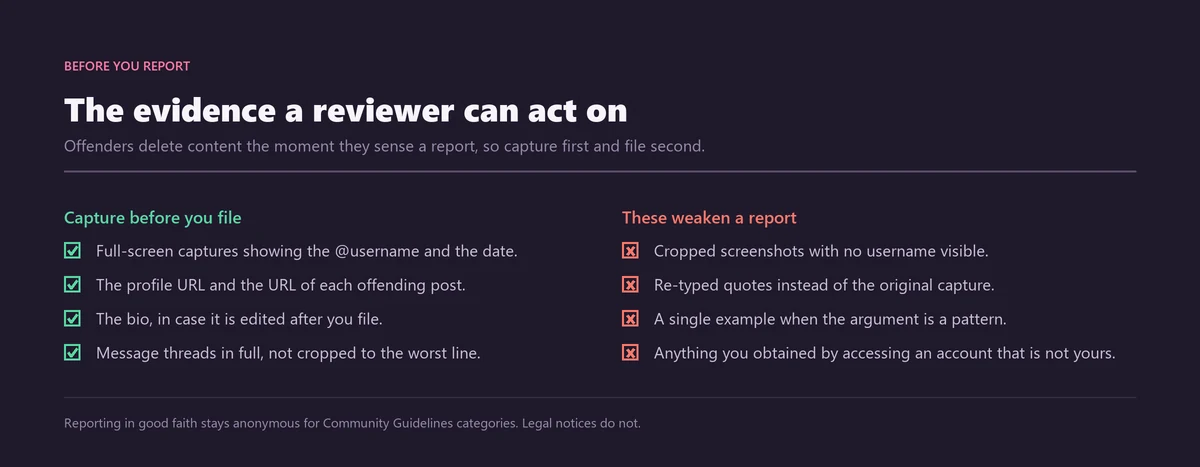
There is one exception to capture everything. Never save, forward or re-share a sexual image of a person under 18, in any circumstance, including as evidence in your own case. Report it and let the specialist route handle the file, which is covered further down this page.
Is there an Instagram report panel that can ban a stalker?
No. There is no Instagram report panel, moderator dashboard or paid queue that removes an account on request. The phrase sells because it describes a control room that would be enormously reassuring to have access to, and that nobody outside Meta has. The real interface is the Report button inside the app.
Search the term and you find checkout pages, Telegram handles and dashboards with invented queue counters. What is on offer is either nothing at all or a pool of throwaway accounts filing identical complaints. Neither changes the assessment Instagram makes, because that assessment is about the content, not about the crowd standing around it.
Instagram states the position plainly in its own Help Center guidance on reporting: whether something is removed turns on whether it breaks a rule, not on how many times it was reported. One accurate report against a genuine violation therefore outperforms a purchased flood, every single time.
You do have a panel. It is yours rather than Meta's. Settings, then Help, then Support Requests lists every report you have filed with its status, and Account Status shows any action taken against your own profile. Those two screens are the whole legitimate tracking surface, and they cost nothing.
Honest paid help exists and it uses exactly those channels. What a service can genuinely add is assessment, meaning which guideline a behaviour actually breaks, and the discipline of assembling evidence in a form a reviewer can act on. That is the argument set out in our guide to an Instagram account takedown and picking the form that fits the harm. Anything sold as privileged access is not that, because nobody can report an Instagram stalker through a door you cannot also walk through yourself.
How do you file an Instagram harassment report step by step?
To report an Instagram stalker, file an Instagram harassment report from the exact surface where the harm sits, choose Harassment or bullying, and describe the pattern in the free-text box. Report the profile when the account exists to target you. Report individual posts, comments or messages when an otherwise ordinary account has crossed a line once.
- Finish capturing the evidence. Once you file, the content can disappear within the hour.
- Block the account. Blocking is silent and immediate, it does not announce that a report is coming, and it stops the next message arriving while you are still typing.
- Open the three-dot menu on the profile, post, Reel or Story. For a comment, press and hold the comment. For a direct message, press and hold the message itself.
- Choose Report, then Harassment or bullying. Use the threatening or violent option where there is an explicit threat, and the private information option where your address, workplace or phone number has been posted.
- Fill in the free-text field wherever the flow offers one. Two sentences beat a dropdown label: what has been happening, over what period, and the fact that you have asked them to stop.
- Report every linked account in the same sitting, and say in each report that they belong to one person.
- Check Support Requests a few days later instead of refiling. A duplicate report opens a second ticket, not a faster one.
Category choice does more work than length. The label routes your case to a queue with a specific policy attached, so a threat filed under spam is assessed against the spam policy and nothing else. Where the behaviour spans several surfaces, a Story today, a comment yesterday, a message last week, file the strongest one first and reference the rest in the text.
The per-surface mechanics differ enough to deserve a walkthrough of their own, which is how to report an Instagram Story, post, profile or DM. If what you want is the whole account assessed rather than one item, read what disable, delete and ban actually mean when you report an Instagram account before you file, because the target you pick sets a ceiling on the outcome.
What do you do when the stalker keeps making new accounts?
Report it as evasion, not as a fresh incident. A stalker returning on a new handle is not an unrelated stranger; they are working around a block or an enforcement action that already exists. Framed that way, your report is about a pattern Instagram already has a rule against, and the whole cluster can be actioned together.
Start with the block itself. When you block someone, Instagram offers to block any other accounts they already have or later create, and taking that option is what stops the third and fourth handle from reaching you before you have even noticed them. It works from signals rather than certainty, so it will not catch everything.
Then make the connection explicit. A reviewer has no way of knowing that three near-identical handles are one person. Say so, list them together, and give your reasons: the same profile photograph, the same opening message, the same phrasing, an overlapping follower list, or contact resuming within hours of a block.
Keep the chronology tight. Every new handle goes into the log with the date it appeared, the date you blocked it and the report reference if you have one. A list of eleven handles with dates reads as one sustained campaign. Eleven reports filed in isolation across three months read as eleven small complaints.
Do not reply to any of them, not even to say stop. You have already said it. Every reply confirms that the account reaches you, and in a criminal case it can be used to argue the contact was mutual. Screenshot, block, log, report, and let the silence be the message.
How do Restrict and Limits lock a stalker out?
Restrict and Limits are the two controls almost nobody switches on, and they are the ones built for exactly this. Restrict hides a person's comments from everyone except themselves and routes their messages to a request folder. Limits temporarily hides comments and message requests from accounts that do not follow you or only followed recently.
Instagram's own explainer on the difference between Restrict, Mute, Block and Report is the first-party source for what Restrict does: the restricted account cannot see your activity status or whether you have read their messages, and their comments on your posts are visible only to them unless you approve each one individually.
| Control | What it does | Do they find out? | Best used when |
|---|---|---|---|
| Block | Cuts off profile access, messages, comments and search in both directions | No notification, though the absence is visible if they look | You want them gone and the evidence is already captured |
| Restrict | Comments visible only to them, messages moved to requests, no read receipts or activity status | No | You need the contact to keep arriving somewhere you can screenshot it |
| Limits | Hides comments and message requests from non-followers and recent followers for a set period | No | A wave of new accounts is arriving at once |
| Mute | Removes their posts and Stories from your feed only | No | You want the anxiety reduced without changing anything else |
| Hidden Words | Filters comments and message requests containing terms you choose | No | The abuse is repetitive and uses the same words every time |
Restrict deserves a specific note in a stalking case. Blocking is the safer instinct, but it also ends the flow of evidence, and in a case heading towards a court it can be worth keeping one monitored channel open while everything else is shut. That is a judgement about your own safety and there is no wrong answer to it.
Around those two, close the ordinary doors. Switch the account to private, remove the stalker and any obvious sock puppets from your followers, set who can tag and mention you to people you follow, turn off message requests from strangers, and enable two-factor authentication. None of this waits on a reviewer agreeing with you.
Who can see your location on Instagram, and how do you switch it off?
Check the Instagram Map first, then the quieter leaks. The Map shares your most recent active location with an audience you choose, and it sits alongside four other things that give away where you are: location tags on posts, Notes, Add Yours stickers and geotagged Reels. A stalking case in 2026 has to cover all five.
The Map arrived in the United States in early August 2025 and caused an immediate row about geolocation exposure. Adam Mosseri answered on Threads that much of the alarm was a misunderstanding: sharing is off by default, switching it on takes two separate confirmations, and the audience is yours to set, whether that is Friends, Close Friends, a chosen list or nobody at all. CNBC reported his response on 7 August 2025.
Off by default is not the same as off. People enable things while exploring a new feature and then forget, and a stalking case is exactly the situation in which to check rather than assume. Open the Map from your inbox, read who is currently in the audience, and remove anyone you do not actively trust.
- Open the Map from your direct messages inbox and read the audience setting. Set it to nobody if you are in any doubt.
- Work backwards through recent posts and Reels and remove location tags, particularly anything near home, work, a school or a gym.
- Turn off location sharing in Notes, and stop answering Add Yours prompts that reveal a place or a routine.
- Check your phone's own permissions. Give Instagram approximate location rather than precise location, or deny it entirely.
- Look at the backgrounds of photographs already published: house numbers, number plates, school uniforms, a station sign through a window.
Is the stalking coming from inside your account or your phone?
Some of what looks like uncanny knowledge is not observation at all. If someone knows about messages nobody else saw, or appears somewhere you only mentioned privately, treat account or device compromise as the working theory until you have ruled it out. The check takes ten minutes and changes everything that follows.
- Open Accounts Centre, then Password and security, then the list of places you are logged in. Note anything you do not recognise in your log, then sign those sessions out.
- Read the login activity for locations and times that are not yours.
- Check apps and websites for third-party connections you never authorised, and remove them.
- Look at what your Accounts Centre links together. A shared Facebook, Threads or Messenger login is a door straight into Instagram.
- Check the email address and phone number on the account, along with recovery options and any mail forwarding rule pointing somewhere you do not control.
- Change the password, then move two-factor authentication to an authenticator app rather than SMS if the number itself may be compromised.
Beyond the account sits the device. Stalkerware, meaning commercial monitoring software installed on a phone by somebody with physical access to it, reads messages long before any platform policy becomes relevant. The Coalition Against Stalkerware publishes guidance and a list of security partners whose products detect it.
Order the checks by risk. If somebody holds your login, everything else on this page is visible to them, including the report you file and the evidence folder sitting in your email. Close that door before you open any other.
What changes when the stalker is a current or former partner?
The sequencing changes. A partner or ex may still hold the recovery email, the phone number attached to the account, a shared Accounts Centre, a family mobile plan or a device they set up for you. Lock things down in the wrong order and the first thing that happens is not safety, it is a confrontation.
This is the highest-risk version of the case and it deserves its own order of operations. Federal law in the United States recognises the relationship explicitly: 18 U.S.C. § 2261A covers stalking carried out through electronic communication and protects immediate family members, intimate partners and even pets, not only the person directly targeted.
- Copy the evidence out first, to an account and a device they have never had access to. A new email address opened on a work machine or a friend's laptop is enough.
- Work out what they still control: the recovery email, the phone number, the Accounts Centre link, the mobile plan, the cloud backup, the shared family account that quietly shows your location.
- Speak to an advocate before you change anything visible. In the United States the National Domestic Violence Hotline is on 1-800-799-7233; in the United Kingdom the National Stalking Helpline is on 0808 802 0300.
- Change the quiet things first, meaning passwords, recovery email and two-factor method, and the visible things last, because a removed follower or an unlinked account is a notification in everything but name.
- Then block, then report, then take the log to the police if contact continues.
Expect escalation at the point access is lost, and plan for it rather than being surprised by it. That is the moment when somebody who has been quietly watching starts contacting mutual friends, family or your employer instead. Tell the people around you before it happens, and ask them plainly not to pass anything on.
How long does an Instagram report take to be reviewed?
There is no published answer. Meta does not commit to a review time, so how long does an Instagram report take has no honest single figure: hours in some cases, a fortnight in others. Automation screens the obvious breaches quickly, while anything that needs context waits for a person to read it.
What moves a case along is clarity rather than urgency. A credible threat with the words visible in a screenshot is unambiguous. A pattern of following, tagging and reappearing on new handles is genuine stalking and genuinely harder to assess from one flag, which is where the free-text description and the list of linked accounts earn their place.
Track it rather than refile. Settings, then Help, then Support Requests shows the status of what you filed, and Account Status shows action taken against your own account. A result of no action taken means somebody looked and disagreed, which is a prompt to add context through the review option once, not to file the same thing again.
While it sits in a queue, your own controls are already working. Block, Restrict, Limits, going private and two-factor authentication all take effect the second you set them, and none of them wait for a reviewer. Treat the report as the slower, background half of the job.
Do Instagram report bots or panels work against a stalker?
No. The honest answer to do Instagram report bots or panels work has not changed: Instagram assesses whether content breaks a rule, and identical coordinated reports are detected and discounted rather than counted up. Volume buys nothing here, and most of the tools selling it are really after your login.
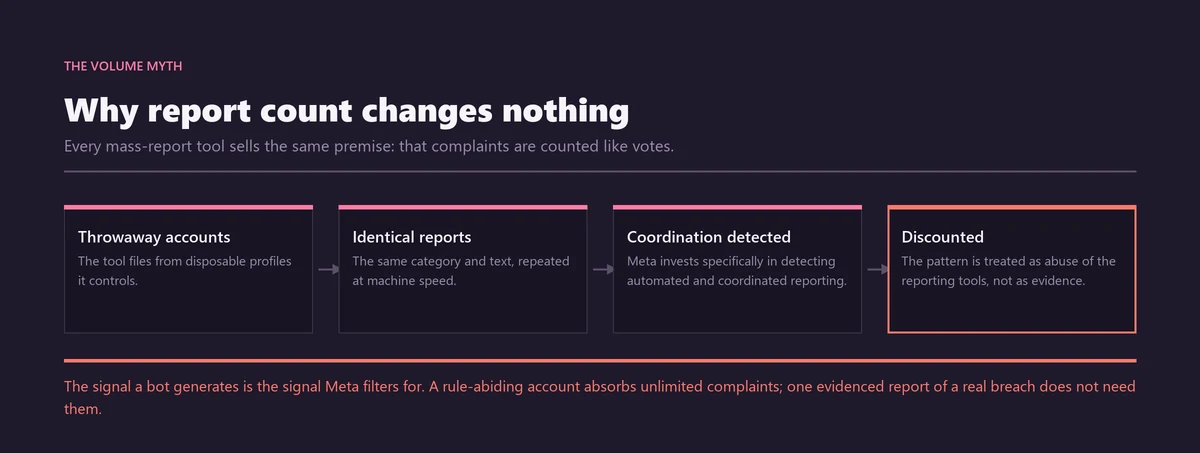
There is a second failure mode that matters more when you are the victim. Coordinated false reporting is itself against the rules, and the accounts doing the reporting are the ones that look abnormal to a classifier. A campaign bought on your behalf can therefore land restrictions on you rather than on the person stalking you. That is the exact opposite of what you set out to do when you tried to report an Instagram stalker.
A report is evidence handed to a reviewer. A thousand copies of it are still one piece of evidence.
Then there is what the tool is really for. A large share of report bots, panels and profile-viewer apps exist to harvest logins and card details, which is grim in any circumstance and dangerous when somebody is already trying to get inside your account. If a service asks for your Instagram password, the password is the product.
Paid help is not the same thing as a bot, and the distinction is worth being precise about. We have written plainly about what a legitimate engagement includes and what it cannot promise in Instagram ban as a service: what you are really buying and what it costs, and about the realistic routes in how to get an Instagram account taken down. Neither involves a panel.
When should you report a stalker on Instagram to the police?
Report a stalker on Instagram to the police the moment the behaviour stops being a rules problem and becomes a crime: credible threats, contact that continues after a block, attempts to find you in the physical world, anything tied to domestic abuse, and anything involving a child. Do not wait for the platform report to resolve first.
Platform reports and police reports are not alternatives, and filing one does not weaken the other. Instagram can remove a profile. It cannot order a person to stop, cannot arrest anybody, and cannot compel disclosure from a bank or a phone network. Those are the things that end a stalking case rather than pausing it.
The federal position in the United States is more specific than most people expect. 18 U.S.C. § 2261A carries up to five years for a base offence, and a mandatory minimum of one year where the conduct took place while the person was violating a protective order. Electronic communication is expressly within scope.
That protective order is the other half of the answer, and it is a separate application from the criminal one. A civil protection order, called a restraining order in many states, is granted by a court and can bar contact by any means, name specific social accounts, and be entered into national databases so that officers in another jurisdiction can verify it exists.
One technical change matters for what can be obtained later. Instagram stopped supporting end-to-end encrypted direct messages on 8 May 2026, as reported by MacRumors among others. In practice a reported thread is now something Meta itself can review, and records held by Meta can be sought by law enforcement through legal process, which is why an early preservation request from an officer is worth asking about.
Take the log, not the story. Officers want a chronology with dates, handles and URLs, the full-screen captures, the list of linked accounts, any report references from Support Requests, and a short statement of what you have already done. In the United States, online crime can also be filed with the FBI's Internet Crime Complaint Center; in the United Kingdom, call 101, or 999 if you are in immediate danger.
What route fits each kind of stalking-related abuse?
Not everything goes through the Report button. Impersonation has its own form and asks for photo identification. Intimate images have a hashing service that blocks them without you uploading anything anywhere. Private details posted to intimidate have a specific category. Choosing the right door is most of the work.
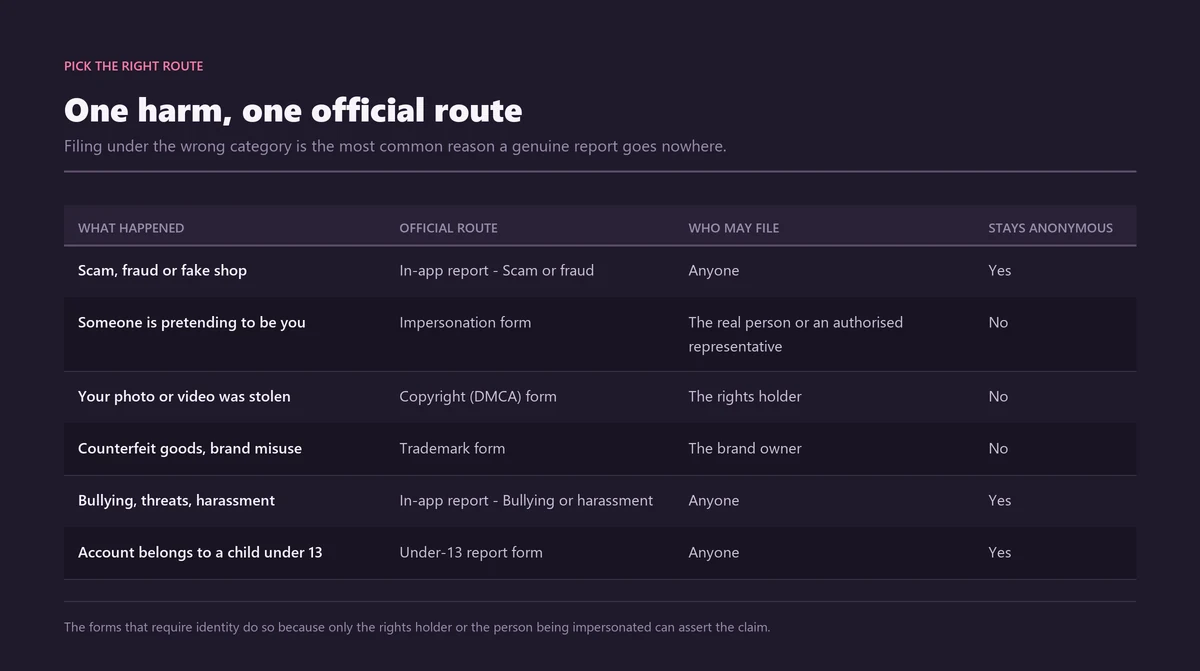
| What you are facing | Where it goes | Worth knowing |
|---|---|---|
| Repeated unwanted contact and harassment | In-app Report, Harassment or bullying, plus Block or Restrict | Capture first, and add the police as soon as threats appear |
| Your home address, workplace or phone number posted | In-app Report, private information category | Prohibited by the Community Guidelines regardless of where the data came from |
| An account pretending to be you | The impersonation form, with government-issued photo ID | Only you or an authorised representative may file it |
| Threats to publish intimate images | Report the account, then the hashing service, then the police | Do not pay and do not keep replying |
| New accounts appearing after a block | Report each one and state that they are linked | Evasion is a violation in its own right |
| Your photographs reposted on their profile | Copyright report | Copyright claims are not anonymous; your details go to the other party |
How do you report doxxing tied to stalking?
Report the exact post, Story or comment that carries the detail, and pick the private information category rather than generic harassment. Instagram's Community Guidelines prohibit sharing personally identifiable information to harass or intimidate. Capture it first, because doxxing content is deleted faster than almost anything else the moment the poster suspects a report.
Then treat the consequences separately from the post. If your home address is out, tell the people who live at it. If it is your workplace, tell a manager before a stranger telephones. Removal of the original does not recall the copies, and doxxing frequently comes immediately before an offline incident, which makes it a police conversation as well as a report.
What do you do about sextortion or threats to share images?
Stop replying and do not pay. Sextortion, meaning a threat to publish an intimate image unless you send more images, money or contact, almost never ends with payment; payment only establishes that payment works. Meta sets out the definition and the reporting route in its Safety Center guidance on intimate images.
Report the account and the messages, then use a hashing service so the image is blocked across participating platforms without you uploading it anywhere. Adults use StopNCII; anyone under 18, or an adult acting for them, uses NCMEC's Take It Down. Both work from a hash generated on your own device, so the picture itself never leaves it.
Where the same person is also running a fake profile in your name, the two problems need filing separately and in a particular order, which is set out in our guide to the Instagram impersonation form, photo ID and reporting blackmail. If they have taken the handle itself rather than copying your face, the realistic recovery routes are in how to claim an Instagram username.
What should a parent do if a teenager is being stalked?
Use the supervision tools rather than the confiscation instinct. Instagram Teen Accounts limit who can message a young person to accounts they already follow or are connected to, and Family Center gives a parent visibility of who a teenager is talking to without handing over the contents of the messages.
Meta's June 2026 update, published on its newsroom as Strengthening Teen Accounts, extended a 13-plus content default across Instagram, Facebook and Messenger and added parent notifications through Family Center, including alerts to a supervising parent about repeated searches related to self-harm. That is the current and citable state of the minor protection route.
The practical sequence matches the adult one, with one addition. Capture the evidence, restrict or block, report the account, and involve the school if the stalker is another pupil. Schools carry their own safeguarding obligations and frequently act far faster than any platform queue does.
Two lines are absolute. Never save, forward or send a sexual image of a person under 18 anywhere, including to police through a messaging app; describe it and let them direct you. And if an adult is contacting a child, that is not a moderation question at any stage. It goes to law enforcement straight away, and in the United States to NCMEC's CyberTipline alongside the platform report.
If you are unsure whether what you are looking at crosses a line, describe the account to us and we will tell you which route applies, including when the honest answer is that this is a police matter rather than a reporting one.
What can a report realistically achieve?
A report puts a reviewer or a classifier in front of behaviour that would otherwise go unassessed. What follows scales with severity: a single post removed, a comment hidden, a feature limit that blocks messaging or posting for a period, strikes accumulating, or the account disabled where the breach is severe or repeated.
What it is not is a delete button, and no honest service will describe it as one. You supply the evidence, Instagram makes the decision, and the outcome can be smaller than the harm felt. That gap is real, and it is better known in advance than discovered after a fortnight of refreshing a status screen.
The part you control is larger than it looks. Blocking, Restrict, Limits, going private, closing the location leaks, clearing out sessions and connected apps, and moving your recovery details somewhere a stalker cannot reach all take effect immediately, and none of them depend on anybody agreeing with you.
Our position on the rest is fixed. We file only against accounts that genuinely breach the Community Guidelines or the law, only through Instagram's official channels, and never against a legitimate account because somebody has fallen out with its owner. Where a case is a criminal matter we will say so and point you at the police rather than sell you a report.
If you want the full picture of what can be filed and where, the rest of our Instagram reporting and takedown solutions cover each route in detail, and you can send us the handle and the dates if you would rather somebody else assembled the case. We will tell you plainly whether there is enough evidence to report an Instagram stalker with any prospect of success, or whether the next step is an officer rather than a form.
Sources
- Instagram Help CenterHow reporting works and what gets removed
- Instagram Help CenterCheck the status of something you reported (Support Requests)
- Instagram Help CenterAccount Status and actions taken on your account
- Instagram Help CenterInstagram Community Guidelines
- Meta Safety CenterSextortion and non-consensual intimate images
- Meta NewsroomStrengthening Teen Accounts, June 2026
- Cornell Legal Information Institute18 U.S.C. § 2261A, stalking
- Coalition Against StalkerwareDetecting and handling stalkerware on a device
- National Domestic Violence HotlineSafety planning support, 1-800-799-7233
- Suzy Lamplugh TrustNational Stalking Helpline, 0808 802 0300
Frequently asked questions
Can Instagram tell you who is stalking your profile?
No. Instagram has never shown who views a profile, and no app, website or hidden setting can reveal it. Anything advertising that feature is guessing or harvesting logins. The only viewer data Instagram publishes is the list of people who watched your Story, which can at least show you a repeat first viewer worth logging.
Should you block a stalker or report them first?
Capture the evidence before you do either. Once you hold full-screen screenshots, the profile URL and the dates, block first and report second. Blocking is silent and takes effect immediately, while a report can take days and may end with the account, the posts and all your proof being deleted at once.
How long does an Instagram report take to be reviewed?
Meta publishes no review time, so there is no honest single figure. Automated systems clear obvious breaches quickly, while anything needing context waits for a person, which can mean days. The 24 to 48 hour number repeated across blogs is not a Meta service level. Track your case under Settings, Help, Support Requests rather than refiling.
How do you stop someone making new accounts to follow you?
Use the option Instagram offers when you block, which covers other accounts that person already has or later creates. Then report each new handle as evasion of an existing block rather than as an unrelated case, listing the handles together and explaining how you know they are the same person. Evasion is a violation in itself.
Do Instagram report bots or panels work against a stalker?
No. Instagram assesses whether content breaks a rule, and identical coordinated reports are detected and discounted rather than added together. A purchased pile-on can also mark the reporting accounts as the abusive ones. Many of these panels exist to collect logins and card details, which is a serious risk when somebody is already targeting you.
Can the police get Instagram messages and account records?
Through legal process, yes, and an officer can also send Meta a preservation request that freezes records while that process runs. A private individual can do neither. Instagram stopped supporting end-to-end encrypted direct messages on 8 May 2026, so a reported thread is content Meta itself is able to review. Report early, while records are fresh.
Can I get a civil protection order against an Instagram stalker?
Yes, through a court, and it is a separate application from any criminal complaint. A civil protection order, called a restraining order in many states, can bar contact by any means, name specific social media accounts, and be entered into national databases so that officers elsewhere can verify it. Bring your dated log to the hearing.
Is stalking someone on Instagram illegal?
It can be. In the United States, 18 U.S.C. § 2261A covers stalking carried out by electronic communication, carries up to five years for a base offence, and adds a one-year mandatory minimum where a protective order was being violated. It protects immediate family members, intimate partners and pets as well as the direct target.
How do I know if someone can see my location on Instagram?
Open the Instagram Map from your inbox and read the audience setting. Sharing is off by default and takes two separate confirmations to enable, and the audience can be set to nobody. Then check the quieter leaks: location tags on old posts, Notes, Add Yours stickers, geotagged Reels and identifiable backgrounds in photographs.