Instagram mass report bot: what it does, and what it costs you
Reviewed 8 August 2026 · 4,091 words · 17 min read
The tools ranking for this search are wrappers around a free button, and the free ones need your password before they will press it.
An Instagram mass report bot does not work: Instagram removes content for genuine rule-breaks, not report volume, and Meta detects and discounts the coordinated automated reporting every bot produces. The free Telegram and GitHub versions need your login to run, so the realistic outcome is a stolen account rather than a banned one.
If a profile is genuinely scamming, impersonating or harassing you, send us the link and your screenshots, and we file through official channels against real violations only.
- Instagram states that the number of reports does not determine whether content is removed.
- Instagram's official API allows comment moderation only — there is no abuse-report endpoint at any access tier.
- Meta removed more than 159 million scam ads in 2025, with 92% taken down before anyone reported them.
- Kaspersky's GitVenom research found 200+ fake GitHub repositories hiding malware, including Instagram automation utilities.
- SMM panels publicly advertise Instagram reports from around $0.03 each, or $0.90 per 1,000.
Do Instagram mass report bots work?
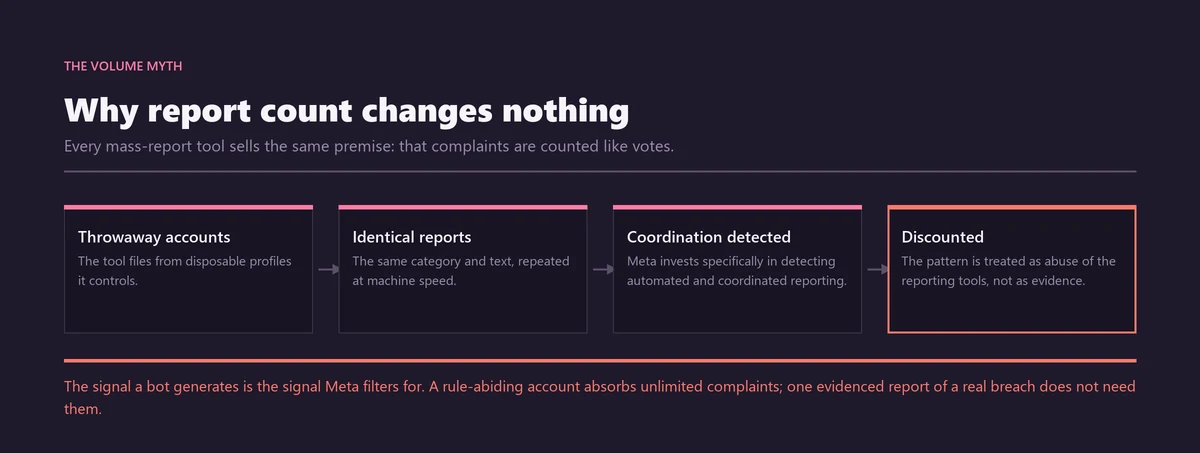
No. An Instagram mass report bot fires identical complaints from disposable profiles, and Instagram is explicit that the number of reports is not what decides an outcome. A reviewer weighs one piece of content against one rule. An account that has broken no rule survives any volume of complaints.
That single sentence undoes most of the sales copy you will meet in this search result. The Instagram Help Center describes a global review team that removes content when it genuinely breaks the Community Guidelines, and says the number of times something is reported does not determine whether it comes down (Instagram Help Center). No counter is ticking towards a ban.
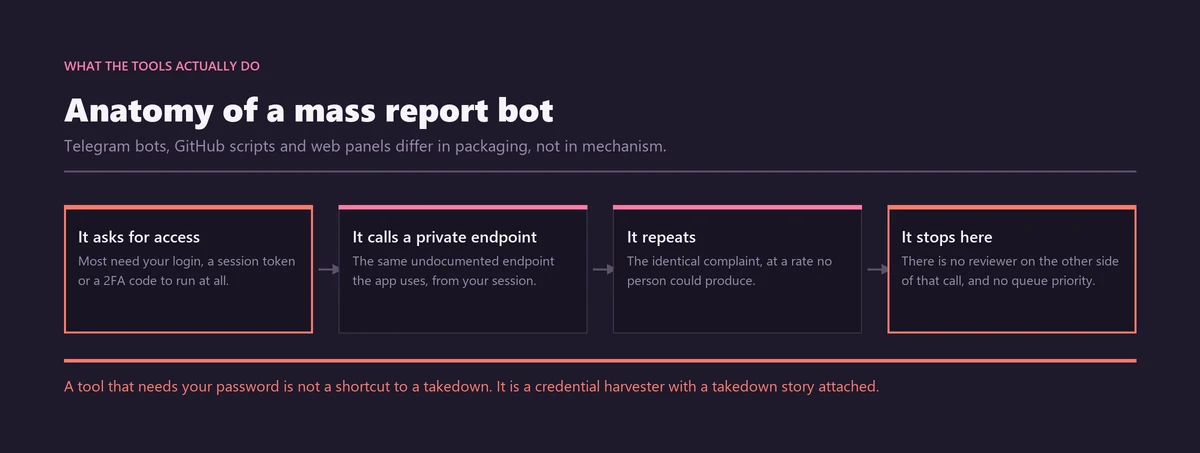
The second failure is structural rather than statistical. Every bot draws its reports from bulk-created throwaway accounts, and that pattern is what Meta's abuse systems are built to notice. AlgorithmWatch, investigating mass-reporting on Meta's platforms, found the company had invested significantly in technology to detect accounts that engage in coordinated or automated reporting (AlgorithmWatch). A tool's cheerful "reports sent" banner tells you it reached a server. Nothing beyond that.
Set that against the pitch and the product collapses on its own terms. If ten thousand reports and one report produce the same result when no rule was broken, the whole thing is a way of paying for the difference between zero and zero. The one thing volume changes reliably is how obvious the campaign looks from Meta's side.
How many reports does it take to ban an Instagram account?
There is no number. Instagram does not run a report quota, so no total — not fifty, not fifty thousand — tips a compliant account into a ban. A single documented breach can be actioned on its own merits. Anyone quoting a "minimum reports to ban" figure is quoting a threshold that does not exist.
This is the most-searched question in the topic, and its answer is unsatisfying enough to sustain an entire industry. A number would make the problem purchasable: buy enough units, get the outcome. Without one, the only lever left is the quality of a single submission — which rule was broken, what proof you hold, and whether you used the right form.
Volume is not merely useless. It is counterproductive. A sudden burst of near-identical complaints against one profile reads as an abuse signal rather than as evidence, so the pattern a bot exists to manufacture is the pattern Meta's systems discount hardest. We work through that arithmetic at length in our breakdown of whether mass reporting an Instagram account changes the outcome.
What is an Instagram mass report Telegram bot, and how does it differ from a panel?
An Instagram mass report Telegram bot is a chat account inside Telegram: you send it a profile link and it pushes the same complaint repeatedly from accounts it controls. A hosted web panel, a downloaded script and a Telegram bot differ in packaging, not in mechanism. All three finish at the same public report form.
Because the differences are cosmetic, the useful comparison is not "which one works best" but "what does each need from you, and where does it stop". You will notice there are no success rates in the table below. That is deliberate. Nobody publishes an audited figure, and every percentage quoted for these tools traces back to the people selling them.
| Format | How it submits | What it needs from you | Where it dead-ends |
|---|---|---|---|
| Telegram bot | Chat command to the operator's own automation | Often your username and password, sometimes a two-factor code | Credentials leave your control; reports land as one coordinated burst |
| GitHub or GitLab script | Your machine, driving private mobile and web endpoints | A text file of Instagram logins, plus a proxy list | Breaks at the next app change; the access itself breaches the Terms of Use |
| Hosted web or SMM panel | The operator's farm of throwaway profiles | Usually just a target link and payment | Throwaway-account signature is the one Meta filters hardest |
| Manual in-app report | Instagram's own review queue | Nothing beyond your own account | Limited by whether a rule was actually broken, which is the only real limit |
| Documented case on an official form | The dedicated form built for that harm | Evidence, and ID where the form requires it | Nothing automated; the decision still rests with Meta |
Two things fall out of that table. The delivery format changes your personal exposure enormously — a Telegram bot that wants your password is a very different risk from a panel that only wants your money — while changing the outcome for the target not at all. And the only rows without a mechanical dead-end are the ones where a genuine rule was broken.
The most polished counter-argument comes from the paid panels: no login required, reports submitted externally. That part is true, and it does remove the credential-theft risk, which is a real difference from the free scripts. It fails elsewhere. Those external reports come from farmed throwaway profiles, the single signature Meta's coordination detection is most practised at filtering. If you are still weighing the market up, our survey of which Instagram reporter tools are real and what actually removes an account compares the categories side by side.
How much does an Instagram mass report bot cost, and what are you actually buying?
Panels advertise reports from around three cents each, with bulk rates near ninety cents per thousand. Those are the vendors' own published rate cards — we do not link to them — and they are the most honest thing on the page. Reason from the price: a fraction of a penny cannot buy a human reviewer.
Work out what that money physically covers. A phone-verified Instagram account with real posting history costs a resale market far more than a tenth of a cent. A minute of a trained moderator's time costs more again. At ninety cents per thousand, the unit being sold is one automated form submission from a burner profile, and the seller's margin depends on that burner staying as cheap and disposable as possible.
- Not buying: queue priority — Meta does not sell or accept paid escalation from the public.
- Not buying: a human decision — the submission enters the same automated triage as a free report.
- Not buying: credible reporters — the filing accounts are exactly the throwaways the system discounts.
- Actually buying: a log file showing that submissions were attempted.
The pricing also explains the churn. A vendor selling something the platform ignores has no reason to survive its own refund requests, so the brand rotates, the domain changes, and the same operator returns under a new name. Re-buying from a "better panel" after a failed order is the most common way people lose the money a second time.
Is there a working Instagram mass report GitHub script?
Public repositories exist; a working one is a separate claim. Search any code-hosting site and an Instagram mass report GitHub script appears in seconds, some carrying hundreds of stars and forks. Stars measure curiosity, not results — and the code itself, once you read it, explains why the results never arrive.
Open one of these projects and the shape is always the same. The script drives Instagram's private mobile or web endpoints while logged in as somebody, which is why the repositories ship with an accounts file and a proxy list. The typical instructions ask you to paste usernames and passwords into a plain text file before the tool will run at all.
Two practical failures follow from that design. First, unofficial endpoints move. Instagram ships changes constantly, and a scraper-style script breaks the week a parameter is renamed, which is why so many of these repositories sit frozen after a handful of commits. Second, the access is prohibited outright: automated and unauthorised access breaches the Instagram Terms of Use.
So even the best-maintained project on the list hands you brittle code that demands a password in order to perform an action the platform has already told you it does not count. The same reasoning applies to the spam-flavoured versions of these tools, which we take apart in our piece on how spam accounts on Instagram really come down.
Are Instagram mass report bots safe, or do they steal your login?
Frequently the tool is more dangerous than the profile you point it at. Free scripts and Telegram bots want your username, password or a two-factor code before they will run, and code repositories are now a documented delivery route for credential-stealing malware dressed up as social media automation.
Kaspersky's researchers named the pattern. Their GitVenom investigation found more than 200 repositories hosting fake projects with hidden malicious code — Telegram bots, game cheats, Bitcoin wallet managers and Instagram automation utilities among them — used to steal personal and banking data and to hijack wallet addresses from the clipboard, with around five bitcoin, roughly $485,000 at the time, traced to the operators (Kaspersky Securelist).
The technique has since scaled. Help Net Security reported on 15 July 2026 that a single financially motivated actor had published roughly 292 brand-impersonating repositories to push an infostealer, spanning security tooling, fintech, crypto wallets and developer utilities, with victims routed in from search results (Help Net Security). A repository looking professional is evidence of nothing at all.
Instagram's own guidance runs the same way: handing your login to a third-party app puts the account at risk of compromise, and the platform keeps a dedicated page on why an account becomes vulnerable (Instagram: Third-Party Apps; Instagram: account at risk). Once someone else holds a live session, they can post as you, message your followers, or lock you out.
AlgorithmWatch documented where this ends at the far edge: attackers mass-report a target into suspension, then contact Meta claiming the suspended account is theirs, take it over and resell it. The report bot is one component in an account-theft economy, and the buyer is a target inside it as often as the person being reported is.
I have already run an Instagram mass report bot — what now?
Assume everything the tool touched is compromised and work outward from your credentials. If you typed a password into a bot, a panel or a script, or ran a downloaded binary on your own machine, the safe default is that session tokens, saved browser passwords and cookies left with it. Rotate first, investigate afterwards.
- Change your Instagram password from a device that never ran the tool, then change the password on the email address attached to the account, because that mailbox is the reset route for everything else.
- Open Settings, then Accounts Centre, and end every session under "Where you're logged in" that you do not recognise. Changing a password does not always evict an already-active session.
- Turn two-factor authentication off and back on so the shared secret is regenerated, then store a fresh set of backup codes somewhere the compromised machine cannot reach.
- Review connected apps and revoke any authorisation you did not deliberately grant.
- Check Settings, then Account Status. If a bot ran under or alongside your profile, this is the screen where a coordinated-reporting penalty would appear.
- If you executed a downloaded file, treat the whole machine as suspect: run a reputable scanner and rotate passwords for banking, email and any crypto wallet held in the browser.
On the money, be realistic. Payments to these panels usually run through anonymous handles or crypto, where a chargeback has no counterparty to name. Save the order page, the chat log and the payment reference anyway. If the transaction passed through a card processor there is a narrow window in which fraud may be arguable, and keeping the record costs nothing.
What almost never helps is buying again. The failure was not the vendor's quality; it was the assumption underneath the purchase. If a genuine violation sits behind all of this, put the same energy into one properly evidenced submission instead — the contact page is where to send the link and the screenshots if you would rather someone else assembled the case.
Could a report bot get your own account banned instead?
Yes, and this is the risk that actually materialises. Automated access already breaches Instagram's Terms of Use, but the sharper exposure is intent: coordinated false reporting is treated as inauthentic behaviour, and enforcement in these cases lands on the accounts driving the campaign rather than on the target of it.
The consequences escalate the way any other policy breach does. A warning first, then feature limits such as losing the ability to comment, post or use direct messages, then a disabled account. Because the signal is behavioural, it does not depend on the target complaining about you. An Instagram mass report bot run from or linked to your real profile generates the signal by itself.
Coordinated false reporting is one of the few things in this whole process that reliably produces enforcement — against the person doing it.
There is legal exposure at the edges too. An organised effort to remove someone from a platform does not become lawful because it was routed through an app, and depending on where both parties live it can be framed as harassment. In the EU, the Digital Services Act entitles a wrongly-actioned user to a statement of reasons and a route to challenge the decision, which is exactly the paper trail a false campaign cannot afford.
Reporting in good faith carries none of this. A genuine report stays anonymous to the person reported, costs nothing, and leaves no mark against you. If your aim is a legitimate removal, our guide to the violation, the evidence and the right route for banning an Instagram account sets out what a reviewer can actually act on.
If reports barely move the needle, what actually removes accounts?
Automated detection does, at a scale no report campaign approaches. Meta's published enforcement figures show most action beginning inside its own classifiers rather than in the report queue. That is why the outcome bot buyers pay for often arrives free, on Meta's schedule, with nobody having filed anything at all.
Meta stated in March 2026 that it had removed more than 159 million scam ads across 2025, with 92% taken down before anyone reported them, alongside 10.9 million Facebook and Instagram accounts linked to criminal scam centres (Meta Newsroom, March 2026). The report queue is the minority path even in the category the public reports most.
Independent analysis puts a sharper number on it. The Center for Countering Digital Hate, examining Meta's own data around the January 2025 "More Speech, Fewer Mistakes" policy shift, found that over 97% of enforcement actions in the most affected policy areas had been proactive, with under 3% arising from user reports (CCDH). That figure is the CCDH's reading of the data, not Meta's own framing of it.
Meta's Q3 2025 integrity reporting, summarised by Social Media Today in December 2025, tells the same story from the other direction: under 1% of content on Facebook and Instagram was removed for policy violations, under 0.1% was removed in error, and roughly 4% of the user base — about 140 million profiles — is estimated to be fake (Social Media Today).
The overnight sweep of 6–7 May 2026 that creators nicknamed the "Great Purge" is the clearest illustration of all. Vast numbers of bot, spam and inactive Instagram accounts disappeared inside a single window, celebrity follower counts dropped by millions, and no user report featured anywhere in it (Yahoo Creators). Treat the loss figures as widely reported and creator-observed rather than Meta-confirmed; no formal breakdown was published.
None of that makes reporting pointless. It means a report works as a signal about one specific violation, not as a lever you can pull harder — the distinction our guide to what makes an Instagram ban actually stick is built around.
How do you spot a fabricated statistic on a page like this one?
Check three things. Is a publisher named, is there a link you can open, and does the figure appear anywhere outside the pages selling the service? Most numbers in this niche fail all three. They circulate between competing blogs, gaining authority through repetition alone, and originate nowhere you can inspect.
Below are claims currently circulating on pages that rank for this query. Each is listed because no source for it could be found, not because it has been disproven. That is the point: an unsourced number is not evidence in either direction, and it is not something to act on.
| Claim in circulation | Why it does not hold | What is actually published |
|---|---|---|
| "92% enforcement success within 24–72 hours" | No named study, and Meta publishes no review-time commitment for user reports | Instagram states report volume is not decisive and gives no timeframe |
| "Median enforcement time fell after a Q1 2026 moderation upgrade" | No such upgrade or median appears in Meta's Transparency Center | Meta's integrity reports publish volumes and error rates, not per-case medians |
| "47 Instagram cases handled January to June 2026" | An internal tally a reader has no way to audit | Nothing; a vendor's private case count is not a statistic |
| "X reports guarantees a ban" | Contradicts Instagram's own published position | The Help Center says the number of reports does not determine removal |
Apply the same test to this page. Every figure above carries a publisher and a live link, and where a number is contested — the May 2026 follower losses, for instance — it is labelled as reported rather than confirmed. That is the standard worth holding any provider to before you send them money or evidence, this one included.
The habit matters well beyond bots. It is the same discipline that stops you believing a service can guarantee an account will be deleted, a promise we unpick in our walkthrough of the four official routes for getting an Instagram account deleted.
What if someone is mass-reporting your account?
The mechanic that makes bots useless is the same one protecting you. Review still turns on whether a rule was broken, so a wave of false complaints against compliant content should not remove it on volume alone, and Meta's systems are built to discount precisely that coordinated pattern.
That is the design rather than a guarantee. Mistakes happen, and Meta's own reporting acknowledges a small share of removals are wrong. If something of yours has been actioned, the useful response is procedural, not defensive.
- Open Settings, then Account Status, to see what was actioned and under which policy. Guessing at the reason wastes the appeal.
- Request a review from that same screen. This is the in-product appeal and it is the fastest formal route available to you.
- If you are in the EU, keep the statement of reasons Meta must provide under the Digital Services Act. It also opens access to a certified out-of-court dispute settlement body if the review goes against you.
- Preserve your own evidence: screenshots of the content as published, timestamps, and any posts or messages showing a group organising the reports.
- Do not retaliate with reports of your own. A counter-campaign places you inside the behaviour Meta acts on, and it weakens an otherwise clean appeal.
Keep the campaign evidence even after a successful appeal. Organised brigading is usually one part of a wider harassment pattern, and the record is what turns a later complaint — to the platform, to a regulator, or to the police — into something more than an assertion. If an account of yours has already been disabled after a brigading attempt, describe the sequence on the contact page and we will help you frame the appeal.
What removes a rule-breaking account instead of a bot?
One documented report through the correct official channel. What moves Instagram is evidence tied to a specific rule and filed on the form built for that harm. Route matters as much as proof: an impersonation case submitted as generic spam rarely gets read as the Community Guidelines violation it plainly is.
The harm behind these searches is not abstract. The FTC reported that losses to social media scams reached roughly $2.1 billion in 2025, about eight times the 2020 figure (FTC, April 2026). Cases like those do get acted on, when the paperwork is right.
- Capture proof before you do anything else. Screenshot the cloned bio, the scam post and the threatening messages with dates and handles visible, because offenders delete the moment they sense a report.
- Identify the rule that was actually broken — fraud, impersonation, bullying and harassment, hate speech, counterfeit goods — rather than whichever label is quickest to tap.
- Use the dedicated form where one exists. The Instagram impersonation form is the right route when a profile is pretending to be you, and only the real person or an authorised representative may submit it, with ID attached when prompted.
- Report the post and the account separately when both breach the rules. A documented pattern reads very differently to a reviewer than a single flag does.
- Submit once, then stop. Repeat filings from the same person add nothing and begin to resemble the behaviour Meta discounts.
- Watch your notifications for the outcome and keep the reference. Your report stays anonymous to the person you reported.
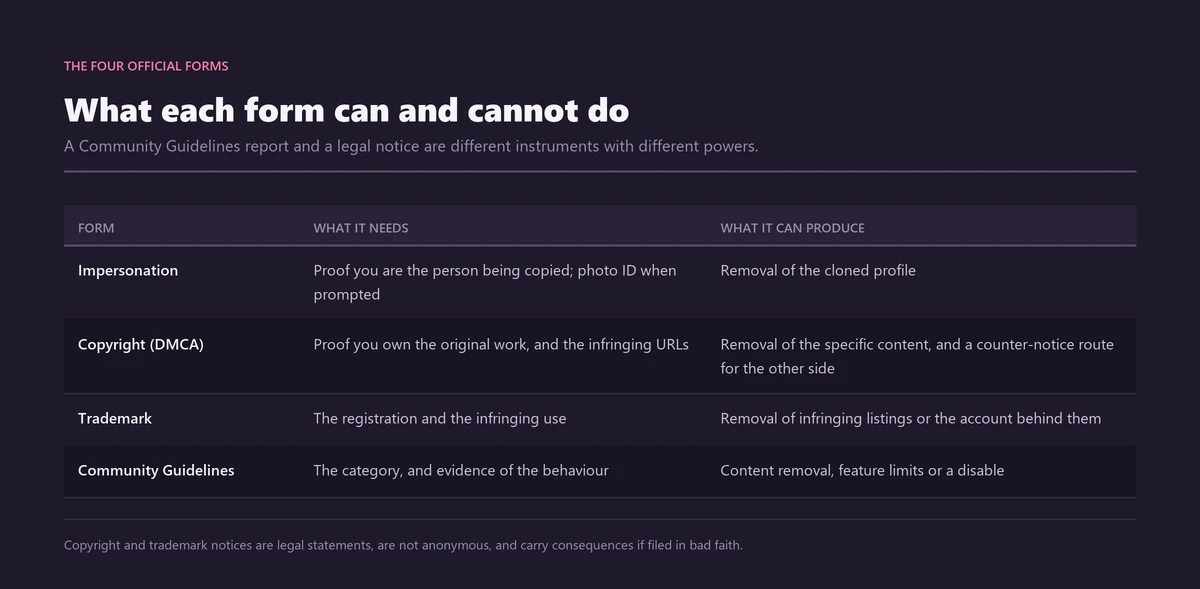
Knowing which categories a reviewer can act on decides whether any submission lands at all. The breaches that reliably reach a decision are these:
- Impersonation — a profile passing itself off as you, your business or a public figure.
- Fraud and scams — investment, romance, crypto and advance-fee cons.
- Hate speech — attacks based on protected characteristics.
- Bullying and harassment — targeted abuse, threats and organised pile-ons.
- Counterfeit and intellectual property — fake goods and stolen work, escalated through the copyright and trademark routes rather than an ordinary report.
- Sextortion and child safety — treated as a priority category with its own escalation path.
One boundary deserves stating plainly, because the rest of this market ignores it. Nobody can have an account removed for being irritating, for winning an argument, or for being an ex-partner. Where there is no genuine Community Guidelines violation and no legal breach, there is no route, and any provider claiming otherwise is describing a fantasy. The limits of who can compel a removal are set out in our piece on who actually holds the power to delete someone else's Instagram account.
If you would rather hand the assembly work over, that is what we do. We match the breach to the exact guideline it violates, build the evidence pack and file it through Instagram's official tools. Send the profile link and your screenshots through the contact page, or look through the wider set of Instagram reporting and takedown solutions we handle. We act on genuine violations only, and never against a legitimate account.
Sources
- Instagram Help CenterReporting content and how removal decisions are made
- InstagramWhy your account may be at risk
- Meta for DevelopersInstagram Platform — Comment Moderation
- Center for Countering Digital HateMore Transparency and Less Spin — analysis of Meta's enforcement data
- Kaspersky SecurelistFake GitHub projects distribute stealers in the GitVenom campaign
- Federal Trade CommissionReported losses to scams on social media eight times higher than 2020 (April 2026)
- Meta Transparency CenterIntegrity Reports, Third Quarter 2025
Frequently asked questions
Do Instagram mass report bots actually work in 2026?
No. Instagram states that the number of reports does not decide whether content is removed, so a profile that breaks no rule survives any volume of complaints. Meta also detects and discounts coordinated or automated reporting, which is the exact pattern every bot produces. A single documented violation achieves more than ten thousand automated ones.
Is an Instagram mass report Telegram bot different from a paid panel?
Only in packaging. A Telegram bot, a hosted panel and a downloaded script all push automated submissions into the same public report queue, and none has private access to a reviewer. What differs is your own exposure: the Telegram version usually wants your login, while a panel usually only wants your money.
Is there a working Instagram mass report GitHub script?
Repositories exist; working ones are a different claim. These scripts drive Instagram's private endpoints while logged in as somebody, which is why they ship with an accounts file and proxies. Instagram's official API offers comment moderation only, with no abuse-report endpoint at any tier, so the script has no sanctioned route and breaks whenever an endpoint changes.
Are Instagram mass report bots safe to run?
Often not. Free scripts and Telegram bots typically require your username, password or a two-factor code, and Instagram warns that sharing credentials with third-party apps puts an account at risk of compromise. Kaspersky has documented malware hidden inside fake repositories, including Instagram automation utilities. A tool asking for your password is best read as the scam itself.
Can a mass report bot get my own Instagram account banned?
Yes. Automated and unauthorised access breaches Instagram's Terms of Use, and coordinated false reporting is treated as inauthentic behaviour, so enforcement falls on the accounts driving the campaign rather than the target. That can mean a warning, feature limits, or a disabled profile. Organised harassment campaigns can also carry legal exposure outside the platform.
How many reports does it take to get an Instagram account deleted?
There is no threshold. Instagram does not run a report quota, so no total tips a compliant account into deletion, and a clean profile survives unlimited complaints. One evidenced report of a genuine breach can be actioned on its own. A sudden flood of identical reports is read as an abuse signal instead.
Is it illegal to use an Instagram mass report bot?
It is risky on several fronts. Automated and unauthorised access breaches Instagram's Terms of Use, and knowingly filing false reports as part of a coordinated campaign can support harassment or defamation claims depending on where both parties live. In the EU, the Digital Services Act gives a wrongly-actioned person a statement of reasons and a route to contest it.
How much does an Instagram report bot cost, and what are you paying for?
Panels advertise reports from about three cents each, or roughly ninety cents per thousand. Reason from the price: a fraction of a penny cannot buy a human reviewer, a phone-verified aged account, or any access to Meta. It buys one automated form submission from a burner profile, usually paid for through an anonymous handle with no chargeback route.
What removes a rule-breaking Instagram account instead of a bot?
One documented report filed through the right official channel. Screenshot the violation with dates and handles visible, choose the exact policy it breaches, and use the dedicated form where one exists: the impersonation form when a profile pretends to be you, the copyright or trademark routes for stolen work. Evidence matched to a real rule reaches a reviewer; automated volume does not.