How do you delete someone else's Instagram account, and who holds that authority
Reviewed 8 August 2026 · 3,184 words · 14 min read
Authority decides this, not access: only a defined set of people can make Meta remove an Instagram account, and each of them has to prove who they are.
You cannot delete someone else's Instagram account yourself, and a password would not make it lawful. Only Meta can remove an account it does not own, and only for people it recognises as entitled to ask: the owner, anyone using the under-age report, a deceased user's lawful representative, or a rights holder.
If a profile impersonating you, targeting a child or extorting you needs removing, send us the handle and dated evidence: genuine violations only, never a legitimate account.
- Only the account holder can delete an Instagram account; the deletion screen requires that account's own password.
- Meta removes an account where it cannot verify the holder meets Instagram's minimum age, and the report form asks only for the username.
- Full removal of a deceased user's profile is limited to verified immediate family or a lawful representative with proof of authority under local law.
- Meta publishes no review timeframe for any account removal request, and states that a request may be rejected or sent back for clarification.
- A memorialised profile shows "Remembering", cannot be logged into by anyone, and is removed from public surfaces such as Explore.
Can you delete someone else's Instagram account yourself?
No. No user can delete another user's profile, and no setting, form or app changes that. Instagram's deletion screen belongs to the account holder and asks for that account's password. Every other removal happens because Meta decided to act, which makes the real question who you are entitled to be, not how you get in.
Three different people arrive here typing "delete someone elses instagram account" into a search box, and they need three different answers. One means it literally: that profile gone, tonight, by their own hand. One means something narrower and achievable: Meta takes it down. The third is in the wrong place entirely and wants to delete their own account.
Sorting yourself into the right group saves days. The literal reading has no honest answer beyond no. The second has seven or eight real routes, each with a different gatekeeper and a different proof requirement. The third takes four taps inside the app. Most pages ranking for this question collapse all three into one shrug and stop there.
Who actually has the authority to get an Instagram account deleted?
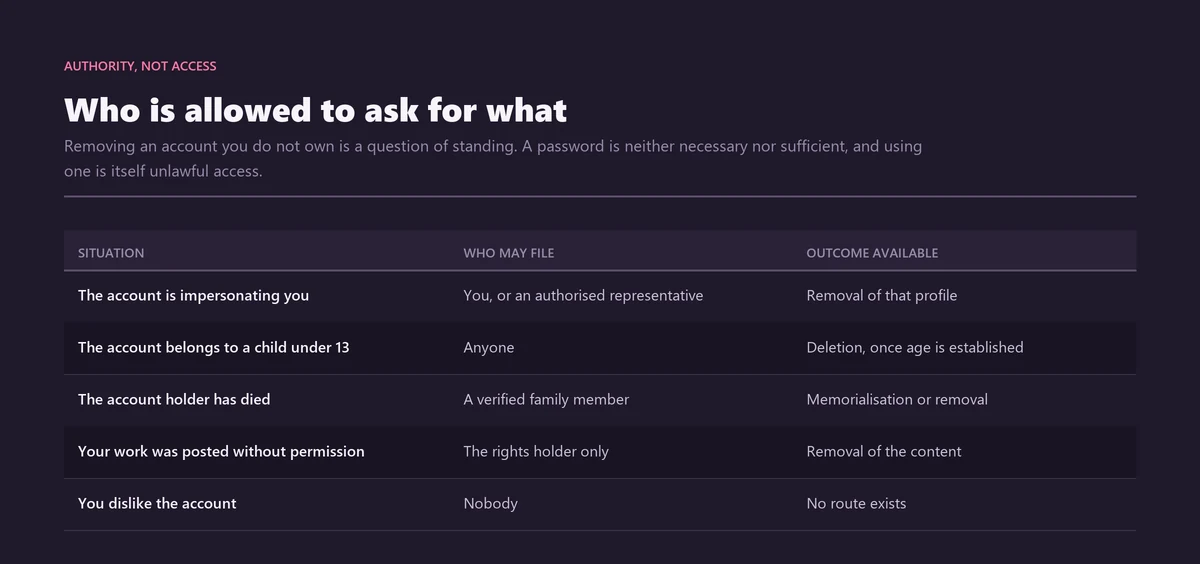
Five categories of person, plus Meta itself. The account owner, anyone filing the under-age report, the lawful representative of someone who has died, an authorised representative of a medically incapacitated user, and a verified rights holder. Everybody else can report, and a report is a request for enforcement, not a deletion.
| Who is asking | Route open to them | What Meta requires | Realistic outcome |
|---|---|---|---|
| The account holder | Delete Your Account, in settings | That account's password | Deletion after a 30-day window |
| Anyone, where the holder is under the minimum age | Under-age report form | The username, filed logged out | Deletion if age cannot be verified |
| Verified immediate family or lawful representative of a deceased user | Deceased-user removal request | Proof of death and proof of authority under local law | Profile removed |
| Anyone able to prove a death | Memorialisation request | An obituary or news article link | Profile frozen as a memorial |
| Authorised representative of an incapacitated user | User Requests review | Proof of Authority plus medical documentation | Account removed on review |
| The impersonated person or their authorised representative | Impersonation form | A photo of that person holding government ID | Account disabled if the claim holds |
| Rights owner or their agent | Copyright or trademark report | Ownership evidence; your details are passed on | Content or account removed |
| Anyone at all | Community Guidelines report | Screenshots, links and context | Warning, restriction or disablement |
| Meta | Its own detection and enforcement | Nothing from you | Any of the above |
Read the right-hand column before the left. Only a handful of rows end in the word deleted, and they are rarely the rows people try first. A stranger filing an impersonation report on your behalf gets nothing, because Meta restricts that form to the person being impersonated. That same stranger reporting the same profile as under-age can have it deleted outright.
That asymmetry is the whole subject. Same profile, same reporter, same evidence, opposite results, decided by which door was used. If you want the four removal outcomes hiding behind the word "deleted" set out in sequence, the four official routes to getting someone's Instagram deleted covers each one in turn.
Is it illegal to delete someone else's Instagram account?
Where you do it by getting into the account, yes, in most jurisdictions. Using credentials you were not given is unauthorised access, and it stays unauthorised when you guessed the password, when a friend passed it on, and even when the account is impersonating you. Being the victim creates no right of entry.
In the United States that sits under the Computer Fraud and Abuse Act, 18 U.S.C. § 1030, which turns on access without authorisation rather than on the damage done afterwards. In the United Kingdom, section 1 of the Computer Misuse Act 1990 covers unauthorised access to any program or data held in a computer. Wiping the contents once inside engages section 3 as well.
Neither statute has a self-help exemption. A court that accepts you were impersonated will still treat the login as an offence. The remedy the law offers you is the platform's own process, not a key to the front door.
Which report actually ends in deletion rather than a disable?
The under-age one. Where Meta cannot confirm that the person behind an account meets Instagram's minimum age, it removes the account rather than restricting it. That is the clearest deletion commitment attached to any third-party report, and the form sits open on the web with no login required to use it.
The threshold itself is not a single number. Thirteen covers most of the world. Several jurisdictions set it higher, and Australia's under-16 rules moved it again, so an account that is perfectly compliant in one country is reportable in another. Get the country right on the form, because it decides which rule gets applied.
- Open the report form for an Instagram user under the minimum age while logged out, so nothing ties the report to your own profile.
- Enter the username exactly, with no @ symbol and no profile URL wrapped around it.
- Give the country you believe the account holder lives in, because the age threshold follows local law.
- Add only what you genuinely know about the person's age. Do not invent a birthday to make the form look stronger.
- Submit, and expect nothing back: no confirmation email, no case number, no queue you can check later.
The form asks for a username and almost nothing else, which reads like a weakness until you see where the work actually goes. Meta shifts the burden onto the account holder, who is asked to verify their age. It is the failure to do that, not the strength of your evidence, which triggers the removal. Nobody adjudicates your submission, because nobody asked you for one.
That design is exactly why the route should never be pointed at an adult. A false filing burns a real one, and Meta treats coordinated false reporting as inauthentic behaviour in its own right, which makes a pattern of bad reports actionable against the person doing the reporting.
How do you delete someone else's Instagram account without a password?
You do not delete it at all. You ask Meta to remove it, and that request is judged on documents and standing rather than credentials. The phrase assumes a password is the missing ingredient. It is not. The only route that needs one is the owner deleting their own account.
Every other route turns on proof. A death certificate. A photo of an ID held up to the camera. A registered trademark. Change the evidence and the outcome changes; change the person filing and it changes again. No software sits in that gap, because the gap was never technical in the first place.
This is why automation pitches fail on inspection rather than on principle. Whether a product calls itself an Instagram mass report bot or a spam report bot for Instagram, it is submitting the same open form you can submit yourself, faster, and from accounts Meta can see are coordinated. Speed was never the constraint. Standing is.
Volume is the wrong variable regardless. Meta's own Integrity Reports for H1 2026 record more than 159 million scam adverts removed across 2025, with 92% of them taken down before anyone reported them. Detection does most of the work. Your report's job is to be correct and correctly addressed, not to be one of a hundred.
What proof does each removal route actually demand?
A different document each time, and the wrong one sinks the request quietly. Meta reviews these individually and states that a request may be rejected or sent back for clarification, so a filing with a missing certificate is not a draft you can return to. Gather the paperwork before you open the form.
| Route | Document Meta asks for | Who it must come from | Does it stay anonymous? |
|---|---|---|---|
| Under-age report | The username, and the holder's country | Anyone | Yes |
| Memorialisation | An obituary or news article link | Anyone, no Instagram account needed | Not applicable |
| Deceased-user removal | Proof of death, plus proof of authority under local law such as letters of administration | Verified immediate family or lawful representative | No |
| Incapacitated user | Proof of Authority and medical documentation confirming incapacitation | Authorised representative | No |
| Impersonation | A photo of the impersonated person holding government-issued ID | That person, or an authorised representative such as a parent | Yes, to the reported account |
| Copyright or trademark | Evidence you own the right, plus your contact details | Rights owner or their agent | No, your details go to the poster |
| Community Guidelines | Screenshots, links, dates and context | Anyone | Yes |
Two rows deserve a second look. Copyright and trademark reports are not anonymous: Meta passes your name and contact details to the person you reported, which matters a great deal when that person already frightens you. And "Proof of Authority" is Meta's own term, set out in its User Requests standard alongside the medical documentation it expects with an incapacitation request.
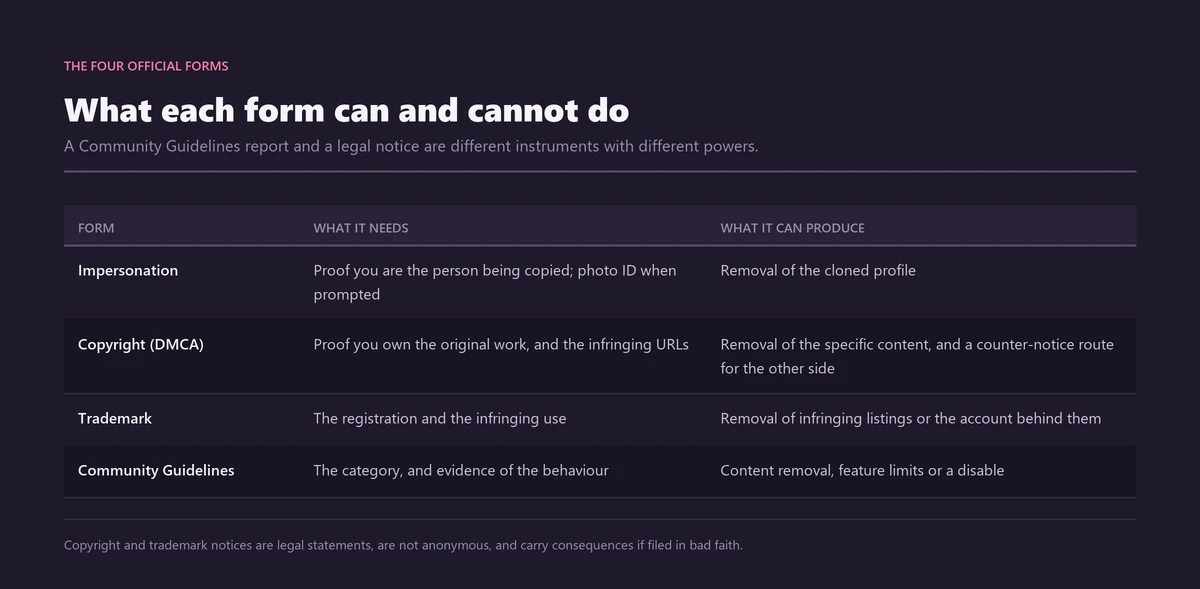
Scan or photograph everything in one sitting, name the files plainly, and read the form's own wording before you upload. Most rejections we see are not weak cases. They are strong cases filed on a form that could never deliver the outcome the person was hoping for.
How do you delete a deceased family member's Instagram account?
Through the deceased-user removal request, and only if you are a verified immediate family member or the lawful representative of the person or their estate. Instagram's Help Centre asks for proof of death and proof of your authority under local law. Memorialisation is open to anyone, on much lighter evidence.
The two requests are not interchangeable, and one cannot easily be undone into the other, so the family should settle which outcome it wants before anyone starts typing. Removal takes the profile down for good. Memorialisation freezes it in place and keeps it visible to the people who want it there.
- Agree, as a family, whether the profile should come down or stay standing as a memorial.
- Scan the death certificate and, for removal, the document proving your authority: a birth certificate showing the relationship, letters of administration, or the local equivalent.
- Open the Instagram Help Centre page for a deceased person's account and choose the request that matches the decision.
- Upload everything in a single pass, because there is no case number to quote afterwards and no saved draft to come back to.
One detail catches families badly. Meta will not hand over the login to a memorialised profile, whatever documentation you provide, so any plan that starts with getting inside the account to tidy it first does not survive contact with the policy. No processing time is published for either request, by Meta or anyone else with standing to know.
What is the difference between memorialising and deleting an Instagram account?
Deletion removes the profile. Memorialisation preserves it and locks it: the account stays up, but nothing about it can change again. Families who arrive wanting deletion frequently choose memorialisation once they understand the mechanics, because deletion erases the photographs along with the account.
- The word "Remembering" appears beside the person's name.
- Nobody can log into the account, including family members who have the password.
- Posts, comments, likes, followers and tags are frozen exactly as they were.
- The profile stops appearing on public surfaces such as Explore.
- The username stays attached to the memorial and does not return to the pool.
Read that last point before you promise anyone a handle. A memorial keeps its username indefinitely, and Meta has never published a rule releasing usernames from removed accounts either. Anyone selling you a specific name on a specific date is selling a timing they have no way to influence, and charging for the wait.
The choice is also one-directional in practice. A removed profile cannot be brought back and memorialised later, and Meta offers no undo once it has acted on a removal request. If the family is split, memorialise first; the option to request removal afterwards still exists, and the reverse does not.
What does "permanently deleted" actually mean on Instagram?
It means a defined process that only the account holder can start. Requesting deletion opens a 30-day window in which logging back in cancels the whole thing. After that, Meta says the profile and its information are permanently deleted and cannot be retrieved, with up to 90 days to finish removing posted content.
Then comes the caveat few pages quote. Meta states that copies of content may remain in backup storage after the 90 days, kept so it can recover from a disaster, a software error or another data-loss event. The profile is gone from Instagram. The backups are a separate system with a separate purpose.
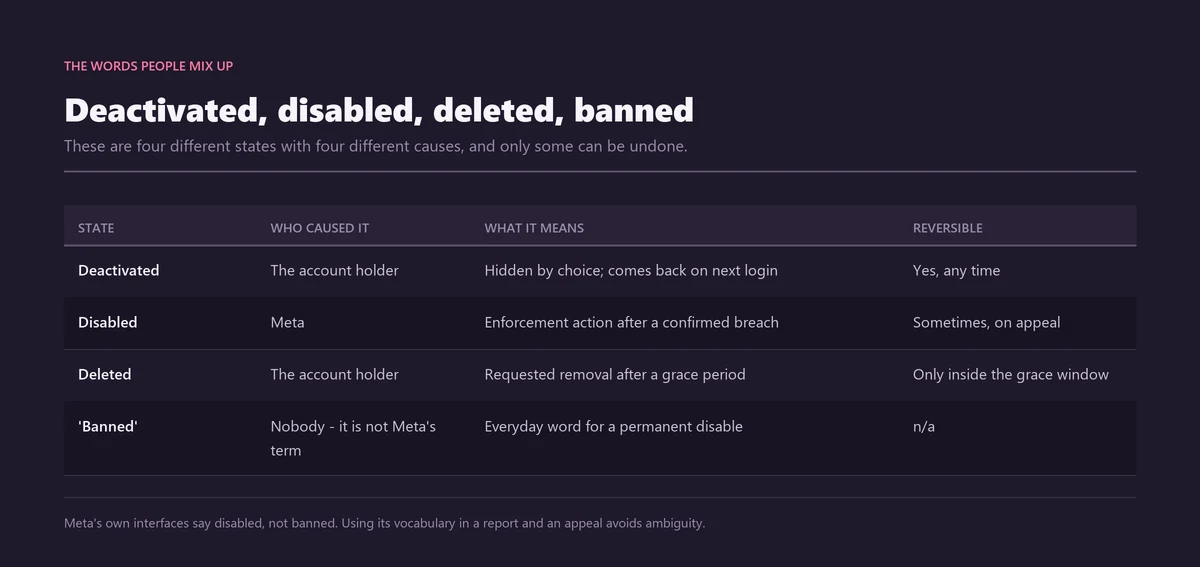
The distinction that trips everyone up is deleted versus disabled. A disabled account is hidden and appealable; Meta publishes no statement that it is ever erased and no retention period for its data. So anyone telling you they can delete someone's Instagram account permanently through a report is claiming more than Meta does. What actually makes an Instagram ban stick deals with the appeal that usually follows a removal.
Only one mechanism on Instagram produces a genuine, irreversible deletion, and it runs on the owner's password.
What if the account is on your phone, or used to be yours?
Neither of those is a deletion problem, and treating them as one makes the situation worse. A profile left signed in on your device needs logging out. An account that was yours until somebody took control of it needs recovery, which is a different set of forms with a different goal entirely.
Their account is still signed in on your device
Use the account switcher and remove the session. That takes the profile off your phone and leaves the account untouched, which is almost always what the person actually wanted. Deleting from a session someone left open would mean using their live credentials to destroy their account: a breach of Instagram's terms and, depending on where you live, a criminal offence.
The account is yours and someone else is running it
Start at instagram.com/hacked, or the login-help flow, where a security code or a video selfie proves ownership and hands the account back. Recover first, then decide. Once you are back inside, deleting is a settings screen away and entirely lawful, because it is your account. Reporting your own stolen profile for impersonation usually stalls instead, since that form is built around proving who you are rather than who took it.
Will Instagram delete an account just because you asked?
No. Every removal is a platform decision applying Meta's own policies, reviewed case by case, and Meta says plainly that a request may be rejected or sent back for clarification. A removal is not a court-ordered deletion. It carries no legal finding and sets no precedent for the next report you file.
That matters practically, not just philosophically. Because it is a policy decision, the other side can appeal it, which is why an account you got taken down can reappear a fortnight later. It also means your case is measured against a written standard rather than against how upset you are, and the language of that standard is what your evidence should mirror.
In the EU and EEA there is a formal escalation. The Digital Services Act gives users an internal complaint route under Article 20 and, under Article 21, access to a certified out-of-court dispute settlement body such as the Appeals Centre Europe. Those bodies review the decision and issue an outcome, but the Regulation does not make that outcome binding on the platform.
A court order does not open a separate door either. Meta's Law Enforcement Guidelines route private parties, civil litigants included, back to the ordinary Help Centre, and the records portal is limited to authorised law enforcement. An order works by compelling the person who holds the account, not the company hosting it.
Who is selling "guaranteed" Instagram deletions, and what are they selling?
Two things, usually to the same person in sequence. First a ban, bought for a small fee and produced by abusing Instagram's most sensitive report categories. Then, once the target is desperate enough, the restoration. The second sale is worth far more than the first, and that is the entire business model.
Vice reported operators charging around $60 to get an arbitrary account banned, and ExpressVPN documented the same market. The method was not clever. Copy the target's name, bio and profile photo onto a controlled account, then report the genuine profile for impersonating it. The self-harm and suicide categories were abused the same way, precisely because they are the ones Meta acts on fastest.
Consequences did arrive. Meta sued Idriss Qibaa in early 2025 over a business it described as selling the ability to disable and reinstate accounts, and he was sentenced in May 2025 to 36 months in prison, with a $75,000 fine and $200,000 in restitution, after extorting people whose accounts he had taken down. Vice's original reporting described the restore side as the profitable half.
The volume pitch belongs to the same family. Buying a hundred reports on one profile changes nothing about whether the profile broke a rule, and it hands Meta a coordination signal instead; whether mass reporting an Instagram account bans anyone works through the arithmetic in full.
How do you match your case to the route that can actually work?
Start from the harm, never from the outcome you want. The harm decides which form exists, the form decides who may file it, and the filer decides what proof is required. Working backwards from "I want it deleted" is how people end up on the one form that cannot deliver deletion.
- A profile using your name and photographs: the impersonation form, filed by you or an authorised representative, with a photo of that person holding government ID.
- An account run by someone under the minimum age: the under-age form, filed logged out, with the username and country.
- A relative who has died: memorialisation or removal, depending on what the family has decided.
- Scams, threats, harassment or stalking: a Community Guidelines report, whose ceiling is disablement rather than deletion.
- Your own stolen account: recovery first, every single time.
File once and file properly. There is no queue to check and no case worker to chase, so the first submission is effectively the only one that counts. If the profile has clearly broken a rule but you cannot tell which category fits, matching a violation to the right reporting route is the piece worth reading before you touch a form. If you have been quoted a price by a paid Instagram reporter tool, check which form it is actually filing before you pay for it.
Where a case is genuinely borderline, get a second read before filing rather than after a rejection. Send the handle and dated screenshots through our contact page, or work through the rest of the solutions library first. We take on genuine Community Guidelines or legal violations and file them through Instagram's own channels. We do not touch accounts that are merely disliked, and no honest service can tell you Meta's answer in advance.
Sources
- Meta Transparency CenterUser Requests | Community Standards
- Instagram Help CentreRequest the removal or memorialisation of a deceased person's Instagram account
- Instagram Help CentreDelete your Instagram account
- Instagram Help CentreReport an Instagram account of someone under the minimum age
- Instagram Help CentreReport an account impersonating you on Instagram
- Meta Transparency CenterIntegrity Reports, H1 2026
- Legal Information Institute, Cornell Law School18 U.S. Code § 1030 — Fraud and related activity in connection with computers
- Appeals Centre EuropeAppeals Centre Europe, certified out-of-court dispute settlement body
- Federal Trade CommissionFTC Begins Enforcing the TAKE IT DOWN Act
- ExpressVPN BlogHow Fraudsters Ban Instagram Accounts
Frequently asked questions
Can you delete someone else's Instagram account if you have the password?
No, not lawfully. The deletion screen will accept the password, so the act is technically possible, which is exactly why people assume it must be allowed. Using credentials you were not given is unauthorised access under the US Computer Fraud and Abuse Act and the UK Computer Misuse Act 1990, and being impersonated by that account creates no exemption.
Is it illegal to delete someone else's Instagram account?
In the United States and the United Kingdom, yes, where deleting it means accessing an account you have no authority over. The offence is the unauthorised access itself, before any damage is even considered. Asking Meta to remove an account through an official form is entirely lawful. Doing it yourself through the account holder's login is not.
How do I delete my child's Instagram account?
If you know the login, use Delete Your Account in the app's settings, which opens a 30-day window before permanent deletion. If you do not have the login, file the under-age report with the username and your country. Meta removes accounts where it cannot verify that the holder meets Instagram's minimum age for that jurisdiction.
How do I delete a deceased family member's Instagram account?
Use the deceased-user request in Instagram's Help Centre. Full removal is limited to verified immediate family members or the lawful representative of the person or their estate, and requires proof of death plus proof of your authority under local law. Memorialisation is open to anyone who can supply an obituary or a news article link.
What is the difference between memorialising and deleting an Instagram account?
Deletion takes the profile down. Memorialisation leaves it visible, adds "Remembering" beside the name and freezes it: nobody can log in, and posts, comments, likes, followers and tags stop changing. The profile also disappears from public surfaces such as Explore, and the username stays attached to the memorial indefinitely rather than returning to the pool.
Does a disabled Instagram account get deleted?
Meta does not say so. Its disabled-account pages describe a profile that stops being visible while an appeal route stays open, with no statement that the data is erased and no retention period published anywhere. Treat disabled as hidden and reversible. Deletion is a separate process, and only the account holder can start it.
How long does Instagram take to act on a reported account?
There is no published figure, for any route. Meta reviews requests individually and says one may be rejected or sent back for clarification, but it commits to no timeframe at all. Severe categories move faster because they are prioritised internally. Any page quoting 24 to 48 hours has invented that number outright.
Can you delete an Instagram account with a court order?
Not directly. Meta's Law Enforcement Guidelines route private parties, including civil litigants, back to the ordinary Help Centre, and its records portal is restricted to authorised law enforcement. A court order works by compelling the account holder to delete or hand over the account. It does not open a channel into Meta for you.
Can you claim a username after the account holding it is removed?
Sometimes, and never on a schedule anyone can promise you. Meta publishes no rule returning handles to the pool after a removal, and memorialised profiles keep theirs indefinitely. If a username genuinely matters, register a close variant now rather than waiting. Any service guaranteeing a specific handle by a specific date is selling timing it cannot control.