Safety reports·Threats, doxxing and the queue each one lands in
Instagram threats and doxxing: the report route each one needs
Search for Instagram threats and the first page of results is about malware. Phishing kits, credential stealers, fake brand messages. Almost none of it is written for the person who opened their message requests last night and found out what a stranger intends to do to them.
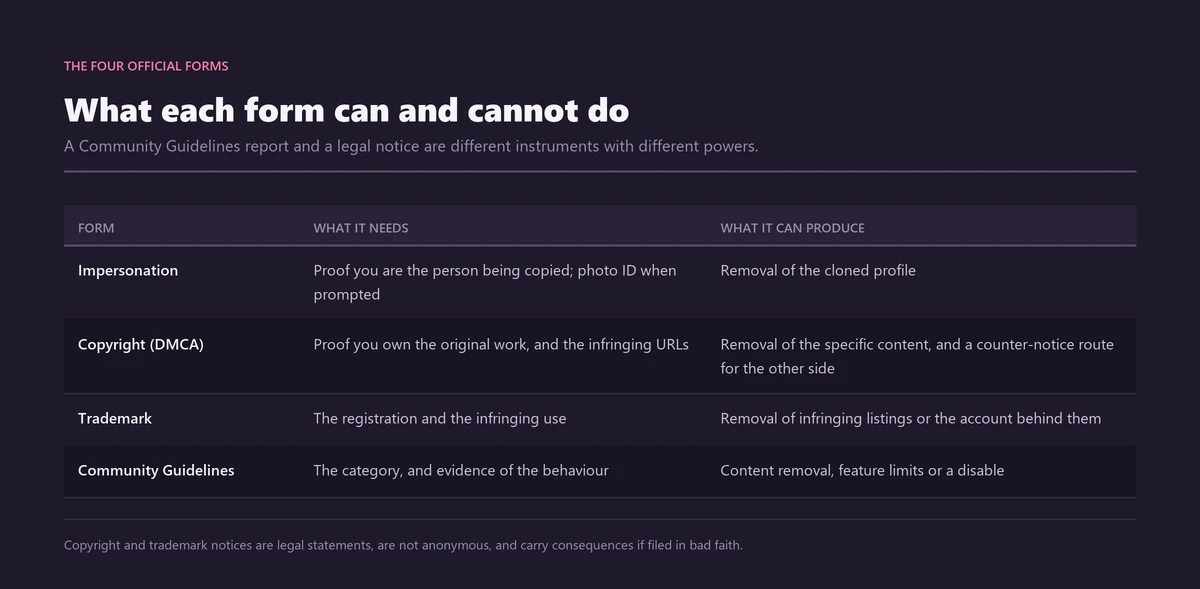
Instagram threats and doxxing go to two different Meta queues. Violent threats belong in the in-app Report flow under Violence, doxxing in the privacy violations form, and stolen photos in the copyright form. Picking the wrong one sends your evidence to reviewers testing the wrong policy.
Two different things get called Instagram threats
One is a security category and one is a person. Search engines currently serve the security category, because vendors write more about phishing than victims write about being frightened, and a query about Instagram threats returns listicles on malware, fake login pages and account takeovers.
This page is about the other one. Someone has written something to you or about you that made you check your locks, and you want to know where that goes. Threats on Instagram are handled under Meta's Violence and Incitement standard and doxxing under Privacy Violations, two separate rulebooks with separate review teams behind them, and nothing in the app tells you so.
That distinction is not academic. A doxxing post reported as a threat gets tested against a policy about violence, fails because a home address contains no violent language, and comes back cleared.
Same post, same evidence, correct queue, different answer. If you are new to how any of this gets decided, the wider map of routes on this desk's home page and the full catalogue of reporting solutions both start from one principle: category is the whole case.
What counts as a threat under Meta's rules?
Credibility, not tone. Meta's Violence and Incitement standard removes "language that incites or facilitates violence and credible threats to public or personal safety", and the same policy admits in its own rationale that people "commonly express disdain or disagreement by threatening or calling for violence in non-serious ways".
That admission is the reason so many reports come back cleared. Meta reads context, and reviewers are trained to separate a furious hyperbole from a statement someone might act on. Instagram death threats sit at the sharpest end of that scale, and a message that names you, names a place, or names a time is far more likely to be read as credible than the same threat shouted into a comment thread with no target attached.
Four things push a threat towards the credible end in practice: a named target, a location, a timeframe, and evidence the person can reach you. Send all four in the same capture where they exist. A message that says "I know you finish work at six on Grove Road" carries no violent verb at all and is still one of the strongest reports you can file, because it demonstrates capability rather than temper.
Threats attached to a demand are a different animal and take a different route. If somebody is threatening to publish something unless you pay, that is extortion, and the sequence for it is laid out in the first-hour plan for Instagram extortion. If the account making the threat is wearing your name or your face while it does so, the impersonation route runs in parallel and is covered in impersonation and blackmail reporting. Both can be filed alongside the violence report; they are not alternatives to it.
How to report threats on Instagram, step by step
Report the message or post, not the profile, unless the whole account exists to threaten people. The in-app route is five decisions long and only two of them are obvious.
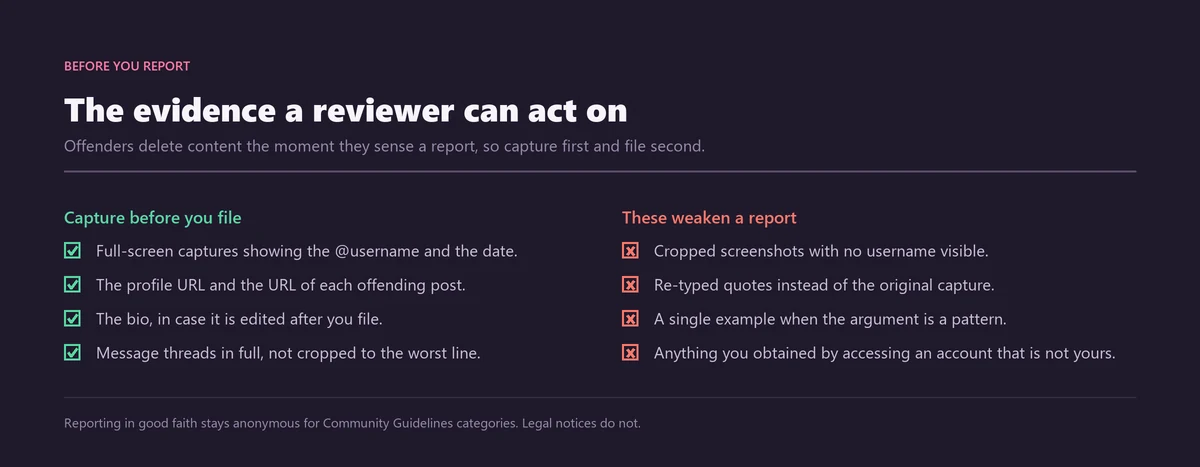
- Capture before you touch anything. The username, the message and the date in one frame, then the profile as a second shot, then the profile URL copied as text. Every control you are about to use removes the account from your view, and evidence you can no longer reach is evidence you no longer have.
- Open the three-dot menu on the item itself. On a threatening DM this means the conversation or the individual message; on a comment it belongs to the comment row; on a Story it is the share menu inside the Story. Reporting the profile instead files a different report against a different object.
- Choose Report, then read the reason list properly. Nothing is sent yet. The category you pick is the policy a reviewer will test your evidence against, so an Instagram violence report needs the violence or credible-threat branch, not the generic bullying one that sits above it.
- Give the detail the form asks for. Instagram asks for links, usernames and a description of the content so it can find and review the item quickly. A description that quotes the threatening words back is worth more than one that summarises the mood of them.
- Block, restrict or mute afterwards, never before. These take effect immediately and the report does not. Doing them in the other order is the single most common way people destroy their own case in the first ten minutes.
Where Instagram threatening messages hide before you can report them
A request you have never opened is a request you cannot report. Message requests sit outside your inbox until you tap into them, so open the conversation, capture it, then report it from inside. A surface-by-surface walkthrough on reporting a Story, post, DM or Reel covers where each control hides, and if the threat arrived in a public reply the mechanics differ again, which is the subject of reporting a comment and what follows it.
What an Instagram violence report has to contain
Links, usernames, dates and the words themselves. Everything else is optional. Where you have no account at all, or the content sits inside a profile you cannot see, the in-app route is closed to you, and Meta's standalone contact forms become the logged-out alternative — the same forms the app funnels into.
The routing table: threats, harassment, doxxing and stolen photos
Four complaints that feel identical to the person making them land in four different places. This is the table we build every case from, and the column that surprises people is the last one.
| What happened | Meta policy it breaks | Where it goes | Anonymous? |
|---|---|---|---|
| Threat of violence, death threat | Violence and Incitement | In-app report, violence branch | Yes |
| Pile-on, insults, sustained targeting | Bullying and Harassment | In-app report, or the standalone harassment form | Yes |
| Home address, phone number, workplace posted | Privacy Violations | Privacy violations form | Yes |
| Your photographs reposted by someone else | Intellectual property | Copyright form | No |
Read the last column before you file anything. Instagram states that a report is anonymous except when you are reporting an intellectual property infringement, which means the Instagram stolen photos route is the one case where your name and email address are passed to the person you are reporting. When the person holding your pictures is also the person threatening you, that is a serious decision rather than a formality, and it is worth taking the violence and privacy routes first and the copyright one later, or through a representative.
Is there a separate Instagram abuse report form?
No, and this trips people up constantly. Type Instagram report abuse into a search bar and you get a dozen pages describing one of two existing doors as though it were a third. There is one bullying-and-harassment contact form and one in-app flow, and the search phrases all point at that same pair of doors: an Instagram harassment report filed in the app and an Instagram abuse report filed through the form reach the same policy team. What differs is whether you need an account to reach them. So an Instagram abuse report form and an Instagram report harassment form are the same document with two names people have given it, and hunting for a third one wastes the hour that matters most.
Meta rotates the direct URLs of its contact forms without notice, which is why we reach every form through its Help Centre article rather than a bookmark, and why a form link copied from a three-year-old blog post so often lands on an error page. A current inventory of live routes, with what each one asks for, sits on the Instagram reporter tool page. Commercial accounts have two extra doors again, covered in reporting a giveaway or business account, and if the threatening account has taken a handle that belongs to you, the separate username release routes apply on top.
Instagram doxxing is a privacy report, not a harassment report
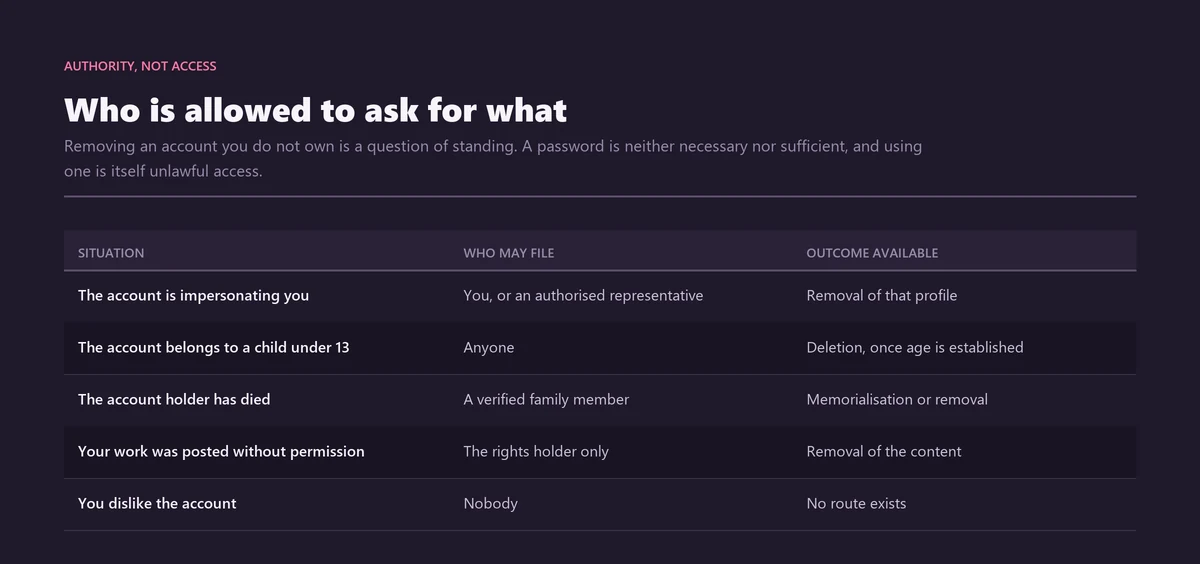
File it under Privacy Violations and it is judged on what was published. File it under harassment and it is judged on how someone spoke to you, which a bare address does not do. That single misrouting is why so many people conclude Instagram does nothing about doxxing on Instagram when what actually happened is that their evidence was measured against the wrong rule.
Meta's Privacy Violations standard is unusually specific about what counts, and the specificity is useful to you because it tells you which sentence of your report to write first. The policy bars national identification numbers such as social security numbers, passport numbers or individual taxpayer identification numbers. It bars "full private residential addresses of others, including building name or pins on a map identifying the address". It bars personal contact information, bank account numbers with security or pin codes, card details with validity dates, and medical or biometric information taken from official documents. There is also a partial-address rule that almost nobody quotes: a street, a city, a postal code or a GPS pin becomes reportable when it is shared in the context of organising protests or surveillance, and a city alone qualifies where the population is under 50,000.
Quote the matching clause in your report. Instagram doxxing policy language in your own description does more work than an emotional account of the harm, because the reviewer's job is a policy match, and you have just done half of it for them. Write which category the post falls into, then the URL, then the harm. In that order.
People search for Instagram doxx and Instagram doxxing as if they were separate things, and the underlying question is almost always the same one: my details are up, how do I get them down. The answer to how to report doxxing on Instagram is the privacy violations contact form, which loads while logged out, and which asks whether the content involves you, your child under 13, or someone you legally represent. That eligibility question is the gate. A friend cannot file it for you, which is the single most common reason a doxxing report is closed without action.
Doxxing rarely arrives alone. Where it comes with monitoring, following or repeated contact from new accounts, the sequence in the evidence-first plan for a stalking case is the one to run, and it puts the police contact earlier than most people expect. And because so many people hesitate at the report button for fear of retaliation, it is worth reading what Instagram does and does not disclose, set out on whether Instagram tells anyone who reported them.
Why Instagram's doxxing policy changed in 2022
Because a post used to be allowed if the address was findable somewhere else. On 8 February 2022 the Oversight Board published its first ever policy advisory opinion, on the sharing of private residential information, and made 17 recommendations to Meta.
Its central recommendation was to remove the exception permitting private residential information to be shared when it was considered publicly available. Board members reasoned that public records take effort to obtain while a social post spreads in hours, so treating the two as equivalent understated the real-world risk. Meta agreed and committed to closing the loophole in April 2022. The current standard carries no publicly-available defence, which is why an address lifted from a property register is reportable today and was arguably not in 2021.
One recommendation Meta has never delivered is worth knowing about, because its absence shapes what you should expect. The Board asked for "a specific communications channel for victims of doxing, available to both people who use its platforms and those who do not", with priority handling. No such channel exists. What you have instead is the same contact form as everyone else, which is why a doxxing case that is genuinely urgent needs a parallel police report rather than patience. What a filed report actually sets in motion is unpicked on what reporting someone on Instagram does.
When should you stop reporting and call the police?
The moment a threat names a place, a time or a weapon. Instagram's own guidance points the same way: when a conflict appears to have become a credible threat, contact local authorities, who are in a position to assess it and intervene in a way a content reviewer cannot.
Expect friction at that door too. In a Washington Post opinion piece on 3 November 2022, Sherry Hakimi described receiving death threats through Instagram and being told by local police that they had no jurisdiction and that she should contact Meta, while Meta's own channels produced no response even after an internal escalation. Her argument was that Instagram users need a dedicated way to report death threats. Four years on, they still do not have one, and the gap she fell into is the same gap cases fall into today.
Name the law when you go. There is no single federal doxxing offence in the United States, but 18 U.S.C. § 2261A, the federal stalking statute, reaches electronic communication used to cause substantial emotional distress or reasonable fear of serious bodily injury, and carries up to five years. More than fifteen states now have statutes addressing doxxing or the publication of personal information directly; Kentucky's 2021 law, which made publishing personally identifiable information with intent to harass a Class A misdemeanour, was among the first. An officer who is unsure whether an online threat is their business responds differently to a complaint that cites a statute.
What will not help is volume. Recruiting friends to pile reports onto the same account does not accelerate anything, because Meta judges a report on whether the content breaches a standard, and coordinated reporting is itself discountable under the inauthentic-behaviour rules. That arithmetic is worked through on how many reports it takes to delete an account, the tooling claims are dismantled on mass reporting an Instagram account, and the software sold for it is examined in the mass report bot anatomy. Every hour spent on that is an hour not spent on the police report that can actually compel something.
What Meta's 2025 enforcement retreat means for your report
It means the burden moved onto you. On 7 January 2025 Meta announced it was scaling back proactive enforcement in three areas specifically: violence and incitement, hateful conduct, and bullying and harassment. Those are the exact three policies a threat or a doxxing post falls under, and the change shifted detection from automated systems towards user reports.
Measured effects are large, with a caveat you should hold onto. The Center for Countering Digital Hate analysed nearly 8 million Facebook comments directed at members of Congress across two six-month windows either side of the change and published the results as Safety Off on 9 June 2026: violent threats rose from 1,800 to 7,600, hate from 6,900 to 30,000, and harassment from 15,700 to 39,900. That caveat matters: this study looked at Facebook comments aimed at public officials. Nobody has published an Instagram equivalent, and anyone quoting those numbers as Instagram figures is inventing the attribution.
Two published figures from Meta round the picture out. Its Q3 2025 integrity reporting put Instagram enforcement precision above 87%, meaning roughly one action in eight was wrong, and Meta stated separately in January 2025 that one to two of every ten enforcement actions may have been mistakes. So a cleared report is not proof your evidence was weak, and a removal is not proof the system is working well. Both are appealable, and appealing is normal rather than exceptional.
In practical terms, a well-built single report now outperforms what a scattergun approach could ever reach, because there is less automation catching things before you get there. Account-level thresholds that decide whether anything durable happens are covered in what actually gets an account banned, the form-and-proof mechanics in getting an account taken down and the takedown route itself, and the question of whether any of it lasts in what makes a ban permanent.
If the account comes back under a new handle
Report it as ban evasion, not as a fresh threat. Meta's account integrity rules cover accounts created or repurposed to evade a previous removal, and a report filed on those grounds carries the history of the earlier case with it, which a new report starting from zero does not.
Say so explicitly in the description. Give the old handle, the date it was actioned, the new handle, and what makes them the same person: the same photographs, the same followers, the same phrasing in the first message. We filed one of these in March for a client whose harasser had rebuilt three times in five weeks, and the version that finally stuck was the one where we stopped describing the threats and started describing the pattern of rebuilding. The removal followed in nine days.
Here is the commitment, and it is a narrow one. File the violence report, file the privacy report separately if details were published, take the same bundle to the police the same day, and treat the copyright form as a later and separate decision because it carries your name. Do not wait to see whether one queue works before starting the next; they do not talk to each other. Where an account keeps returning or the case has outgrown a form, the routes for ending an account entirely are set out in getting an Instagram account deleted and who actually holds that authority, and what a paid desk can and cannot promise is written plainly on Instagram ban as a service. Instagram Ban Service prepares and files the reports and escalates where a route allows it; Instagram makes every decision about the outcome. If you want a case looked at, open a file with the desk and send the captures you already have.
Sources
- Meta Transparency CenterIntegrity reports, Q3 2025: Instagram enforcement precision above 87%
Frequently asked questions
Does Instagram take death threats seriously?
Meta's Violence and Incitement standard removes credible threats to personal safety, and a direct death threat naming you is the clearest case it recognises. Whether a reviewer agrees depends on the wording and the context around it, so file the report and take the same evidence to the police rather than waiting on one queue.
Is doxxing against Instagram's rules even when the information is public?
Yes, and that changed in 2022, when Meta accepted an Oversight Board recommendation and dropped the exception allowing private residential information to be posted merely because it was available elsewhere. Today's Privacy Violations standard bars full private residential addresses, including a building name or a pin dropped on a map, with narrow exceptions for charitable appeals and missing-person searches.
Can you report threats on Instagram without an account?
Yes, through Meta's standalone contact forms rather than the in-app menu. Privacy, harassment and copyright forms all load while logged out. The three-dot route does not. It needs an account and needs you to be able to see the content, which rules it out for anything sitting inside a private profile.
Will the person know I reported their threat?
They may learn the content was reported. They are not told by whom, because Instagram states that reports are anonymous except for intellectual property claims. That exception matters here: if you report stolen photos under copyright, your name and email go to the person who posted them.
How long does Instagram take to review a threat report?
Meta publishes no turnaround for a first review, and the 24 to 48 hours quoted across the web has no source behind it. The only published figure covers a second look: when you request a review of a decision, Meta says the content is looked at again, usually within 24 hours.
What should I screenshot before reporting a threatening message?
Capture the message, the username and the date in one frame, then the profile itself as a separate shot. Add the profile URL as text. Blocking hides the account from you afterwards, which makes a later capture harder, so photograph everything before you use any control that removes it from view.