Report mechanics·Reviewed 8 September 2026·15 min read
What does reporting someone on Instagram do, from the tap to the decision?
You tapped Report, the menu closed, and the profile is still there. Nothing on screen tells you whether a person read it, whether a machine closed it, or whether anything is coming. Here is the whole chain.
Reporting sends one piece of content to Instagram to be checked against one Community Guideline. If reviewers confirm a breach they hide or remove it, and repeat breaches move the account along a strike ladder. It also quietly tunes what your own feed recommends. It never deletes an account on request.
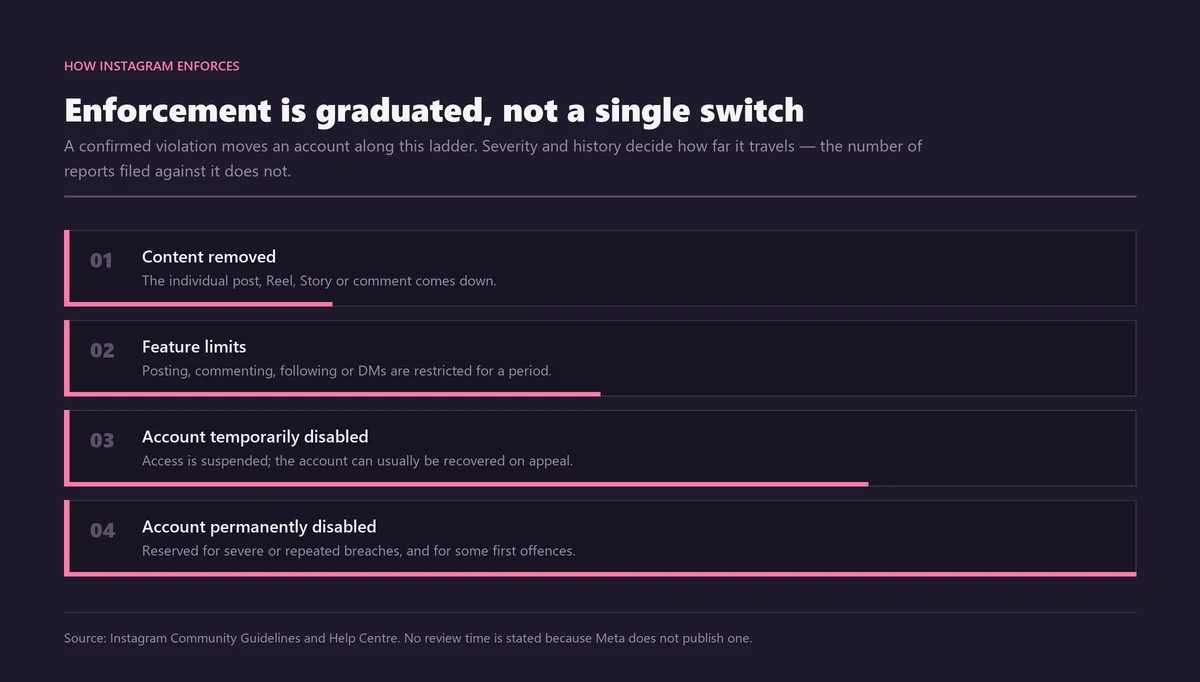
- A report is a request that one item be checked against one rule. Meta's Help Centre states that the number of times something is reported does not decide whether it comes down.
- Reporting also changes your own app: Instagram says it may use your report to show similar content lower in your Feed and recommendations.
- Ten strikes bring a 30-day restriction on creating content. One occurrence is enough in the gravest categories.
- Instagram reviews up to 30 of the most recent messages in a reported conversation.
- There is no undo button. The only official retraction route covers intellectual property claims.
What does reporting someone on Instagram do?
It opens a case. One specific item — a post, a Reel, a comment, a message, or a profile as a whole — is queued for a check against one specific Community Guideline, and the answer to that check does not change because the question was asked twice.
Instagram's Help Centre describes the outcome in a single conditional: "If we find that the content violates our Community Guidelines, we'll take action to hide or remove the content from Instagram." Everything else people expect from the button lives outside that sentence.
The second effect is the one almost nobody mentions, and it fires whether or not the report succeeds. Meta says it may use your report to make content similar to what you reported appear lower in your Feed and in the recommendations it makes for you. So the button has a private function alongside the public one. Even a report that a reviewer closes without action has told the ranking system something about what you do not want to see, which is why the same account can vanish from your Explore tab while remaining perfectly visible to everyone else.
The question arrives in a dozen spellings. What happens if u report someone on instagram, what happens when u report someone on instagram, what does report do on instagram, does reporting on instagram work — each of them reduces to the same mechanism, and the honest answer to does reporting someone on instagram do anything is yes, conditionally: it does something when the content genuinely breaks a rule and the reviewer can see that it does.
What it does not do is count. Meta's Help Centre answers the volume question flatly, stating that the number of times a piece of content is reported does not determine whether it is removed — written for Facebook, and applied through the same review model on Instagram. We take that arithmetic apart with the evidence under does volume ever get anyone banned. Instagram Ban Service exists because the difference between a report that lands and a report that dies is almost never volume, and almost always what the reviewer was given to look at.
How does Instagram reporting work once you press Submit?
Your report joins a queue that is already mostly full of cases nobody reported. Meta's automated classifiers reach the majority of violating content first, and its documentation says technology finds more than 90% of the content it actions before any user flags it.
That statistic reframes what your report is for. You are not switching on enforcement; you are adding a case that the machines missed, usually because it needs context a classifier cannot read — a bio that only makes sense if you know the person being impersonated, a payment demand that reads as ordinary conversation without the screenshots around it. Meta's own description of the split is that technology detects potentially violating content and then sends it to review teams to check and take action on. Where the classifiers are strongest, the gap barely exists: Meta put proactive enforcement against content from designated criminal organisations at 99.6% on Instagram for the first half of 2026.
What happens after you report someone on Instagram
Five steps, in order.
- The report is bound to one item and one reason. The category you tapped becomes the question the reviewer answers. Pick "I just don't like it" and you have asked a question with no policy attached to it.
- Automated systems triage it. Severity decides position. Content that endangers someone is escalated ahead of a spam complaint, and clear-cut breaches can be actioned without a human ever opening the case.
- A reviewer opens what you attached, and nothing else. They see the reported item and the profile it sits on. They do not see your history with this person, your other reports, or the pattern you know is there unless the report itself shows it.
- A decision lands against the rule, not the person. Content is hidden or removed, or the case closes with no action. Only after that does the account-level consequence follow, and only for confirmed breaches.
- The outcome appears in Support requests. More, then Settings, then Help, then Support requests, then Reports. Instagram Ban Service treats this screen as the only real evidence a report existed, because the app sends nothing else.
No published service level governs any of those steps. Instagram has never issued a review deadline, so the "24 to 48 hours" figure that circulates on this subject was invented by the pages repeating it.
What does reporting a post on Instagram do that reporting an account does not?
A post report puts one piece of evidence in front of a reviewer. An account report asks them to judge a profile from its name, photo, bio and recent output, which is a harder question and a slower one.
The distinction matters because strikes attach to violating content. What happens when you report a post on Instagram is that the item is assessed and, if it breaches a guideline, removed — and that removal is what places a strike on the account behind it. What happens when you report an instagram account is that the same machinery runs against profile-level signals instead, which is the right route when the profile itself is the violation: a cloned identity, a shopfront selling counterfeits, a page whose entire purpose is one person's harassment.
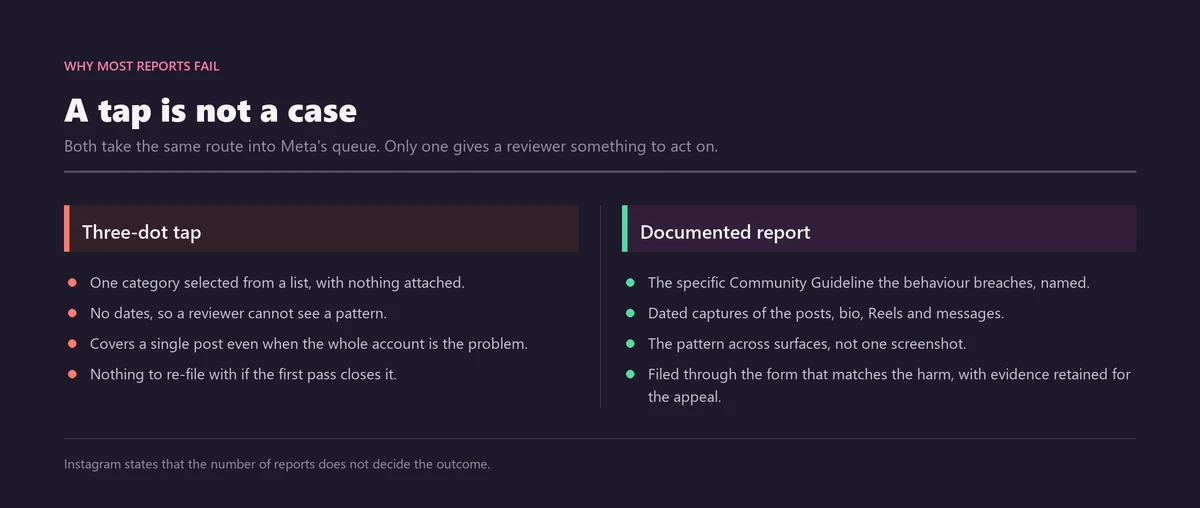
Get this wrong in either direction and the case stalls. Reporting the whole account over a single abusive comment invites a reviewer to look at a profile that mostly complies and close the file. Reporting one post when the account is running a coordinated scam removes a screenshot and leaves the operation intact.
What happens when you report an account on Instagram, in practice, is that you have asked the broader question, so the evidence has to be broader too. Instagram Ban Service files at whichever level the harm actually sits at, and where a profile is impersonating a real person, that means the identity route rather than the content route.
Does reporting an Instagram account delete it?
No. Does reporting an instagram account get it deleted is the most common expectation attached to this button, and the answer is that deletion sits at the far end of a ladder your report can only start someone climbing.
Meta publishes the ladder. A first strike brings a warning. Strikes two to six bring restrictions on specific features for a limited period. The seventh strike carries a one-day restriction on creating content, the eighth three days, the ninth seven days, and from the tenth onward a 30-day restriction. Strikes on Facebook and Instagram expire after one year, and Meta says it will not count strikes on violating content posted more than 90 days ago for most violations, or more than four years ago for severe ones. Complaints filed slowly never accumulate.
| Outcome | What triggers it | Visible to you? |
|---|---|---|
| No action | No breach found, or the category did not match the content | Yes, in Support requests |
| Recommendation demotion | Your report, regardless of the verdict | No — it only changes your own feed |
| Content hidden or removed | A confirmed Community Guidelines breach | Yes, in Support requests |
| Feature restrictions | Strikes two to six on the account | No |
| Content-creation restriction | Strike seven onward, from one day to 30 | No |
| Account disabled | Repeated breaches, or one severe occurrence | Only if the profile disappears |
The single-occurrence route is real but narrow. Meta states that a violation may be severe enough — it names child sexual exploitation content — that it will disable the account after one occurrence. Nothing below that severity band bypasses the ladder, which is why what actually decides a ban turns on category and evidence rather than persistence, and why no report threshold exists to hit.
Deletion, in Meta's vocabulary, is also not the same event as a ban. An account can be deactivated, disabled, or erased, and only some of those states are reversible — we separate them under what makes a removal permanent, deletion route by route, and who actually holds that authority. Instagram Ban Service tells clients which state their case can realistically reach before any filing starts, because the gap between "removed" and "deleted" is where most disappointment with reporting is manufactured.
Report category decides what a reviewer is allowed to act on
The category is not a label on the complaint. It is the complaint. Each route sends the case to a different queue with a different evidence bar and, in two cases, a different consequence for your own anonymity.
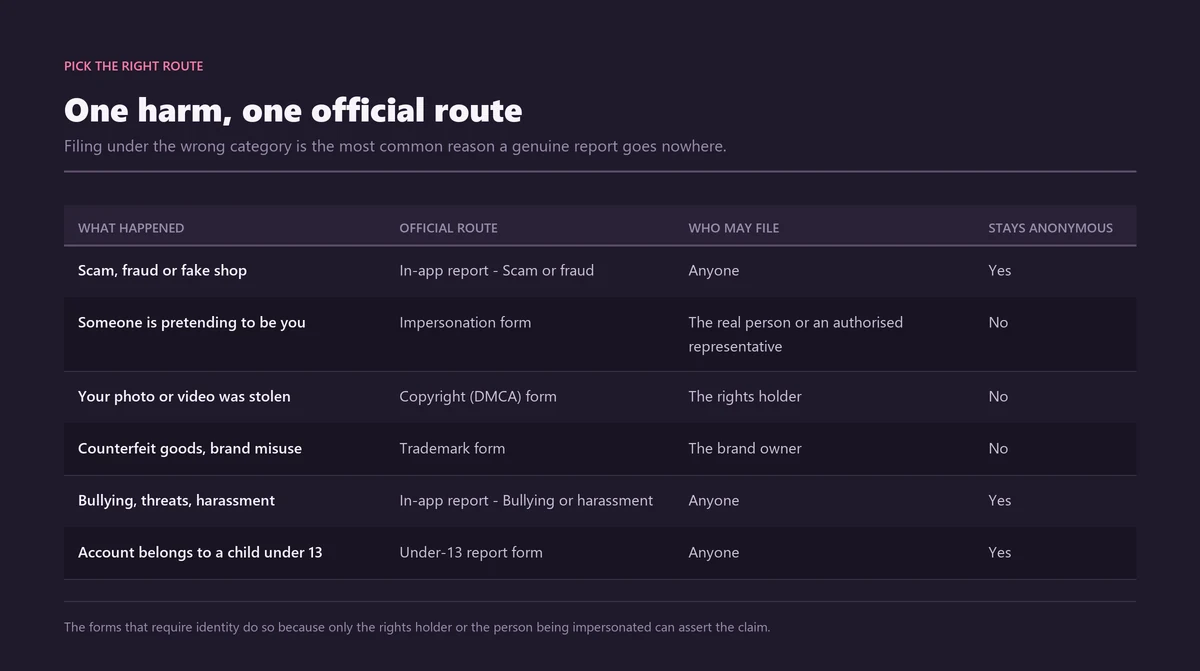
| What happened | What the reviewer checks | Realistic outcome |
|---|---|---|
| Scam, fraud, fake shop | The offer, the payment request, the pattern across posts | Content removal, then account action if the profile is built on it |
| Impersonation of a real person | Identity documents from the person being impersonated | Profile removal, since the account itself is the breach |
| Bullying or harassment | The specific messages or posts, read against interaction history | Content removal and strikes; account action on a pattern |
| Copyright or trademark | Proof of ownership or registration | Content removal under a legal notice, with your name disclosed |
| Account belongs to a child under 13 | The username alone | Deletion where Meta cannot verify the holder is old enough |
Two rows in that table cost you something. Intellectual property claims are legal notices rather than community complaints, so the ordinary confidentiality does not hold — a distinction we set out in full under who learns that you reported them. Everything else on the list stays anonymous.
Choosing between them is the decision that decides the case. Where a fake profile is demanding money, the extortion route and the impersonation route point at the same account but ask different questions, and the answers arrive on different timescales; see the first-hour extortion sequence and the impersonation form field by field. For commercial abuse, fake giveaways and business scams have their own channel, and stalking cases need evidence captured before anything is blocked. When the whole profile has to come down, the form that fits the takedown and the proof each route demands are where Instagram Ban Service starts a file.
Stories, Reels and DMs: what a reviewer can still see
Reporting works from every surface Instagram has, but the surfaces differ in what survives long enough to be judged. A Story is the fragile one.
| Surface | What the reviewer receives | Time pressure |
|---|---|---|
| Post | The single item, plus the profile it sits on | None; it stays up until actioned |
| Reel | The same as a post, and it carries a strike when removed | None |
| Story | The retained copy of an item the public can no longer open | High; capture it before the 24 hours run out |
| Comment | The comment and the post it hangs under | Low, unless the author deletes it |
| Direct message | Up to 30 of the most recent messages in the conversation | High; older abuse falls out of the window |
| Whole profile | Name, photo, bio and recent output judged together | None, but the evidence bar is higher |
What happens when you report a Story on Instagram
The report is filed against content with roughly 24 hours of life left in it. Meta retains reported material for review, so the case does not evaporate the moment the ring disappears from the profile. You have still handed a reviewer something the rest of the world can no longer verify, which is why your own dated capture matters more here than anywhere else on the app.
What happens when you report a DM on Instagram
Direct messages carry the most useful published detail on this whole subject. Instagram states that it reviews up to 30 of the most recent messages sent in reported conversations. That is a concrete window, and it changes tactics: the outcome depends on whether the abuse sits inside those last 30 messages or three hundred messages back, buried under small talk you exchanged afterwards. Report while the relevant messages are still recent.
What happens when you report a Reel on Instagram
This follows the post model exactly, since a Reel is content and carries a strike when removed. Comments behave the same way, with one extra option worth knowing about before you report at all: the moderation controls covered under reporting a comment and what follows it can remove the thing from your post without involving a reviewer. The per-surface taps themselves — including Notes, broadcast channels and message requests — are mapped in the surface-by-surface reporting walkthrough. Instagram Ban Service asks clients for captures before filing on any ephemeral surface, because a Story you did not screenshot is a claim you cannot re-file.
When someone reports you on Instagram, what happens?
Nothing, at the moment it is filed. No notification is sent, no counter ticks up, and if a reviewer finds no breach you will never learn a report existed. What happens when someone reports you on instagram becomes visible only if a decision goes against you.
When it does, the decision surfaces in Account Status, reached on desktop by clicking More in the bottom left, then Settings, then Account Status under "More info and support". The screen lists content removed for going against the Community Standards and the features you can no longer use, and it carries the control that matters: Request a review of our decision. That control is the answer to being reported unfairly, and it is used far less than it should be. Instagram Ban Service cannot file it for you: a review request has to come from the account holder, through the account the decision landed on.
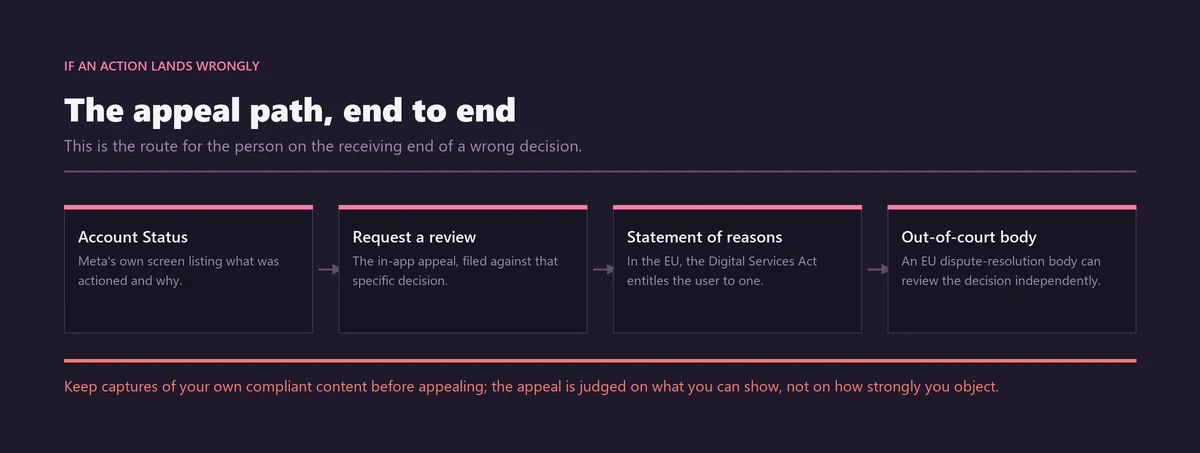
Panic here is usually misplaced, and Meta's own numbers are the reason. Its Integrity Reports for H2 2026, published on 27 August 2026, put enforcement precision at around 92% on Instagram for the first half of 2026, and across Facebook and Instagram less than 0.1% of content was removed incorrectly. Meta has also been unusually candid about the other side of that figure. Writing in January 2025, its chief global affairs officer Joel Kaplan said of the millions of content actions taken daily that "one to two out of every 10 of these actions may have been mistakes", and the company subsequently reported roughly a 50% reduction in United States enforcement mistakes between the fourth quarter of 2024 and the first of 2025. Both things are true at once: most decisions are correct, and the wrong ones are common enough that an appeal is a reasonable first assumption rather than a long shot. Anyone reading this because a rival, an ex-partner or a coordinated group has been filing against their account should treat Account Status as a log rather than a verdict, request the review on each specific decision rather than writing to support in general, and keep their own dated captures of the compliant content before it is touched.
European users hold an extra lever. Under the Digital Services Act, Regulation (EU) 2022/2065, Instagram must give the person whose content was removed a statement of reasons and set out the redress available, and an independent out-of-court dispute body can review the decision afterwards. Where an account has already gone dark, what "disabled" actually means and how recovery works covers the states and the clocks attached to each.
Can you unreport someone on Instagram?
For an ordinary Community Guidelines report, no. Instagram publishes no cancel control, no withdrawal form and no support route for taking one back, and searching how to unreport someone on instagram returns a great deal of confident advice that is simply wrong.
One exception is real, and it is narrower than the articles suggest. Intellectual property claims can be retracted, because they are legal notices and a notice can be withdrawn. Meta's Help Centre tells rights holders to complete the retraction form supplied in the email that referenced their original report, and states the consequence plainly: once we receive notice that you'd like to withdraw your report, we'll restore the content if it has already been removed, with an email confirmation to follow.
We took that route in September 2026, when a client wanted a copyright notice pulled back within a day of sending it. The retraction arrives as a form referenced in the original report email; the live Help Centre page lists no email address at all. That matters, because a widely copied instruction tells people to write to an ip@ address at instagram.com quoting a report number. The instruction survives only in stale copies of an older page, it never covered harassment or spam reports, and following it means waiting on a mailbox for an answer that is not coming.
Instagram accidentally reported someone: what now?
The practical position is this: an accidental report against content that breaks no rule is closed by a reviewer with no action, and no strike attaches to an innocent account. There is nothing to undo because nothing was done. Filing a corrected report under the right category is available and useful; filing a retraction is not. Instagram Ban Service checks category and evidence before anything is submitted precisely because submission is one-way.
Instagram report not working — why did nothing happen?
Start by checking whether the report exists. More, then Settings, then Help, then Support requests, then Reports lists what you filed and the decisions attached, though Meta warns that every report that you've made may not be viewable there.
An absent row is not proof that nothing happened. Reports filed through the standalone web forms and reports closed automatically frequently never surface on that screen, so treat it as a partial record.
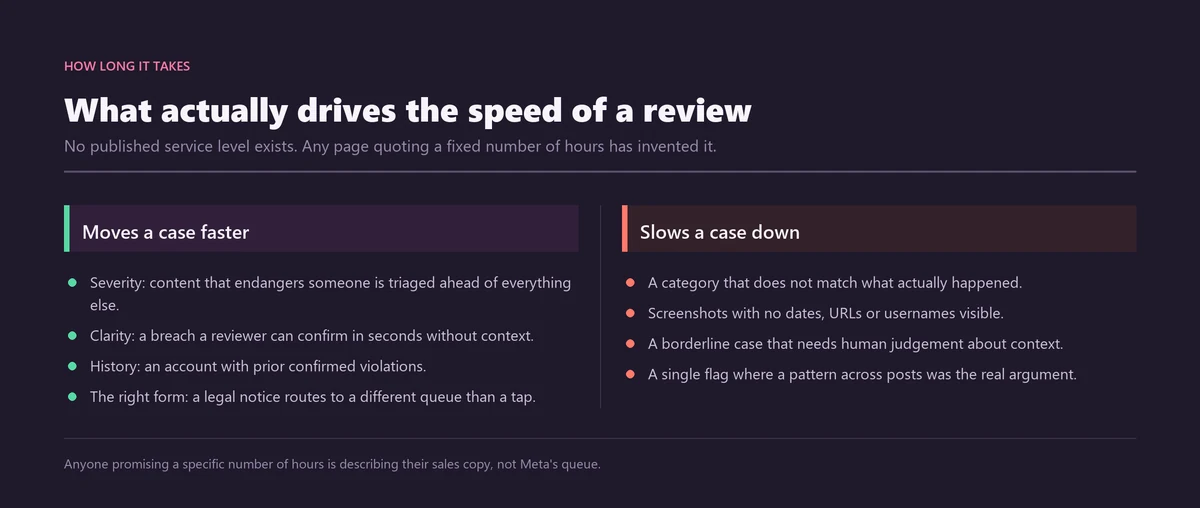
When the row is there and reads "no action taken", the cause is almost always one of three things. The category did not match the content, so the reviewer answered a question you did not mean to ask. The evidence was a single screenshot with no username, no date and no URL, leaving a reviewer to take your word for a pattern. Or the behaviour is genuinely unpleasant and genuinely permitted, which is the outcome nobody wants and the one an honest service has to name.
There is a fourth possibility worth sitting with, because Meta's own data supports it. Prevalence — the share of viewed content that breaks a rule — has been rising on Instagram rather than falling. Violent and graphic content went from 0.09% to 0.10% in the fourth quarter of 2025 to between 0.14% and 0.15% by the second quarter of 2026, and adult nudity from 0.06% to 0.07% up to between 0.09% and 0.11%, which Meta attributed to changes in reviewer training and review workflows. Your report can be correct, correctly categorised and still be one case inside a queue that is carrying more of them than it was a year ago.
Instagram false report campaigns, and what Meta does about them
The mirror image of this question deserves an answer too. A coordinated group flagging the same account repeatedly is not treated as a louder signal. Meta's Inauthentic Behavior policy, last updated on 11 December 2025, prohibits users from misusing Meta reporting systems to harass, intimidate or silence others, and Meta's adversarial threat reporting documents takedowns of networks built to do exactly that. Volume is a risk to the people generating it, not a lever. That is the whole case against mass report bots, spam report bots and the ban-for-hire market that sells them, and the reason Instagram Ban Service files once, properly, instead.
What a documented report carries before it leaves this desk
A reviewer gives a case seconds. The work is making those seconds sufficient, which means the file has to answer the policy question without the reviewer needing to reconstruct anything.
- Name the guideline, not the grievance. Every file opens with the specific Community Guideline the behaviour breaches, in Meta's own vocabulary rather than ours.
- Attach dated captures with usernames and URLs visible. A screenshot that cannot be located in time or attributed to a handle proves nothing a reviewer can act on.
- Show the pattern across surfaces. Posts, Stories, Reels and messages together demonstrate intent that any one of them alone does not.
- Match the route to the harm. The category decides the queue, the evidence bar and whether the client is named. That trade is put to them before filing, never after.
- Keep the pack for the appeal. If the first decision is wrong, the review request is judged on what can be shown, and the pack is already built.
Instagram Ban Service files and escalates the report; Instagram makes the final decision, and no outcome here can be promised. We decline cases aimed at accounts that have broken no rule, because there is no route for disliking someone and nothing in the system rewards trying. Where a case is really about a handle rather than a harm, releasing a dormant username is a different problem with different routes, and the official instruments available to any user without us are set out in the reporting toolkit.
So, concretely: before you tap Report again, open Support requests and read what the first one actually returned. If it says no action, do not re-file the same complaint — change the category to the one that names the real harm, attach dated captures, and file once. If the content is a legal matter rather than a community one, treat it as a legal notice and accept being named. And if money, threats or a child are involved, the report is the smaller half of the job and the police are the larger one. The full set of routes sits in every reporting solution we document; bring a case that has a rule behind it to the desk and we will tell you honestly which route it fits.
Sources, with retrieval dates
- Instagram Help CentreReporting a conversation: Instagram reviews up to 30 of the most recent messages
- Instagram Help CentreCheck the status of a report: the Support requests path and the completeness caveat
- Instagram Help CentreAccount Status: removed content, restricted features and Request a review
- Meta Transparency CenterRestricting accounts: the strike ladder from a first warning to a 30-day restriction
- Meta Transparency CenterHow technology detects violations: most violating content is actioned before anyone reports it
- Meta Transparency CenterIntegrity Reports H2 2026: enforcement precision around 92% on Instagram for H1 2026
- Meta Transparency CenterIntegrity Reports Q1 2025: roughly a 50% reduction in United States enforcement mistakes
Frequently asked questions
Will the person find out I reported them?
Not for an in-app report. Instagram's Help Centre states that your report is anonymous except when you are reporting an intellectual property infringement, and that the account you reported will not see who reported them. Copyright and trademark claims are the exception, and they are a significant one, because those notices carry your name to the other side.
How long does Instagram take to review a report?
Meta publishes no deadline, so no honest figure exists. Severe content is triaged ahead of everything else and can be actioned in minutes, while a borderline harassment case needing human judgement can sit for weeks. Instagram Ban Service quotes no turnaround either, for exactly that reason: any page naming a fixed number of hours is describing its own guesswork rather than Meta's queue.
Can I report an Instagram account without having an account myself?
For several routes, yes. The impersonation, copyright, trademark and under-13 forms on help.instagram.com submit without a login. The in-app Report control is the exception, because reaching the three-dot menu requires being signed in to the app.
Does reporting a post hide it from my own feed?
Effectively, yes, and this is the least-known part of the button. Instagram says it may use your report to show content similar to what you reported lower in your Feed and in its recommendations. That happens whether or not the report succeeds, so an account can keep posting normally to everyone else while largely disappearing from your own app.
Can I get in trouble for reporting people too often?
Not for filing genuine reports, however many of them there are. Meta's Inauthentic Behavior policy targets something narrower: misusing its reporting systems to harass, intimidate or silence people. That is how coordinated flagging campaigns are classified, and Meta's adversarial threat reporting describes taking such networks down. No published penalty exists for one person filing one bad-faith report, but organising a group to bury an account puts the group at risk rather than the target.
Does reporting someone on Instagram do anything if they broke no rule?
Almost nothing. The reviewer closes the case with no action, no strike is recorded, no notice is sent, and the person never learns a report was filed. The one lasting effect lands on you rather than on them, because the report still teaches your own feed to show you less content like theirs.
Can you report an Instagram account that has already been deleted?
Once a profile is gone there is nothing left to act on, and the Report control disappears with it. Keep your dated captures anyway, because if the same person returns under a new handle that history turns a fresh complaint into a documented pattern.