How many reports to delete an Instagram account: what actually decides it
Reviewed 16 August 2026 · 4,480 words · 20 min read
Meta publishes no report threshold. Here are the five invented ones in circulation, the numbers Meta does publish, and what a reviewer is allowed to act on.
No fixed number exists. Meta's Help Centre states that the number of times something is reported does not determine whether it is removed; a confirmed breach of the rules does. So how many reports to delete an Instagram account is the wrong question. One evidenced report can be enough, and ten thousand identical ones can achieve nothing.
If a profile is scamming, impersonating or harassing you, send the link and we will work out which official takedown route fits the breach, and say so plainly when none does.
- Meta's Help Centre answer is one sentence: the number of times something is reported does not determine whether it is removed.
- One occurrence can be enough. Meta names child sexual exploitation as a breach severe enough to disable an Instagram account on a single instance.
- Strikes on Facebook and Instagram expire after one year, so complaints filed slowly never accumulate into a removal.
- Over 96% of the child sexual exploitation content Meta removed between October and December 2025 was found before anyone reported it.
- Five report thresholds circulate online, from three to a hundred. Not one of them appears in a Meta document.
Five numbers are in circulation, and none of them came from Meta
Ask the question anywhere and a figure arrives within seconds. Three reports. Five. More than ten. Fifty to a hundred. Every one of those numbers sits on a page that cites no source at all, and most were published in 2022 and never revisited since. Meta has issued none of them.
Here they are side by side, with what each one actually rests on.
| The number claimed | Where it circulates | What it cites |
|---|---|---|
| Three or four reports | Tech-tips blogs, first published 2022 | Nothing |
| Three to five "credible" reports | Follower and growth services | Nothing |
| More than ten reports | The same 2022 tech-tips cluster | Nothing |
| Fifty to a hundred reports | A marketing blog that calls the figure unconfirmed itself | Nothing |
| Five to seven within 24 hours | Telegram panel copy, imported wholesale to Instagram | Nothing |
The pattern is the tell. A number that came from a platform would be traceable to a platform document, and each of these traces instead to another blog that also cites nothing. When the same figure appears on six sites with six different sets of adjectives and no citation between them, it is not a finding. It is a rumour with good search rankings.
The commercial versions are worse, because they attach a price to the invention. A panel advertising removal at five thousand reports is describing a mechanism that does not exist, then charging for the volume nobody needs. We have written separately about what mass report bots actually do, and about the economics behind Instagram ban as a service. Neither buys the outcome on the label.
Not one of the five has ever appeared in a Meta document.
How many reports to delete an Instagram account?
Somewhere between one and never, and the count is not the variable. Meta's own strike documentation says a violation may be severe enough that it will disable an Instagram account after a single occurrence. At the other end, a profile breaking no rule survives unlimited complaints, because there is nothing for a reviewer to find.
That range is the honest answer — and it is not an evasion. It describes how the system is built. A report is not a vote. It is a request that one specific item be checked against one specific rule, and the answer to that question does not change when the question is asked again.
So the ceiling is one, in the categories that carry the most harm. Everything below that severity band moves through the strike system rather than through complaint volume, and strikes attach to violating posts, not to the reports filed about them. Fifty people flagging the same caption produce one assessment and, at most, one strike.
Which is why mass reporting an Instagram account reliably produces nothing against a compliant profile. There is no accumulator to fill.
The page that answers this, and the wording that trips people up
Meta answers the question directly, under the heading "Does the number of times something gets reported determine whether or not that content is removed?" The answer runs to a single sentence: the number of times something is reported does not determine whether or not it is removed.
The wording is where people get stuck. That help page is written for Facebook and says "removed from Facebook". Instagram has no separately worded twin of it that renders outside the app. Anyone quoting it as "Instagram says" is being loose, and on a page about invented numbers we would rather be exact than convenient.
Exactness costs nothing, because the same review model demonstrably covers both surfaces. Meta counts strikes on Facebook and Instagram together and says so in the same breath as it explains why the Facebook restriction ladder does not extend to Instagram. One enforcement system, two front ends. The help page also supplies the rule that stands in place of the missing number: "We use the same guidelines each time we review whether a profile goes against our Community Standards."
None of that stops a single report from being decisive. It changes what makes it decisive, which is why the practical companion to this page is what actually happens when you report an account rather than any advice about how often to press the button.
How many reports to ban an Instagram account, when "ban" means four different things?
The count is irrelevant in all four cases, but the four outcomes are not interchangeable. People asking how many reports to ban an Instagram account usually want one specific outcome without knowing its name. Deactivated, disabled, permanently disabled and deleted are four separate states reached by four separate routes.
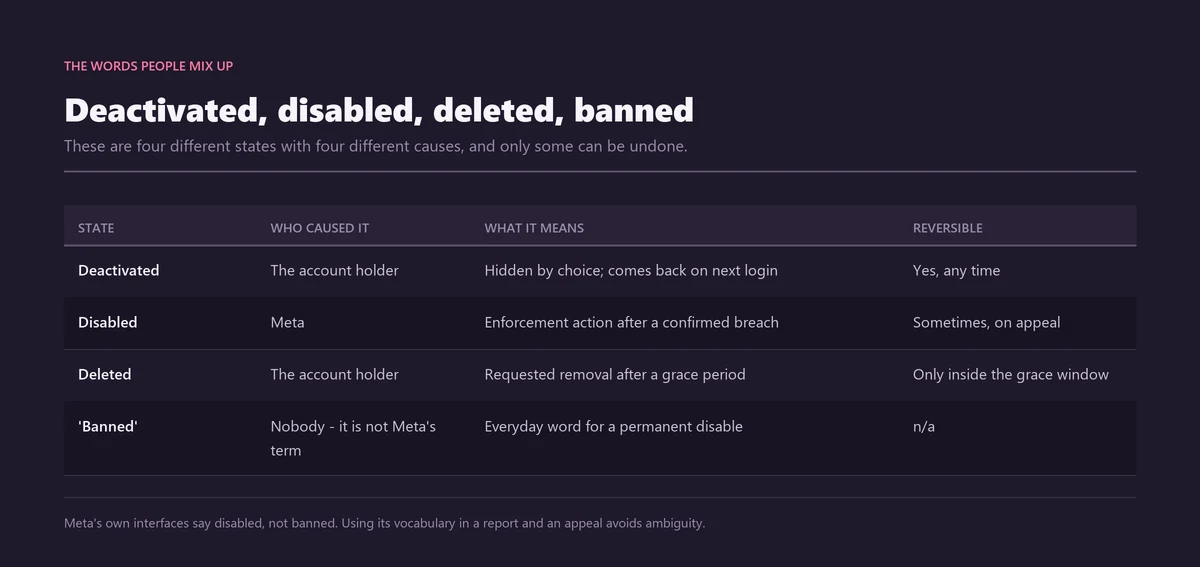
Deactivation is something only the owner can do, and it reverses on the next login. A disable is Meta's decision and arrives with an appeal window attached. A permanent disable is the end of that appeal path. Deletion removes the data itself, and it follows some disables and not others.
Reports only ever aim at the middle two. No report deactivates an account, because deactivation is a setting rather than a penalty, and no report deletes data directly. That distinction does more work than any threshold could. Someone who wants a fraudulent shop gone needs a disable; someone who wants their own photographs gone needs a content removal. Those are different filings, backed by different evidence, and confusing them is a far commoner reason for failure than filing too few times.
How many reports to get banned on Instagram without anyone reporting you
Most enforcement never involves a report at all. Meta publishes a metric for precisely this, the proactive rate, defined as "the percentage of all content or accounts acted on that we found and actioned before users reported them to us".
That is the number the threshold question is really groping towards, and it moves by policy area rather than sitting still. Meta removed 13 million pieces of child sexual exploitation content from Facebook and Instagram between October and December 2025, and put the share it found before anyone reported it at over 96%. Accounts are banned on Instagram every day with a report count of zero, because the detection systems reached them first.
The routes behind each of the four outcomes are set out in the guides on getting an account banned, on getting posts and profiles deleted, and on who is actually allowed to delete an account.
How many reports to ban Instagram account permanently?
Still no number, and here the arithmetic runs against the person filing. Strikes expire. Meta states that all strikes on Facebook or Instagram expire after one year, and that it will not count strikes on violating content posted over 90 days ago for most violations, or over four years ago for severe ones.
A slow drip therefore never accumulates. Report one post a month for two years and the early strikes fall off the clock before the later ones land, which is the exact opposite of how the myth imagines the mechanism working.
What a permanent removal actually requires, including the categories that reach it on a single occurrence, is covered in full on banning an Instagram account permanently.
The numbers Meta does publish
There is no threshold, but there is a published record, and it answers most of what the threshold question is really asking. Everything below comes from Meta's own documentation, with the date attached. None of it is a promise about any individual case.
| Number | What it measures | Source |
|---|---|---|
| One occurrence | Enough to disable an Instagram account in the most severe categories | Counting strikes |
| One year | The lifetime of every strike on Facebook or Instagram | Counting strikes |
| 90 days / 4 years | The age limit on content Meta will still count a strike for: most violations, then severe violations | Counting strikes |
| Over 96% | Share of child sexual exploitation content removed October to December 2025 that Meta found before anyone reported it | Meta Newsroom, 7 July 2026 |
| More than 87% | Enforcement precision on Instagram: correct removals as a share of all removals | Integrity Reports Q3 2025, published 11 December 2025 |
| Less than 1% | Share of content removed for violating the policies in that quarter | Integrity Reports Q3 2025 |
| Less than 0.1% | Share removed incorrectly in the same period | Integrity Reports Q3 2025 |
| Usually 24 hours | The turnaround Instagram states for a second look once you request a review | Instagram Help Centre |
| 13 | The minimum age, and the one report route where Meta commits to deleting the account | Instagram Help Centre |
Read together they say something the threshold myth cannot. Removal is rare, accuracy is high without being perfect, and the overwhelming majority of what comes down was never reported by anybody. A report is not a lever with a load rating stamped on it. It is a referral into a system that mostly finds things on its own.
The precision figure deserves a moment if you are the one being reported rather than the one reporting. Enforcement precision above 87% on Instagram, published in Meta's third-quarter 2025 integrity report, means close to one removal in eight was contested or wrong. That is the whole argument for the appeal path existing, and for using it rather than opening a new account.
The reporting cadence changed as well, and it changes what "current" means when someone quotes a figure at you. Meta moved to semiannual integrity reporting: the First Half 2026 set, updated 19 March 2026, carries the second half of 2025. So the freshest published enforcement data always trails the present by a good margin, and anyone citing this quarter's Instagram numbers is citing something Meta has not released.
Notice what is absent from the whole record. There is no published review time for a first report. No 24 hours, no 48, no 72. Meta publishes a re-review expectation, which is a different thing and is covered below. If you want the form-by-form view of which route produces which outcome, that lives on Instagram account takedown.
What a reviewer can actually check
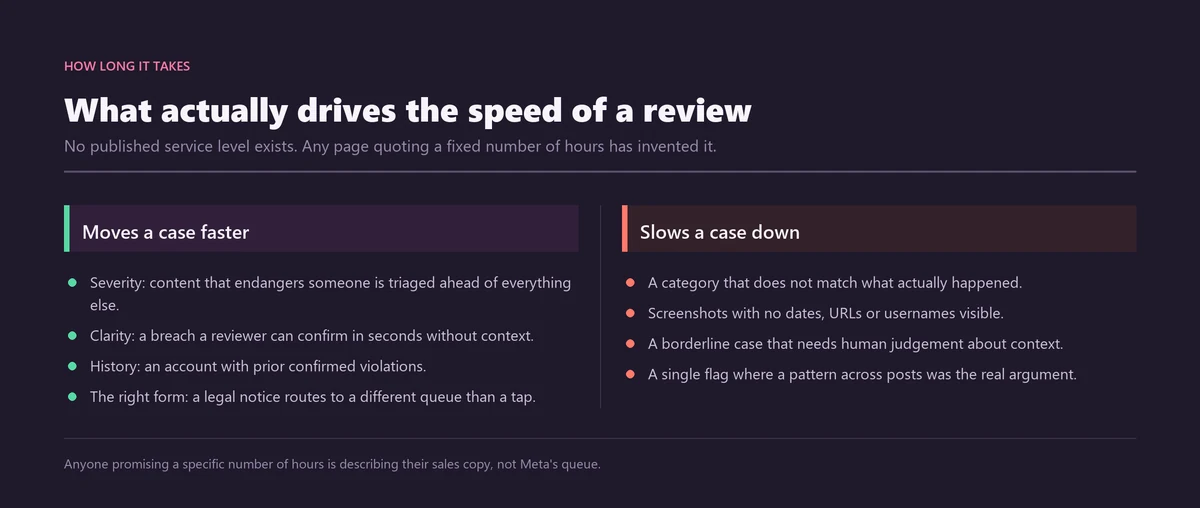
Five things, and a count is not among them. Whether a specific rule was broken. Whether the evidence shows it without interpretation. Whether the person filing is entitled to file that particular claim. What the account has done before. And how much harm follows if the reviewer gets it wrong.
Severity sets both the pace and the ceiling. A credible threat and a badly cropped meme enter the same queue and leave it at very different speeds, because the cost of being slow is not the same in the two cases. All else equal, the more serious the harm, the less the account's previous history matters.
Specificity does most of the remaining work. "This account is a scam" is a claim. A dated capture of the payment request, the shop link, the message where the seller changes the price after payment, and the exact caption that breaks the rule is a case. One of those takes a reviewer under a minute. The other asks them for a judgement call nobody has given them the context to make.
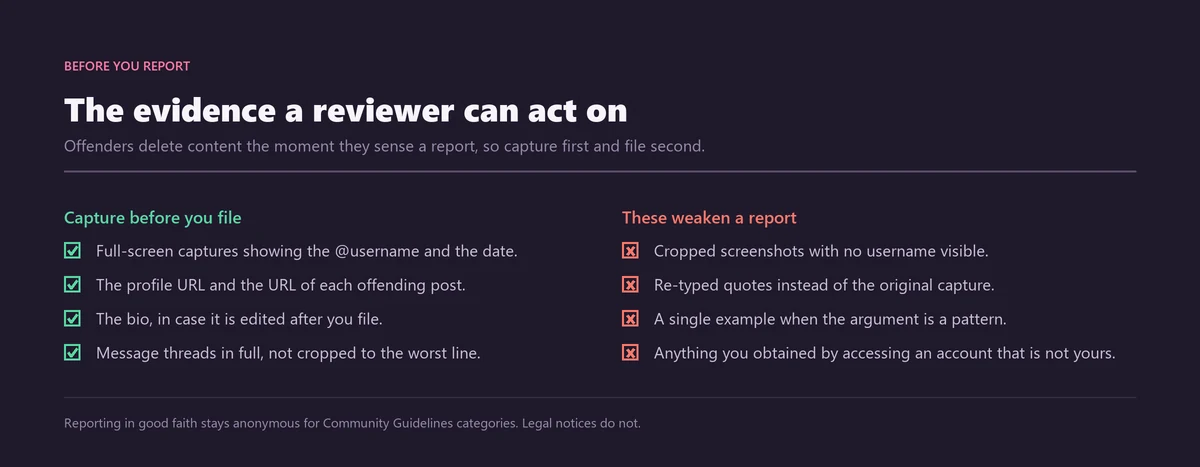
Standing is the quiet one — and the one most often got wrong. A Community Guidelines report can be filed by anyone and stays anonymous. A legal claim cannot: an impersonation report is open only to the person being impersonated or their authorised representative, and a trademark claim only to the rights holder. Filing from the wrong seat is a common way for a strong case to die without a word.
The same test runs through every specific route, whether the problem is a fake giveaway or a business that took the money, extortion, or a stalker who keeps rebuilding accounts. Different evidence each time. Same question underneath.
What happens after you file, and can you make Instagram look again?
You get a decision, and you can contest it once from inside the app. Instagram tells you whether the content went against the Community Guidelines, and that notice lands in Support requests rather than in your notifications, which is the reason most people never see it.
- Open your profile, then the menu in the top right.
- Below More info and support, tap Help.
- Open Reports and violations, then Reports.
- Open the decision notification and tap See report details.
- If the decision looks wrong, tap Request review.
Instagram states that once you ask it to take another look, the content is reviewed again, usually within 24 hours. That is the only turnaround figure Meta publishes anywhere in this process, and it applies to the second review rather than the first. Treat it as an expectation, not a commitment.
There is a second outcome worth knowing about, because it looks like failure and is not. Instagram says it may use your report to make content similar to what you reported appear lower in your feed and in the recommendations it makes for you, even where the content itself stays up. Nothing visible happens to the account. Something invisible happens to your feed.
If the second review upholds the original decision, some cases can be escalated to the Oversight Board, although not every decision qualifies. The wider toolkit, including which reporting tools are genuinely official and which are marketing, is on the Instagram reporter tool page. The surface-by-surface version for Stories, DMs, Reels and comments sits on reporting a Story, page, post or DM.
Instagram report a problem is a different button, and it removes nobody
It is the bug channel. Instagram report a problem sends a technical fault to engineering: a crash, a feature that will not load, a screen rendering wrong. It has no connection to the Community Guidelines queue, and no content reviewer will ever see an account through it.
The confusion is fair enough, since both live under Help and both use the word report. The route runs Profile, then Menu, then Help below More info and support, then Report a problem. Instagram then offers to let you return to where the fault happened and shake your phone to report it, or to tap Report problem without shaking.
Sending an abuse complaint down that pipe achieves nothing at all, and it costs you the time the real report would have taken. It is a common enough mistake that we ask about it early whenever somebody tells us they reported an account weeks ago and heard nothing back.
For genuine violations, the in-app report on the profile or the post is the entry point, and dedicated forms handle impersonation, copyright and trademark separately. Spam has its own quirks, which are set out on reporting Instagram spam.
Where the report-count myth actually comes from
From other platforms, mostly, and from the shape of the word itself. People search this in phrasings that give the mental model away, and the model is voting: enough hands go up and the account falls. The most common searches are close to grammatically identical in that assumption.
They are worth quoting exactly, because they are what people type. "After how many reports insta id gets deleted" and "how much reports for ban instagram account" both treat the report as a unit of currency accumulating towards a purchase price. So does "how many reports do you need to get banned", which arrives here overwhelmingly from gaming communities. And "how many reports to delete someone's account" asks about an authority that almost nobody actually holds.
Game bans are where the intuition is imported from, and this is the part worth taking seriously rather than mocking. Several large multiplayer platforms genuinely do weight report volume in an automated first pass, so the folk knowledge is not invented from nothing. It is transplanted from a system that works differently. Review bombing on storefronts reinforces the same instinct. Neither maps onto a moderation queue that assesses one item against one written rule.
The word itself carries the rest of it. In ordinary English a report is testimony, and testimony corroborates: ten witnesses beat one. That instinct is sound in a courtroom and useless here, because Meta is not weighing testimony about whether a post exists. It is looking at the post.
If what you want is the account gone, the routes are laid out in how to get an Instagram account taken down. If what you want is the handle, that is a different problem entirely, and no volume of reports releases a username. That one is on claiming an Instagram username.
What do we send instead of a report count?
One report, built so that a stranger can verify the breach in under a minute. That is the whole method. No volume component, no panel, no second account, and nothing that would read as coordinated to a system designed to spot coordination.
A file that leaves this desk carries four parts: the exact rule we say was broken, quoted; dated captures of the posts, bio or messages that show it; the URLs and usernames in a form a reviewer can paste straight in; and a plain statement of who is filing and on what basis they are entitled to. Then it goes through the official route for that specific harm. Nothing else happens after that, because nothing else can.
Volume measures effort. Evidence is the only thing a reviewer is permitted to act on.
When we began screening cases this way we expected constant arguments about it. Mostly there were none. The pattern that kept repeating was people who had already filed the same complaint eight or ten times before getting in touch, and every time we asked what evidence had been attached, the answer came back as none. The in-app flow never asks for any, so nobody thinks to send it. Refiling once, with dated captures and through the correct form, was what moved those cases. The earlier attempts had never been the problem, and were never going to be the solution.
We also decline more cases than we file. A report aimed at an account that has broken no rule does not simply fail; it marks the person filing it, and Meta acts against coordinated false reporting rather than against its target. If the case is a dispute with an ex-partner or a competitor, there is no route here at any price, and you will hear that in the first reply.
So stop counting. Pick the one rule the account actually breaks, capture the evidence with dates on it, file once through the route that fits the harm, and use Request review if the answer comes back wrong. That sequence is slower than pressing a button a hundred times. It is also the only version of this that has ever worked.
If you want a second pair of eyes on which rule and which form before you file, send the profile link to the desk. Every other route we handle is indexed on the solutions hub, and what this Instagram ban service will and will not take on is set out plainly on the front page.
Sources
- Meta Transparency CenterCounting strikes
- Meta Transparency CenterRestricting accounts
- Meta Transparency CenterProactive rate
- Meta Transparency CenterIntegrity Reports, Third Quarter 2025, published 11 December 2025
- Meta Transparency CenterIntegrity Reports, First Half 2026, updated 19 March 2026
- Instagram Help CentreWhat to do if Instagram didn't remove content that you reported
- Instagram Help CentreReport a technical problem on Instagram
- Instagram Help CentreReport an Instagram user under the minimum age
- Meta Transparency CenterCommunity Standards
Frequently asked questions
After how many reports insta id gets deleted?
There is no such count. Instagram removes an account when a confirmed violation justifies it, and Meta names child sexual exploitation as an example of a breach severe enough to disable an account after one occurrence. A profile that breaks no rule is not deleted at any number of reports, on any timescale.
How much reports for ban instagram account?
None, in the sense the question means. Report volume appears nowhere in Meta's published enforcement rules, which turn instead on the strike system, the severity of the breach, and whether the evidence shows the violation clearly enough for a stranger to confirm it.
How many reports to delete someone's account, if you are not the person affected?
The count is still irrelevant, and standing matters more than volume here. Anyone can file a Community Guidelines report about anything they can see, and that report stays anonymous. Only the person being impersonated, a rights holder or an authorised representative can file the claims that carry the strongest evidence. And only the under-age route ends in a deletion Meta actually commits to.
How many reports do you need to get banned, on Instagram or anywhere else?
On Instagram, no number applies. That phrasing travels here from gaming platforms, several of which genuinely do weight report volume in an automated first pass. Meta's queue does not work that way: it assesses one item against one written rule, and asking the same question fifty times returns the same answer.
Is there a published figure for how long an Instagram report takes?
Not for the first review. Meta publishes no review-time commitment for an initial report. It does publish one for the second look: once you request a review, Instagram states the content is reviewed again, usually within 24 hours. Any page quoting 24 to 72 hours for a first report has invented that window.
Can Instagram tell that twenty reports came from one person?
Assume so. Reports about the same item resolve into a single review rather than stacking, so twenty complaints and one complaint produce the same assessment. Coordinated false reporting is a breach in its own right, which means a visible pattern is more likely to create a problem for the sender than for the target.
Do reports expire, or can the same complaint be filed again later?
The report does not expire, but the strike behind it does. Meta states that all strikes on Facebook or Instagram expire after one year, and that it will not count strikes for content posted more than 90 days ago in most cases, or more than four years ago for severe violations. Refiling an old complaint rarely adds anything. New evidence does.