Report mechanics·Anonymity, disclosure and status
Does Instagram tell you who reported you? The rule, and the one exception
Most pages answering this question paraphrase a single Help Centre sentence and stop. The sentence has a clause on the end, and the clause is where people get named.
No. Instagram does not tell you who reported you, and its Help Centre states plainly that your report is anonymous. One exception exists: report an intellectual property infringement and Meta routinely passes your name, your email address and your report details to the person you reported.
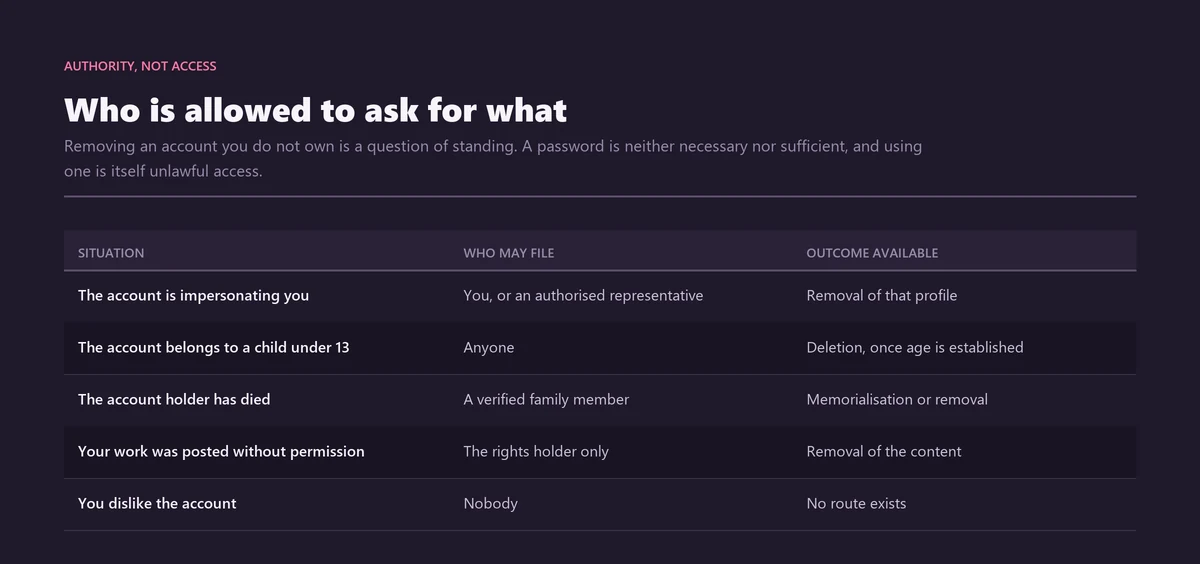
Dealing with a profile that is impersonating you, running a scam or targeting someone with harassment? Send us the profile link and dated screenshots and we will pick the route and file the takedown through Instagram's official forms. Genuine breaches only.
Are Instagram reports anonymous?
Yes, for the ordinary in-app report. Meta's Help Centre puts it in one line: "Bear in mind that your report is anonymous, except if you're reporting an intellectual property infringement." That is the whole rule, and the clause after the comma carries more weight than the nine words before it.
A second Help Centre page removes any ambiguity from the reported person's side. It states that the account that you reported won't see who reported them. No screen, setting or export inside the app exposes the complainant.
Phrased the other way, is reporting on Instagram anonymous when you tap through the three-dot menu on a post, a Story, a comment or a direct message? It is. The route is identical across surfaces, and so is the confidentiality. What changes the answer is not which surface you report from but which instrument you reach for, which is the distinction the rest of this page is built on.
The one report type that carries your name and your email
An intellectual property notice is a legal statement, not a community complaint, and Meta treats it accordingly. Its Help Centre says: "We regularly provide the rights owner's name, your email address and the details of your report to the person who posted the content that you are reporting." The word doing the work there is regularly. This is not an edge case Meta reserves for litigation — it is the standing practice for copyright reports.
The same disclosure is documented from the other direction. Meta tells a user whose content was removed for copyright that the notification may include the name and email address of the rights owner who made the report. So both parties are told the same thing: on a copyright route, the complainant is identified.
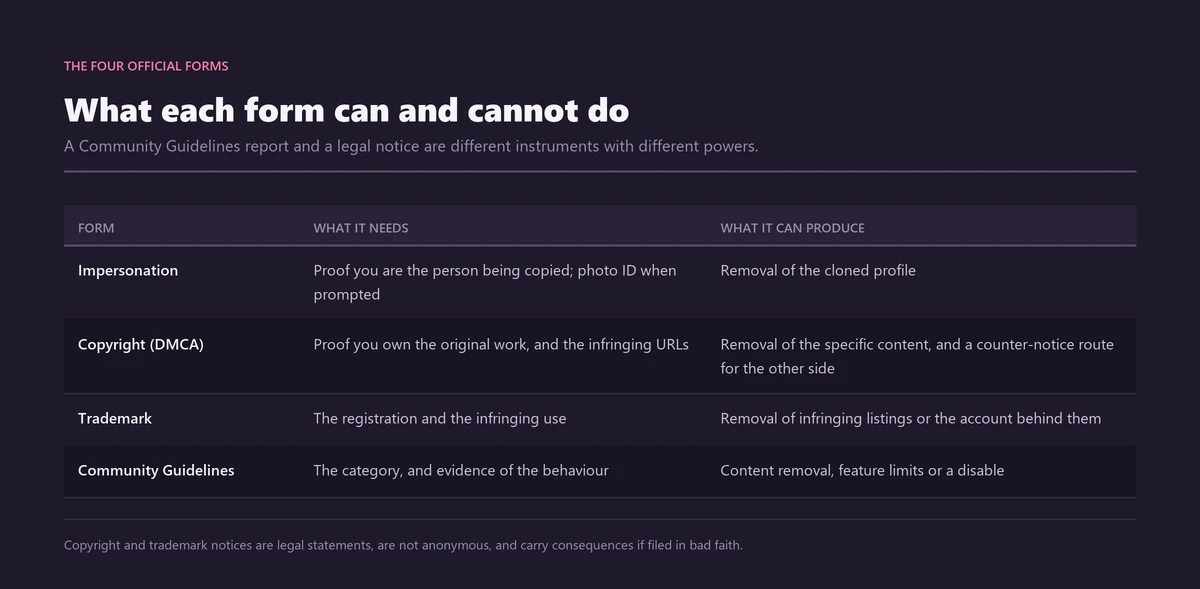
Trademark notices follow the same logic. A rights holder asserting a registered mark is making a claim that the other side is entitled to answer, which is impossible against an anonymous accuser. The evidence an account takedown demands differs by route for exactly this reason.
Impersonation sits in a third position that most guides miss entirely. The report stays confidential in the sense that Meta does not forward your details to the impersonator, but the form itself is not anonymous to Meta: it collects your full name, your email address, and a photograph of your government ID, which Meta says is deleted within thirty days. Only the impersonated person or an authorised representative may file it. If someone is running a cloned profile against you, our impersonation and blackmail report guide walks the same form field by field.
| Route | Who learns your identity | What you must supply |
|---|---|---|
| In-app report (Community Guidelines) | Nobody | A category and the content |
| Copyright / DMCA notice | The person you reported | Name, email, proof of ownership |
| Trademark notice | The person you reported | Name, email, registration details |
| Impersonation of you | Meta only | Name, email, photo ID |
| Under-13 report | Nobody | The username |
Read that table before you choose a form rather than after. People reach for copyright because it feels like the strongest instrument available, and it often is, but choosing it converts an anonymous complaint into a named one. Where a scam account has stolen your photographs, both a copyright notice and a Community Guidelines report are technically available. Only one of them puts your email in front of the scammer. That trade is worth making deliberately, and it is the single most consequential decision on this page.
Does Instagram show who reports you, ever?
Outside the intellectual property route, no. There is no notification, no log and no setting. The reported account receives information about the rule and the content, and nothing about the person who raised it.
This is where a genre of bad advice fills the vacuum. Guides suggest deducing the reporter from a drop in followers, from who stopped viewing your Stories, or from who last argued with you in the comments. None of that is evidence. Reports are invisible to the follower graph, an unfollow can happen for any reason at all, and the timing correlation people find convincing is the ordinary result of looking hard enough at a small dataset.
Third-party apps that promise the reporter's name deserve blunter treatment. No Instagram API exposes reporter identity, so nothing can be read from a legitimate integration. Those tools resolve to one of two things — a guess dressed as an answer, or a credential harvester. Handing over a login also breaches Instagram's terms and puts your own account at risk, which is the same failure mode we document for mass report bots and for spam report bots.
Can a reporter ever be unmasked?
Yes, through legal process rather than through the app, and the distinction is worth understanding before assuming anonymity is absolute. Instagram will not reveal a reporter to another user under any circumstances. A court is a different matter.
Meta's Law Enforcement Guidelines set out a tiered structure under the United States Stored Communications Act, and the tiers determine what any given instrument can compel.
| Legal instrument | What Meta may disclose |
|---|---|
| Subpoena | Basic subscriber records |
| Court order under 18 U.S.C. §2703(d) | Transactional records |
| Search warrant | Stored content |
There is also a jurisdictional wrinkle almost nobody covers. Under the European Union's Digital Services Act, Regulation (EU) 2022/2065 of 19 October 2022, a notice submitted through the illegal-content mechanism must carry "the name and email address of the individual or entity submitting the notice" under Article 16(2)(d), with a carve-out for child sexual abuse offences. An EU illegal-content notice is therefore not an anonymous instrument, even though the ordinary Community Guidelines report filed from the same phone is.
The practical reading: anonymity is a property of the route, not a property of reporting. Choose the instrument that matches the harm, and know which column you are standing in before you file.
What happens if someone reports you on Instagram
Nothing visible happens at the moment of reporting. A report enters a review queue; if a reviewer finds no breach, the account holder never learns a report existed at all. Only a confirmed breach produces a notice, and that notice names the rule, not the reporter.
Where that notice lands is Account Status, reached from More, then Settings, then Account Status under "More info and support". It lists content removed for going against the Community Standards, features you can no longer use, and it carries the control to request a review of the decision. That review path is the practical response to an unfair report, and it is also the reason panic about being reported is usually misplaced.
Being reported is not the same as being actioned, and Meta's own numbers put the risk in proportion. For Q3 2025, the most recent period in which Meta published a per-app figure, it reported enforcement precision of more than 87% on Instagram, and said that less than 1% of content produced across Facebook and Instagram was removed for breaching its policies, with less than 0.1% removed incorrectly. The same report concedes that about 1 out of every 10 pieces of content removed came down in error. That is the honest reason the appeal control exists, and the reason a single malicious report is far less dangerous than the folklore suggests.
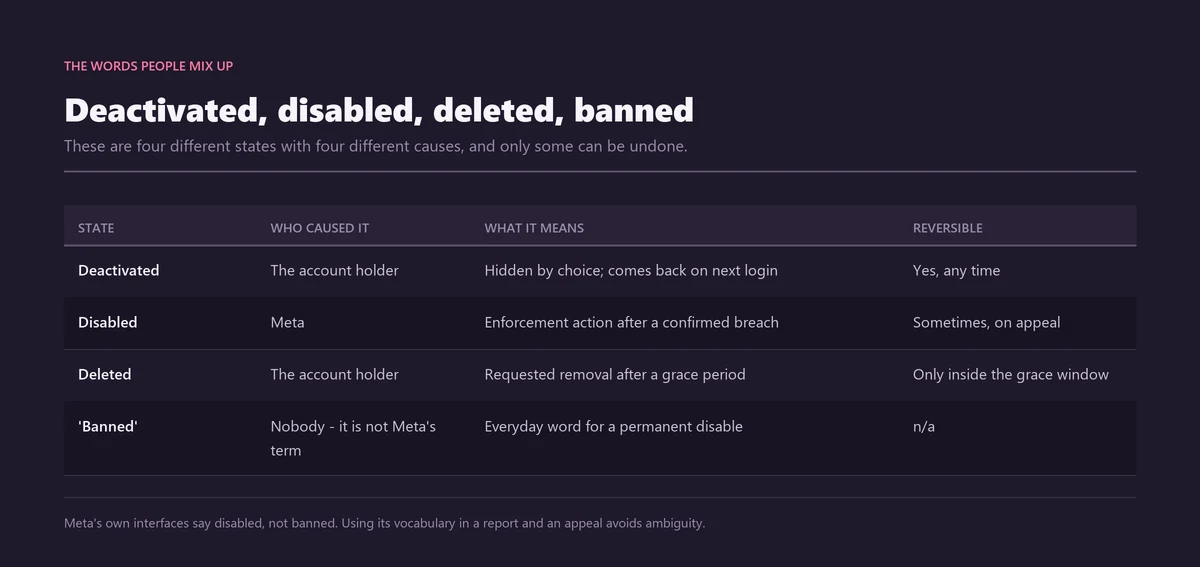
The vocabulary matters when you appeal. Deactivated, disabled and deleted are four different states with four different causes, and only some can be undone, which we separate in detail under disable versus delete. If a decision has gone against you and the internal review fails, the Oversight Board is the external escalation. Writing in December 2025, the Board put its own record at more than 300 recommendations to Meta, around 75% of them adopted in full or in part, drawn on more than 11,000 public comments. Meta's chief global affairs officer, Joel Kaplan, had been blunter about the error rate a year earlier: "we think one to two out of every 10 of these actions may have been mistakes," he wrote in January 2025, before Meta reported a roughly 50% reduction in United States enforcement mistakes between the fourth quarter of 2024 and the first of 2025.
How to report an Instagram account anonymously
Stay on the Community Guidelines route and your identity never travels. The procedure is short, and the only decision that can cost you anonymity is the one in step two.
- Open the content itself, not the profile. Report the specific post, Story, comment or DM that breaks the rule. A report anchored to evidence a reviewer can see beats a general complaint about an account.
- Pick the category that matches what actually happened. Scam, harassment, impersonation, nudity, under-13. Do not select copyright unless you own the work and accept being named.
- Submit once, from your own account. Filing again from other accounts adds nothing, and Meta states the number of reports does not determine removal.
- Note the date and the username. If the behaviour continues you will need a pattern, and a pattern is what escalation is built from.
Two routes stay anonymous and need no login at all: the under-13 form, which asks only for the username, and the standalone abuse forms on help.instagram.com. That matters if you deleted your own account to get away from the person you are reporting. For target-specific walkthroughs see reporting a Story, page or DM, fake giveaways and business scams, and stalking cases, where evidence handling matters more than speed.
How to check report status on Instagram
Instagram keeps a record of what you reported, and it is buried three levels down. On desktop the path is More in the bottom left, then Settings, then Help in the left menu, then Support requests, then Reports. It shows whether action was taken, what the decision was, and whether a review is available.
Where the Instagram support request page lives
Searches for how to see account report history Instagram land on this same screen, and they hit the same limit: it lists reports you filed. It has never listed reports filed against you, which is the second most common misreading of this feature after the belief that it names the reporter.
Meta also declines to promise completeness. Its Help Centre carries the caveat that every report that you've made may not be viewable in Support requests. Reports filed through the standalone web forms and reports closed automatically often never appear. We took this path on desktop in August 2026 to confirm the wording, and the screen listed only reports filed from that account; several older web-form submissions were absent entirely. An empty row is not proof that nothing happened.
Beware the search results around this query. "Instagram support request page" surfaces contact aggregators and at least one fake support telephone number. Instagram operates no phone support. Any page offering a number to call about a report is harvesting something.
How long does an Instagram report take?
Meta publishes no service level for report reviews, so any specific figure you have read was invented by the page you read it on. The widely repeated "24 to 48 hours" appears in no Meta documentation. Support requests records the date an action was taken and never a target for it.
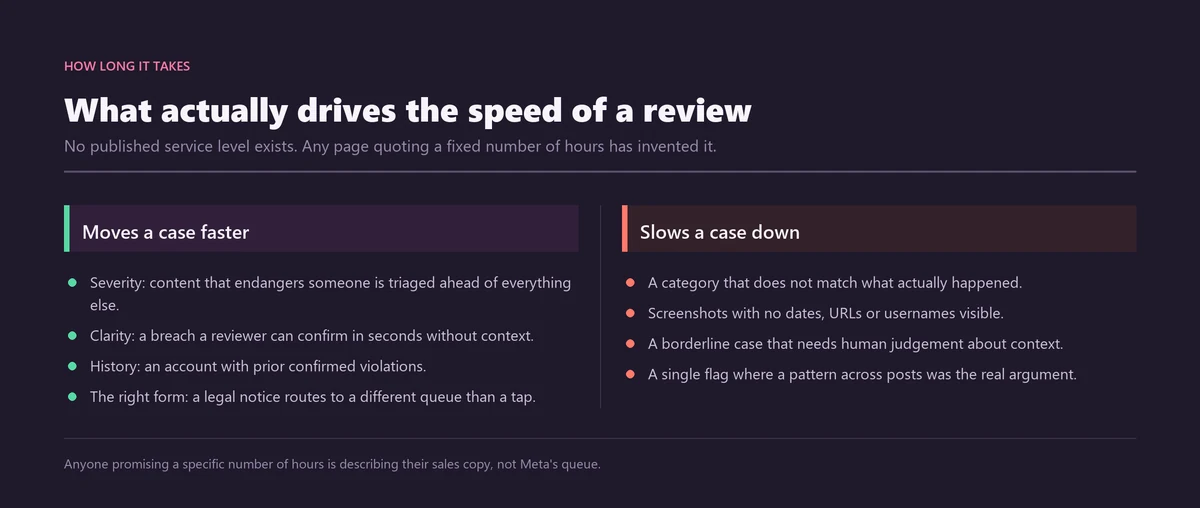
What genuinely moves a case is triage priority. Content that endangers someone is escalated ahead of everything else. A breach a reviewer can confirm in seconds, without needing context, resolves faster than a borderline case requiring human judgement. An account with prior confirmed violations is assessed differently from a clean one. And a legal notice routes to a different queue from a tap, which is why form selection changes timing as well as anonymity.
Volume does not appear anywhere on that list. The belief that a threshold of reports triggers automatic removal is the most durable myth in this subject, and we take it apart with the evidence in does volume actually get anyone banned and what actually decides a ban.
What we check before a report leaves this desk
Route selection is most of the work. A case arrives described as harassment and turns out to be impersonation with a copyright component — and those three framings carry three different forms, three different evidence burdens, and three different disclosure consequences for the person filing.
We ask for the profile URL, dated screenshots showing usernames and timestamps, and a plain description of what happened and when. Then we decide which instrument fits, and we say so explicitly when the strongest available route is also the one that will name you. That is a decision for the client to make with the facts in front of them, not one to discover afterwards.
We decline cases aimed at accounts that have broken no rule. There is no route for disliking someone, no threshold of complaints that removes a lawful account, and the ban-for-hire market that claims otherwise is examined in ban as a service. If you want the honest version of the adjacent questions, we cover which official form fits a takedown, deletion route by route, who can actually delete an account, what makes a ban permanent, releasing a dormant username, the official reporting toolkit, and, where money is being demanded, extortion and sextortion, which belongs with the police as well as with Meta.
So: if you are weighing a copyright notice against a Community Guidelines report, file the Community Guidelines report first unless you actually need the content taken down under copyright law. It costs you nothing, it keeps your name out of the other person's inbox, and it leaves the legal instrument available if the first route fails. When the case is genuinely a legal one, bring it to the desk and we will file it properly. The full set of routes we handle sits in every reporting solution we document, and Instagram Ban Service takes only cases where a real rule or a real law has been broken.
Sources
- Instagram Help Centre"The account that you reported won't see who reported them"
- Instagram Help CentreCheck the status of a report: Support requests path and the completeness caveat
- Instagram Help CentreAccount Status: removed content, restricted features and requesting a review
- Instagram Help CentreImpersonation report form: name, email and photo ID, deleted within 30 days
- Meta Transparency CenterIntegrity Reports Q3 2025: Instagram precision above 87%, under 0.1% removed incorrectly
- Oversight BoardRecommendations to Meta, adoption rate and public comments
Frequently asked questions
Can I take back a report I have already sent?
There is no undo control. Once a report reaches the queue it stays there, and Instagram gives the reporter no way to withdraw it. What you can do is stop adding to it. If you filed under the wrong category, the cleaner fix is a single fresh report under the correct one, because a reviewer reads the category first.
Does the person get a notification the moment I report them?
No. Nothing is sent at the moment of reporting. A notice appears only if a reviewer confirms a breach and acts, and that notice describes the rule and the content, never the complainant. The gap between filing and any visible outcome is why people wrongly assume their report vanished.
Can I report an account without having an Instagram account myself?
For several routes, yes. The impersonation, copyright, trademark and under-13 forms on help.instagram.com are ordinary web pages that submit without a login. The in-app Report control is the exception, since it lives inside the app and needs a signed-in account to reach the three-dot menu.
Why does my report not appear in Support requests?
Because Meta does not promise that every report will. The Help Centre states that every report you have made may not be viewable in Support requests. Reports filed through the standalone web forms, and reports resolved automatically, frequently never surface there. An absent entry is not evidence that nothing happened.
Does reporting from several accounts make removal more likely?
No, and it works against you. Meta states that the number of reports does not determine whether content is removed. Coordinated filing from multiple accounts is detectable, gets discounted, and can put the accounts doing it in breach themselves. One accurate report beats fifty identical ones.
Can a third-party app tell me who reported me?
No such app exists, because no Instagram interface or API carries the reporter identity. Anything advertising the feature is selling a guess or harvesting your login. Meta's terms prohibit unauthorised access, so handing credentials to one of these tools risks your own account for information the tool never had.