Impersonation·Identity report or copyright notice
Someone is impersonating me on Instagram: is a DMCA takedown of the fake account the better route?
A DMCA notice gets sold as the heavy option against a fake Instagram account. It is narrower than that. It reaches only what you own, and it costs something the impersonation form never asks for: your name, sent to the person pretending to be you.
A DMCA takedown can remove a fake Instagram account only when the copy is built from photos or videos you own, and it hands your name and email to whoever runs it. Instagram's impersonation report reaches the whole account whatever it copied and stays confidential, so file that first and keep copyright for your own images.
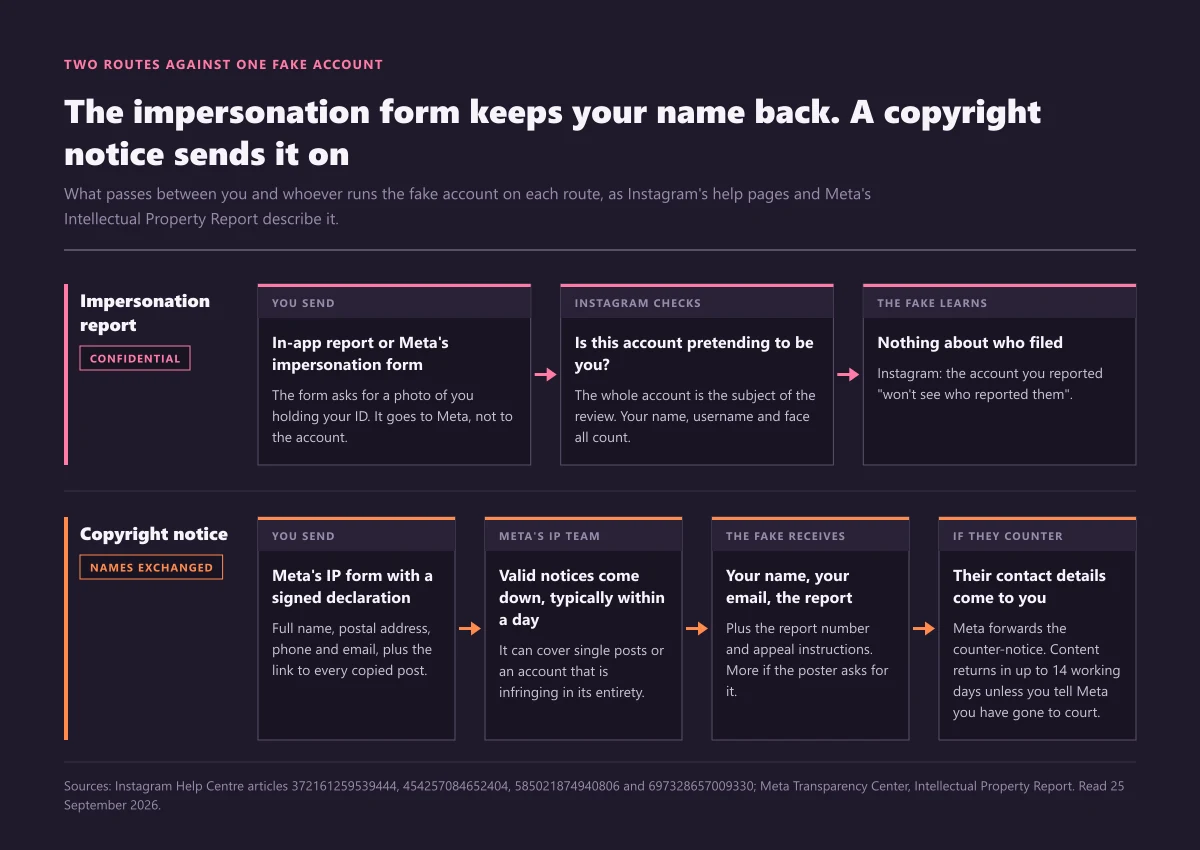
- Instagram's impersonation form offers three situations, and a business is not one of them.
- A copyright notice can name a whole account only when that account infringes in its entirety.
- A counter-notice is signed under penalty of perjury and brings the sender's contact details to you.
What Instagram's help centre gives you when someone is impersonating you
Two routes and one line about anonymity. Instagram's page titled "Report an account that's impersonating you on Instagram" sends account holders to the report inside the app and everyone else to a contact form, mentions that Meta Verified carries an "impersonation protection benefit", and ends with the sentence that shapes everything below: your report is anonymous, "except if you're reporting an intellectual property infringement."
Inside the app, the path runs from the fake profile's Options menu to Report, then Report account, then It's pretending to be someone else. Instagram then asks who is being copied and offers four answers: you, someone you follow, a celebrity or public figure, or a business or organisation. One limit applies before you pick. An account can be reported for impersonating someone or something, "but not for misrepresenting itself", so a profile that invents a medical licence or a charity it does not run belongs under a different reason. Every menu option is laid out in how to report a profile or page.
Meta's form is called "Report an impersonation account on Instagram or Threads", and its first question offers three situations: "Someone created an account pretending to be me or a friend", "Someone created an account pretending to be someone I represent (e.g. my child)" and "I can't log in to my old account". Only two of them are impersonation reports. Choose the third and the impersonation form swaps its questions for account-recovery steps that start at Get help signing in. If the account you think is copying you turns out to be an old one of your own that you can no longer open, recovery is the route and the impersonation queue cannot help.
Does Instagram remove fake accounts before anyone reports them?
Sometimes, and mostly for famous people. Instagram's impersonation page says it runs "systems and tools that constantly monitor the Instagram ecosystem for potential imposters of public figures and creators". Nothing there promises the same watch over a private account, which is why a copy of an ordinary person tends to stay up until somebody reports it.
For the evidence to gather before either route, see the guide to taking the copy apart piece by piece; for who may file at all, the fake account report eligibility guide. None of Instagram's pages sets the identity report beside a copyright notice, and that gap is where people lose weeks, or give away more about themselves than they meant to.
What an Instagram DMCA fake account takedown can actually remove
Only the parts of the copy that are your own work: photos you took, videos you filmed, artwork you made. Instagram's copyright page says that "names, titles, slogans or short phrases aren't considered to be original enough to qualify for copyright protection", so the display name, the handle and a bio claiming to be you all sit outside any copyright notice, however plainly they point at you.
That still leaves a lot. Meta's Intellectual Property Report says rights holders can report anything from individual posts to "an entire profile, account, Page, group or event, if they believe the latter to be infringing in its entirety". A fake whose grid is nothing but your selfies fits that description. One that mixes three of your photos with stock images and reposted memes does not, and gets handled post by post, each with its own link.
Post-by-post removals can still end the account. Instagram's repeat infringer policy says an account that keeps posting infringing material "may be disabled", and Meta's report says it disables repeat infringers "in appropriate circumstances". Neither page gives a number, so treat disablement as possible rather than as something a count of notices buys. How the other enforcement counts work is covered in what triggers an Instagram ban.
Speed is where the notice looks strongest on paper. Meta says a complete and valid IP report is removed "typically within a day or less" by a team working around the clock in several languages, and Instagram publishes no equivalent figure for impersonation. Vendor pages promising removal in 24 to 72 hours are quoting themselves. Volume is not small either: Instagram's own transparency report under the EU's Digital Services Act counted 94,759 intellectual property notices among the 388,783 notices filed between January and June 2026, about 24% of the total.
If a single post is the whole problem, reporting that one post or the post-first takedown route may be all you need. The copyright form itself, field by field, is in the copyright report guide.
Impersonation report or copyright notice, row by row
The two routes answer different questions. One asks whether the account is pretending to be you; the other asks whether it uses work you own. Most people copied with their own selfies qualify for both, and the side effects are not the same.
| Question | Impersonation report | Copyright notice |
|---|---|---|
| Who may file | The person copied, or an authorised representative such as a parent; friends can flag it in the app | The owner of the work, or someone authorised to act for the owner |
| What you prove | That you are the person copied, with a photo of you holding your ID on the form | That the work is yours: originals, dates, where you first posted it |
| What it can remove | The account | The copied posts, or the whole account if it infringes in its entirety |
| Name, handle and bio | Covered | Not covered, because names are not copyright |
| What the fake learns about you | Nothing about who filed | Your name or your client's, the email you gave, the report details |
| How the fake can answer | An appeal inside Instagram | A counter-notice under penalty of perjury, which sends you its contact details |
| Published timing | None | "Typically within a day or less" for valid reports |
| Threads | The form asks for the Threads username too | Threads posts go on the same Meta form, each with its own link |
| If it keeps happening | Each new copy needs a new report | Repeat infringement can disable the account |
Read down the columns and the trade is plain. The identity report asks more of you up front and gives nothing away. The copyright notice asks for proof of ownership and gives your name to the other side, which only matters if you can file it at all.
Who owns the photos on the fake account?
Usually whoever took them. Instagram's copyright page puts it plainly: "if you take a photo, you are likely to own the copyright for that photo", while "if you appear in a photo or video, that doesn't necessarily mean you have a copyright in that photo or video". A fake built from pictures your friends took of you is built from their copyright, not yours.
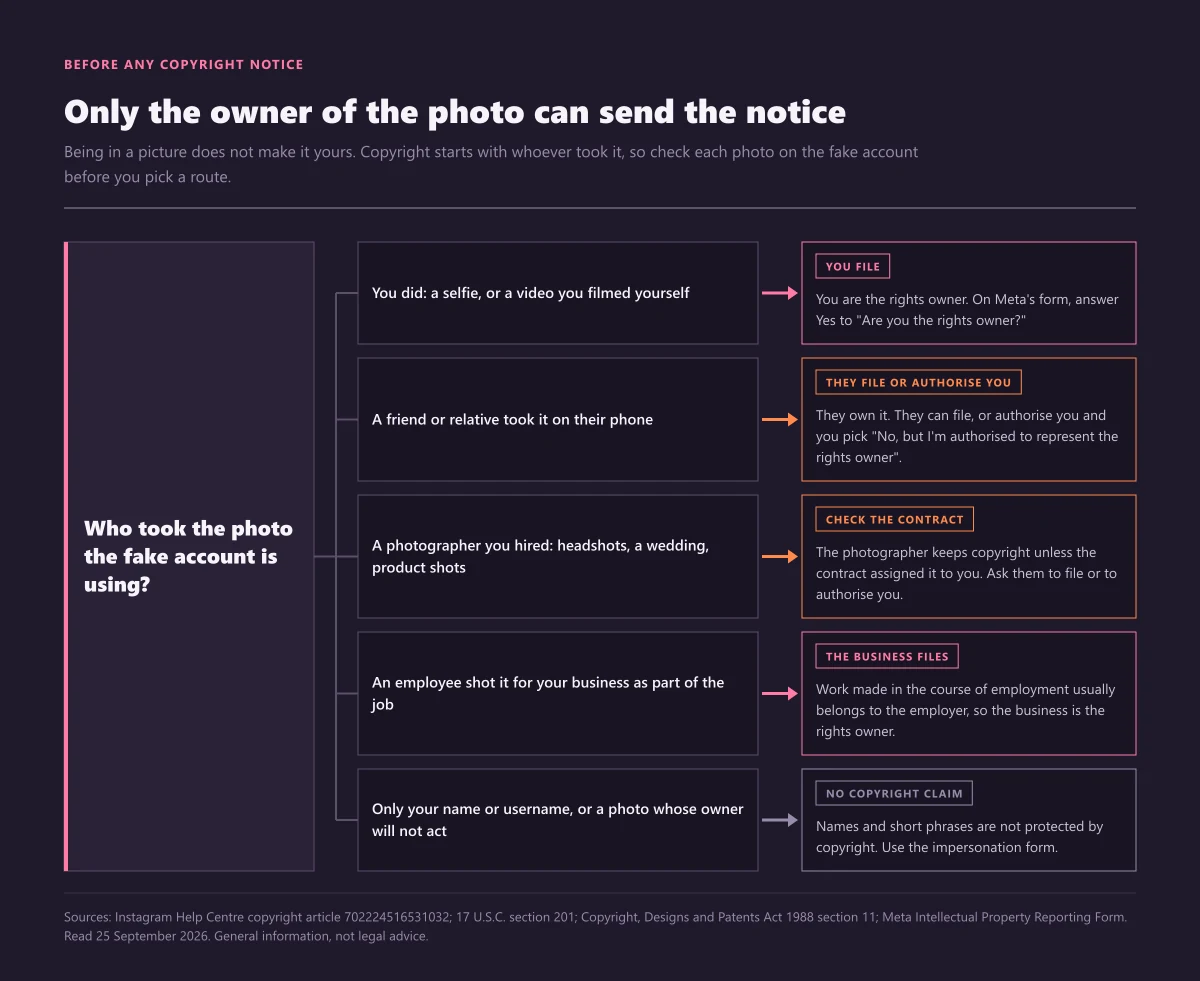
Meta's form enforces this on its first screen. After "Where are you asserting rights?", it asks "Are you the rights owner?" and offers three answers. "Yes" and "No, but I'm authorised to represent the rights owner" both carry on. "No" stops the report with a message that it "must come from the rights owner or someone authorised to report on their behalf".
So the fix is usually a message rather than a lawyer. Ask the friend or photographer to file, or ask them for a short written authorisation and file as their representative; the name field then wants the owner's name, which the form says "may be your full name or the name of the organisation for which you are the authorised representative". A photographer you hired keeps the copyright unless your contract assigned it to you. Photos staff shot for your business as part of the job normally belong to the business, and Instagram's page flags exactly that case: if you create a work as part of your job, "you might not be the owner of the copyright in that work". Statute law agrees on both sides of the Atlantic: US law treats the employer as the author of a work made for hire under 17 U.S.C. section 201(b), and in the UK an employee's photograph belongs first to the employer, "subject to any agreement to the contrary", under section 11(2) of the Copyright, Designs and Patents Act 1988.
Do not claim a photo you did not take. The notice carries a declaration made under penalty of perjury, and under 17 U.S.C. section 512(f) anyone who knowingly misrepresents that material is infringing can be liable for the damages, costs and attorneys' fees that follow. Meta also says its human review exists partly to catch reports that are "fraudulent, erroneous, or submitted in bad faith".
Where nobody who owns the photos will act, or the copy uses nothing but your name, copyright has nothing to offer. The identity report then carries the whole case, and Instagram's copyright page points people who merely appear in someone else's photo towards its privacy reporting route instead, the channel also used for doxxing and other privacy violations.
Your name goes to the person behind the fake, and theirs comes back only if they fight
A copyright notice starts an exchange of names that the impersonation route never starts. When Instagram removes content after a copyright report, it typically sends the poster the report number, the rights owner's name, the "Email address provided by the reporting party", the details of the report and instructions on how to appeal. It adds that it "may provide additional information if it's requested by the person who posted the reported content". Instagram's list of what a copyright report must contain goes further. It asks for "Your complete contact information (full name, postal address and phone number)", then notes that it regularly provides "your name, contact information and the contents of your report" to the person you report. Assume anything you type into those fields can reach whoever runs the fake.
A business address and a work email keep your home out of it, and so does a representative who files for you. A representative does not keep your name out: Meta says that when an authorised representative files, it passes on "the name of the organisation or client" that owns the right.
The exchange can reverse. If the account answers with a counter-notice, US law requires it to carry the sender's name, address and telephone number, a statement under penalty of perjury that the removal was a mistake, and consent to the jurisdiction of a federal court. Instagram says it forwards a valid counter-notice to the person who reported, and that "the information that they receive includes your contact information". Unless you tell Instagram you have filed a court action, the content comes back within up to 14 working days.
For an impersonator that is an awkward choice. Keeping the stolen photos means signing a real name and address under oath and sending both to the person being copied. An impersonator who counters has identified themselves to you; one who stays silent loses the posts.
Naming someone who never counters is a court matter. Instagram's impersonation help page says private parties cannot obtain account content at all, and that it may release basic subscriber information "only where the requested information is indispensable to a case", on a valid subpoena or court order, "and after notice to affected account holders". Whoever runs the copy hears about it first. Copyright law adds one more door for a rights owner, a subpoena issued by a federal court clerk under section 512(h) to identify an alleged infringer, and it is not automatic either. In June 2022 a federal judge in San Francisco quashed one aimed at an anonymous Twitter critic, holding that these subpoenas can face First Amendment scrutiny. Both doors need a lawyer, not a form.
If the copy is part of a campaign against you, weigh all of this before a copyright notice goes anywhere. An ex or a stalker who built the fake gains little from your name, which they already know, and a great deal from a home address. The harassment reporting guide applies alongside this page, and what a reported person can still work out covers how anonymity holds up on every other report type.
A fake business account meets a form with no business option
Instagram's impersonation form has no box for a company. Its three situations are you or a friend, someone you represent, and an old account you cannot open, so a brand copied by a lookalike account starts somewhere else: the in-app report, where "A business or organisation" is one of the four choices under It's pretending to be someone else, or the intellectual property forms.
A registered trademark is the stronger lever, because it reaches what copyright cannot. Instagram's Trademark Report Form lets you say that "The rights owner's trademark is used in the profile picture, name, username or bio", takes up to 30 links, and accepts a whole account only if you believe it infringes your mark "in its entirety". Each report may cover "only one registered trademark", and the form warns that "Abuse of this form may result in the termination of your account". Owners of registered marks are pointed first to Brand Rights Protection, Meta's console for reporting trademark, counterfeit and copyright problems in one place.
| What the fake business account copied | Route | Who files |
|---|---|---|
| Your registered brand name in its handle, name or bio | Trademark Report Form, the "profile picture, name, username or bio" reason | The trademark owner, or someone reporting for that organisation or client |
| Your logo | Trademark form if the logo is registered; a copyright notice for original artwork | The owner of the mark, or whoever owns the artwork |
| Product and campaign photos | A copyright notice for each post, or for the account if every post is yours | The business, where staff took them as part of the job |
| An unregistered trading name, nothing else | In-app report: It's pretending to be someone else, then A business or organisation | Anyone who knows the business |
| Payment requests sent to your customers | A scam report on the account and on each conversation | Each customer who was contacted |
Copyright still covers the business's own material, and an unregistered name with nothing behind it leaves the in-app report as the only door, with no certificate for the reviewer to check. Where the copy is taking orders or deposits, the scam side matters as much as the identity question; the scam account reporting guide explains how to push the account itself down rather than one message at a time.
Regulators are now looking at the platform side as well. On 24 September 2026 the US Federal Trade Commission voted 2-0 to ask for public comment on updating its rule on impersonation of government and businesses, including whether the ad-optimisation practices of social media and other platforms are furthering impersonation scams. Its notice cites more than 1 million imposter-scam reports and nearly $3.5 billion in losses for 2025, and says nearly 30% of people who lost money were first contacted on social media.
Instagram won't take down an account impersonating me. What is left?
A second route, not a louder first one. Instagram says the number of times something is reported doesn't decide whether it's removed, so sending the same report through the same channel again mostly asks the same queue the same question.
Start with what was actually refused. A reply saying the account doesn't go against the Community Guidelines answers the report it came from, and Instagram lets you ask for a second review from Support requests in the app. Then look at what the reviewer had in front of them. The form wants you in the photo with your ID, not a scan of the card on a desk. A copy that uses your stage name while your ID shows your legal name needs something tying the two together, such as your official website. A profile that calls itself a fan or parody account is judged against Meta's labelling rules, not as a straight copy, and fan, repost or gossip pages built around a real person have their own takedown routes.
Then change instruments. A refusal on identity grounds says nothing about ownership, and Meta's IP team works from a different question: is this your work? If the copy uses photos you took, a copyright notice opens a fresh case with its own reviewers; for a brand, the trademark form does the same. This is the one point where accepting the name exchange is usually worth it.
Check the Threads side at the same time. The impersonation form asks for the Threads username of the reported account and of the person copied, so one identity report can name both, while a copyright notice needs each Threads post listed with its own link. A copy living only on Threads is no side issue any more: Meta announced on 16 June 2026 that Threads had reached 500 million monthly active users, against the more than 400 million reported in August 2025.
In the EU, the Digital Services Act adds a formal notice and certified dispute bodies, and the fake account report guide sets out that ladder. To confirm that an account has actually gone rather than just vanished from your view, see how to tell whether a reported account was banned. If the person being impersonated has died, the memorialisation route is the one Meta acts on.
What an impersonation removal service can file for you, and what it cannot
Whatever you could file yourself, done with more care, and never a right you do not have. A service can prepare the identity report for you to submit with your own ID. It can send a copyright notice as your authorised representative once you have shown ownership, and file trademark reports for a registered mark. What it cannot do is hide your name from the other side of a copyright notice, or turn a photo someone else took into yours.
Be wary of the rest of the pitch. "DMCA fake account takedown" offers that promise the name and bio will come down are promising something copyright does not reach. A seller who asks for your Instagram password, sells mass reports or quotes a fixed removal time is selling something Instagram does not offer. Where those mass-reporting offers actually lead has been traced separately, and the comparison of report apps, bots and panels goes through what the products themselves do.
Instagram Ban Service works impersonation cases in the order this page sets out: identity report first, ownership checked photo by photo, and copyright or trademark notices only where the client owns what the fake is using. When we took Meta's copyright form through its first screen on 25 September 2026, it asked where the rights are asserted, from a list of 252 countries and territories, and then whether the filer is the rights owner. That second question is why a case built on a friend's photos now starts with a signed authorisation rather than with the form. Instagram Ban Service files and follows up each report; Instagram alone decides it.
File the impersonation report yourself today, from the fake profile or on Meta's form, and name the Threads profile if there is one. Send a copyright notice only for photos you took, from a work email and a business address, and only once you have accepted that the other side will see your name. Bring anything harder, whether a business copy, a refused report or a copy that keeps coming back, to the contact desk; the solutions index lists the routes this page only mentions.
Sources
- Instagram Help CentreCopyright: who owns a photo, the employer case, and names and short phrases
- Instagram Help CentreRepeat infringer policy: an account "may be disabled"
- Legal Information Institute, Cornell Law School17 U.S.C. section 512: notices, counter-notifications (g), misrepresentation (f) and subpoenas (h)
- Legal Information Institute, Cornell Law School17 U.S.C. section 201: initial ownership, and works made for hire
- Electronic Frontier FoundationIn re DMCA section 512(h) Subpoena to Twitter, Inc., N.D. Cal., order granting motion to quash, June 2022
Frequently asked questions
Can I send a DMCA notice against a fake account that only uses my name?
No. Instagram's copyright page says names, titles, slogans and short phrases are generally not original enough for copyright protection. A copy that borrows your name and nothing you created is an identity case, filed through the in-app report or Meta's impersonation form, where your name is exactly what the reviewer checks.
Does one copyright notice also cover the fake's Threads profile?
Only the posts you list. Meta's IP form handles Instagram and Threads, but each copied item needs its own link, and the notice removes content rather than the profile unless the whole account infringes. The impersonation form reaches further here, because it asks for the reported account's Threads username as well.
Somebody is impersonating me on Instagram and Reddit threads say to get friends to mass report it. Does that help?
Not in the way those threads hope. Instagram says the number of reports does not decide removal, so a pile of identical reports adds little. Friends can still flag the copy from its profile and say whose account it copies, which helps a reviewer find you. The report that settles it is the one you file with your ID.
Is a DMCA takedown faster than an impersonation report?
On paper, yes. Meta says a complete, valid IP report is typically handled within a day or less, and it publishes no figure at all for impersonation reports. Speed is not the only cost, though: the copyright route sends your name and email to the account, and it removes only the posts you own.
I'm not in the United States. Can I still use the copyright route?
Yes. Meta's form starts by asking where you are asserting rights and lists countries worldwide. The DMCA counter-notice procedure Instagram describes covers content removed for violating US copyrights; removals under other countries' laws come with an appeal route for the poster instead. The ownership rules and the name disclosure apply either way.
What happens if I report a photo I didn't take?
The report can fail, and you take on legal risk. The declaration is made under penalty of perjury, and 17 U.S.C. section 512(f) makes anyone who knowingly misrepresents infringement liable for the damages that follow, including costs and attorneys' fees. Ask the photographer to file, or get their written authorisation and file as their representative.