Intellectual property·Filing a real notice, and recognising the fake one
Instagram copyright report forms, DMCA notices, and the fakes that imitate them
Every guide to this starts at the form. The form is the easy part. What goes wrong is that one phrase now covers two opposite situations, and the correct advice for each is the reverse of the advice for the other.
A genuine Instagram copyright report is a legal notice filed on Meta's own webform, signed under penalty of perjury, and it carries your name and email to the person you report. The copyright warning that arrives by WhatsApp, DM or email is not that. It is phishing, and Instagram does not send it.
Is the Instagram copyright violation message on WhatsApp real?
No. Meta does not deliver enforcement decisions through WhatsApp, and it does not send you to a login page to contest one. Legal clothing is the whole trick: nobody panics at a spam warning, everybody panics at the word copyright.
Almost nothing in the script has changed since Kaspersky documented the campaign in March 2019. You are told your account will be permanently deleted for copyright infringement, you are given 24 hours, occasionally 48, and a button marked Review complaint or Appeal. It leads to a copy of the Instagram login screen. Enter the password and a second screen asks for your email password too, on the pretext of checking that the two match. Guard.io, which updated its breakdown on 3 April 2026, still lists tells that were there six years earlier: odd grammar, a sender like mail@theinstagram.team, a domain that is not instagram.com.
One honest caveat about the channel. Security vendors who have actually dissected this campaign name email and Instagram DMs, not WhatsApp; the WhatsApp association comes from the extortion wave described further down, where the follow-up contact is a phone number. So treat the messenger as irrelevant and the destination as the test.
Report the sender the way you would any scam account, change the password if you clicked, and turn on two-factor authentication before you do anything else. What an Instagram report does to an account works no differently here.
Where a genuine copyright decision actually appears
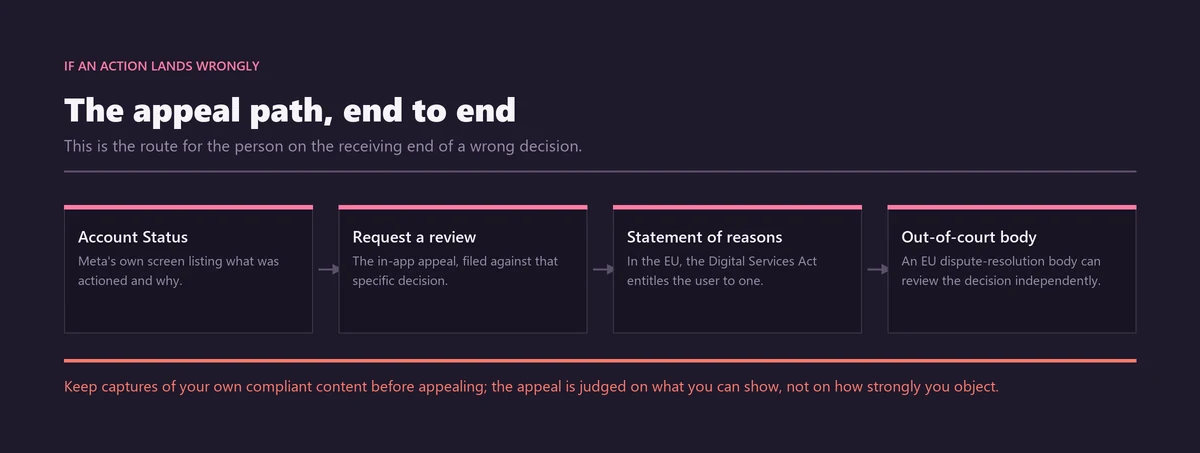
Inside the app, and nowhere else first. When Meta acts on an intellectual property complaint it records the decision in Account Status, reached through Settings without following anybody's link. An email may follow, but it only copies what is already sitting there.
That gives you a fifteen-second test. Open Instagram, check Account Status, and if it is silent, the inbox is lying.
Genuine notices read differently too. Meta names the removed post and the rights owner who complained, because it has to give you enough to respond. A phishing message stays vague about work, claimant and post, since inventing those details costs more than the attack is worth.
No real notice ships with a tool, either. A message offering software, a bot or a paid dashboard that will clear the complaint belongs to a separate scam family, unpacked in the survey of which Instagram reporting tools genuinely exist.
How do you report copyright infringement on Instagram?
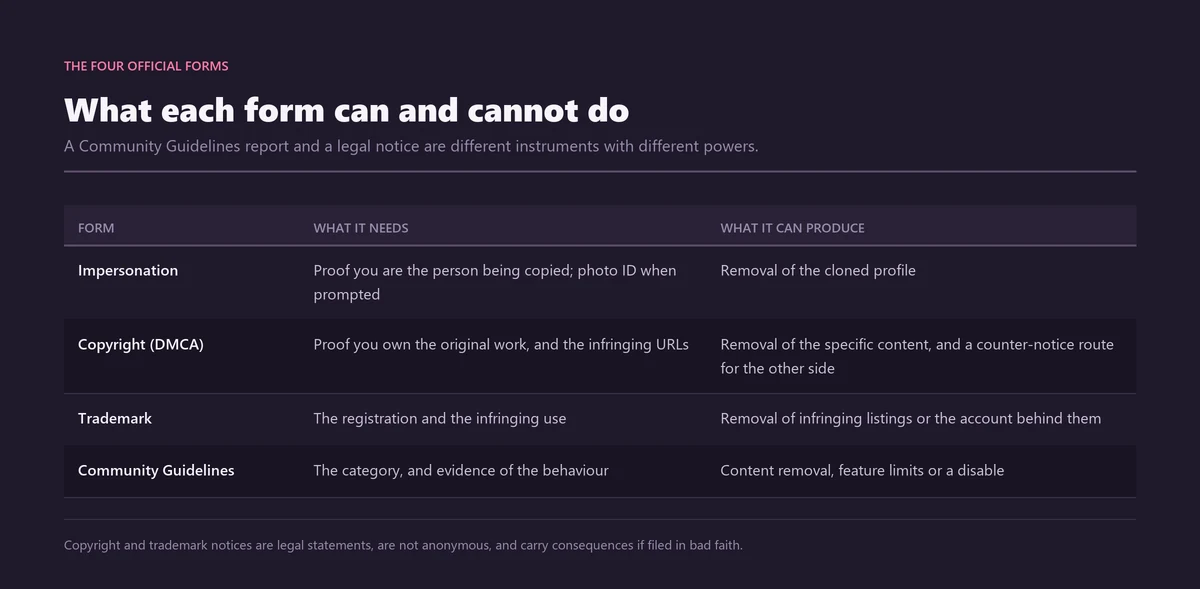
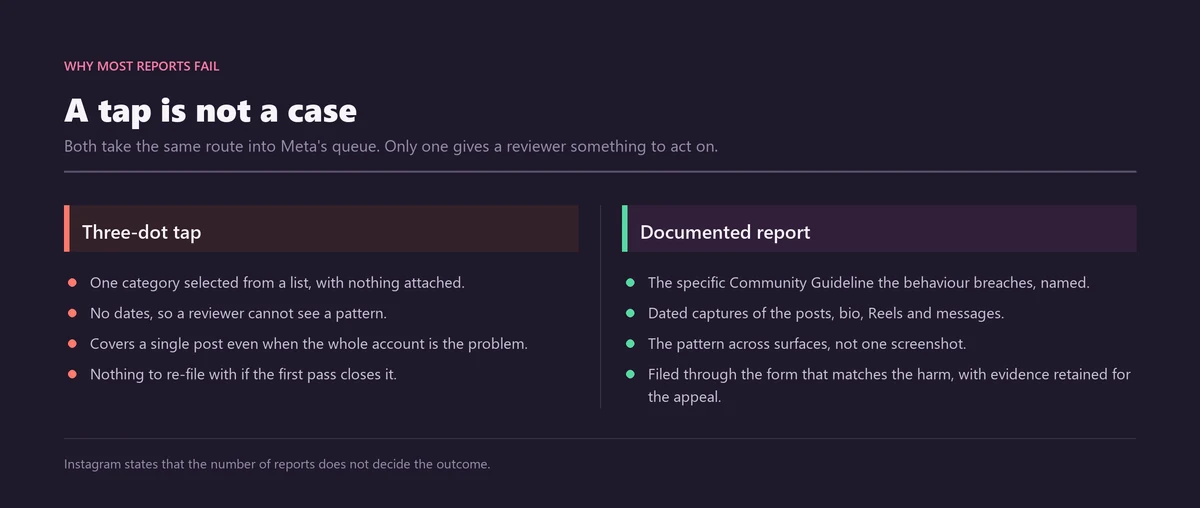
Through one of two webforms, neither of which is the three-dot menu on the post. Instagram's in-app report is a Community Guidelines instrument. Copyright and trademark are legal instruments, and they sit on separate forms outside the app entirely.
Checked on 18 September 2026, the copyright address every guide still prints, help.instagram.com/contact/552695131608132, no longer serves a form of its own. It redirects to the Meta Intellectual Property Reporting Form, one intake covering Facebook, Instagram and Threads together. Walkthroughs published before this year still point at the old page, which works because of the redirect and looks nothing like their screenshots. Trademark is unchanged, served directly at the Instagram trademark report form.
One destination, three different names
What people call the Instagram copyright report form, the Instagram DMCA form and the Instagram copyright infringement form is a single page under three labels, and both intellectual property routes open without a login. Photographers and brands who never joined Instagram are among the most copied people on it, so account-free access is not a detail.
No form decides who owns anything. It collects a sworn statement and passes it on, which makes an Instagram copyright infringement report exactly as strong as the evidence behind the sworn part. Removing a post and removing an account are separate outcomes as well, and the routes that reach an entire Instagram account cover the cases where content removal was never the remedy you wanted.
Are Instagram photos copyrighted the moment you post them?
Yes, in every country that signed the Berne Convention, which is more than 180 of them. Protection attaches when the work is fixed, with no registration, no notice and no watermark required. The photograph you took this morning is copyrighted; so is the Reel you edited on the bus.
Posting does not surrender that. Instagram's Terms of Use keep ownership with you and take a licence instead, described as non-exclusive, royalty-free, transferable, sub-licensable and worldwide, and it ends when you delete the content. That licence runs between you and Meta. It grants nothing to the account that reposted your photo, which is why credit in a caption is not permission and why copyright infringement Instagram cases survive a tag.
Two limits matter before you file. Copyright covers the work and never the idea, so a stranger shooting the same pose at the same landmark has copied nothing. Meta also treats names, titles, slogans and short phrases as too brief to qualify, which quietly removes usernames, taglines and most captions from the copyright lane.
Owning a work and being able to sue over it are separate questions in the United States, and the gap between them is wider than most creators expect. In Fourth Estate Public Benefit Corp. v. Wall-Street.com, decided unanimously on 4 March 2019, the Supreme Court held that an owner cannot begin an infringement suit until the Copyright Office has actually issued the registration, not merely received the application. Registration changes nothing about your right to send a takedown notice, which needs none at all. That asymmetry is the practical reason the notice route does almost all of the real work on Instagram, and why a lawyer is rarely the first call.
What copyright infringement on Instagram actually covers
The photograph, the video, the Reel, the illustration, the long caption with real authorial content in it. Not the handle, not the brand name, not the idea for a series. Where the stolen thing is the brand rather than the work, the remedy is trademark and the form changes.
Rights outlive their authors, incidentally. Copyright passes to an estate, so heirs file over a late relative's photographs, which overlaps with the separate bereavement process for a memorialized Instagram account without being the same request.
The six things a DMCA notice has to contain
American law lists them, and the list is short. Section 512(c)(3)(A) of title 17 of the United States Code sets out six elements, and a notice missing one of them is not a valid Instagram DMCA takedown no matter how strongly it is worded.
- A signature. Physical or electronic, from a person authorised to act for the owner. Typing your name into the Instagram DMCA form satisfies this.
- Identification of the work. The photograph, video or Reel you own. Where several works are covered by one complaint, a representative list is allowed.
- Identification of the infringing material. Enough information to locate it, which in practice means the exact post URL rather than the profile.
- Your contact details. Address, telephone number and email. These are the details that travel onward, so read the section on anonymity before you choose which email to give.
- A good-faith statement. That the use is not authorised by you, your agent or the law. Fair use and fair dealing live inside this element.
- A statement under penalty of perjury. That the information is accurate and that you are the owner or authorised to act for them.
Meta also keeps a designated agent for notices sent on paper, reachable at Meta Platforms, Inc., 1601 Willow Road, Menlo Park, California 94025. Almost nobody needs it, because the form routes to the same place faster and a posted Instagram DMCA report gains nothing but a delivery receipt.
One practical note from the desk at Instagram Ban Service. When we filed a batch of these for a product photographer in March, the two notices that stalled were the two where the client had sent profile links instead of post links; both cleared within days of being refiled against the exact URLs. Reviewers act on what is pinpointed, not on what is described. That same precision decides what a notice can reach, which is where the difference between removing a post and deleting somebody else's Instagram account stops being academic.
Your name and email reach the person you report
Intellectual property is the one category where reporting is not anonymous. Meta's policy states that it regularly provides the person who posted the content with the rights owner's name, your email address and the details of your report, and removal notices to the other side may carry the same. No box on the form opts you out.
That is structural rather than careless. A copyright claim is a legal accusation with a legal answer, and nobody can file a counter-notice against an opponent they cannot name. Anonymity and due process were never both available here, and the statute chose due process.
So give a business or professional email rather than a personal one. That address is going to a stranger who has just lost a post, and element four of the list above is where you commit to it. Where an agent files, Meta passes on the name of the organisation or client whose right is at stake, which hides the individual without hiding the rights owner. Every other report type on the platform behaves the opposite way, a contrast set out in full in whether Instagram tells you who reported you.
How do you report an Instagram post or Reel for copyright?
By collecting the URL of the specific item, then filing once with all of them. The mechanics of how to report Instagram post for copyright and how to report Instagram reel for copyright are identical at the form; the difference is entirely in how you capture the address, and Reels are where people get it wrong.
- Open the item on the web, not in the app. The browser address bar gives you a permanent link. The share sheet in the app sometimes gives you a redirect that expires.
- Copy one URL per item. A carousel counts as one post. Six stolen photographs posted separately are six URLs, and a profile link covers none of them.
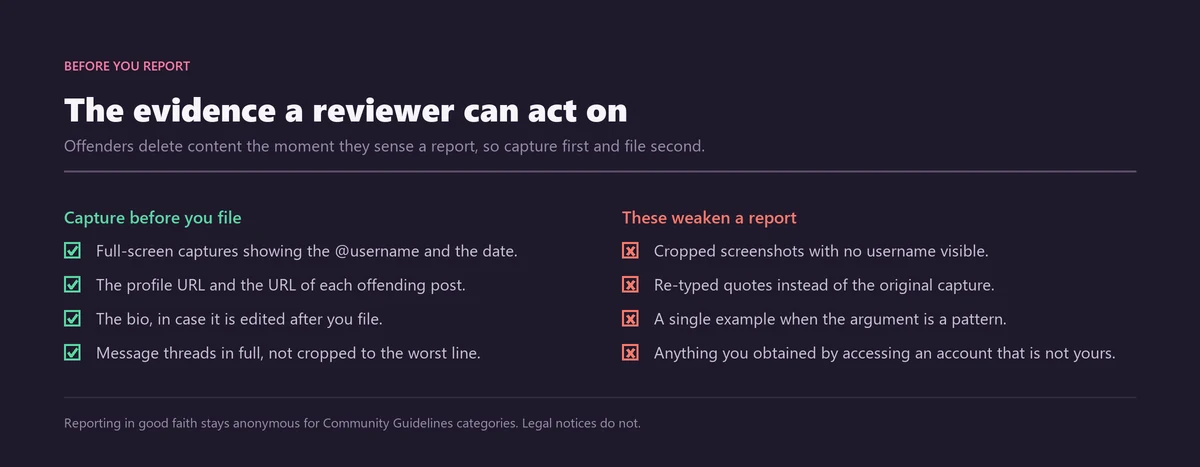
- Screenshot before you file. Full screen, showing the handle and the date. Infringing posts vanish quickly, and a removed post with no capture is a claim you can no longer evidence on appeal.
- File once, listing everything. Repeated separate notices about the same account read as volume rather than as evidence, and the Instagram copyright report form accepts multiple links in a single submission.
Stories expire in 24 hours, which makes them the hardest surface to act on and the one where capturing first is not optional. Per-surface differences, including what a Story link looks like once it has gone, sit in the guide to reporting a Story, post, DM or Reel. Knowing how to report stolen content on Instagram is mostly knowing this discipline, and where the theft sits in a comment rather than a post the route changes again, because reporting a comment on Instagram runs on the in-app machinery rather than the legal forms.
Copyright, trademark and impersonation are three separate forms
Picking between them is the single decision that determines whether a takedown works. They are not degrees of the same complaint. They protect different things, demand different proof, and produce different outcomes, and filing the wrong one usually means starting over rather than being redirected.
| Form | Protects | Who may file | Proof required | Anonymous? |
|---|---|---|---|---|
| Copyright | The work: photo, video, Reel, artwork | The owner, or an authorised agent | Ownership, the exact URLs, a sworn statement | No |
| Trademark | The brand: name, logo, registered mark | The registrant, or an authorised agent | Registration number and certificate, one mark per report | No |
| Impersonation | The person: your identity or account | You, or a representative | Photo ID when prompted | Yes |
| Community Guidelines | Behaviour: spam, harassment, scams | Anyone who sees it | The category and evidence of the conduct | Yes |
The trademark lane has the strictest gate on the platform. Every Instagram trademark report covers exactly one registered mark, asks for its registration number and a link to it in a public database such as the USPTO search system, and accepts a scanned registration certificate as evidence. A pending application does not qualify. An Instagram trademark infringement report from a brand that never completed registration will not proceed, which pushes unregistered businesses toward the impersonation route or toward a copyright claim over the logo artwork itself.
When the account is pretending to be you, not copying you
That is impersonation. It needs no registration and no ownership proof beyond identity, and it stays anonymous, with the forms and the photo-ID step covered in the Instagram fake account report routes. Counterfeit sellers and cloned shopfronts sit closer to trademark again, and that split is in the walkthrough for reporting an Instagram giveaway or business.
What happens after an Instagram copyright takedown is filed?
Meta reviews the notice, removes the content if it accepts the claim, and tells the poster why. Scale gives some sense of the machinery: in 2023, on Meta's own published figures, the company took down 14,092,779 pieces of content on the basis of 7,034,447 copyright reports, alongside 2,463,444 pieces removed from 2,035,439 trademark reports. Facebook and Instagram are not broken out separately.
No timetable is published. That 24-to-72-hour range quoted across takedown vendors is an estimate from their own caseloads, not a Meta commitment, and repeating it as one sets clients up for a disappointment nobody actually promised them.
Published in the other direction, though, is a hard clock. A DMCA Instagram takedown can be answered by a counter-notice, and the statute then forces a decision inside a fixed window, covered two sections down. Removal is provisional in a way a Community Guidelines action is not, so a DMCA Instagram removal that gets contested can reverse itself without anybody at Meta changing their mind.
A successful Instagram copyright complaint removes content. By itself it does not close the account or hand you the handle.
Can you give someone a copyright strike on Instagram?
Not in the way the phrase implies, because Instagram publishes no strike counter. Searches for how to give copyright strike on Instagram mostly return YouTube material, and the premise travels across with them: YouTube tells you that three strikes terminate a channel, and people assume a matching number exists here. It does not.
Meta's own wording stays deliberately open. Repeat infringement may lead to the account being closed or the Page removed, and may bring lesser consequences first, including limits on posting photos and videos or the loss of particular features. No threshold, no tier, no published count. Restorations after a successful appeal or a withdrawn report are counted back in the account holder's favour, which is the closest thing to a scoreboard that Meta describes.
The Reels variant is the same answer. Asking how to give copyright strike on Instagram reels assumes Reels carry their own enforcement track, and they do not; a Reel is content under the same intellectual property policy as a feed post, matched by the same systems and counted the same way.
Filing to punish rather than to protect
This is where the question usually leads, and it is worth answering plainly. Section 512(f) makes anyone who knowingly materially misrepresents that material is infringing liable for damages, including costs and attorneys' fees. That liability is not theoretical decoration on the statute; it is the mechanism the law provides precisely because takedown power is easy to abuse.
And volume does nothing. Instagram states that the number of reports does not decide the outcome, a point examined at length in the breakdown of how many reports it takes to remove an account and again in the teardown of what spam report bots actually accomplish. Ten identical false notices are ten instances of the same liability, not ten times the pressure.
The abuse is now industrial, which is the strongest argument for keeping your own filings clean. Malwarebytes reported on 10 September 2026 that criminals were filing fabricated copyright complaints to get accounts suspended, then demanding cryptocurrency to withdraw them, noting that Meta does not verify the authenticity of complaints when they are filed and that repeated complaints can trigger a temporary takedown. One victim in that account paid 50 dollars; Meta acknowledged in court that a single user had been hit with 13 fraudulent strikes. The same instrument that protects a photographer is the instrument being pointed at one.
The counter-notice, and the ten-to-fourteen-day clock
Anyone whose content is removed can push back, and the statute sets the timetable rather than the platform. Under section 512(g)(2)(C), once a valid counter-notice arrives, the provider replaces the removed material and ceases disabling access to it in not less than 10, nor more than 14, business days.
- The counter-notice is filed. It identifies the material, states under penalty of perjury a good-faith belief that removal was a mistake or misidentification, and consents to a court's jurisdiction.
- Meta forwards it to the original claimant, contact details included. The person who filed the notice learns exactly who is contesting it.
- The clock runs. Restoration follows inside the statutory window unless the claimant acts.
- The only thing that stops restoration is a lawsuit. The claimant must notify Meta that they have filed a court action seeking to restrain the activity. An angry email does not qualify.
That fork is what separates a real rights holder from an opportunist, and it is why the extortion racket collapses when a victim files. Withdrawing a fabricated complaint costs the fraudster nothing. Suing over it exposes them to section 512(f), which is the last thing they want.
Is an Instagram copyright takedown service worth paying for?
Only when the work is assembling the case, never when the work is filing it. Both forms are free and take a few minutes, so any Instagram copyright takedown service charging purely for submission is charging you for typing. Real time goes on the part before: establishing ownership with dated originals, finding every copy, capturing each one before it disappears, and deciding which of the four forms the harm actually belongs to.
Instagram Ban Service handles that assembly and files through the same public forms you could use yourself, with no privileged channel and no relationship with Meta, because none is available to buy. An Instagram DMCA takedown service claiming otherwise is describing something that does not exist. Meta's Rights Manager, the closest thing to a fast lane, is granted by application at Meta's discretion and cannot be resold. An Instagram trademark infringement removal service hits the same wall, and stops dead at the registration certificate when there is not one.
This desk declines more of these than it takes. No registration, no trademark filing. No proof of authorship, no copyright filing. A grievance that is really harassment, stalking or exposure of private information is not a copyright matter at all and belongs with the threats and doxxing forms or, where somebody is being followed and watched, with the evidence-first route for an Instagram stalker. Pricing and the honest limits of paid help sit in the examination of what a ban service can and cannot sell.
Two instructions carry the rest of this page. Start with Account Status before believing any copyright message, and capture every infringing post before filing anything. Everything else here is correctable on appeal; those two are not recoverable once the post is gone. Bring the originals, the URLs and the dates to the contact desk, or read the other reporting solutions first and confirm copyright is the right instrument before a single form is opened.
Sources
- Instagram Help CenterHow do I report copyright infringement on Instagram?
Frequently asked questions
Is the Instagram copyright infringement notice in my email real?
Check where it wants you to go. A real decision from Meta is visible inside the app, under Account Status, with no link needed to reach it. A fake Instagram copyright infringement notice exists only in the message and pushes you to a login page through a button called Appeal or Review complaint. Kaspersky documented that pattern in 2019 and Guard.io updated the same red flags in April 2026.
How long does an Instagram copyright complaint take to process?
Meta publishes no processing time for an Instagram copyright complaint, and the 24 to 72 hour figures repeated across takedown blogs have no Meta source behind them. What is published is the other clock: a counter-notice restores the content in not less than 10 nor more than 14 business days. Treat anything faster as a vendor estimate rather than a commitment.
Can I file an Instagram trademark infringement report without a registration?
No. The trademark form limits every Instagram trademark infringement report to one registered mark, asks for the registration number and a link to it in a public database, and accepts a scanned registration certificate as proof. A pending USPTO application does not qualify. Unregistered brands are left with the impersonation route or a copyright claim over the actual artwork.
Does a copyright report get the username released to me?
It does not, and neither does a trademark report. Instagram states that usernames go to the first person who requests them and cannot be reserved, so the most either notice achieves is removal of the content or the account behind it. Meta also treats names, titles, slogans and short phrases as too short to carry copyright at all.
What happens if someone files a false copyright claim against me?
File a counter-notice. The law is on your side when the claim was knowingly false: section 512(f) makes anyone who knowingly materially misrepresents that material is infringing liable for damages, costs and attorneys' fees. Malwarebytes reported in September 2026 that criminals were doing exactly this at scale, then demanding payment to withdraw the complaints. Paying them settles nothing, because a withdrawn complaint can be refiled the next day.
Do I need an Instagram account to report copyright infringement?
No. Both intellectual property forms open without a login, which matters for photographers and brands who never joined the platform but keep finding their work on it. You still supply a real name and a working email, because the notice is a legal document and Meta passes those details on to the person you report.
Someone reposted my photo with credit. Is that still infringement?
Credit is not a licence, so yes, it can be. Tagging the photographer changes nothing about permission, and the licence you granted Meta under the Terms of Use does not extend to other users. Whether you should file is a different question from whether you are entitled to. Ask for removal first, and file the notice only when the message is ignored.