Takedown · one post, one picture, one Story, then the account
How to get an Instagram post taken down first, and when you can take down the account behind it
In the first half of 2026, people in the European Union sent Instagram 388,783 formal notices about illegal content. Over the same six months, Meta carried out 22,699,983 content removals there on its own initiative, without being asked. Those two figures, from the report Meta filed on 28 August 2026, explain why so many takedown attempts stall. A report is a narrow door, and it opens for one item, one rule and the right form.
To get an Instagram post taken down, report the post itself: open it, tap the three dots, choose Report and pick the reason matching the rule it breaks. Legal claims (copyright, privacy, defamation, local law) go on Help Centre forms instead. The account comes down only when it is itself the violation, or its posts add up.
Can Instagram take down posts and Stories without anyone reporting them?
Yes, and far more often than it does on request. The power sits in one sentence of Instagram's Terms of Use, and the scale shows up in Meta's EU filings.
Section 6 of the Instagram Terms of Use reads: We can remove any content or information that you share on the Service if we believe that it violates these Terms of Use, our policies (including our Community Standards), or we are permitted or required to do so by law.
Any content covers a Reel, a comment or a live Story as much as a grid post. So yes, Instagram can take down posts, and it can take down Stories too. The same section lets it stop providing the service to an account outright.
How often does Instagram take down posts in practice? Meta's Digital Services Act transparency report for Instagram, covering 1 January to 30 June 2026 in the EU, counts 63,556,069 measures taken on Meta's own initiative under its terms. Of those, 22,699,983 were content removals, 30,115,659 were account terminations, and 58,838,153 were carried out by automated means alone. Classifiers catch spam, fake accounts and copies of images already known to break the rules. They cannot know that the woman in a beach photo never agreed to it going online, or that the caption under a team picture names a fifteen-year-old's school.
That gap is where a report earns its keep. It is the only way context reaches a reviewer.
How to get an Instagram post taken down with the in-app report
File against the post rather than the profile, and choose the reason by the rule it breaks, not by how it made you feel.
- Capture it first: a full-screen shot with the @username, the date and the content visible, plus the link from Share, then Copy link. A post that notices attention can vanish, and a reviewer cannot weigh what has gone.
- Open the post and tap the three dots above it, the menu Instagram's Help Centre calls Options.
- Choose Report and pick the reason that names the breach: a scam, bullying, nudity, hate or a threat. For one image inside a carousel, report the post that holds it.
- Answer the follow-up screens and submit. Instagram's wording on its reporting page is that the account you reported
won't see who reported them
. - Read the verdict under Help, then Reports and violations, then Reports, and ask for another review from that screen if the answer is no.
Step five is where most people stop paying attention. Instagram's page on content it didn't remove promises one thing: After we've reviewed the content, we'll let you know whether it did or did not go against our Community Guidelines.
A refusal usually means the reason you picked did not match what the reviewer saw. Refile once, under a better-fitting reason and with the capture the first report lacked, instead of sending the same complaint again.
A single abusive reply goes through a different gesture, covered in the guide to reporting a comment. The full set of routes a post can travel, forms included, is compared in how to report a post on Instagram, and the outcomes short of removal, such as a warning screen, are laid out in what a report actually sets in motion.
What does an Instagram takedown request or takedown notice actually do?
It changes the rulebook. An in-app report asks whether a post breaks Instagram's rules, while a takedown notice asserts a legal right, and the form you choose decides who may send it and how far the removal reaches.
| The claim | Where it is filed | Who may file | What comes down |
|---|---|---|---|
| The post breaks the Community Guidelines | Report, from the item's own menu | Anyone who can see it | The post, everywhere, if a reviewer agrees |
| Your photograph, video or artwork, copied | Instagram's copyright report form | The rights holder or an authorised agent | The post; your name and email reach the poster, who can counter-notify |
| A false statement that damages you | Defamation Reporting Form | The injured party or someone authorised, such as an attorney | For United States filings, nothing without a court order |
| Unlawful under a national law in the EU | Legal removal request form | The notifier, who gives a name and email under DSA Article 16 | Usually a block in that country only |
| Unlawful under UK law | Reporting unlawful content in the UK form | The person depicted or targeted, a parent, a representative or anyone else | Usually a block in the UK only |
| An intimate image shared without consent | StopNCII, and in the US a TAKE IT DOWN request | The person depicted | In the US, removal within 48 hours of a valid request, known identical copies included |
The EU route shows how these forms are framed. Instagram's legal removal request page opens with If you're in the EU and prefer to submit a request to remove content that you believe is unlawful
, points to a dedicated form, and warns in the same breath that reporting doesn't guarantee that it will be removed
. The UK version, Reporting unlawful content in the UK, asks for the link, an explanation of why the content violates specific laws, and a declaration that the report is accurate and made in good faith.
Reach is the part people miss. Where a post is illegal in one country but inside Meta's rules, Instagram's local-law page says we make it unavailable in the relevant country or territory
, and its own example is Holocaust denial, restricted for people in Germany. Meta checks each legal complaint against its policies first and removes the content outright when it breaks them. A takedown request that also names the Community Guidelines rule a post breaks can therefore end in removal everywhere, while one resting on national law alone usually stops at a border.
Defamation is the narrowest door of all. The Defamation Reporting Form accepts reports only from the injured party or someone authorized to report on their behalf
, and for United States claims it states that without a court order establishing the content is unlawful, Instagram is not able to act on that content
.
How to get a picture taken down on Instagram when it shows you
Take your name off it first, which needs nobody's approval, then file on the privacy route, because a photo of you is usually someone else's copyright.
If the post tags you, tap the picture, tap your username and choose Remove me from post. The image stays up but stops pointing at your profile, and Tag options lets you hide it from the tagged tab on your own page. For someone whose employer or ex scrolls their tags, those thirty seconds often matter more than the removal itself.
Getting the picture itself taken down is another matter. Copyright belongs to whoever took the photo, so the person in it rarely has a copyright claim at all. Instagram describes its privacy violation form as reserved for people reporting potential violations of their privacy concerning their image or video
. Meta's Privacy Violations policy, last changed on 30 April 2026, then draws the lines by age: an image of a child under 13 may be removed on a report from the child or a parent or guardian, a teenager between 13 and 18 has to ask personally, and adults qualify only from outside the United States and applicable law may provide rights to removal
.
Some pictures belong on other routes entirely. An intimate image shared without consent goes to StopNCII, which fingerprints it on your own device, and in the United States to a request under the TAKE IT DOWN Act, which since 19 May 2026 obliges platforms to remove valid requests and known identical copies within 48 hours. A photo posted beside your home address or with a threat is a doxxing or threat case, and the threats and doxxing routes set out which form each needs. Your photos worn by a profile pretending to be someone else are evidence for a fake account report.
Can you take down an Instagram Story after the 24 hours are up?
Sometimes. Instagram takes a Story off the profile after a day but keeps it, and where it went decides whether anything is left to report.
The Help Centre names three destinations. Stories disappear from your profile, Feed and messages after 24 hours
, unless the poster keeps them on the profile as a Highlight. Instagram's help page on that feature says they remain visible as highlights until you've removed them, even after the original story has disappeared
. Everything else goes to the poster's archive, since Stories that you create and share on Instagram are saved to your Stories archive
, where nobody else can see them unless the poster shares them again.
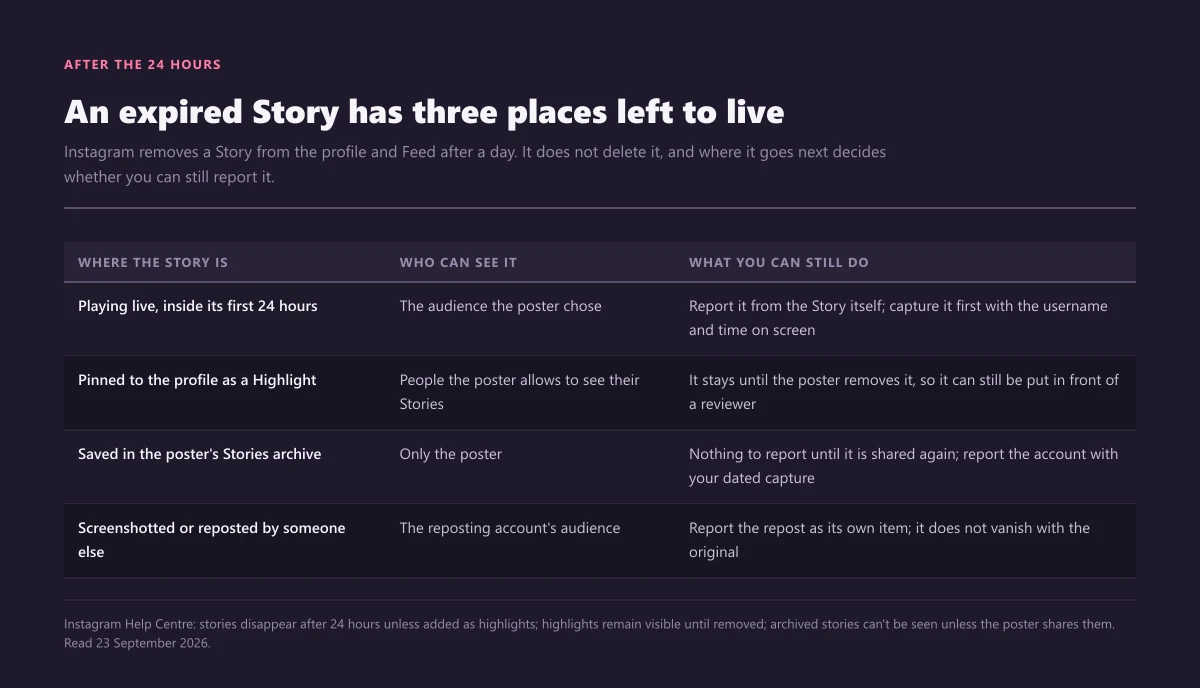
A Story pinned as a Highlight is therefore still on the profile, still visible to the audience the poster allows, and still something a reviewer can be shown. An archived one is out of your sight but not deleted, and it can come back whenever the poster chooses, so report the account with your capture and the date the Story ran. Screenshots and reposts are separate items that outlive the original, each reported where it sits.
Can you take down an Instagram Story you posted yourself? At any moment: open it, use its menu to delete it, then clear it from your archive and any Highlight if you want every copy gone. The controls for other people's Stories, pages and DMs, surface by surface, are in the Story and page reporting guide.
How long does it take to get a post or account taken down?
Meta's EU filing gives the first published figure: a median of 28.89 hours from notice to action, counted only where Instagram acted.
When the Instagram Ban Service desk opened Meta's Instagram report for this page on 23 September 2026, we saw that its median-time column carried no unit, so we checked it against the Commission's template in Implementing Regulation (EU) 2024/2835. The instruction there is blunt: The median time must be indicated in hours.
The same field allows providers to leave out cases where they decided not to act on a notice. Read together, the numbers say that when an EU notice about Instagram led to action in early 2026, half of those actions landed within about 29 hours, and they say nothing about the much larger number of notices that ended without any action.
| Instagram in the EU, 1 January to 30 June 2026 | Figure |
|---|---|
| Article 16 notices received | 388,783 |
| Of those, sent by trusted flaggers | 1,401 |
| Actions taken on notices under the law | 1,820 |
| Actions taken on notices under Instagram's terms | 66,327 |
| Median time from notice to action | 28.89 hours |
| Median time for trusted flaggers | 3.72 hours |
| Complaints about a notice left without action | 5,179, of which 1,542 reversed |
Meta states that every Article 16 notice goes through manual review. Trusted flaggers, organisations certified under the Digital Services Act, get the 3.72-hour median. Outside the notice system, Meta's page on prioritising content review says the queue is ordered by severity, virality and how likely something is to break the rules, which is why a threat moves faster than a rude caption.
Independent tests are less flattering. The Anti-Defamation League reported 253 items, 150 accounts and 103 posts, in January and February 2026. Within its two-week window Instagram removed 11 of the accounts and 8 of the posts, and in 20 cases said it lacked the bandwidth to review them, Jewish Insider reported on 15 April 2026. Meta answered that over two-thirds of the flagged items were removed before publication and that some did not break its policies.
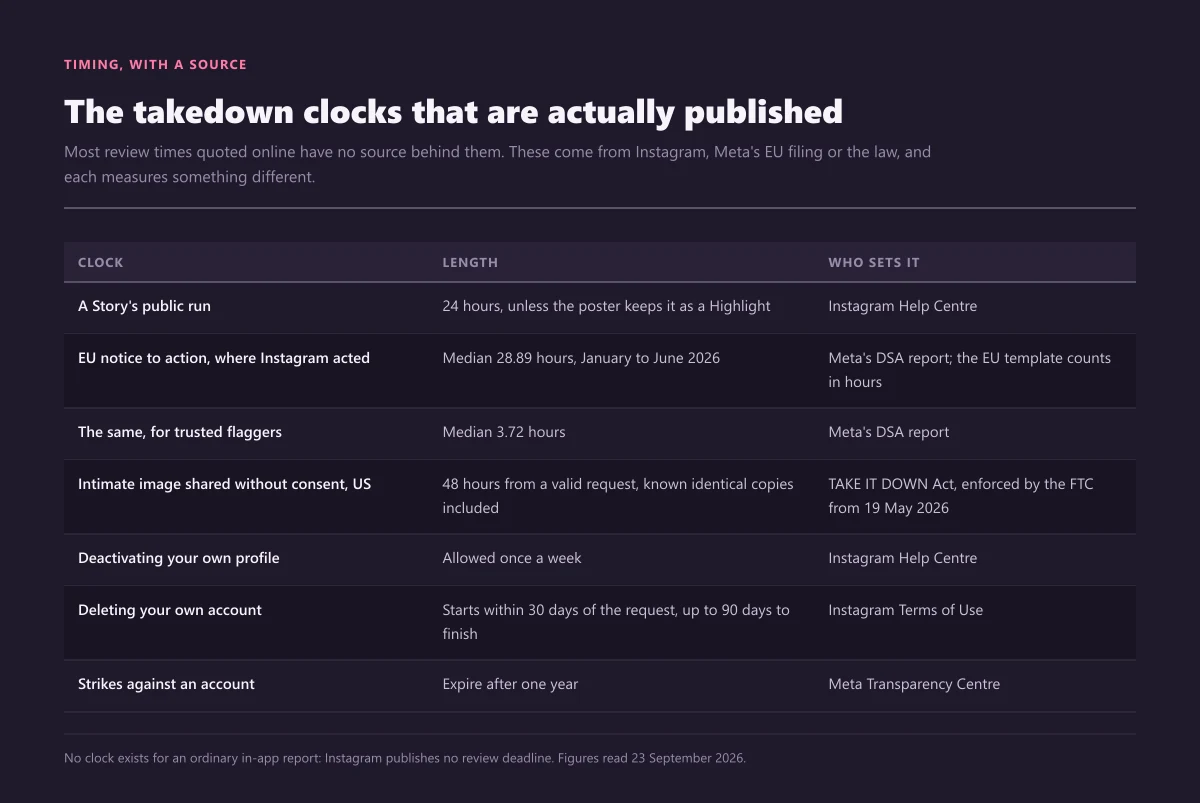
So how long does it take to get an Instagram account taken down? Longer than a post, because the question is bigger. And how to get an Instagram account taken down immediately has no honest answer beyond this: no button exists, the routes with legal clocks move fastest, and a threat to someone's safety belongs with the police first.
When can you take down an Instagram account or page, not just its posts?
When the account is the breach itself, or when what it keeps posting adds up. Otherwise the post goes and the profile stays.
Reviewers judge the item in front of them. A fake shop can lose five posts in a month and keep taking deposits, because each report removed one upload and none of them asked what the account exists to do. Five situations turn the question from the post to the account.
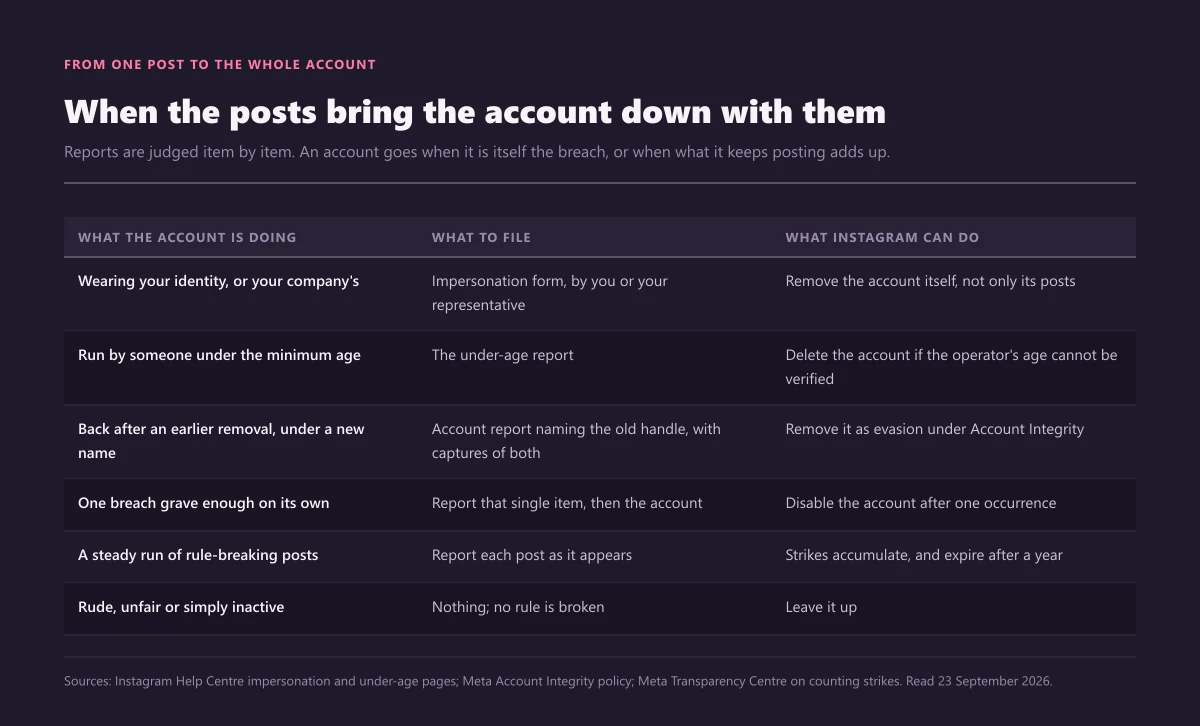
Identity comes first. A profile pretending to be you can be removed whole through the impersonation form, but Instagram acts on those reports only from the person copied or an authorised representative. Age is second: Instagram deletes an account when it cannot verify that the person running it is old enough. Evasion is third, since Meta's Account Integrity policy covers accounts created or repurposed to get around an earlier removal. Severity is fourth, because Meta says some violations are grave enough to disable an account after one occurrence, the ground covered in what makes an Instagram ban permanent. The fifth is accumulation. Strikes from removed posts build towards restrictions and a disable, and they expire after a year, which is why the number of reports has never been the lever people hope it is.
A page is an account as far as Instagram is concerned, so how to take down an Instagram page follows the same logic: file from the profile menu, as reporting a whole profile or page explains, and describe what the page is for rather than one post on it. Bot and spam networks are the exception, since they mostly fall in automated sweeps, a point the spam report bot teardown makes with numbers.
Expect some account removals to reverse. Meta's EU report logs 7,816,585 complaints against Instagram account suspensions or terminations in the first half of 2026, and 2,838,533 of them, about 36%, were reversed. A takedown resting on captures, dates and the exact rule survives that second look far better than one resting on a feeling. To confirm an account you reported really went, run the checks that separate a ban from a block, because a block, a rename and a deactivation all look alike from outside.
Old, inactive, famous or your own: accounts no report will remove
Inactivity breaks no rule, and an owner's account is the owner's to switch off. For these cases a report is the wrong tool.
Does Instagram take down inactive accounts? On its own schedule, not on request. Its inactive username policy is a single encouragement, We encourage people to log in and use Instagram and Threads once they've created an account
, with no deadline attached. Meta does clear dormant profiles, though. After follower counts fell across Instagram on 6 and 7 May 2026, a Meta spokesperson told Telangana Today: As part of our routine process to remove inactive accounts, some Instagram accounts may have noticed updates to their follower counts.
So how to get an inactive Instagram account taken down comes down to what it is doing. An abandoned profile stays until Meta's own process reaches it; a dormant one that impersonates you goes on the impersonation form.
Your own old account is a recovery job first, because deleting it requires logging in. Work through Instagram's login help with every email address and phone number you might have used, then take it down deliberately:
- Open Settings, then Accounts Centre.
- Find Deactivation or deletion, which sits under Personal details and Account ownership and control in most versions of the app.
- Choose Deactivate account to hide the profile, or Delete account to end it.
The difference is time. Instagram lets you deactivate your profile only once a week, and a deactivated profile returns the moment you log back in. Deletion is slower than the button suggests: the Terms say the process will automatically begin no more than 30 days after your request
and that it may take up to 90 days after that, and the Help Centre deletion page adds that the cancellation window varies by region. That answers how do you take down your Instagram account, and why nobody can do it for you.
Celebrity disappearances follow the owner's rules too. Did Britney take down her Instagram? Repeatedly, by every public account: the profile went dark in September 2021 and March 2022, several times in 2023 and 2024, in November 2025 and again in early March 2026, before it returned on 27 March 2026, Us Weekly reported. No outlet has reported Meta removing it, and each return after a login is what deactivation looks like. When an owner has died, the family route is a memorialised Instagram account rather than a takedown.
What Instagram Ban Service files, and the requests it turns down
Instagram Ban Service starts every case at the smallest removable unit. We ask for the link to the post, picture or Story, a capture with the username and date visible, one sentence on the rule you believe it breaks, and whether you are the person it concerns, since the privacy, impersonation and defamation routes accept only that person or their representative. The desk then picks one route, files once and keeps the reference for any review or appeal. Instagram makes the decision, and nobody outside Meta controls it. Reporters who want to stay unnamed should read the one exception to report anonymity and what the other side is shown before anything goes in.
We turn down requests aimed at accounts that break no rule: critics, business rivals, former partners who have posted nothing reportable. We also refuse anything that would mean logging into someone else's profile.
Deciding what to do tonight? Report the post, with the capture attached and the most precise reason the menu offers, and hold the account question until identity, age or a pattern gives you a case. Send the link to the case desk if you would rather have the route chosen for you, or read the other Instagram reporting guides first.
Sources
- Meta Transparency CentreInstagram DSA VLOP Transparency Report, January to June 2026, published 28 August 2026
- Instagram Help CentreWhat to do if Instagram didn't remove content that you reported
- Instagram Help CentreLegal removal request for content believed unlawful in the EU
- InstagramReporting unlawful content in the UK
- Instagram Help CentreContent that violates local law: country-level restriction
- InstagramDefamation Reporting Form
- Instagram Help CentreThe Story Highlight feature and how long it stays visible
- Meta Transparency CentrePrioritising content review: severity, virality and likelihood of violating
- Meta Transparency CentreAccount Integrity policy
- Instagram Help CentreThreads and Instagram's inactive username policy
- Telangana TodayMeta statement on removing inactive accounts, 7 May 2026
- Instagram Help CentrePermanently delete or deactivate your Instagram profile
- Us Weekly via YahooBritney Spears returns to Instagram, 27 March 2026
Frequently asked questions
Does Instagram take down inactive accounts if you ask?
No. Inactivity breaks no rule, and Instagram's inactive username policy names no deadline. Meta does clear dormant profiles on its own schedule; a spokesperson called it a routine process after follower counts dropped in May 2026. A dormant account that copies your identity can still go through the impersonation form.
How do you take down your Instagram account yourself?
Open Settings, then Accounts Centre, and find Deactivation or deletion. Deactivating hides the profile until you log back in and is allowed once a week. Deleting begins no more than 30 days after the request and can take up to 90 days to finish, and the window for changing your mind varies by region.
Did Britney take down her Instagram, or did Instagram?
Every public report points to her. The account has gone dark and come back repeatedly since 2021, most recently returning on 27 March 2026, which is how an owner's deactivation behaves.
How do I get an old Instagram account taken down if I can't log in?
Recover it first, because only a logged-in owner can delete an account. Work through Instagram's login help with every email address and phone number you might have used. If recovery fails and someone else now runs the profile under your name, report it on the impersonation form with your photo ID.
Can a post come back after Instagram takes it down?
Yes. The poster can ask for a review, and in the EU Meta reversed 3,339,196 of the 8,955,778 complaints it received about its Instagram decisions in the first half of 2026. A copyright removal can also return after a counter-notice. Keep your captures until the matter is settled.
What if the post is on a private account, or the poster blocked you?
A block hides the post from you, not from Instagram. Ask someone who can still see it to report it from the post's own menu, and use the impersonation, under-13 or intellectual property forms where they fit, since those open without logging in. The capture you took before the block is the evidence that survives.
Is the Instagram takedown notice in my DMs real?
Almost certainly not if it arrives as a DM or email with a countdown and a login link. Real enforcement shows up inside the app, in Account Status, and Instagram never asks you to confirm a password through a message. Open Account Status yourself instead of tapping anything in the notice.
Is there a way to get an Instagram account taken down immediately?
Not through reporting. Instagram publishes no instant route, and in the EU its median time from notice to action was 28.89 hours in early 2026, counting only notices it acted on. If someone is in danger, call the police first. For intimate images in the United States, the TAKE IT DOWN Act sets a 48-hour deadline.
Can you see whether the post you reported was taken down?
Yes, for in-app reports. Go to Help, then Reports and violations, then Reports, where Instagram says whether the content went against its Community Guidelines, and request another review there if you disagree. Web-form claims, such as impersonation reports, are answered by email instead.