Reporting · a single post, photo or story
Report a post on Instagram: the 6 official routes and which one fits
Six official routes can take an Instagram post down. Five of them are forms almost nobody sees, because the three-dot menu answers first and looks like the entire system. Choosing between them is the part that decides the outcome.
To report a post on Instagram, open the post, tap the three dots above it and choose Report. That in-app route covers most Community Standards breaches. Impersonation, copyright, trademark, under-13 and intimate-image cases have their own forms, and filing those in the app instead usually wastes the complaint.
Where is the Report button on an Instagram post?
Three dots, then Report, then a reason. Instagram puts the reason list in front of you immediately and files the complaint against its Community Standards, which is why reporting a post on Instagram feels like a ten-second job, and why so many ten-second reports come back with nothing.
- Open the post itself rather than the profile grid, so the report attaches to that piece of content and not to the account as a whole.
- Tap the three dots at the top right of the post, then choose Report.
- Pick the reason that describes what the post actually is. This is the decision that matters; everything after it is confirmation.
- Submit, then check Settings, then Help, then Support Requests a day later. The decision appears there, and nowhere else.
The same menu handles a photo, a video, a carousel and a Reel. Reporting a comment uses a different gesture, and a story, page or DM sits on its own surface again. If the account is private or has blocked you, the in-app route is closed and a Help Centre form becomes the only way in.
Which official route does your report actually belong in?
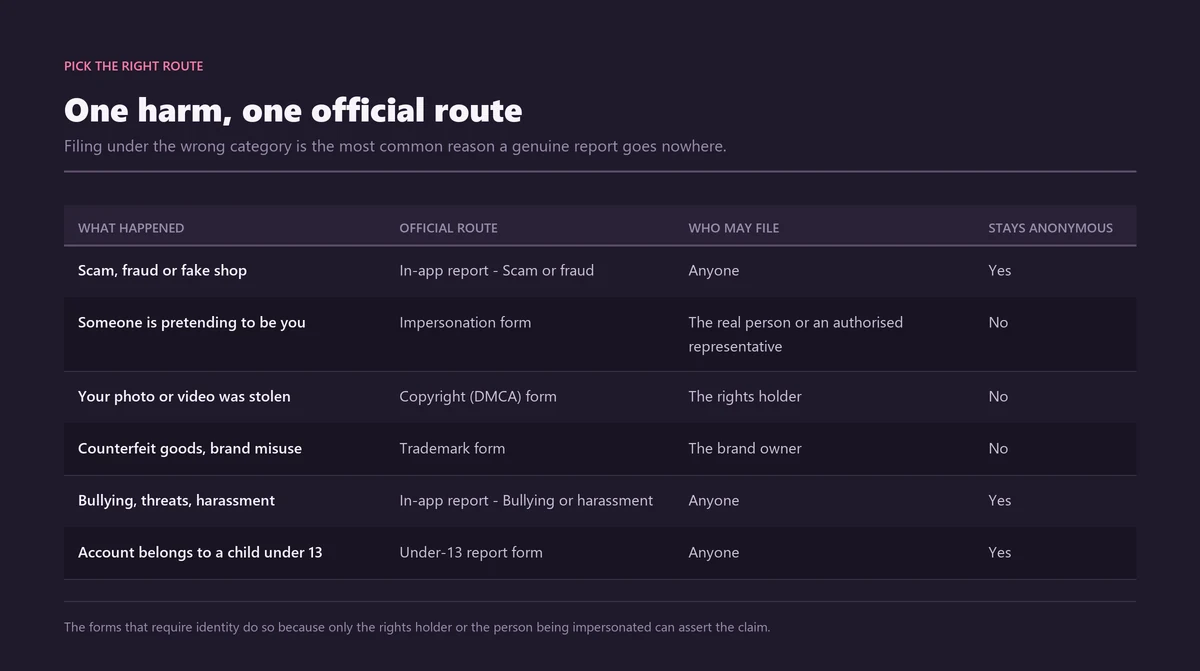
Match the route to the harm rather than to your level of anger. Instagram runs one general in-app channel plus a set of identity-bound forms, and a complaint filed in the wrong lane gets measured against the wrong rulebook before it is refused.
| What the post is | Route that decides it | Who may file | Reporter stays unnamed |
|---|---|---|---|
| Bullying, threats, hate, self-harm | In-app report, matching reason | Anyone who can see it | Yes |
| Scam, fake shop, fraudulent giveaway | In-app report, fraud or scam | Anyone who can see it | Yes |
| Someone posing as you or your business | Impersonation form | The person copied, or an authorised representative | No |
| Your photograph or video, reposted | Copyright report form | The rights holder only | No |
| Your brand name or logo, misused | Trademark report form | The brand owner | No |
| Account run by a child under 13 | Underage report form | Anyone | Yes |
The pattern in the last column is not arbitrary. Every route that requires your name is a legal claim rather than a rules complaint, and the person you reported is entitled to know who asserted it so they can answer or counter-notify. Community Standards reports carry no such right, which is why they stay anonymous, and the wider question of what Instagram tells the account you reported splits along the same line. A bystander filing a fake account report must therefore travel as scam or fake identity, never impersonation, because a bystander has no standing to assert somebody else's identity claim.
Three categories hide in plain sight inside the in-app list. Giveaway and business scams belong under fraud rather than spam. Threats and doxxing split across two separate policies and get refused when filed as ordinary harassment. A post about someone who has died sits outside the whole system, because memorialising an account is a request, not a report.
Why the in-app report is the weakest route you can pick
It is the only route with no evidence field. You choose a reason from a list, tap send, and the reviewer receives your category label and the post. Nothing you know about the context travels with it: not the earlier posts that establish a pattern, not the message that proves intent, not the date the harassment started.
That gap is no longer only a practitioner complaint. In October 2025 the European Commission issued preliminary findings that Facebook and Instagram breach the Digital Services Act on this exact point, saying the platforms appear to use dark patterns in their notice-and-action mechanisms and fail to give users a simple way to flag illegal content. The Commission added that the appeal route does not appear to let people attach explanations or supporting evidence at all. Meta disputes the findings and no final decision has issued, so read it as a regulator's opening position rather than as settled law. It still describes what anyone who files these regularly has watched happen for years.
The second reason to take route selection seriously is a policy change Meta made on 7 January 2025. Announcing a broader moderation shift, the company wrote: For less severe policy violations, we're going to rely on someone reporting an issue before we take any action.
Proactive systems were kept for illegal and high-severity violations, like terrorism, child sexual exploitation, drugs, fraud and scams
. Below that line your report is not a nudge to a system already watching. It is the trigger. File under the wrong policy and the correct rule never gets checked by anyone at all.
Meta also merged the Instagram, Facebook, Messenger and Threads rulebooks into one set of Community Standards on 12 November 2024, then renamed Hate Speech to Hateful Conduct in January 2025. Guides written before those dates name categories that no longer exist.
What does a reviewer need to see before acting?
A reviewer needs to confirm that a named rule was broken by a specific account on a specific date, without leaving the file you handed over. Everything else is noise. On a harassment case in March we filed twice: the first submission, a plain in-app report, came back refused inside a day; the second, carrying full-screen captures with usernames and timestamps, was actioned eleven days later. Instagram Ban Service assembles that capture set before anything is submitted, because the second filing is the expensive one.
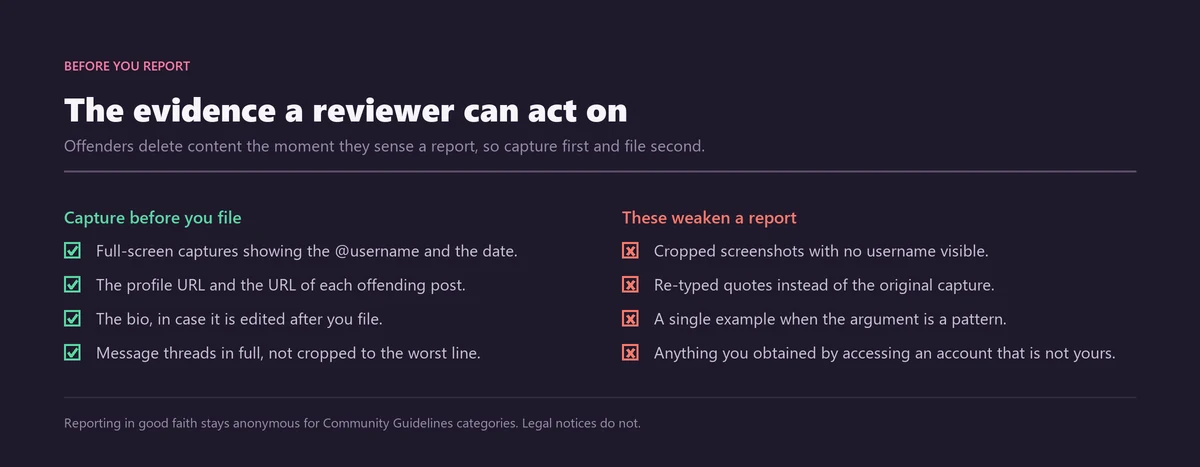
- Full-screen captures showing the @username and the date, not cropped down to the offending line.
- The profile URL and the direct URL of every post you are reporting.
- The bio as it reads today, because it is usually edited within hours of a report landing.
- The single guideline you say was broken, named. Not three possibilities.
Re-typed quotations are worth nothing, because a reviewer cannot verify text you transcribed yourself. Neither is anything obtained by logging into an account that is not yours, which is unlawful access in most jurisdictions and taints the rest of the file.
How do you report a photo on Instagram that someone took of you?
Not under copyright, in almost every case. The photographer owns the copyright in a photograph, not the person standing in it, so the subject of a stolen picture usually has no claim to make on that form. This is the most expensive misunderstanding in the whole area, and it explains a great many refusals that arrive without explanation.
Reporting a photo on Instagram therefore forks three ways. If you pressed the shutter, or you own the image because it was made for you under contract, the copyright form is yours and the Instagram report photo route through intellectual property is the strongest one available to anybody. If you did not, and the picture was taken somewhere you had a reasonable expectation of privacy, the privacy violation form is the fit. If the image is sexual and you never consented to it being shared, neither of those is the right door.
For that third case, hash-matching does the work. StopNCII.org creates a digital fingerprint of the image on your own device and shares only that fingerprint, never the picture itself, with participating platforms including Facebook and Instagram. In the United States the TAKE IT DOWN Act added a legal deadline on top: signed on 19 May 2025, with the Federal Trade Commission beginning enforcement on 19 May 2026, it obliges platforms to remove non-consensual intimate imagery, including AI-generated forgeries, within 48 hours of a valid request. Where the subject was under 18 when the image was made, NCMEC's Take It Down is the correct service instead.
How to get someone's Instagram post deleted when it is about you
Standing decides this, not effort. Whether you can get someone's post deleted on Instagram turns on whether the post breaks a rule you personally have the right to invoke, and persistence is no substitute for that. People searching for how to get someone's Instagram post deleted are usually looking at content that is cruel but not rule-breaking, and that distinction is where most attempts end.
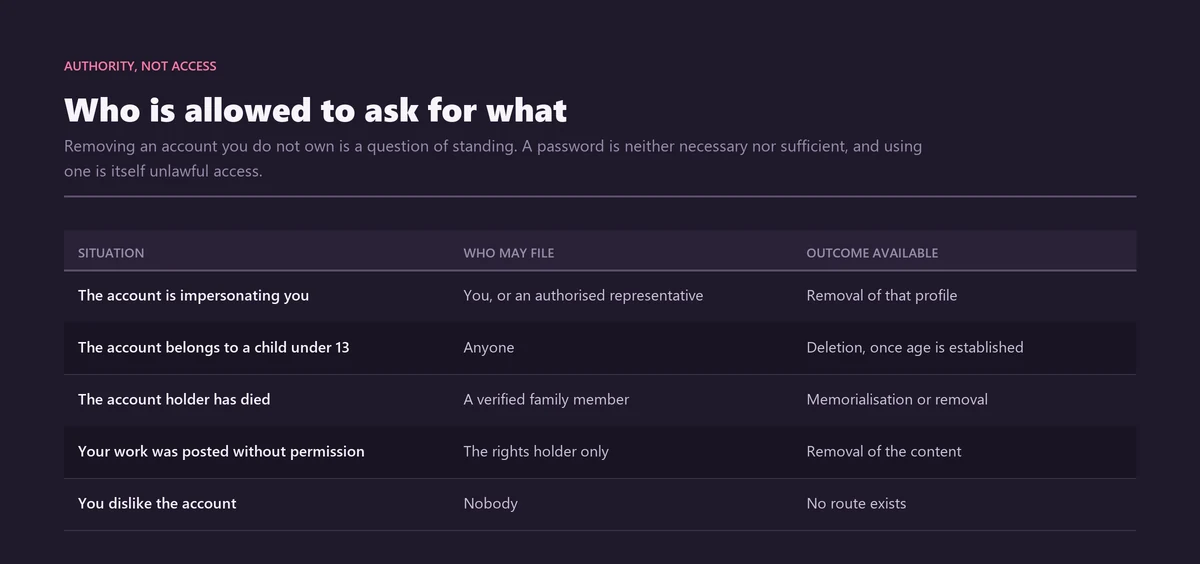
Work down the list in order. The post carries your copyrighted photograph, so the rights-holder route opens. It names your employer and invents a crime, so defamation law applies through a lawyer rather than through a report button. It targets you repeatedly across weeks, so the bullying and harassment policy covers the pattern even where no single post crosses the line alone. It demands money to take something down, so it is extortion and belongs with the police as well as with Instagram. It merely embarrasses you, so nothing applies, and the honest answer is that no route exists.
When the target is the whole account rather than one item, the decision changes shape, and deleting someone else's Instagram account runs on a separate set of rules again. Anyone asking how to get someone's photo deleted on Instagram for a friend should note the split in the table above: the identity-bound forms will refuse them, the Community Standards categories will not.
Reporting a story runs on a 24-hour clock
A story deletes itself after a day, and a reviewer cannot open what no longer exists. An Instagram story report filed on the second day has nothing behind it, so capture before you file. If it has already gone, report the account and describe the story, its date and the rule it broke. The surface-by-surface detail for how to report someone's story on Instagram, along with pages and DMs, sits on the story and page reporting guide.
What happens to a reported Instagram post?
It goes to review against the Community Standards, and the outcome is removal, a warning screen, demotion in feeds, or nothing at all. A reported Instagram post that stays up has not necessarily been ignored, because demotion is a real outcome that looks identical to inaction from the outside. An Instagram post reported by you surfaces in Support Requests once it is decided, and the full taxonomy of what reporting someone on Instagram does covers the account-level consequences.
Meta publishes how often it gets this wrong. Its Integrity Reports of 27 August 2026 put global enforcement precision on Instagram at around 92% for the first half of that year, which leaves roughly one action in twelve landing on content that should have stayed up. The same report tracks violent and graphic material on Instagram climbing from 0.09% to 0.10% of views in Q4 2025 to 0.14% to 0.15% by Q2 2026, so the queue your report joins is getting busier rather than quieter.
Strikes attach to the account behind the post, never to you. Meta's published ladder gives a warning at the first strike, feature restrictions from the second through the sixth, then content-creation blocks of one day at seven strikes, three days at eight, seven days at nine, and thirty days at ten or more. That first warning does more work than it looks: the Oversight Board reported in December 2025 that more than 730,000 Instagram users chose to open the eligible-violation notice during its first three months, and that most of them worked through it rather than take the strike.
How long does Instagram take to decide?
No published service level exists, and the 24-to-48-hour figure repeated across most guides has no source at Meta. Severity, clarity and route drive the speed instead.
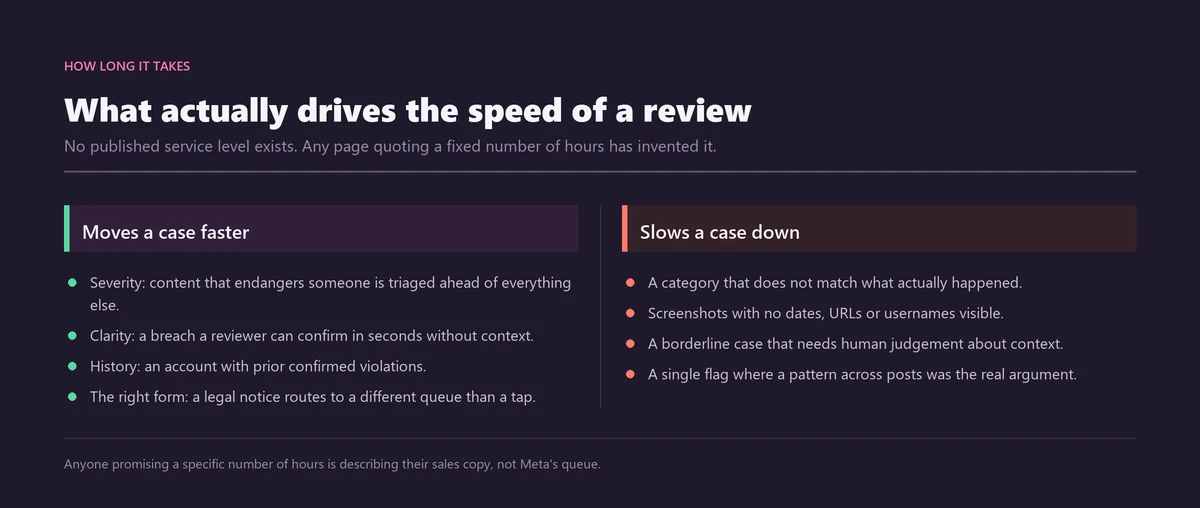
Legal notices route to different queues than tapped reports, which is one more argument for choosing the form over the menu wherever you qualify for both. In the European Union, Article 16 of the Digital Services Act obliges platforms to handle notices in a timely and diligent manner, though it sets no fixed clock either.
Your report came back refused. What is left?
An escalation ladder, and almost nobody climbs it. Most people re-report the same post the same way and receive the same answer, because nothing in the second submission differs from the first.
| Step | Where | What it needs |
|---|---|---|
| Request a review | Settings, Help, Support Requests | Nothing new; a second reviewer reads the same file |
| Re-file on a different route | Help Centre form | A rule you qualify to invoke, plus dated evidence |
| Oversight Board | oversightboard.com | Meta's appeals exhausted, plus the reference ID from your Support Inbox |
| Legal notice | DMCA, DSA Article 16, or a lawyer | A claim that exists outside platform policy |
The Oversight Board step surprises people, because it is usually described as a route for users whose own content was removed. Meta's own guidance confirms that it also takes appeals about content posted by another person that has been left up, provided you have exhausted Meta's appeals first and hold the reference ID that the final decision generates. The Board reported in December 2025 that Meta had implemented around 75% of the 300-plus recommendations it has issued since 2020.
Instagram Ban Service treats a first refusal as information about the route rather than a verdict on the post, since it usually means the category was wrong, the evidence was thin, or the claim needed a form the filer never qualified for. Instagram still makes every final decision, and no service anywhere controls that.
Does reporting the same post from more accounts help?
No, and Meta says so directly. Its Help Centre states that the number of times something is reported does not determine whether it is removed, and that the same Community Standards apply at every review however many complaints arrive.
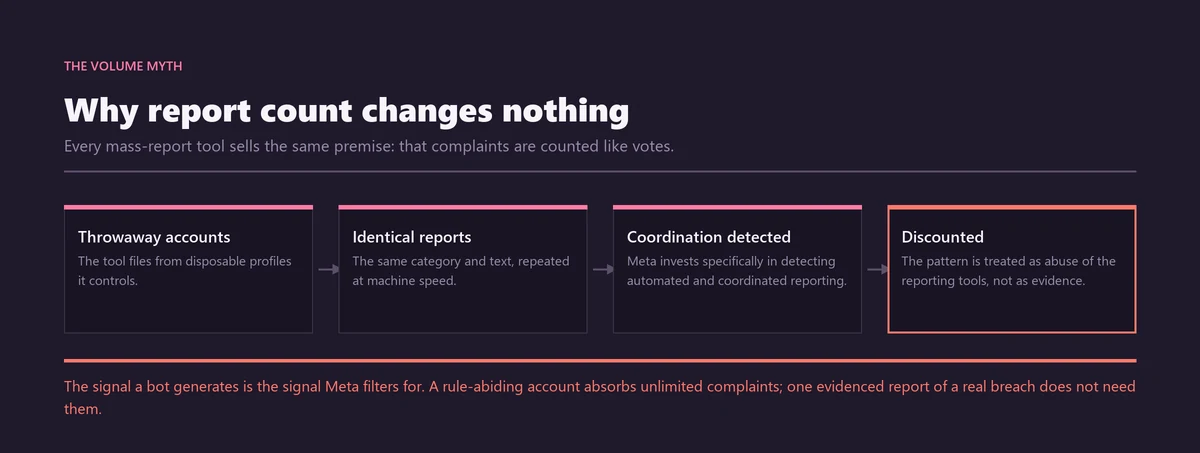
Organised waves are worse than useless. They are detectable by design, they get discounted, and the accounts that join in can be actioned for coordinated behaviour, which is how a group of friends trying to help ends up restricted instead. The arithmetic behind how many reports it takes to remove an account is not a number at all, and the tools sold on the promise that it is get taken apart in the breakdown of what a spam report bot actually does.
Report the account, not just the post, when the pattern is the problem
One post rarely carries a case alone. Where the harm is a campaign, a single item filed in isolation gets judged in isolation and survives, because the reviewer sees one ambiguous image instead of forty days of targeting.
So file the post-level report where a single item clearly breaks a single rule, and move account-level the moment your argument depends on repetition. The routes for getting an Instagram account taken down and for reporting and disabling a profile take a different kind of evidence, and a sustained campaign by one person against another is a stalking case before it is a content case. If you are unsure which shape your situation has, send it to the case desk before you file. A refused report is harder to rescue than an unfiled one.
Sources
- European Commission, preliminary findings on TikTok and Meta under the Digital Services Act, October 2025.
- Meta, More Speech and Fewer Mistakes, 7 January 2025.
- Meta Help Centre, on report volume and removal decisions.
- Meta Transparency Center, restricting accounts and the strike ladder.
- Meta Transparency Center, appealing to the Oversight Board.
- Meta, Integrity Reports, 27 August 2026.
- Oversight Board, five-year assessment, 4 December 2025.
- Federal Trade Commission, enforcement of the TAKE IT DOWN Act, May 2026.
Frequently asked questions
Can you get someone elses Instagram post deleted without their password?
Yes, and a password would not help you anyway. Removal is decided by whether the post breaks a rule, not by who can sign in. Logging into an account that is not yours is unlawful access in most jurisdictions, and it destroys the evidence value of everything you then collect.
How do you get someones Instagram photo or picture deleted?
Match the picture to a rule first. If you took the image, the copyright form applies. If it shows you in a private setting and you did not take it, the privacy violation form applies. If it is sexual and non-consensual, the intimate image route applies. Disliking the photo matches nothing.
Does it matter if I choose the wrong report category on Instagram?
It matters more than anything else you control. The category you pick decides which policy the reviewer checks the post against. A harassment post filed as spam gets measured against the spam rules, fails that test, and comes back with no violation found even though the post breaks a different rule.
Can I report a post on Instagram on behalf of someone else?
For ordinary Community Standards breaches, yes, and anyone who can see a post may report it for bullying, threats, nudity or fraud on behalf of a friend who cannot face doing it themselves. The identity-bound forms are the exception: impersonation accepts only the person being copied or their authorised representative, and copyright only the rights holder.
Can I report the same Instagram post again after it was rejected?
You can, but re-filing the identical complaint through the identical route usually produces the identical answer. What changes an outcome is a different route, a different policy, or evidence the first submission did not carry. Use the review request inside Support Requests first. It costs nothing and puts the file in front of a second reviewer.
How do you report a post on Instagram without an account?
Instagram keeps logged-out reporting forms in its Help Centre for impersonation, intellectual property, privacy and underage accounts. They need the offending username and your dated evidence. The trade-off is that the decision never appears in an in-app inbox, so keep your own copy of what you sent.
What information does an Instagram copyright report need?
The link to each infringing post, a description of your original work and where it can be seen, your real name and contact details, and a good-faith statement. Meta passes your name and contact details to the person you reported so they can respond, which no Community Standards report does.