Reporting · a person, and what happened next
How do I report someone on Instagram, and how can I tell whether they were banned?
The report itself is a short run of taps. The harder half comes afterwards, because Instagram explains a ban to the person who was banned, while whoever reported them gets the verdict only in Support requests, a record filed away under Help that few people think to check.
Open the person's profile, tap the three-dot Options menu at the top right and choose Report, then pick what the account is doing wrong. Messages and comments have their own Report option, and defamation or copyright claims go through Instagram's web forms. Whatever you file in the app, the decision usually appears later in your Support requests, under Help.
How do you report someone on Instagram from their profile?
Through the Options menu at the top right of their profile, which leads to Report and three possible reasons. A report started there is filed against the account as a whole, the right target when the problem is the person rather than one thing they posted.
- Open their profile by tapping the username on a post, a story or your chat with them.
- Tap Options at the top right: three dots in a row on iPhone, stacked vertically on Android.
- Tap Report, then choose the reason that fits. Instagram offers three for a profile: posting content it shouldn't, pretending to be someone else, or belonging to a child under 13.
- Follow the on-screen questions to the end and submit. Blocking or restricting the account afterwards stops further contact and leaves the report in place.
On a computer the route is almost identical at instagram.com: click Options next to the username, select Report, then choose the type of account you are reporting. A desktop report joins the same review as one sent from the app, so switching devices changes nothing. Instagram Ban Service files account-level cases from this same menu whenever the breach is visible on the profile itself, and reaches for a web form only when the claim is one that a form exists for.
Of the three reasons, the middle one trips people up. Anyone can flag an account for pretending to be someone else from this menu, but the impersonation form, the route that carries more weight, belongs to the person being copied, and a bystander has a narrower set of choices, set out in the fake account report guide.
Which part of Instagram should the report start from?
Start from the place where the rule-breaking is visible, because each Report button files a complaint about the object it is attached to. A threat that arrived by message is reported from the chat. An abusive reply is reported from the comment. A pattern that only makes sense across weeks of posts belongs on the profile.
| Where the problem is | How to reach Report | What the report covers |
|---|---|---|
| The account as a whole | Three dots at the top right of the profile | The account |
| A post or Reel | Three dots on the post | That post only |
| A comment | Swipe left on it, or press and hold | That comment only |
| A direct message | Tap and hold the message | That message; a one-to-one chat can be reported whole from the name at the top |
| A group chat | Tap and hold a message, or open a member | Messages and people only, never the whole group |
| Someone who blocked you | No button reaches them from your account | See the next section |
Messages hold one surprise: Instagram's Help Centre says deleted, unsent or edited messages could be included in a report, so a threat later edited into an apology is not necessarily gone. A single post has its own walkthrough for reporting a post, and reporting a comment uses a different gesture on iPhone than on Android. Whichever surface you use, the person is not told who reported them; the one exception, intellectual property, is explained in what Instagram tells the account you reported.
How do I report someone on Instagram who has blocked me?
Ask someone who can still see the account to report it, because a block hides the profile and its Report button from you. That is essentially the whole of Instagram's official advice. When we read the Help Centre article for this situation in September 2026, we saw one short page: ask a friend with an account, and expect no action until Instagram can find the content. It linked none of the web forms that still work for a blocked user.
Those forms are why a block is less final than it looks. None of them needs you to see the account, and all of them can be filed without logging in:
- The impersonation form, for the person being copied or someone authorised to act for them. It asks for a photo of government ID, which Instagram says it deletes within 30 days.
- The under-13 form, which anyone may use for an account run by a child below Instagram's minimum age.
- The copyright and trademark forms, for rights holders only and never anonymous; the copyright report walkthrough covers what they ask for.
Instagram Ban Service starts from those forms whenever a client has been blocked, since a friend reporting in the app can only point at what they can see, not at the messages the blocked person received. A block followed by fresh accounts under new handles is a pattern rather than a one-off, and the stalking and repeat-contact guide shows how to document it so a reviewer sees the whole run.
Can you report someone on Instagram for buying followers?
Yes, although no reason in the report menu names it. Buying followers breaks the rulebook Instagram has shared with Facebook since November 2024: Meta's Spam policy bans attempting to or successfully selling, buying, or exchanging for engagement
, follows included, so the report belongs under spam.
Set expectations low for what that report achieves. Instagram's standard response is to strip the fake engagement rather than remove the buyer. In November 2018 it announced it had begun removing inauthentic likes, follows and comments generated by third-party growth apps, which is exactly the kind of engagement a follower purchase delivers.
Selling on the strength of fake numbers is where the complaint gains teeth, and where it can leave Instagram altogether. Since 21 October 2024 the US Federal Trade Commission's rule on reviews and testimonials, at 16 CFR 465.8, has made it unlawful to buy fake indicators of social media influence, bot followers included, when the buyer knew or should have known they were fake and uses them to misrepresent influence for a commercial purpose. Each violation can draw a civil penalty of up to $53,088. Inflated numbers also dress up scams: the FTC's April 2026 Data Spotlight put 2025 losses to scams that started on social media at $2.1 billion, about eight times the 2020 figure. A shop or influencer inflating its numbers to sell to you is closer to a consumer complaint than a spam report, and belongs with the scam or fraud reasons if money changed hands.
So the working answer to how to report someone on Instagram for buying followers: report the account as spam, claim nothing you cannot show, and expect the followers to go before the account does.
Is there an Instagram defamation reporting form, and who may use it?
Yes, and it sits outside the app. The in-app Report menu has no defamation option, so Instagram's defamation reporting form is the only channel built for false statements of fact, and it accepts reports only from the person defamed or someone authorised to act for them.
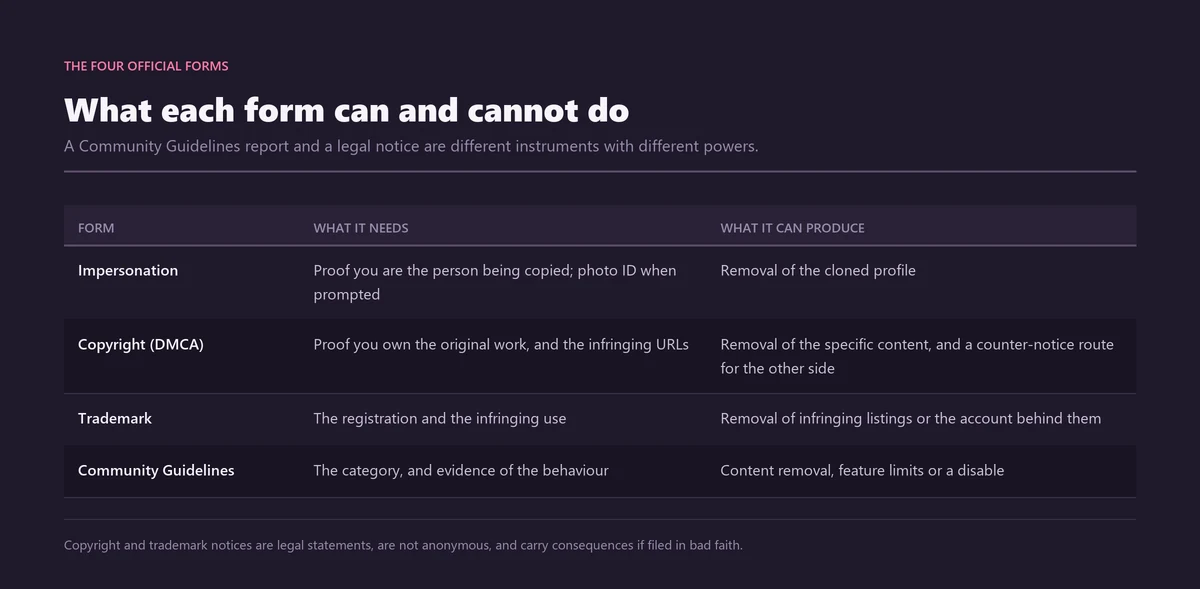
An Instagram defamation report is a legal claim rather than a rules complaint, and that changes what it can do. Meta says the form may not be available in your location, and it publishes no list of where it works. Expect a restriction in the country whose law was broken, not the deletion of an account. That is how Meta's local-law machinery runs at scale: in the first quarter of 2025 it restricted more than 500,000 pieces of Instagram content after government claims that local or national law had been broken, against more than 18 million on Facebook.
Which country's law applies changes the answer again. In the United States, Section 230 of the Communications Decency Act stops a platform being treated as the publisher of its users' posts, so US claims usually proceed against the author in court. In England and Wales, section 5 of the Defamation Act 2013 and the regulations made under it give a website operator 48 hours to pass a complaint on to the poster, who then has until the fifth day to respond. Instagram Ban Service prepares defamation filings only for the person named in the posts or someone acting for them, because the form discards everyone else's.
Two practical points follow. Name each post by its link and quote the exact words you say are false, because a form that says only "this account lies about me" gives the reviewer nothing to test. And if the same posts harass you repeatedly, file the in-app bullying report as well; it is judged against Instagram's own rules, which need no court to interpret them.
How do you know if someone got banned on Instagram, or only blocked you?
Rule out the two look-alikes first, a block and a changed username. What remains, a deactivation, a disable or a deletion, looks identical from the outside, and only the account holder, or Instagram's answer to your own report, can tell those three apart.
Anyone working out how to know if someone got banned on Instagram starts from the same screen: a profile that will not load. A deactivated or deleted account shows "Sorry, this page isn't available", as MakeUseOf's walkthrough documents, and Instagram's Help Centre says a disabled account is no longer visible to others either, so all three collapse into the same blank. An old link to a username that has since changed fails the same way. A block is the odd one out: the blocked person tends to see "User not found" or a bare profile with no posts, bio or follower counts, while everyone else sees the account as normal.
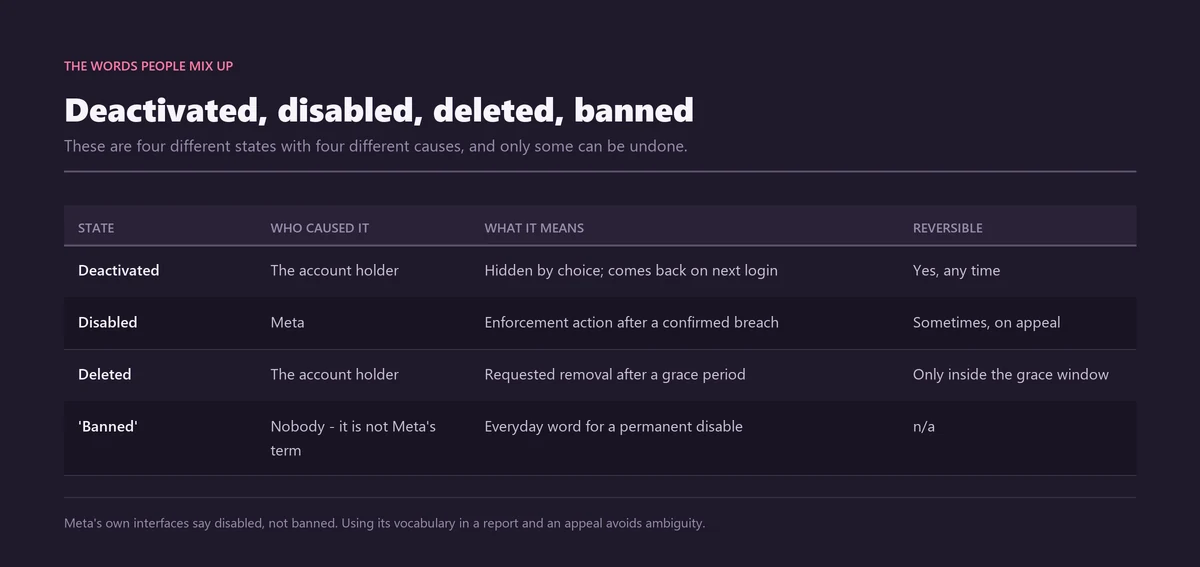
| What happened | From your account | From a friend's | Can it come back? |
|---|---|---|---|
| They blocked you | User not found, or a profile with no posts or counts | Loads normally | It never left |
| They changed username | Old link fails | Found under the new name | It never left |
| They deactivated it | Sorry, this page isn't available | Same | Yes, the moment they log in |
| They deleted it | Sorry, this page isn't available | Same | Only during the grace period |
| Instagram disabled it | Not visible | Not visible | Sometimes, on appeal |
| An under-13 account was removed | Not visible | Not visible | No, and nobody tells you |
Five checks, in order of effort, answer how to see if someone got banned on Instagram as far as an outsider can:
- Ask a friend to open the profile link. If it loads for them and not for you, you are blocked and the account is live.
- Search the person's display name and look for their profile photo rather than the old @handle. A renamed account turns up under its name.
- Open your old message thread. A name that now reads Instagram User, or in some cases a string beginning with __deleted__, means the account is out of service rather than blocking you, though not why.
- Give it time. A deactivated account returns the moment its owner logs back in, and a self-deleted one can usually be restored for 30 days, a window Instagram says varies by region, so a missing profile this week says little about next month.
- If you reported the account, open your profile menu, tap Help, then Reports and violations, then Reports. On a computer the same record sits under Settings, Help, Support requests. That is the only place Instagram tells a reporter what it did.
That fifth check outweighs the other four put together. Support requests shows when Instagram acted on your report and what it decided, sometimes with an option to request a review, though Instagram warns that not every report can be viewed there. One route never reports back at all: after an under-13 report, Instagram says you will not get confirmation that the account was deleted, only that you should no longer be able to see it. Instagram Ban Service treats a vanished profile as unconfirmed until that record or a form reply says otherwise, because a deactivated account can be back the next morning and a disabled one can be restored on appeal. Calling a ban too early has a cost, too: stop keeping evidence and there is nothing left to file if the account returns a month later. A handle freed by a deletion can be taken again once nobody holds it, although Instagram warns that someone removed for breaking its rules may not be able to sign up with the same username.
Can you look up why someone was banned from Instagram?
No. Instagram gives the reason for a disabled account only to its holder, in the notice they receive and under Account Status in their own settings, and there is no public lookup.
Anyone trying to work out how to look up why someone was banned from Instagram meets the same wall from three sides. Your own report is the narrow exception: its decision in Support requests shows what Instagram concluded about the thing you flagged, which may or may not be why the account went. In the European Union, platforms file a statement of reasons for moderation decisions into the Digital Services Act Transparency Database, launched in September 2023; on 21 September 2026 it listed 3,971,490,626 statements from the previous 180 days, 43% of them decided entirely by automated systems. Platforms must strip personal data before submitting, though, so none of those entries can be traced to a person. Meta's own transparency reports publish totals, never names.
The silence runs the other way too, since the account you reported is not told who filed against it, and the full chain from your tap to Instagram's decision is laid out in what reporting someone on Instagram does.
What gets someone instantly banned on Instagram?
One violation serious enough that Instagram disables the account after a single occurrence, with child sexual exploitation the example Meta itself gives. Its page on disabling accounts adds a second group that goes on discovery rather than after a strike, including convicted sex offenders and people evading earlier restrictions. Everything else climbs a ladder of warnings and restrictions first.
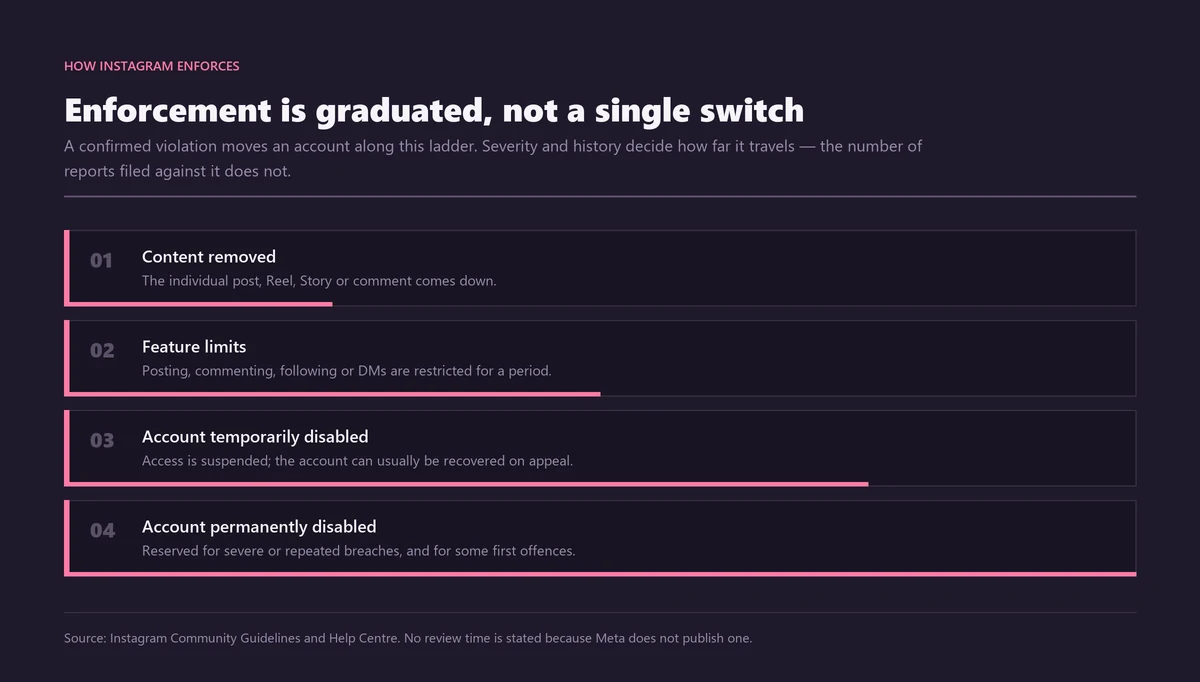
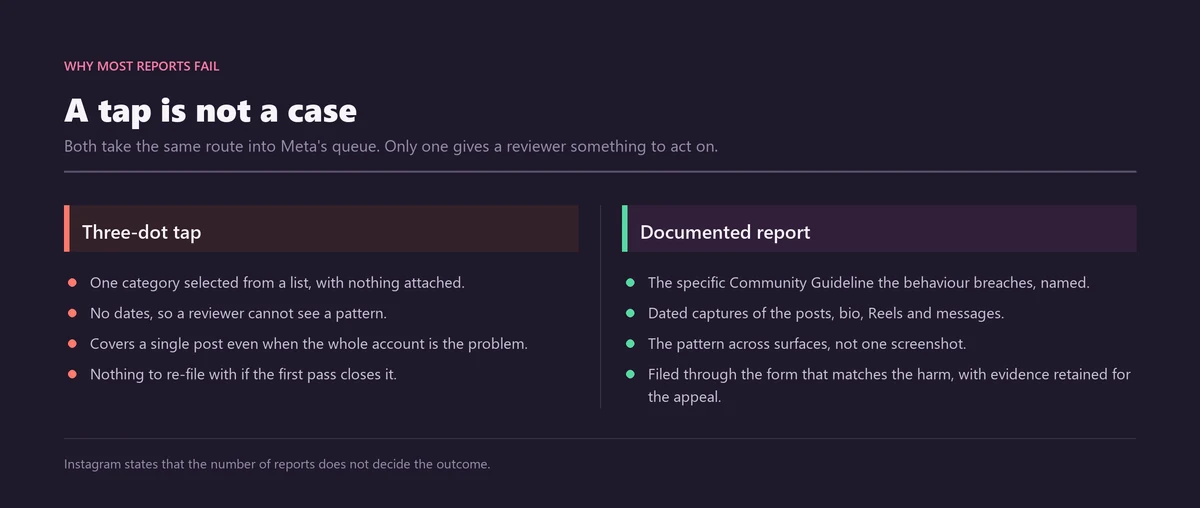
No user can ban another user, and there is no setting for it, so how to ban an Instagram user comes down to reporting a breach that Instagram then acts on. Nothing a reporter does can make an ordinary violation instant. Searches for how to get someone instantly banned on Instagram lead to mass-report services and bots, which fail for a reason Meta states plainly: the number of reports does not decide whether something comes down. The arithmetic behind that is in how many reports it takes to remove an account. Instagram Ban Service will not quote anyone an instant ban, since nobody outside Meta controls the timing.
Severe harm has faster lanes than Instagram's queue. A credible threat to someone's safety belongs with the police as well as with Instagram, and the threats and doxxing guide covers both. Material that sexually exploits a child goes to NCMEC's CyberTipline in the United States, or the national hotline elsewhere, and never only to a report button. The CyberTipline received 20.5 million reports in 2024, down from 36.2 million the year before, a fall NCMEC attributes partly to Meta bundling related reports together from March 2024.
Does the Reddit advice on getting someone's Instagram banned hold up?
Rarely. Mass reporting from throwaway accounts is named outright in Meta's Inauthentic Behavior policy, which bars using fake or inauthentic accounts to misuse Meta reporting systems to harass, intimidate or silence others
. The other favourites fail on their own terms: the impersonation form wants the ID of the person being copied, and an under-13 report only removes an account whose holder cannot verify their age.
Search Reddit for how to get someone's Instagram banned and its Instagram forums also carry the opposite story. In June 2025 TechCrunch reported that r/Instagram and r/MetaLawsuits were filling with posts from people whose accounts had been banned though they said they broke no rule, many of them blaming automated moderation and describing appeals that went unanswered. Paid versions of the shortcut are worse. In February 2021 AlgorithmWatch documented small groups that mass-reported accounts until they were suspended, then posed as the owners to seize them and resell them for $20 to $50 apiece.
Instagram Ban Service declines requests aimed at accounts that follow the rules, and a request framed as "how to get someones Instagram banned" usually describes exactly that: someone disliked, not a breach anyone can show. The advice that does hold up is unglamorous. One accurate report, from the surface where the breach happened, with the date visible. What actually decides a ban is set out in how someone gets banned on Instagram, and why piling on reports changes nothing in whether mass reporting works.
Can you get someone else's Instagram deleted, or get them to delete it?
Only the account holder can delete an Instagram account. Instagram disables accounts that break its rules, and a permanent disable is the closest an outsider's report can come to deletion.
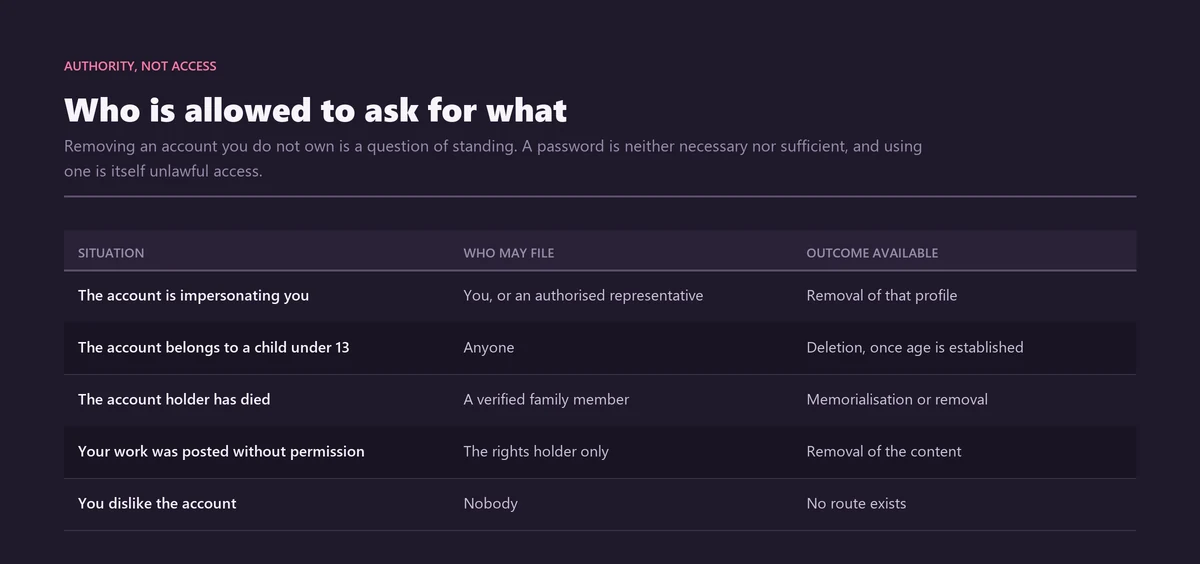
Three situations give someone else real standing. An account run by a child below the minimum age, which is 13 in most countries but higher in some, such as 16 in Australia, can be reported by anyone through the underage form, and Instagram says it will delete the account if it cannot verify the user is old enough. An account whose owner has died can be memorialised on the strength of an obituary link, while removal needs a verified immediate family member and proof such as a death certificate; the memorialisation guide covers both requests. And a court order can compel removal where the content itself is unlawful.
Outside those three, how to get someone to delete their Instagram has no mechanism behind it. You can ask, or you can take legal advice if what they post about you is unlawful. Whether it is typed as "how to get someone elses Instagram deleted" or spelled with care, every search promising a shortcut ends in the same place, and the fast versions sell a speed nobody can deliver. Someone else's account comes down through its own breach, reported on the right route, or through one of the three doors above; no fourth door exists.
One accurate report, then the wait
File once, from the surface that shows the breach, after capturing it with the date on screen, and then leave it alone for a day before checking Support requests.
Expect some reports to go nowhere. In August 2024 the Center for Countering Digital Hate flagged 1,000 abusive comments aimed at ten US women politicians through Instagram's own tools, and a week later 926 of them, or 93%, had seen no action. Refiling the same complaint through the same button tends to produce the same answer; a different route or better evidence is what changes outcomes.
Instagram Ban Service can prepare that file and send it through the official channel that fits, whether that is the in-app report, a Help Centre form or a legal notice, while Instagram alone decides the result. When the aim is a whole account rather than one post, read how reporting an account, profile or page works first, then send the case to the desk with what you already have.
Sources
- Instagram Help Centre: report a post or profile, read September 2026.
- Reporting a message or chat on Instagram, Help Centre, read September 2026.
- Reporting when you have no account or cannot see the content, Instagram Help Centre, read September 2026.
- Meta Transparency Center, disabling accounts, updated 17 July 2025.
- Checking a report under Support requests, Instagram Help Centre.
- Asking Instagram to review a report decision, Help Centre.
- Deleting an account and the cancellation window, Instagram Help Centre.
- Reporting a user under the minimum age, Instagram Help Centre.
- Reporting a deceased person's profile, Instagram Help Centre.
- MakeUseOf, telling a deactivated Instagram account from a deleted one, updated 29 November 2024.
- Defamation reporting form, Instagram.
- Meta, content restricted on local-law grounds and user notifications, updated 5 November 2025.
- Spam policy, Meta Community Standards, updated 26 June 2024.
- Reducing inauthentic activity on Instagram, Instagram, 19 November 2018.
- 16 CFR 465.8, misuse of fake indicators of social media influence, effective 21 October 2024.
- FTC, inflation-adjusted civil penalty amounts for 2025.
- FTC Data Spotlight, reported losses to scams on social media, 27 April 2026.
- Inauthentic Behavior policy, Meta Community Standards.
- 47 U.S. Code section 230, Legal Information Institute.
- The Defamation (Operators of Websites) Regulations 2013, Schedule.
- European Commission, DSA Transparency Database.
- NCMEC, 2024 in numbers, 2025.
- TechCrunch, Instagram users complain of mass bans, pointing finger at AI, 16 June 2025.
- AlgorithmWatch, mass reporting used to seize Facebook and Instagram accounts, 1 February 2021.
- Center for Countering Digital Hate, Abusing women in politics, 14 August 2024.
Frequently asked questions
How can you report someone on Instagram without an account?
Through Instagram's Help Centre forms, which work without logging in: impersonation for the person being copied, the under-13 form for a child's account, and the copyright and trademark forms for rights holders. Harassment, threats and scams have no logged-out form, so for those a friend with an account has to press Report.
If I see "user not found", did someone block me on Instagram?
Not necessarily. The same failure appears for accounts that were deactivated, disabled or deleted, and for old links after a username change. Ask a friend to open the profile; if it loads for them, it is a block.
Is Instagram banning accounts that buy fake followers?
Mostly it deletes the fake followers instead. Instagram has been stripping inauthentic follows produced by third-party apps since November 2018, and a report about bought followers usually ends there. Using inflated numbers to sell is another matter: in the United States, buying fake indicators of influence for a commercial purpose has been an FTC violation since October 2024.
How fast does Instagram act on a reported account?
Meta publishes no deadline for a first review, so any fixed figure you read elsewhere is a guess. If your report is refused and you request a second look through Support requests, Instagram says that review usually happens within 24 hours.
Does reporting from a computer make a difference?
No. The Report option on instagram.com sends the complaint into the same review as the app does, so a post that survived a desktop report would have survived one sent from a phone. The category you pick and the surface you report from change outcomes. The device does not.
Why would Instagram ban an account without any warning?
Because some violations skip the ladder. Meta's rules allow an account to be disabled after one occurrence when the breach is severe enough, and some accounts are disabled the moment Meta finds them. Don't read a sudden disappearance as proof that someone mass-reported it: a single serious violation, a disable on discovery and an owner who simply deactivated all look the same from outside.