Reporter safety·What the other side can learn
If you report someone on Instagram, will they know? What they are shown, and what can still give you away
The account usually belongs to someone you know: an ex, a classmate, a colleague, or the person who has been messaging you for weeks. That is why pressing Report can feel like signing your name. Instagram's policy on the question is settled, and it favours you. Whatever exposure remains sits in the circumstances around your report.
No. Instagram never tells an account who reported it, and the notice sent after a successful report names the broken rule, not the reporter. Two things can still point to you: a route that carries your identity by design, such as a copyright claim, and a situation where you were one of few people able to see the content.
If you report someone on Instagram, will they know from what they are shown?
No. Every outcome of a report ends in one of two things for the other account, silence or a notice about a rule, and neither carries your name. Meta's Help Centre puts the principle in one line: The account that you reported won't see who reported them.
Instagram's own safety explainer, published on 22 November 2024, goes further and calls reporting always anonymous
. That overstates it. Meta's Help Centre keeps one exception the explainer leaves out, and it sits in the last row of this table: a copyright or trademark report carries your name to the person you reported.
| What your report led to | What the account holder is shown | Does it name you? |
|---|---|---|
| No breach found | Nothing in Account Status, which lists actions taken against the account | No |
| Content flagged as possibly hurtful | A notification that it may have been hurtful to others, showing the flagged comment or post with the option to delete or keep it | No, though it shows exactly which item was flagged |
| Post, Reel, story or comment removed | A notice that the content went against the Community Guidelines, logged in Account Status | No |
| Features restricted | Account Status lists what they can no longer do, and for how long | No |
| Account disabled | A message when they try to log in, with on-screen steps to ask for a review | No |
| Copyright or trademark removal | A notice that can include the rights owner's name and the email address used to file | Yes, by design |
Two rows deserve a second look. The hurtful-content notice hands its recipient the flagged comment itself, so a reply aimed at you points back at you whatever the notice leaves out. Only in the copyright row is naming the reporter the system working as intended, which is why stolen photos call for a deliberate choice of route rather than a reflex. For the account-level consequences, see what a report sets in motion; comments follow rules of their own.
Your own view is the mirror image. Support requests is where the decision shows up, reached through Settings and then Help, and it tells you what was done without telling the other side anything about you, although Meta warns that not every report you make may be viewable there.
Every notice in that table also comes with a way to push back, and Meta gets a share of these calls wrong. Its Integrity Reports, updated 27 August 2026, put enforcement precision at the end of the first half of 2026 at around 92% on Instagram and 91% on Facebook, so something like 8% of Instagram actions hit content that should have stayed up.
EU residents have one more case to weigh. A notice filed through the Digital Services Act route for illegal content already requires your name and email, and Article 17(3)(b) of the Act lets the statement of reasons sent to the account holder include the identity of the notifier
where that is strictly necessary
. An in-app report sent from the same phone carries neither requirement, and the route-by-route anonymity rules cover the remaining instruments. Instagram Ban Service raises this before any EU notice goes in, because whether the trade is worth it is the client's call.
Instagram stays silent. The circumstances often don't.
Context gives reporters away when the audience was small, the conversation had two people in it, or the content was about them. Instagram withholds your name. It cannot hide that a Close Friends story reached a handful of people, or that a message thread had exactly one other participant.
However the question gets typed, from the careful version to "if u report someone on instagram will they know" sent at two in the morning, the worry behind it concerns a person rather than a policy. So set aside whether Instagram will tell them. Ask whether they could work it out, which comes down to a short list of situations.
When the Instagram Ban Service desk re-read Meta's help pages and notice descriptions for this guide on 21 September 2026, we saw no notification type, on any surface, that names a complainant outside the intellectual property route. Every exposure we could find was situational.
| Situation | Why they can work it out | What lowers the exposure |
|---|---|---|
| A message in a one-to-one DM | The thread had one other person in it, and Instagram reviews recent messages from a reported conversation | Report the message and keep quiet about it; if the thread shows a pattern, report the pattern |
| A Close Friends story or a small private audience | Story owners can see who viewed, so a removal narrows the suspects to that list | Capture it while it is live, and accept that a short viewer list means you will be suspected |
| A comment exchange that then disappears | The hurtful-content notice shows them the exact comment that was flagged | Report without replying first, so there is no visible exchange to connect |
| A photo of you, or a post about you | The person pictured or named is the obvious complainant | Little can be done; choose the route on its merits |
| A profile impersonating you | Only the person copied, or a representative, may file | Nothing is needed, since the copy already knows whom it is copying |
| Your photograph or video reposted | A copyright notice passes your name and email to the poster | Use a Community Guidelines category if the content also breaks one |
Instagram has known about this fear for years. Introducing Restrict in a post of 8 July 2019, Adam Mosseri wrote that young people were reluctant to block, unfollow, or report their bully because it could escalate
. The new tool, he said, allows people to control their Instagram experience, without notifying someone who may be targeting them
. Those two lines explain the design. The platform can promise that its own systems stay quiet. It cannot promise that the other person won't do the arithmetic, and for anyone who shares a school, a workplace or a friendship group with them, that arithmetic is the whole risk.
Judge that risk before you file, not after; Instagram Ban Service runs the same count with every client before anything is submitted. Count how many people could have seen what you are reporting, and ask whether it was aimed at you. Where a friend also saw the content, their report counts exactly as much as yours would, because a reviewer assesses the content rather than the complainant.
And never tell them you reported. Saying so, even to a mutual friend, is the quickest way to be identified.
If I report someone on Instagram, will they know when I block them afterwards?
Not through a notification: Instagram states that People aren't notified when you block them.
They can still notice. A blocked account can no longer find your profile, see your content or send you messages, and anyone who goes looking for you will see the difference.
That makes the order of your moves more important than any single setting. Instagram's guide to restricting, muting, blocking and reporting sets out what each control does, and they differ sharply in what the other person can see for themselves.
| What you do | Does Instagram tell them? | What they can see for themselves |
|---|---|---|
| Report | No; they get an enforcement notice only if a rule was broken | A removed post or a restriction, with no name attached |
| Block | No | Your profile, posts and messages stop being reachable |
| Restrict | No; Mosseri described it as working without notifying them | Very little, because their new comments on your posts stay visible only to them |
| Mute | No: Instagram won't let them know that you muted them | Nothing, since muting changes only your own feed and inbox |
| Remove follower | No: they won't be notified that you've removed them | That they no longer follow you, if they check |
- Capture before you touch anything. Full-screen screenshots showing the username and the date, the profile link and the message thread. A block, or the other person deleting their post, can put the material out of reach.
- Report the specific item. The message, story, comment or post that breaks a rule, under the category it actually breaks; reporting a single post follows the same logic.
- Then choose how to cut contact. Restrict if nothing should visibly change. Block if contact has to stop, and take the option that also covers other existing accounts and any new accounts they may create.
- Keep a dated log. What you reported, when, and under which category. You will need it if the account comes back under another name.
Instagram Ban Service asks clients to hold off blocking until the captures are done, for exactly the reason in step one.
When they work it out and hit back
Treat retaliation as a new incident with its own report, not as round two of the old argument. A revenge report against your account is judged on your content, not on the anger behind it.
Threats of violence belong with the police as well as with Instagram, and publishing your address falls under a different policy from harassment, a distinction that decides whether the report lands; threats and doxxing on Instagram sets out the routing. Do not reply. A reply turns a one-sided record into an argument, and Instagram Ban Service files retaliation as a fresh case with its own evidence rather than as an addendum to the first.
Someone on Instagram is impersonating me: what do I do, and will they guess it was me?
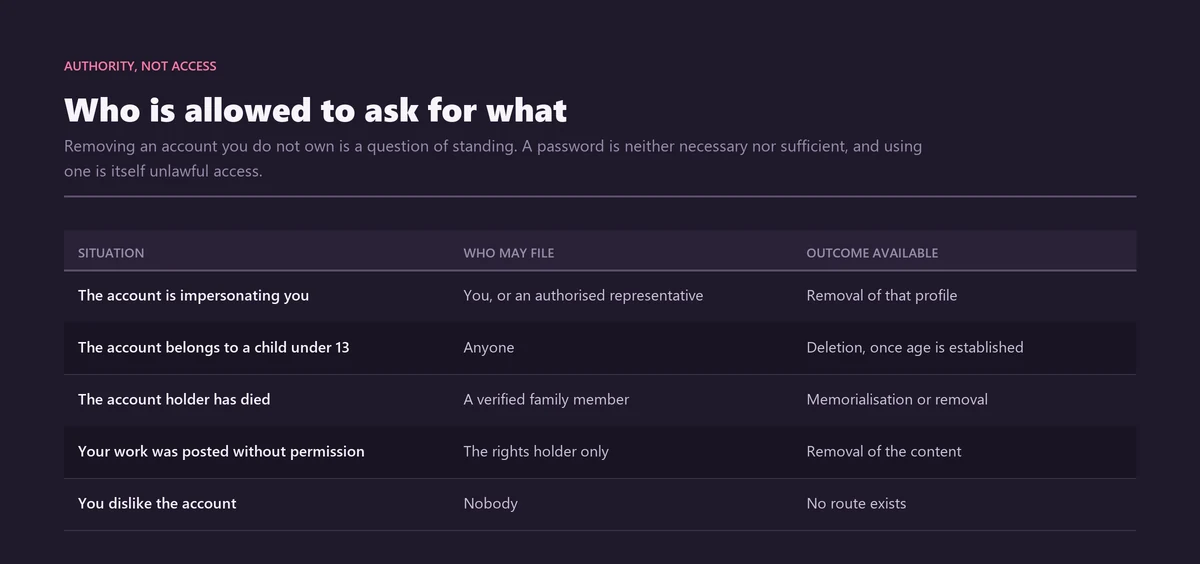
Report the copy as impersonation of you, and assume its owner will guess who filed. Instagram keeps the report anonymous, but it acts on impersonation reports only from the person being copied or an authorised representative, so the claim identifies its author. Here that costs you nothing, since the profile already knows exactly whom it is pretending to be.
What to do if someone is impersonating you on Instagram comes down to four moves, in this order. Save the fake profile's link, username, bio and photos, plus screenshots of anything it has sent to people you know. Report it from the fake profile inside the app, choosing the impersonation option and saying that it is you being copied. If you have no account, or the in-app route stalls, use Instagram's impersonation report form, which asks for a photo of government-issued ID. Then warn the people most likely to be approached, because the copy was built to reach them before you do.
Friends often offer to report it for you. Instagram's position is that it responds to the person being impersonated or their representative and asks everyone else to encourage that person to file, so a stack of reports from friends does less than one from you. What if someone is impersonating me on Instagram and I am under 18? A parent or legal guardian can file as the representative.
Why is there an Instagram account impersonating me?
People with no public profile often ask why someone is impersonating me on Instagram at all. The copies rarely need fame. They need a believable face and a ready-made audience:
- to ask your followers for money, pitch a fake investment or run a giveaway in your name, the pattern behind most fake giveaway and business scams;
- to catfish strangers, with your photos as the face of a romance or friendship scam aimed at someone else, whose own options sit under reporting a fake account;
- to harass or humiliate you by posting as you;
- to give a sextortion account a convincing profile.
The motive decides what else to report alongside the copy: a scam account's posts can also go in under fraud, and a harassment copy under bullying. Instagram Ban Service asks for the fake profile and the genuine one side by side, because in an impersonation case that comparison is the evidence.
Instagram sextortion report: will the person threatening you find out?
Not from Instagram, and in a sextortion case that is beside the point, because the sender already knows whom they are threatening. Speed matters more than secrecy. Stop replying, do not pay, save the messages and the account name, then report the account and the conversation before you block.
Payment is the step people get wrong. NCMEC, which runs the US CyberTipline, says it received more than 50,000 reports of financially motivated sextortion in 2025, an average of 137 a day and up from more than 36,000 in 2024, a rise of roughly 40%. Its advice on paying is short: cooperating or paying rarely stops blackmail
.
The senders are organised, and Meta's takedowns show it. On 24 July 2024 Meta said it had removed around 63,000 Instagram accounts in Nigeria that tried to run financial sextortion scams, including a coordinated network of around 2,500 accounts it linked to about 20 people, aimed mainly at adult men in the US. Around 7,200 Facebook assets went with them, 5,700 of those Groups sharing tips on running the scams.
Three months later Meta announced two defences aimed at the leverage these accounts rely on. Accounts showing signals of scammy behavior
lose the ability to see people's follower or following lists, and ephemeral images sent in private messages can no longer be screenshotted or screen-recorded on the device.
If images exist, hashing stops re-uploads without anyone viewing them: Take It Down for images taken before you turned 18, and StopNCII.org for adults. Cases involving anyone under 18 also go to NCMEC's CyberTipline, and adults in the US can report to the FBI through IC3. Since 19 May 2026 the TAKE IT DOWN Act has obliged platforms to remove non-consensual intimate images within 48 hours of a valid request, with the Federal Trade Commission enforcing it.
Will they find out once the account goes? They will notice it has gone. Expect a fresh account to follow, and block with the option that covers new accounts as well as the current one. Instagram Ban Service can file the account and conversation reports, but the hashing tools are yours to run, because they work on your own device.
What is mass report on Instagram, and do the people in it stay hidden?
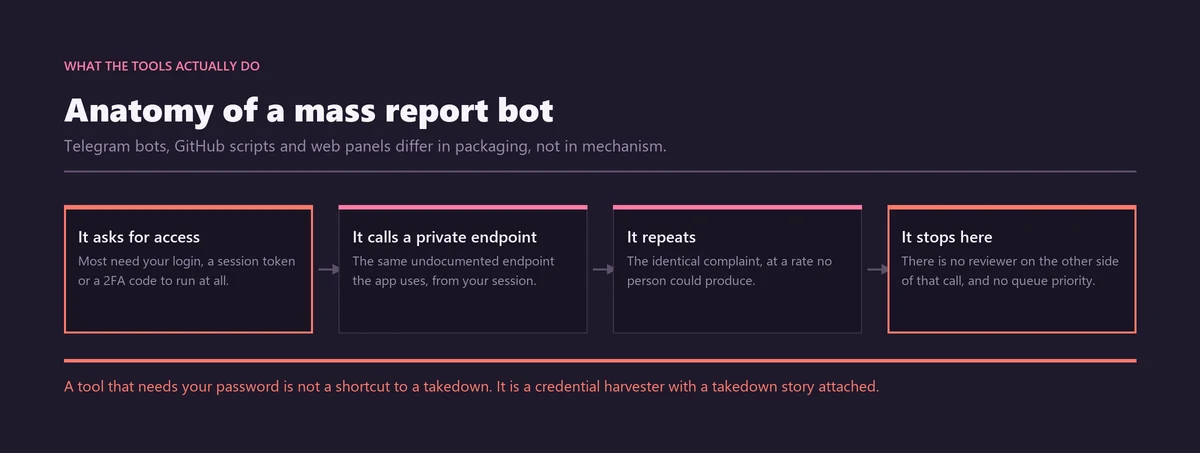
Mass reporting is many accounts, a script or a paid panel filing the same complaint against one target in a short burst, betting that volume forces a removal. The target is never told who took part. Meta is a different matter: its Inauthentic Behavior policy bars anyone who would misuse Meta reporting systems to harass, intimidate or silence others
.
Volume is also the wrong lever. Instagram's Help Centre says plainly that the number of times that something is reported doesn't determine whether or not it's removed, which is why no report count deletes an account. What volume does produce is a pattern, and a pattern is exactly what an integrity team can see.
Meta has acted on that pattern against the reporters rather than their targets. Its Adversarial Threat Report of December 2021 described removing a network in Vietnam that coordinated to falsely report activists and critics of the government, using authentic and duplicate accounts to file hundreds — in some cases, thousands — of complaints
through its abuse reporting tools. That network worked on Facebook; the policy it broke covers Instagram as well.
What do you give away when you pay a bot to mass report?
More than the target ever learns. To pay a bot to mass report an Instagram account, you hand a stranger the target's name, your payment details and, with most tools, your own login or session token. From then on the seller knows exactly whom you wanted gone, and has every reason to tell you it worked. The ban-for-hire market runs on that imbalance.
Is there a safe place or tool to mass report on Instagram?
No. Any place to mass report on Instagram, whether a Discord server, a Telegram channel or a "report for report" group, produces the coordinated burst that policy prohibits, and the mass reporting tool Instagram users get offered usually wants access to their own account first. The reporting tools that reach a reviewer are the ones Meta runs: the in-app report and the official forms. Instagram Ban Service turns down every mass-reporting request, including the ones pitched as a few friends helping out.
Can you get someone banned or deleted off Instagram fast?
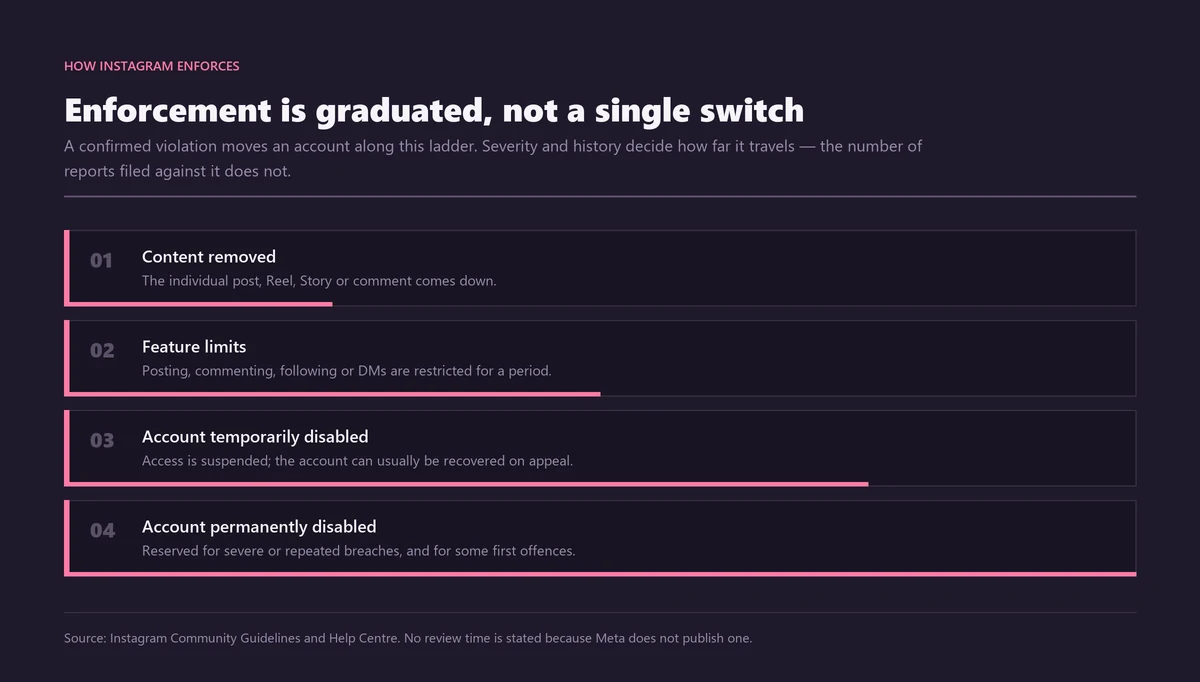
Not on request. Instagram disables accounts for severe or repeated breaches, and speed follows severity: Meta says a violation such as child sexual exploitation can disable an account after one occurrence
, while an unpleasant account that stays inside the rules can absorb any number of reports. Deleting someone else's account is open through very few routes.
So when people ask how to get someone banned on Instagram fast, or immediately, the honest answer turns on what the account did. A credible threat, a child at risk or intimate images shared without consent are the cases Meta treats most seriously, and a report that shows them clearly is the quickest thing available. Below that line, the method is dull and it works as well as anything does: the specific item, the category it genuinely breaks, and captures showing the username and the date.
Deletion is a separate question. Instagram deletes accounts at their owners' request and disables accounts that break its rules; removal of someone else's account is open only in narrow cases, such as an account run by a child under 13 or a family's request after a death, which the memorialisation guide covers. Separate guides map the deletion routes and who holds the authority to ask. And if what you really want is the handle, removal is the wrong tool entirely, since username release has its own routes.
Can you IP ban or permanently ban someone on Instagram?
No user can do either. People searching "how to ban someones instagram account permanently" are looking for a switch that exists only inside Meta, but the rules around it are public. The Terms of Use make eligibility conditional on one line: We must not have previously disabled your account for violation of law or any of our policies.
Meta's Account Integrity policy, updated 28 May 2026, adds accounts created or repurposed to evade a previous account or entity removal
, and none of the public policy pages we checked describes an IP ban at all. So a disabled user who returns under a new name is reportable as ban evasion, which is the nearest thing to an IP ban anyone outside Meta can set in motion. Instagram Ban Service files these with the old account's details set beside the new one.
Is there a Reddit method that gets someone banned immediately?
No, and no method from anywhere else does either.
The two shortcuts people usually have in mind are a harsher category than the content deserves and a group reporting together. A harsher category gets the content checked against a rule it does not break, and group reporting is the coordinated abuse Meta's rules prohibit.
Does hiring a take-down service keep your name out of it?
Only as far as the route allows. A service files through the same official channels you would, so disclosure travels with the route rather than with whoever presses submit: an in-app report names nobody, an impersonation claim belongs to the person being copied whoever types it in, and a copyright notice still carries the rights owner's name to the poster.
Keep that in mind before paying anyone who sells a take down Instagram account service on the promise that the target will never know. Instagram already offers that for free on most routes, and on the routes where it does not, no intermediary can change it.
Instagram Ban Service works inside those limits. The desk reads your evidence, names the route the content genuinely qualifies for, tells you beforehand what that route will disclose and to whom, files it, and follows the decision through. We decline accounts that break no rule, we never ask for a password, and Instagram alone decides the outcome. The official routes to take an account down are public, and we use no others.
So file in this order.
If the content breaks a Community Guideline, use the in-app report and tell nobody. Where it copies you, file the impersonation route and accept that the copy will guess. If it is your photograph and nothing else applies, file the copyright notice knowing your name goes with it. When the choice is not obvious, send the links to the case desk before anything is filed, or look through every reporting route we document.
Sources, with dates checked
- Instagram Help CentreRestrict or unrestrict someone: new comments visible only to the restricted person
- Instagram Help CentreMute or unmute someone: "Instagram won't let them know that you muted them"
- Instagram Help CentreRemove a follower: "they won't be notified that you've removed them"
- Instagram Help CentreHow Instagram decides what to remove: report volume does not decide removal
- Meta Transparency CenterInauthentic Behavior: misuse of reporting systems
- Meta Transparency CenterCounting strikes: disablement after one occurrence for the most severe violations
- Meta Transparency CenterAccount Integrity: accounts created to evade a previous removal
- Instagram Help CentreAbout disabled Instagram accounts: the log-in message and the review request
- Meta Transparency CenterIntegrity Reports: enforcement precision at the end of H1 2026
- Federal Trade CommissionFTC begins enforcing the TAKE IT DOWN Act
Frequently asked questions
If I report someone's comment on Instagram, will they know it was me?
Not by name. A reported comment disappears from your own view, and its author can receive a notice that it "may have been hurtful to others" showing the flagged comment. If that comment was a reply to you, they can connect the two, so report it without replying first.
Does someone know if you report their Instagram story?
Instagram does not tell them, but a story carries a viewer list, so if it reached a small audience and then vanished, the owner can narrow the suspects to the people who watched it. Capture the story before you report it, because it disappears after 24 hours unless it is saved as a highlight.
Will the person know if I report a message they sent me?
They are not notified that a message was reported. In a one-to-one chat, though, only one other person could have done it. Instagram also reviews recent messages from a reported conversation. Take screenshots first, report the message, then choose between restricting and blocking.
Can you get in trouble for reporting someone on Instagram?
Not for an honest report of something you believe breaks the rules. Meta's Inauthentic Behavior policy is aimed at people who misuse its reporting systems to harass, intimidate or silence others, which is where false and coordinated reports land. One accurate report, filed once, is what the system was built for.
If several people report the same account, will it get deleted faster?
No, because Instagram's Help Centre says the number of times something is reported doesn't determine whether it is removed. Several people reporting a genuine breach do no harm, but volume is not what a reviewer weighs, and an organised wave risks being treated as coordinated abuse of the reporting tools, which puts the reporters' own accounts in question.
How do I report an Instagram account to get it deleted if it belongs to a child under 13?
Use Instagram's form for reporting a user under the minimum age, which anyone can file and which asks for the username. If Meta cannot verify that the person running the account is old enough, it says it will delete the account. That makes it one of the few routes where deletion, not disabling, is the stated outcome.
Should I report someone I know, or will it make things worse?
Report it if the content genuinely breaks a rule, and plan for being suspected rather than hoping to stay invisible. Capture the evidence first. Report the specific item, then restrict or block. Don't tell them, don't reply, and if they retaliate, file that as a separate report.