Harassment · bullying · who files the report
How to report harassment on Instagram, and why it matters who files
A friend reports the account that has been posting about you for a month, and two days later the answer comes back: it doesn't go against Instagram's Community Guidelines. Often nobody got it wrong. Under Meta's Bullying and Harassment policy, part of the abuse aimed at private adults only counts once the person on the receiving end reports it.
Report harassment on Instagram from the item itself: the post, comment, Story, chat or profile, choosing Bullying or unwanted contact. Where you can, file from the targeted person's own account. Meta removes several kinds of abuse aimed at private adults only when the target reports it, so a friend's report of the same post can come back cleared.
Who has to file: the self-report rule in Meta's harassment policy
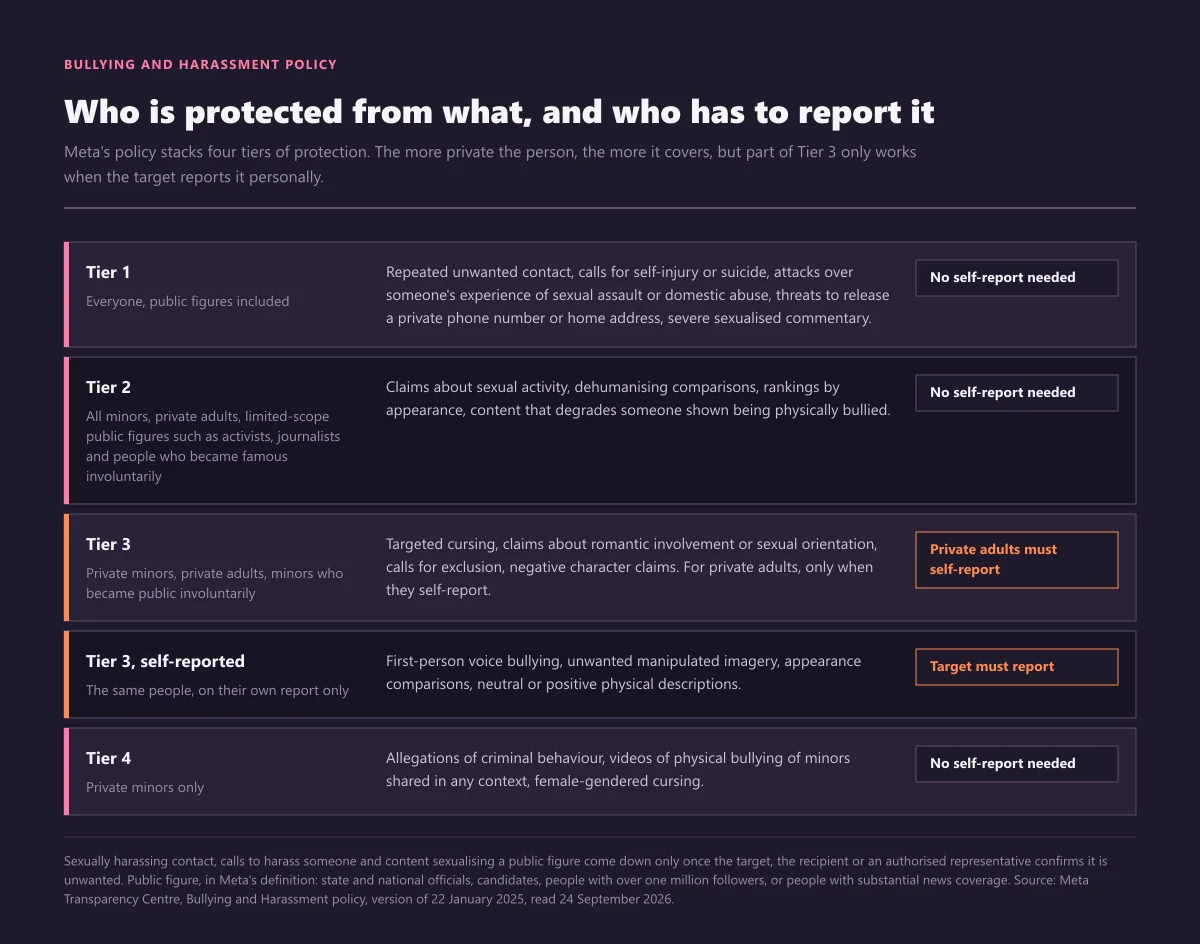
Meta writes it into the policy: some harassment of private adults comes down only when the person it targets reports it.
The line sits in the introduction to Meta's Bullying and Harassment policy, in the version dated 22 January 2025: In certain instances, we require self-reporting because it helps us understand that the person targeted feels bullied or harassed.
The policy then sorts protection into four tiers. Tier 3 names the people it covers as private minors, minors who became public figures involuntarily, and private adults (who must self-report)
. For them it bans targeted cursing, claims about someone's romantic life, sexual orientation or gender identity, calls to exclude a person, and negative claims about their character or ability.
A second list in the same tier works only When self-reported
, and this time minors are included: first-person voice bullying, unwanted manipulated imagery, comparisons of someone's looks with another person's, and even neutral or positive descriptions of their body. A post that sets a colleague's photo beside a film star's to compare their looks comes down under that list once the colleague reports it. A friend reporting the same post has not shown the reviewer that the colleague minds.
Five more items sit in a section headed we require additional information and/or context to enforce
. Each comes down only on the word of the target or an authorised representative of the target
: unwanted Pages, groups and events aimed at a private person, posts calling on others to harass someone, content sexualising a public figure, sexually harassing messages (confirmed by the recipient), and anything else that would otherwise need a self-report. For that last item the policy adds (alive or deceased)
. That is the opening a family uses when the person being mocked has died and the profile has become a memorialised Instagram account.
| Who files the report | What the reviewer can weigh | What to do |
|---|---|---|
| The targeted adult, from their own account | Every tier, including both self-report lists | File each post, comment, Story and chat personally, one item at a time |
| A friend, follower or bystander | Most of Tiers 1, 2 and 4, plus the first Tier 3 list when the target is a minor | Capture the evidence, then ask the target to file the self-report items |
| A parent, lawyer or other representative | Items that need confirmation from the target or an authorised representative | Keep proof that you act for the target; the policy does not spell out how a parent counts |
| Someone with no Instagram account | Nothing yet: the old no-account form is offline | Ask a person with an account to report the item from its own Report link |
This is why piling on does not work. Ten friends reporting the same insult put ten copies of the wrong signal in front of the reviewer, and the number of reports was never the test anyway, as the report-count myth shows. One report from the target, under the right reason, carries what the policy asks for. Filing personally does not hand the harasser your name either; what Instagram tells the reported account covers the single exception, which is intellectual property.
How to report harassment on Instagram, surface by surface
Press Report on the item that hurts, not only on the profile behind it: the reviewer judges the thing you point at.
For most of what follows, the reason to pick is Bullying or unwanted contact, which Instagram's help page on reporting a post or profile lists second among its nine report reasons.
- An account that exists to bully. Instagram's Help Centre says
If an account is established with the intent of bullying or harassing another person
, report it. Open the profile, tap Options, choose Report, then the option about the account. This is the route when you need to report a harasser on Instagram whose whole profile is the problem; reporting an Instagram profile explains which of the three account reasons fits. - A post or Reel. Tap Options above it, then Report, then Bullying or unwanted contact. Steps for each post type are in reporting a post on Instagram.
- A comment. Tap and hold the comment, then Report. Once reported it vanishes from your view, which is not the same as removal; the comment report explains the difference.
- A Story. Report it from the icon at the top of the Story before the 24 hours run out, and screenshot it first. That covers anyone trying to report an abusive Instagram story, report an Instagram story for bullying or report Instagram story harassment aimed at a friend: after expiry, the reviewer may have nothing left to look at.
- Direct messages. Report the chat, not the account. Instagram's page on combating bullying and harassment gives the reason:
the team that reviews the profile doesn't have access to direct messages
. To report abusive messages on Instagram, open the conversation and report the messages or the chat from inside it. Instagram's messaging help adds that deleted, unsent or edited messages can go with the report when the whole chat or a message next to them is reported. - From a computer. Click Options next to the username or above the post. The reasons are the same.
Instagram reporting harassment works item by item. A single cruel post can come down while the account stays up, and the account goes only when its record crosses a line Meta keeps private; taking the post down first, then the account sets out that order. Reporting stays anonymous whichever surface you use, and what the other person learns when you report covers the one notice that can hint at it.
Stopping the contact while a report is pending
Report first, then cut the contact. Restrict, launched on 2 October 2019, hides a person's comments from everyone but them and moves their messages to requests; since 30 May 2024 it also stops them tagging or mentioning you or remixing your Reels. Limits hides comments and message requests from people who don't follow you or followed recently. Block can now cover new accounts they make.
One line from Instagram explains why the report still matters. Introducing Hidden Words on 21 April 2021, it wrote: Because DMs are private conversations, we don't proactively look for hate speech or bullying the same way we do elsewhere on Instagram.
Abuse in your inbox is, for practical purposes, invisible to Meta until someone reports the chat.
Is there still an Instagram bullying report form?
Not one that opens. The harassment and bullying contact form at help.instagram.com/contact/188391886430254 is still quoted by most guides as the Instagram bullying report form. When the Instagram Ban Service desk opened it on 24 September 2026 to check the link, we got a bare Not Found
page, and the facebook.com mirror gave us the same. Instagram's post-reporting page still says that without an account you can report abuse, spam or anything else
, but the only link in that sentence leads to the Community Standards.
What Instagram offers instead is a person. Its page for people without an account says to Ask a friend with an account to report the content using the Report link near the content on Instagram
, and warns that we won't be able to take action on your report until we can find the content that you're reporting
. So a usable Instagram bullying report today needs three things: an account to file from, the exact post, comment or chat, and, for the self-report categories, the target filing from their own account.
That last point is the trap for a parent or partner filing out of care. Their report goes in as a bystander's, and Tier 3 items aimed at an adult stay up. Where the law gives a separate route, it sits outside the app: the EU and UK legal-removal forms are listed with post-first takedowns, and California runs a statutory route of its own for minors.
What changes when the person being bullied is under 18?
More of the abuse is covered, and in California the platform is on a legal clock. Meta's policy gives heightened protection for anyone under the age of 18, regardless of user status
, and Tier 4, for private minors only, adds allegations of criminal behaviour, videos of physical bullying shared in any context, and female-gendered cursing. Teenagers still carry the self-report list in Tier 3, so the most effective Instagram cyberbullying report is often the one the teenager files with a parent sitting beside them. Some filtering is already switched on for them: since Teen Accounts arrived on 17 September 2024, Instagram turns on the strictest version of Hidden Words by default, which keeps offensive comments and message requests out of sight but reports nothing.
Instagram's parent guidance points the same way: a teenager can report that person's posts directly from Instagram
. The same page says Instagram cannot hand over non-public information (such as the offending person's email address) without a search warrant or subpoena from law enforcement
, so identifying the account is a job for a police report, not a parent's request.
California changed the timetable. Business and Professions Code section 22589.1, rewritten by SB 1504 (chapter 900, signed on 28 September 2024), makes a platform run a reporting mechanism that lets any individual, whether or not that individual has a profile
report cyberbullying of a minor. It must confirm receipt in writing within 36 hours, send an update at least every 14 days, and issue a final written determination within 30 days. Each violation carries up to $10,000, and a parent or school administrator who reported can bring the claim. Instagram's help article on the California Cyberbullying Prevention Act on Instagram
answered This content isn't relevant in your location
when opened from outside the state, so the route appears to be offered by location.
The scale is not small. Pew Research Center surveyed 1,458 teenagers between 25 September and 9 October 2025, 908 of them Instagram users, and in its report of 15 April 2026 about one in five of those users had been called an offensive name, had rumours spread about them or had been physically threatened there; 29% called bullying on Instagram a major problem.
So how to report cyberbullying on Instagram for a child: capture it, have the child report each item from their own account while you sit with them, and, in California, keep the written confirmation, because it starts the 30-day clock. In Australia, a child's report that Instagram leaves up for 48 hours can go to the eSafety Commissioner.
Creators, public figures and people who went viral get less cover
Meta counts you as a public figure if you are a state or national official, a candidate, someone who receives substantial news coverage, or someone with over one million fans or followers on social media
. For that group the policy removes attacks that are severe, plus certain attacks where the person is tagged directly; the Tier 3 protections against cursing and character attacks fall away. Critical commentary about a public figure is meant to stay up.
Below that line sits a middle group. Activists, journalists and people who became famous involuntarily count as limited-scope public figures and keep Tier 2, which covers claims about their sex life, dehumanising comparisons and content ranking them by looks. Someone whose clip went viral last week keeps more protection than a politician does.
Sexualised content about a public figure that stops short of the severe rules in Tier 1 is removed only once the target or an authorised representative confirms it is unwanted. Even the severe kind can slip through. The Oversight Board's decision on explicit AI images of female public figures, 25 July 2024, shows how an ordinary report fails here: an Instagram user reported an AI-generated nude of an Indian public figure, and as the report was not reviewed within 48 hours, it was automatically closed
. The appeal closed the same way. Meta removed the image only after the Board took the case.
Creators have a second lever the bystander lacks. When a harasser reposts your own photos or clips, you are the rights holder and the copyright report forms are open to you. When the abuse comes from a profile pretending to be you, the fake account report sets out who may file.
What can you do when Instagram says it doesn't go against the guidelines?
Ask for a second look, have the right person re-file, and then use the routes outside the app.
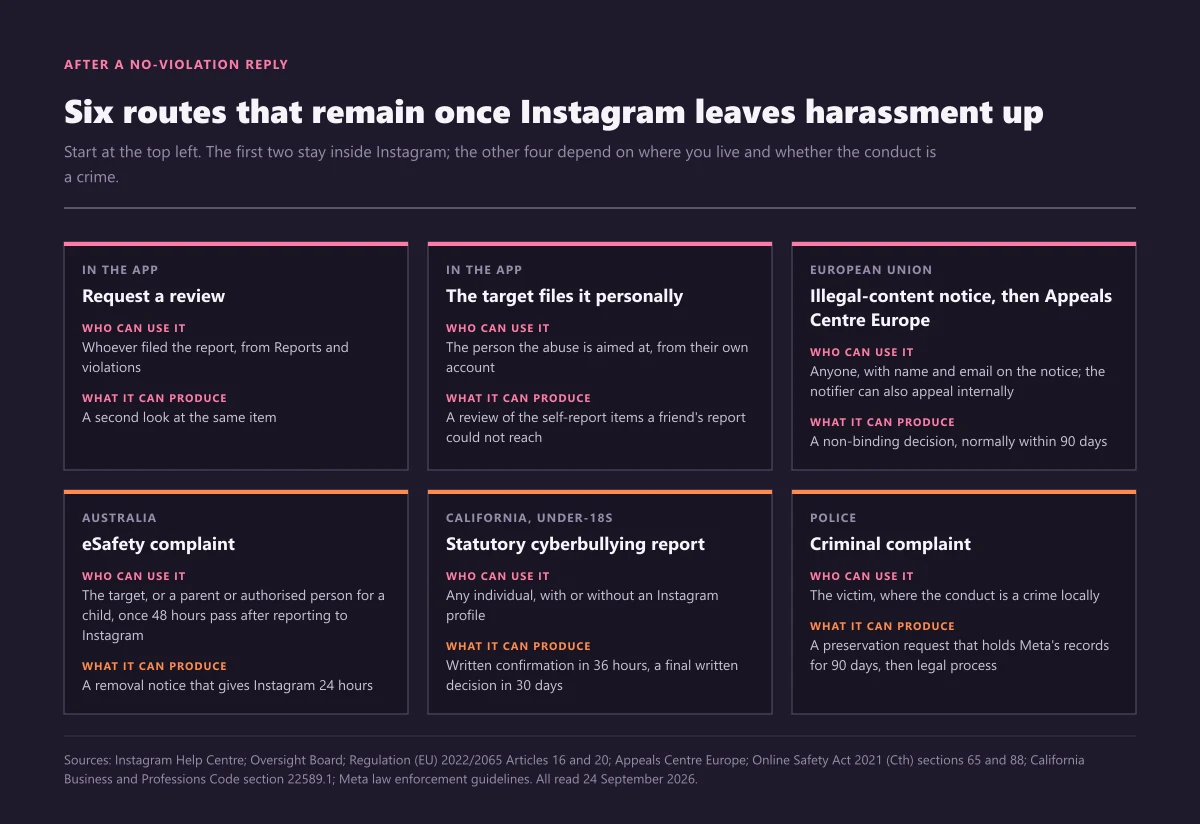
Start with the decision itself. Instagram posts it under Reports and violations, and checking whether a report worked means reading that screen rather than refreshing the profile. Where the page offers a review, ask for one. If the cleared item sits on a self-report list and you were not the target, the fix is procedural: the target files the same item from their own account.
Meta has been asked to close that gap and has not yet done so. In its 30 April 2026 decision on an Instagram comment mocking a wheelchair user, the Oversight Board repeated its recommendation that Meta let users designate connected accounts, which are able to flag potential Bullying and Harassment violations requiring self-reporting on their behalf
. Meta's answer was that allowing others to report on behalf of a person is technically difficult given the way [its] review systems function at scale and may be subject to abuse
. The Board lists the recommendation as in progress.
Refusals are common, not a sign you did something wrong. When the Center for Countering Digital Hate tracked more than 8,700 messages sent to five high-profile women, NBC News reported on 6 April 2022, at least 227 of 253 accounts reported for abuse were still active a month later.
In the EU, harassment that breaks a member state's law can go in as an illegal-content notice under Article 16 of the Digital Services Act, whose recitals name online stalking as an example. The notice carries your name and email address. Article 20 then gives the person who sent it an internal appeal for at least six months, free of charge, and Appeals Centre Europe takes disputes about Instagram after that, deciding within 90 calendar days, extendable to 180. Its decisions are not binding, but platforms must engage with them in good faith.
In Australia, the eSafety Commissioner can order the content down. Report it to Instagram first; if it is still up 48 hours later, a complaint can go to eSafety, which can issue a removal notice giving the platform 24 hours. Children, their parents or someone they authorise can use the cyberbullying scheme. Adults face a higher bar: the abuse must be menacing, harassing or offensive and intended to cause serious harm, and eSafety says the scheme is not intended to regulate hurt feelings, purely reputational damage, bad online reviews, strong opinions or banter
. Its 2024–25 annual report counts 3,406 cyberbullying complaints, up 26%, and shows how the power works in practice: 806 informal removal requests against 2 formal notices. Instagram was named in 17.3% of adult cyber abuse reports.
Instagram harassment removal does not always end at the item. Accounts that keep breaching the rules reach the thresholds described in what triggers an Instagram ban, and the full range of outcomes short of that is in what reporting actually does.
When is an Instagram harassment police report the right step?
When the conduct is a crime where you live. In England and Wales, harassment under the Protection from Harassment Act 1997 needs a course of conduct, meaning conduct on at least two occasions
, and the Act adds that Conduct includes speech
. Two abusive messages from the same account can meet that. Making someone fear violence on two occasions carries up to 10 years, and a message threatening death or serious harm is an offence under section 181 of the Online Safety Act 2023, with up to five years. Scotland uses its own threatening-or-abusive-behaviour and stalking offences. In the UK, report online harassment on 101 or through the police online form.
In the United States, federal law at 47 U.S.C. § 223 covers messages sent without disclosing your identity and meant to abuse, threaten or harass a specific person, with up to two years; every state adds its own harassment and stalking statutes. The FBI's 2025 Internet Crime Report logged 21,557 harassment and stalking complaints, up from 11,672 the year before, and 4,826 complaints about threats of violence. StopBullying.gov tells families to take threats of violence, sexual images of children, stalking and hate crimes to law enforcement rather than only to the platform.
Bring the officer a record they can use:
- the @username and the profile link, captured with the date showing, for every account involved;
- screenshots of each post, comment, Story and message, unedited, with dates and times;
- a short log of when each incident happened, including the ones that were deleted;
- every report you filed and the decision Instagram gave, from Reports and violations.
Speed matters more than volume here. Meta's law enforcement guidelines say it will preserve account records for 90 days pending our receipt of formal legal process
, but also that We do not retain data for law enforcement purposes unless we receive a valid preservation request before a user has deleted that content
. A harasser who wipes the account the week you go to the police can take the records with it. Ask the officer to send a preservation request early. You cannot send it yourself: Meta will not review or respond to requests submitted by non-law enforcement officials
. Threats that name a place, a time or a weapon are an emergency, and the reporting forms for them are laid out in threats and doxxing on Instagram.
What a harassment report service can and cannot do
A service can get the routing right. It cannot report in your place where Meta wants your own report.
Instagram Ban Service handles an Instagram harassment case in three parts. The desk first sorts every capture into Meta's tiers, so that before anything is filed you know which items a friend could report and which only you can. We then file the items that need no self-report through the route that fits them, and prepare the self-report items so that you submit each one once, from your own account, under Bullying or unwanted contact. We never ask for your password or a login code. Last, we put together the record a police officer or a lawyer can work from: handles, profile links, dated captures and every decision Instagram has posted.
Some things no honest Instagram harassment report service can promise. It cannot stand in for you on the self-report lists; Meta told the Oversight Board that reporting on someone's behalf is technically difficult, and the connected-accounts feature the Board asked for does not exist yet. It cannot unmask an anonymous account, because Meta releases that only to police through legal process. And it should not flood the account with reports: the apps and panels that sell exactly that are examined in the report apps and panels teardown, and coordinated false reporting breaks Meta's own rules. We also turn down arguments that have not crossed into harassment. Instagram doesn't mediate disputes between people who use our service
, and neither do we.
If you are the adult being targeted, start tonight and do it yourself. Screenshot everything with the date showing, then report each post, comment, Story and chat from your own account under Bullying or unwanted contact, one item at a time, before you block anyone. If a threat or a second incident puts it over the criminal line, go to the police within the week and ask for a preservation request. Hiring help comes after that, not instead of it; every route is in the reporting guides, and a file can be opened from the case desk.
Sources
- Instagram Help CentreReport a post or profile on Instagram: the nine report reasons
- Instagram Help CentreHow to combat bullying and harassment on Instagram: report the chat, not the account
- Instagram Help CentreReporting harassment or bullying on Instagram
- Instagram Help CentreReport something on Instagram without an account
- Instagram Help CentreReport abusive, inappropriate or offensive content: guidance for parents
- California Legislative InformationSB 1504, Cyberbullying Protection Act, chapter 900, 28 September 2024
- Pew Research CenterTeens' experiences on TikTok, Instagram and Snapchat, 15 April 2026
- Oversight BoardExplicit AI Images of Female Public Figures, 25 July 2024
- Oversight BoardComment Targeting Wheelchair User, 30 April 2026
- Appeals Centre EuropeFrequently asked questions: platforms covered and decision times
- eSafety CommissionerHow to report cyberbullying, updated 10 March 2026
- eSafety CommissionerReport adult cyber abuse
- eSafety Commissioner and ACMAAnnual report 2024–25: complaints, informal requests and removal notices
- legislation.gov.ukProtection from Harassment Act 1997, section 7: course of conduct
- legislation.gov.ukOnline Safety Act 2023, section 181: threatening communications
- Cornell Law School LII47 U.S.C. section 223: harassing communications
- FBI Internet Crime Complaint Center2025 Internet Crime Report: harassment, stalking and threats of violence
- StopBullying.govHow to report cyberbullying, reviewed 11 December 2024
- Instagram Help CentreWays to deal with conflict or abuse on Instagram
Frequently asked questions
Can I report bullying for a friend on Instagram?
Yes, for much of it. Anyone can report threats, repeated unwanted contact, severe sexualised comments and most abuse aimed at minors. What a friend cannot do is stand in for an adult target on Meta's self-report list, which includes targeted cursing and unwanted manipulated images. Meta has told the Oversight Board that reporting on someone's behalf is technically difficult, so the target should file those items personally.
Will the harasser find out who reported them?
Not from Instagram: its help page says the account you reported won't see who reported it, and the only exception is an intellectual property report. When abuse is aimed at one person the harasser can still guess, so report before you block or restrict, and keep your screenshots somewhere they cannot reach.
How long does Instagram take to review a harassment report?
Meta publishes no deadline for the first review of an in-app report. California is the exception for cyberbullying of minors, where the law requires written confirmation within 36 hours and a final written decision within 30 days. Elsewhere nothing is guaranteed: in one case the Oversight Board reviewed, a report nobody looked at closed automatically after 48 hours.
Can the police get a harasser's real name from Instagram?
Only the police can ask, and only through legal process. Meta's law enforcement guidelines say it will not respond to requests from anyone outside law enforcement, and Instagram's parent guidance says it cannot share details such as the person's email address without a search warrant or subpoena. Ask the officer to send a preservation request first, which holds the records for 90 days.
Is cyberbullying on Instagram a crime?
Sometimes, and where you and the other person live decides it. In England and Wales, pursuing harassment on two or more occasions against one person is an offence under the Protection from Harassment Act 1997, and a message threatening death or serious harm is an offence under the Online Safety Act 2023. In the US, 47 U.S.C. section 223 covers anonymous messages meant to abuse, threaten or harass, alongside each state's own laws.
Should I block a harasser before or after reporting them?
After. Don't block first: Instagram's own advice is to report and then block, because the report needs the post, comment or chat in front of you. Block now offers to cover any new accounts the person creates, and Instagram says people aren't notified when you block them, so blocking last costs you nothing.