Impersonation, copied side·People, children and brands
How to report impersonation on Instagram, then take down every part of the copy
The copy usually reaches you second-hand. A cousin asks why you followed them again from a new account, or a customer asks whether your giveaway is real. By then the fake has been messaging people for a while, and it may not be the only one.
To report impersonation on Instagram, open the fake profile and tap Report, Report account, then It's pretending to be someone else, or file Meta's impersonation form with a photo of yourself holding your ID. Only the copied person or their representative can file that form. Stolen photos and a copied brand name go through the separate copyright and trademark forms.
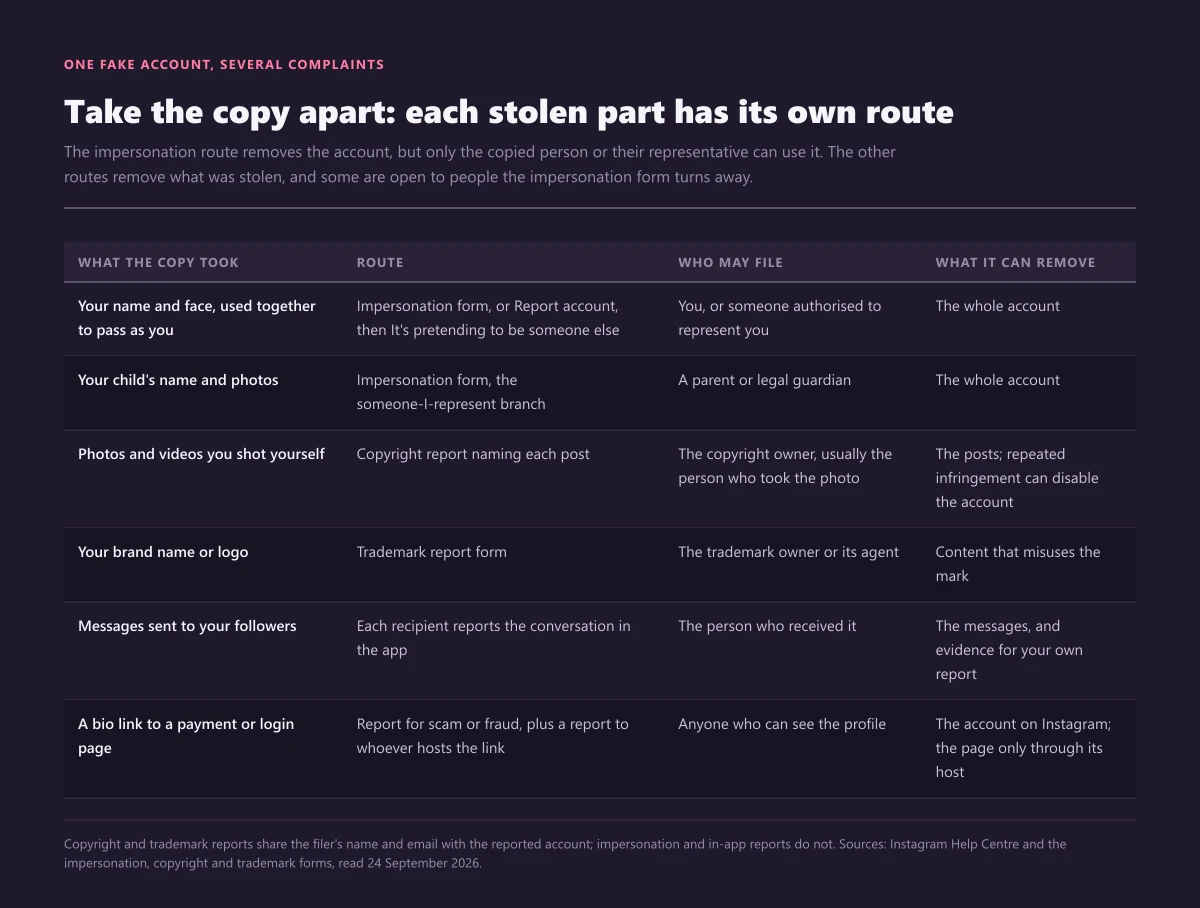
- Meta's impersonation form takes one impersonating account per submission. Three copies means three forms.
- Instagram describes sign-up friction for accounts using a celebrity's name. Nothing in its help pages describes the same check for a private person's name.
- Only you or your representative can file the form, but anyone who follows you can flag the copy from its profile and say whose account it is copying.
Find every copy before you file the first report
Search before you report, because the form will not search for you. Meta's impersonation form says, in its own words: "Please only report one impersonating account at a time. To report another account, please submit another report." A copy you miss stays up after the first one comes down, and whoever runs them carries on messaging your followers from whichever account is left.
Four parts make up the sweep, and their order matters more than the thoroughness of any one of them.
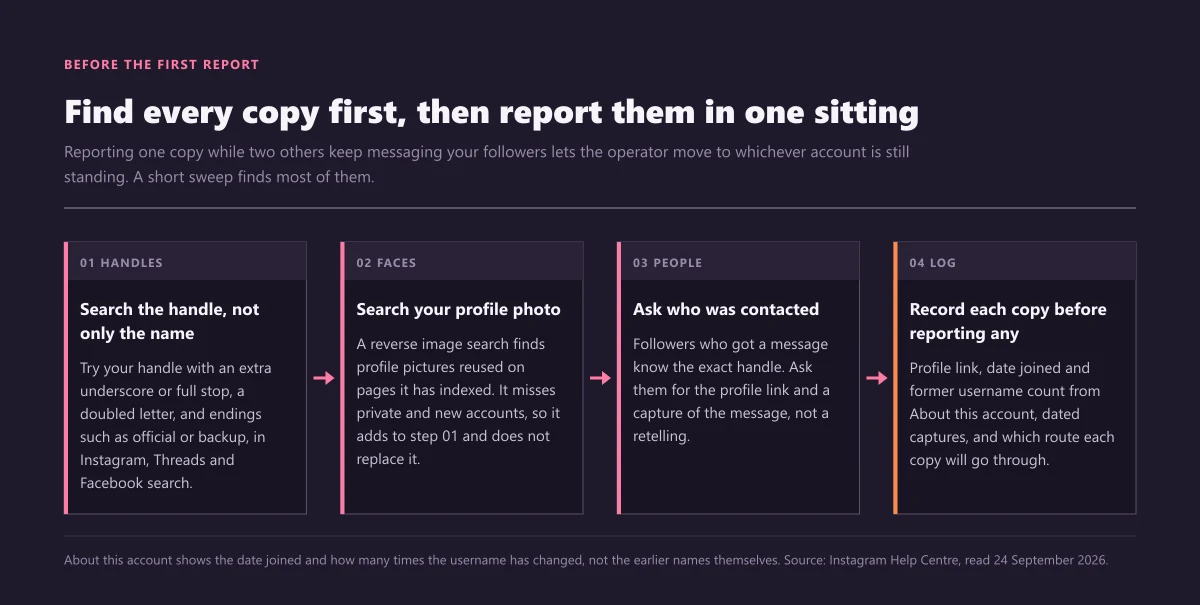
Start with handles rather than names. Your exact username is taken, so a copy works around it: an extra underscore, a full stop in the middle, a doubled letter, or a tail such as official or backup. Type each variant into Instagram search, then Threads and Facebook. The impersonation form has a field for the copy's Threads username beside its Instagram one, so a Threads twin of the same copy can go on the same report.
Then open each copy's About this account page. Instagram shows the date the account joined and how many times its username has changed, and for some accounts the country it is based in. A profile that joined last month and has been renamed several times is a different proposition for a reviewer than one created years before yours, and you want that contrast written into your report rather than left for someone to notice.
Why did Instagram not catch it? Its help page on the subject says "Our tools use a number of signals, scaled detection systems and community reports to identify potential imposter accounts", and that a decision "is either made immediately based on our confidence, or it's sent for review". The sign-up friction it describes is aimed at famous names: "requiring an ID for creating an account with a celebrity's name or having to choose a label (such as a fan account)." A copy of a private person meets none of that, which is why it usually stays up until somebody reports it. What a report then sets moving is laid out in what reporting someone actually does.
What exactly did the copy take from you?
Usually more than one thing, and each thing has its own owner and its own route. Six parts make up a typical copy, split out in the table at the top of this page. Splitting it is practical rather than tidy: the impersonation route can remove the whole account but is open to one person, while the other routes remove less and are open to more people.
How to remove a fake Instagram account pretending to be me with only my photos
Meta's Authentic Identity Representation standard, whose change log runs to 12 September 2026, bars impersonating someone by "Using their image(s), name, or likeness with the aim to deceive others". Read the "or" slowly. A profile that uses your photos under a different name can still breach the rule when the aim is to deceive. The evidence is thinner in that case, though, so a photos-only copy is usually stronger as a copyright complaint than as an impersonation one.
Fan and parody accounts are the carve-out. The same standard lets them stand if they make "its unofficial status abundantly clear at minimum in the account name". A handle ending in fan meets that. A bio line saying unofficial, under a handle identical to yours bar one full stop, does not. And no label licenses reposting photographs you own.
Some parts live below account level. A copy that comments under your posts in your name, or reposts your Reels one at a time, can be reported item by item: see reporting a single post and reporting a comment. Where the photos belong to someone who has died, the family has different routes, set out under memorialisation requests. And a copy that starts publishing your address or phone number has become a safety case, with its own forms listed under threats and doxxing.
Two other routes sit alongside this one. When the copy is used to bully you or pile on in your comments, the bullying and harassment routes carry more weight than an identity claim on its own. Followers who already sent it money need the scam and fraud reporting routes as well, because a takedown does not reverse a payment.
How to report impersonation on Instagram, from the profile or the form
Two doors, one review team. Anyone who can see the copy may use the in-app report, which is quicker. The form is slower and carries your ID, and that document is what lets a reviewer decide which of two near-identical accounts belongs to the real person.
- Capture first. The copy's profile page, bio, the posts that are yours, and any message it sent, each with the date visible. If the account blocks you or disappears, those captures are the only record you have.
- In the app, open the copy's profile, tap the options control, then Report, then Report account, and choose It's pretending to be someone else. Instagram's help page lists who the copy can be pretending to be: you, someone you follow, a celebrity or public figure, or a business or organisation.
- On the form, which works without logging in, choose "Someone created an account pretending to be me or a friend", or the branch for "someone I represent (ex: my child)".
- Name both accounts exactly. The form asks for the full name shown on the copy, its Instagram username and any Threads username, then the same details for the person being copied.
- Upload the photo it asks for. The field wants "A photo of yourself holding your ID or a photo of the person you're authorized to represent holding their ID", saved as a JPEG if possible.
- Send one form per copy, and file each confirmation email under the copy's handle so later replies can be matched to the right account.
Meta says the ID "will be deleted within 30 days" and that it "might use trusted service providers to help review your information". If a phone upload keeps failing, the form's own advice is to complete it from a computer. No Instagram account at all? The help centre's instruction is "If you don't have an Instagram account, you can contact us to report impersonation", and the link goes to the same form.
How to report someone impersonating you on Instagram when a friend spots it first
Your friend has a real option, just a smaller one than yours. Instagram's help page for this case says "You can report the account from their profile. When you report the account, you'll be able to let us know which account the imposter is pretending to be." So a follower who finds the copy can flag it and point at your real profile. The form stays closed to them: choose the friend branch and it replies "Please ask the person being impersonated or their representative to file a report." Run both at once. Friends flag in the app while you file the form, and the eligibility rules behind that split are set out in who may file each fake account report.
On both routes the account you report does not see who reported it, and whether they will know you reported them walks through the one exception, intellectual property. For profile-level reporting on every surface, from the three-dot menu to a shared link, see reporting a profile or page.
How do you take down a fake Instagram account when the impersonation report is refused?
Keep the impersonation report alive and open a second front on what the copy stole. A refusal on identity does not decide the copyright question, because the two are reviewed against different rules by different processes.
Refusals can arrive fast. Alan Shimel, writing on Security Boulevard on 23 January 2026, described a copy of himself that had followed about 85 people in his network, 10 of whom followed it back. His report came back within about fifteen minutes, found no violation of community standards, and offered nothing further. That speed suggests an automated first pass, and a second, better-evidenced filing is reviewed on its own terms.
How to get a fake Instagram account taken down through copyright
Copyright is the lane that survives that answer. If the copy is built from photos and videos you shot, each one is a separate infringement you can name, and Instagram's repeat infringer policy says an account that repeatedly posts infringing content "may be disabled". Two cautions before you file. You have to own the photo, and a picture a friend took of you belongs to the friend, who would need to file it. A copyright report also sends your name and email to the account you report, which the impersonation form does not. For the full walkthrough, see the copyright report for stolen content.
Then re-file the impersonation form once, cleanly, and work the escalation steps Meta publishes: Support requests, a requested review, and after two reviews the Oversight Board.
How to get a fake page taken down on Instagram
Treat it as an account, because Instagram has no separate page product. A fan page, brand page or meme page is an account, removed or left up as one, although its individual posts can come down first, which taking down a post, then the account explains. To confirm a copy is really gone rather than just hidden from you, use the checks in how to tell whether a reported account was banned.
Instagram brand impersonation runs on lookalike handles and fake help desks
Brands get copied at a different scale, and nearly always for money. In the first quarter of 2026, ZeroFox data published by the Anti-Phishing Working Group classed impersonation as 43.8% of all the social media threats it found, against 27.1% for scams (APWG, 27 May 2026). Victim reports point the same way. Impersonation scams were the most reported scam type in the Identity Theft Resource Center's 2025 Trends in Identity report, and 51% of them posed as a general business rather than a person (ITRC, 24 June 2025).
This month's live pattern is the fake help desk. Check Point Research reported on 16 September 2026 that lookalike airline support accounts on X, Facebook and Instagram were answering public complaints, offering $500 or $1,200 in compensation and asking for card details. It counted "Thousands of impersonation accounts", with hundreds of new ones appearing daily. A company that runs a customer-service handle should expect that handle to be copied before its main account is.
A registered mark opens the trademark report form, which wants proof you own the mark and a pointer to the exact element that misuses it: the handle, the profile picture, a bio line, a post. Without a registration, the business branch of the impersonation route and a support case through Meta Business Support are the fall-backs.
Keep the complaint narrow either way. A reviewer compares one element against one registration, and "they are using our brand" gives them nothing to compare.
Courts have started to treat the platform as part of the problem. On 16 September 2026 the Regional Court of Frankfurt am Main ordered Meta Platforms Ireland to stop spreading third-party profiles and adverts on Instagram and Facebook run under the name of the finance brand Finanzfluss or its founder Thomas Kehl, most of them using his photos. The court refused Meta the hosting defence because its ranking algorithm gives it control over what is shown. The judgment (2-06 O 234/25) is not final and can be appealed, according to Legal Tribune Online.
What do fake Instagram account detection and removal services actually do?
They find copies faster than you can and file them through the same forms you have. That is the honest description of the whole category, whether the seller is a brand-protection platform, a personal takedown subscription or a casework desk. None of them has a side door into Meta, and a fake Instagram account removal service is legitimate only while it says so.
| Provider | What it does | Where it stops | Published price |
|---|---|---|---|
| Brand-protection platforms such as ZeroFox, Doppel and Red Points | Scan at scale, group linked profiles, domains and ads into one case, file notices, and watch for copies that return | Built around trademarks and executives; a private person without a registered mark gains little from the IP lanes | Quote only on their own pages |
| Personal takedown subscriptions such as Loti AI | Watch for your face or name online and send removal notices | Its FAQ is written around unauthorised content, not fake accounts as such | $25 a month or $200 a year for the paid plan |
| Casework desks | Split the copy into routes, build the evidence file, re-file after a refusal | The impersonation form still needs the copied person's ID, so you stay involved | Case by case |
| Law firms | Letters to the operator, civil claims, and applications to identify an unknown operator | Slower and dearer, and strongest once the operator has a name | Varies by firm |
Read the marketing numbers for what they measure. ZeroFox advertises a "95% takedown acceptance rate" on its takedowns page, which is a figure about how often platforms accept its notices across 180-plus platforms, not a promise about your account. Its "rebound monitoring", the vendor's term for watching for copies that come back, is the part a private victim can do alone with a monthly sweep. What these platforms add that you cannot easily replicate is the grouping, since Doppel describes bundling linked profiles, domains and adverts into one piece of campaign evidence, which matters when the same operator runs dozens of lookalikes at once.
Red flags in a fake Instagram account removal service
Three signs that an offer is not a service at all: it asks for your password or a login code, it wants payment up front in crypto or gift cards, or it names a removal time and a success rate. The Better Business Bureau's advice on paid account help is short: "Account recovery is always free" (BBB, 27 October 2023). Meta's forms cost nothing either.
Instagram Ban Service sits in the third row of that table. It reads a copy against Meta's published rules, splits it into the parts above, assembles dated captures and re-files through Support requests when a first answer comes back no. Meta decides every report, and a vendor quoting a guaranteed removal is selling something nobody outside Meta controls.
When the copy reports your real account as the fake one
File your own impersonation form first. If both profiles end up reported, the ID-backed report from the real person is the record that breaks the tie, and an operator who expects a report has every reason to file one against you before you file against them.
Bots do not change that arithmetic in either direction. Instagram's position is that "The number of times that something is reported doesn't determine whether or not it's removed from Instagram." An Instagram fake report bot aimed at your account does not remove it by volume, and one aimed at the copy does not remove that either. Most of them also want a login to run, which hands a stranger an account. Sellers of these tools are compared in report apps, bots and panels.
If your own account is restricted anyway, open Account Status in your settings and request a review from there. Keep the evidence that you came first: your join date in About this account, original photo files with their metadata intact, and the copy's join date beside yours. What actually leads to a disable, with or without reports, is in what triggers an Instagram ban.
Can you get in trouble for impersonating someone on Instagram?
Yes, at two levels: Instagram can remove the account, and in several countries the person behind it can be prosecuted or sued. Instagram's Terms of Use say "You can't impersonate others or provide inaccurate information", and add that "you can't create an account for someone else unless you have their express permission". Meta's standard says it "will restrict or disable" accounts that break the rule.
Criminal law is patchier than people expect, and it rarely punishes a fake profile on its own; it punishes what the profile was used for.
| Where | Provision | What it covers | Maximum |
|---|---|---|---|
| Canada | Criminal Code s.403, identity fraud | Fraudulently personating another person, living or dead, to gain an advantage or cause a disadvantage | 10 years on indictment |
| India | Information Technology Act 2000, s.66D | Cheating by personation using a communication device or computer resource | 3 years and a fine of up to one lakh rupees |
| England and Wales | No offence of impersonation as such; Protection from Harassment Act 1997, Online Safety Act 2023 s.179 | A course of harassment; sending information you know is false, meaning to cause non-trivial harm | Criminal penalties, plus civil damages |
| United States | State online-impersonation laws, including California's and Texas's; right of publicity; Lanham Act s.43(a) for brands | Varies by state; exploiting a person's identity; confusion about who is behind an account | Fines or jail under state law; damages and injunctions |
The Canadian text is blunt: "Everyone commits an offence who fraudulently personates another person, living or dead", when done with one of four listed intents, per the Justice Laws website. The UK false-communications offence is narrower than its name, since it needs the sender to know the message is false and to intend harm, as section 179 sets out.
Civil claims are where UK victims have had the clearest result. On 13 July 2026 a statement was read in the High Court in London settling Sasha Davies's claim against Elha-Mai Weston, who ran fake accounts in her name for about four years across seven platforms, including Instagram according to Davies's solicitors. Weston agreed to pay £10,000, apologised and undertook not to contact, impersonate or monitor her again, LBC reported. Her claim ran on harassment, misuse of private information and data protection law.
Naming the operator is where most victims stall, and in practice that is police work. Delhi police arrested a 27-year-old in August 2026 over fake Instagram accounts that used a woman's name and photographs, after obtaining the accounts' registration details from Meta and tracing a mobile number registered to him, as The Hans India reported on 26 August 2026. A private person asking Meta for the same details is sent back to the Help Centre.
How do you stop someone impersonating you on Instagram once the first copy is gone?
You cannot stop someone creating a copy. You can make each one shorter-lived and less convincing, and that is where the effort belongs.
Say publicly which account is yours. A pinned post or a bio line stating that you run one account and never ask for money or codes by message gives followers something to hold a copy against. It costs nothing and it is the step people skip.
Repeat the sweep. Copies come back under new handles, and a removed one does not protect you from the next. Run the four-step search each month for a while, and add every handle you find to the same log, with dates and reference numbers.
Weigh Meta Verified if you are a likely target. Meta's plan page offers "proactive impersonation monitoring" and says "Meta will remove accounts that we determine are pretending to be you." Listed prices run from $14.99 to $499.99 a month per profile, and Meta adds that "Plans, benefits and availability may vary by region, by app and by account". Meta's face-matching protection is for public figures, and on Instagram it is still a plan: its 28 September 2025 update said "In the coming months we also plan to expand our use of this technology to Instagram", and no later announcement of an Instagram rollout could be found on 24 September 2026. For scale, Meta says it took down over 23 million Facebook profiles impersonating large content producers in 2024, then more than 20 million such accounts in 2025, when impersonation reports about those creators fell by 33%. It has published no Instagram figure.
When we worked through the impersonation form again on 24 September 2026, two lines changed how Instagram Ban Service sequences a case. The form takes one impersonating account per submission, and the upload field asks for a photo of the person holding the ID rather than a picture of the ID alone. So the order is now fixed: sweep, log, then one form per copy with that photo ready, and copyright notices for any photos you shot filed the same day. Scans of an ID on a desk get re-shot before anything is sent.
File the form yourself, today, once for each copy you found. Bring the case to the contact desk only if the first answers come back no, and use the full solutions index for any route this page only mentions.
Sources
- Instagram Help CenterTerms of Use: "You can't impersonate others or provide inaccurate information"
- Instagram Help CenterTrademark Report Form
- Identity Theft Resource Center2025 Trends in Identity Report: impersonation scams the top reported scam; 51% impersonated a general business
- Check Point ResearchFake airline support accounts on X, Facebook and Instagram, 16 September 2026
- Justice Laws WebsiteCriminal Code of Canada, s.403 identity fraud, current to 3 September 2026
- legislation.gov.ukOnline Safety Act 2023, section 179: false communications offence
- Better Business BureauScam alert: "Account recovery is always free"
Frequently asked questions
How do I report someone impersonating me on Instagram without an Instagram account?
Use Meta's impersonation form, which opens without a login. Instagram's help page says that if you don't have an account you can contact it to report impersonation, and the link goes to that same form. You still need a photo of yourself holding your ID, and one submission for each copy you found.
Will the account impersonating me see that I reported it?
Not on the in-app report or the impersonation form. Instagram says the account you reported won't see who reported them. Copyright and trademark reports are the exception, because the reported account receives the filer's name and email so it can respond. That matters if the person behind the copy already frightens you.
Is there an Instagram fake report bot that removes impersonators faster?
No. Instagram says the number of times something is reported does not decide whether it is removed, so a bot adds volume without adding evidence. Most report bots also want your login before they run, which hands a stranger the account you are trying to protect. One ID-backed form carries more weight.
Does Meta Verified stop accounts impersonating me on Instagram?
It adds monitoring, not immunity. Meta's plan page offers proactive impersonation monitoring and says Meta will remove accounts it determines are pretending to be you. Prices are listed from $14.99 to $499.99 a month per profile, and benefits vary by region, app and account, so check what your own offer includes.
Is there a set time for Instagram to act on an impersonation report?
Not a published one. Meta's forms and help pages give no deadline. Answers can come very fast: one writer in January 2026 had a refusal about fifteen minutes after reporting a copy of himself. In the Frankfurt case decided in September 2026, many reported fakes came down only days later.
Can I find out who is running the fake account?
Not from Meta as a private person. Police can ask: in a Delhi case in August 2026, officers obtained the fake Instagram accounts' registration details from Meta and traced a mobile number to the man they arrested. If you want the operator named, take your evidence log to the police.
What if the account copying me says it is a fan or parody page?
Check the account name first: Meta lets fan and parody accounts stand only when they make their unofficial status abundantly clear, at minimum in the account name. A fan label buried in the bio does not meet that bar, and even a properly labelled fan page cannot repost photographs you own.
What should my followers do if the copy messaged them?
Report the conversation in the app, not only the profile, and send you the handle and a capture. They should not click links or pass on any code. Anyone who has already paid should call their bank or card provider first, because a takedown does not return money.