Legal routes · forms, addresses, law enforcement and data deletion
Instagram legal removal requests: the form for each requester, the addresses Meta still prints, and the ones it doesn't
Search for Instagram's legal team and you get phone numbers, support inboxes and street addresses that contact directories have copied from each other for a decade. This page starts from the other end: the routes that Meta's own Help Centre, privacy policy and EU transparency filings showed on 28 September 2026, and who is allowed to use each one.
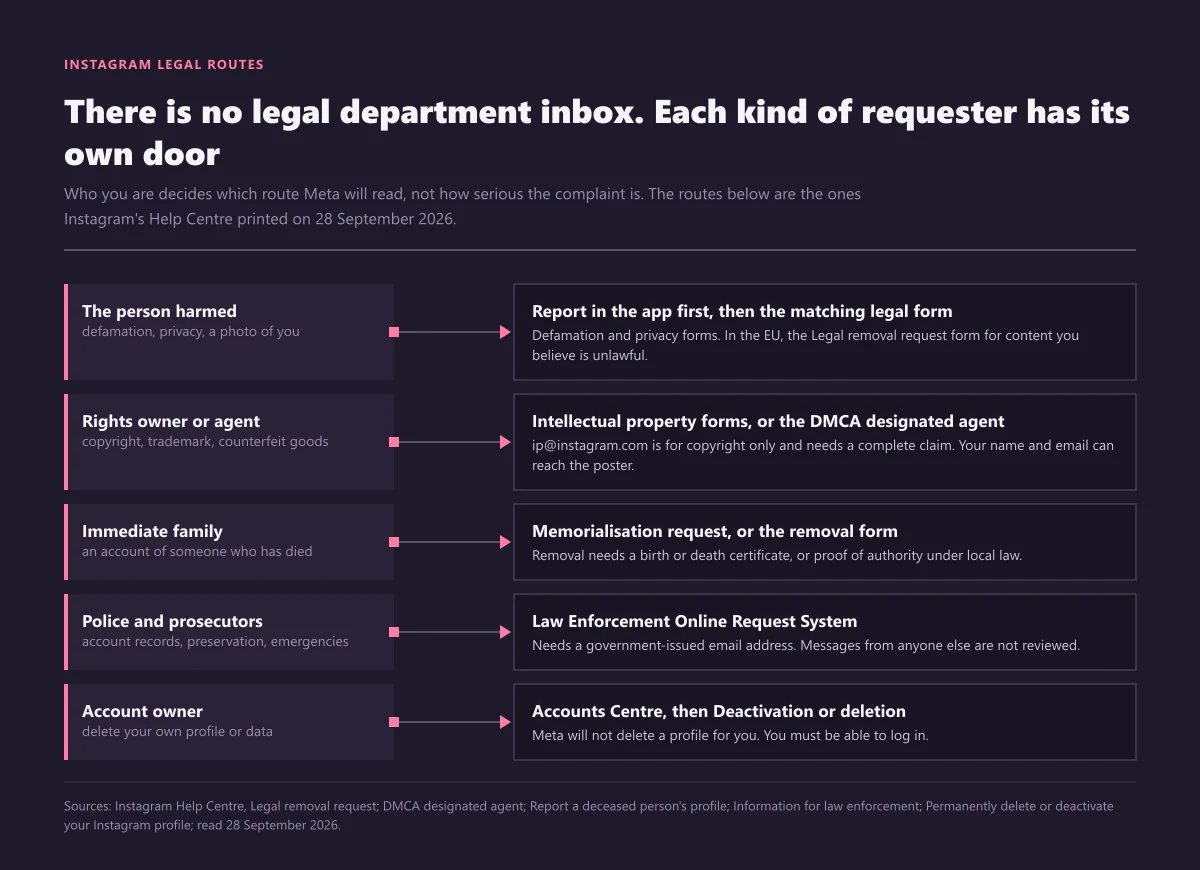
Instagram has no legal department that answers the public by email. Legal removal requests go through forms: defamation, privacy, intellectual property and, in the EU, the Legal removal request form. Only copyright has an address, ip@instagram.com. Police use Meta's records portal. Report in the app first, because most legal notices are settled under Instagram's own rules.
Does Instagram have a legal department email address you can write to?
No public one. The only email address the Help Centre prints for a legal matter is ip@instagram.com, and it takes copyright claims and nothing else.
Meta runs Instagram's legal intake through forms, each built for one kind of claim and one kind of sender. Search for an Instagram legal department email address and you land on directories that fill the gap with whatever they found years ago: support inboxes, a San Francisco office, a Menlo Park road Meta has since renamed. None of those is a place where a lawyer reads your complaint.
Meta's law enforcement page shows most plainly how it wants this handled. It sets out requirements, then warns that it will not review or respond to messages sent to this email address by non-law enforcement officials
, on a page that prints no email address at all. Copyright is the exception, and a narrow one. Meta's DMCA agent page calls the online form the fastest and easiest way
and says anything sent by other means must be a complete copyright claim, so a letter about a stolen photo belongs there and a letter about a defamatory caption does not. How that copyright route plays out for a creator is set out in reporting stolen content under copyright, and where it collides with an impersonation claim is in the impersonation or DMCA decision.
Instagram Ban Service gets this question more than any other about the legal side. Put shortly, there is no Instagram legal department that the public can reach, only doors with a sign on each.
Which postal addresses does Meta print for Instagram legal papers today?
Two: Meta Platforms, Inc. at 1 Meta Way, Menlo Park, CA 94025, and Meta Platforms Ireland Ltd. at Merrion Road, Dublin 4, D04 X2K5, for users in the European region.
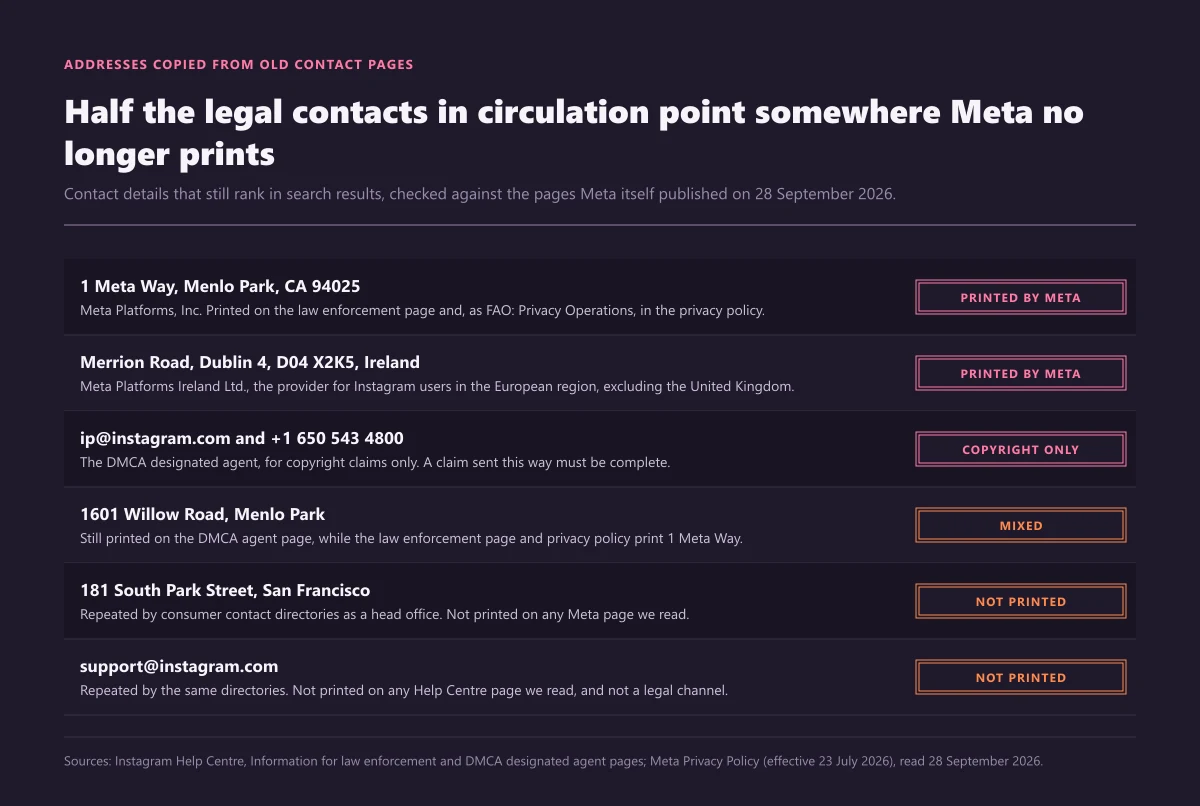
Which entity you write to depends on where the user is. According to Instagram's information for law enforcement, the service provider and data controller for users in the European region, the United Kingdom excluded, is Meta Platforms Ireland Ltd.; everyone else is served by Meta Platforms, Inc. in California. The privacy policy, effective 23 July 2026, gives the same Californian address for privacy questions, complaints and requests, marked FAO: Privacy Operations, in the version shown to us from outside Europe.
Meta's own pages do not agree with each other. Meta's DMCA agent page still lists 1601 Willow Road for its designated agent, with the phone number +1 650 543 4800, while the law enforcement page and the privacy policy print 1 Meta Way. Post sent to the older road may well arrive. Nobody should read it as proof that a different legal department sits there. One consumer-complaints directory that ranks for these queries still gives 181 South Park Street in San Francisco as head office; no Meta page we read on 28 September 2026 prints that address.
Post is slow by Meta's own account. Officials who skip the online system should expect longer response times
, and nothing on any page suggests a private letter is faster.
How to contact Instagram legal department routes, sorted by who is asking
Name yourself first, then the claim. The person harmed, a rights owner, a family member, a police officer and an account owner each get a different route, and a request sent through the wrong one is refused on that ground alone.
- The person harmed. Defamation and privacy forms accept the injured party or someone authorised to act for them, such as a lawyer. A request on behalf of a friend who hasn't asked you is refused.
- A rights owner or agent. The intellectual property forms and the DMCA agent. The cost is disclosure: your name, email and the report can be passed to the poster, a point covered in whether Instagram names the reporter. An agent filing shields the email but not the client's name.
- Immediate family of someone who has died. Memorialisation needs proof of death such as an obituary; removal needs a birth or death certificate, or proof of authority under local law. Both outcomes are compared in what happens to a memorialised account.
- Police and prosecutors. The Law Enforcement Online Request System at facebook.com/records, which needs a government-issued email address.
- The account owner. Accounts Centre. No form replaces logging in.
Ordinary in-app reports stay anonymous, as what the reported account can find out explains, which is one reason Meta steers most people there before any legal form. Threats are the exception to the whole list. A blackmail demand or a sextortion message is a police matter first, and Instagram's own blackmail article says to report it and contact local law enforcement. Instagram Ban Service's steps for reporting extortion on Instagram, for a fake profile used to blackmail you and for threats and published home addresses come before any legal letter.
How do you file a legal removal request on Instagram, and why might the form not open?
Report the item in the app under the Community Standards first. If you are in the EU and the content is unlawful where you live, file the Legal removal request form as well.
That order comes from Meta. Instagram's Legal removal request article opens by saying content that breaks your personal legal rights may also break the Community Standards, points you to the report link in the drop-down menu near the content, and only then offers the form if you're in the EU
. It closes with the sentence every applicant should read twice: reporting something doesn't guarantee that it will be removed
.
- Capture the item with the username, the date and the full text in view, and copy its link.
- Report it from the item itself: Options on a post, as in the post-reporting walkthrough, tap and hold for a comment you want reviewed, the icon at the top for a Story or a page's Story.
- Write down which law the content breaks and in which country. The EU route rests on Article 16 of the Digital Services Act, which asks for the reasons the content is illegal, its exact location, your name and email, and a good-faith statement.
- File the Legal removal request form, or the claim-specific form, with the same links and your capture.
- Keep the confirmation. A notice under Article 16 must be acknowledged and answered with a decision you can contest.
What the Instagram legal removal request form does outside the EU, and inside it
For us it did not open at all. On 28 September 2026 the form's link, help.instagram.com/contact/406206379945942, sent our browser straight to the Help Centre front page, and a fetch from the United States was redirected to a second form number that showed the same front page. Several legal articles behave the same way: the UK Online Safety Act complaint page reads This content isn't relevant in your location
outside the UK. Outside the EU, then, the claim-specific forms carry the load, and the form-by-form takedown comparison lists them. When the whole profile is the problem rather than one item, start from reporting the profile or page.
What does a legal removal request on Instagram usually end in?
A decision under Instagram's own rules. Between 1 April and 27 September 2026, 124,737 of the 125,165 Instagram decisions that began with an EU legal notice were taken under the terms, and 428, or 0.3%, under the law.
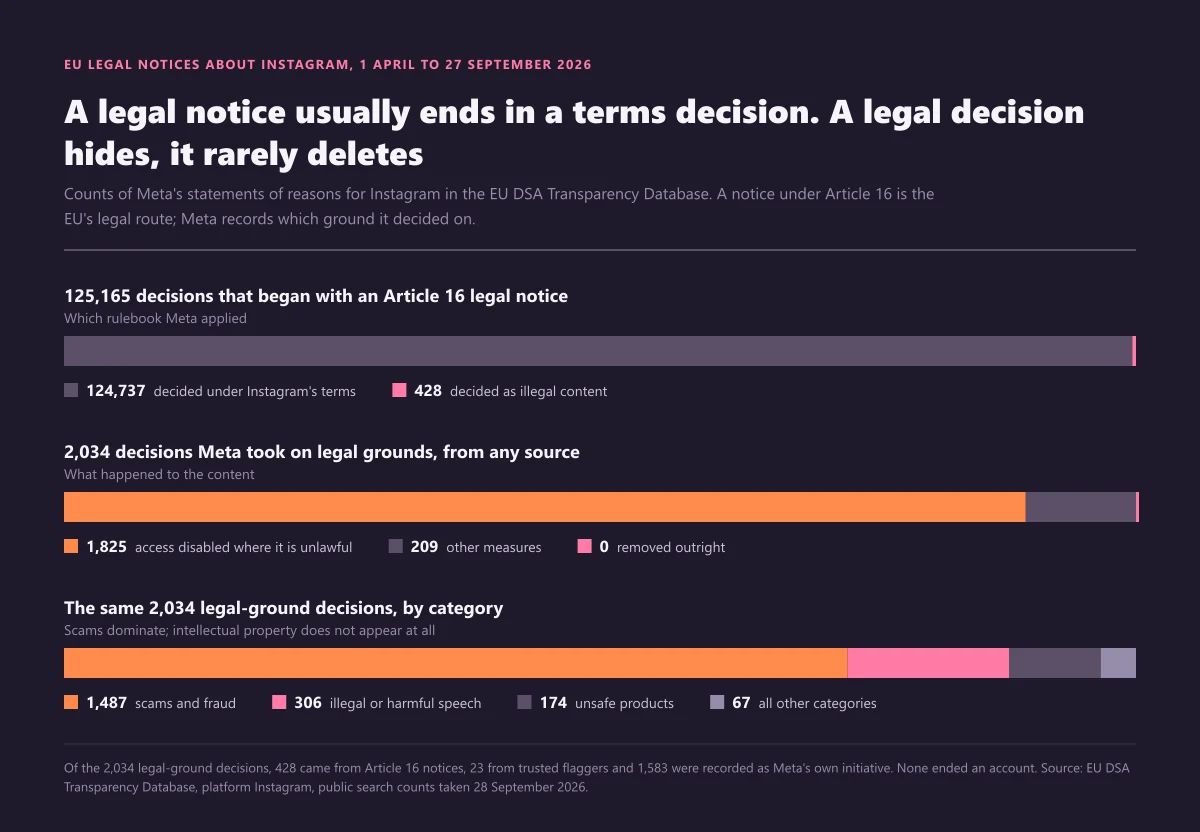
These figures are counts from the EU DSA Transparency Database, where Meta files a statement of reasons for every restriction it imposes on Instagram content in the EU. Instagram Ban Service ran the counts on 28 September 2026. Meta took 2,034 decisions on legal grounds in the window, from every source. Of those, 1,825, about 90%, disabled access to the content, 0 removed it and 0 ended an account. Only 428 came from Article 16 notices and 23 from trusted flaggers; the other 1,583 are recorded as Meta's own initiative.
That pattern matches what Meta says a legal restriction is. When content is illegal under local law
after careful legal review
, Meta makes it unavailable in the relevant country or territory, and Holocaust denial blocked for people in Germany is its own example. A post that breaks the law but not the Community Standards can therefore vanish in your country and stay live everywhere else. A post that breaks the Community Standards comes down worldwide, which is why the in-app report usually does more for the applicant than the legal claim does.
The categories are lopsided. Scams and fraud account for 1,487 of the 2,034 legal-ground decisions (73%), illegal or harmful speech for 306 and unsafe products for 174. Intellectual property accounts for none, although 117,712 of the Article 16 decisions, 94% of them, concerned intellectual property: Meta settles those under its terms. For a fraudulent seller, the scam and fraud reporting guide is the faster route, and a fake prize draw or shop is handled through reporting a giveaway or business account.
What the reported person sees, and what a review actually changes, is covered in what a report sets in motion. A legal notice doesn't gain weight by being filed twice either, a point the report-count myth takes apart, and checking the outcome of a report shows where the answer arrives.
Instagram content removal form or photo removal request: which form fits the ground?
The ground picks the form. Copyright, trademark, defamation, privacy and impersonation each have their own, and each decides who may file and what the poster learns about you.
| Ground | Form and who may file | What to expect |
|---|---|---|
| Copyright | Intellectual property form or the DMCA agent; the rights owner or an authorised agent | Your name, email and report details can reach the poster, who may counter-notify |
| Trademark or counterfeit goods | Trademark form or Counterfeit Report Form; one registered mark per report | Up to 30 links; abuse of the form can cost you your own account |
| Defamation | Defamation form; the injured party or someone authorised | For the United States it stops at Section 230; in some countries it asks for a court order |
| A photo or video of you | Privacy violation form; the person shown, or a parent for a child under 13 | Assessed against local privacy law, not copyright |
| An account posing as you | Impersonation form; you or your representative | Asks for a government-issued ID |
An Instagram photo removal request is where applicants most often pick the wrong door. A photo you took is your copyright. A photo of you taken by someone else is not, however personal it feels, and Meta's copyright page says so directly: appearing in a photo doesn't necessarily mean you have a copyright
. That case goes to the privacy form. An intimate image shared without consent is reported under the non-consensual intimate imagery rule instead.
An account built from your photos to pass as you belongs to the impersonation route, set out in reporting a fake account and in the impersonator takedown order. Insults and a campaign of abuse fall under the harassment and bullying report, and someone watching and following you from account to account is covered by reporting an Instagram stalker. A handle registered to trade on your brand is a trademark matter, and claiming a username you hold rights to shows how far that claim reaches, because usernames are otherwise first come, first served.
Can an Instagram account removal request go through Meta's legal side?
Rarely. Meta removes accounts on request in a handful of named cases: a family member of someone who has died, a convicted sex offender, a child under 13 and a repeat copyright infringer.
For a living adult's account there is no legal form whose outcome is delete this person. Across the six months counted above, Meta's legal-ground decisions on Instagram ended 0 accounts; account removals come from the Community Standards and the Terms of Use. A takedown of someone else's account therefore runs through reports, and the site has several angles on it: what deleting someone else's account involves, getting someone's Instagram deleted by the rules, the account takedown sequence and a case-by-case account takedown.
Each named case has its own evidence. Convicted sex offenders aren't allowed on Instagram, and a report needs a link to a national sex offender registry listing, a news article or a court document; once the status is verified, Meta says it will disable the account immediately. Removing a deceased person's profile needs the certificates listed above. An account holder can also pick Delete after death instead of a legacy contact, and a valid memorialisation request then deletes the profile. Where an account keeps breaking the rules, a report that leads to a disabled account sets out the record Meta weighs, what makes a ban permanent covers the end point, getting a rule-breaking account banned covers the evidence, and the triggers behind an Instagram ban covers the thresholds.
Instagram deletion request for your own profile
Meta's answer is blunt: For security reasons, we can't delete a profile for you.
You must be able to log in and use Accounts Centre, then Deactivation or deletion. After 30 days the profile and its information are permanently deleted, the cancellation window varies by region, the process can take up to 90 days to complete, and copies can stay longer in backup storage or be kept for legal issues. Export your information first; the export tool goes with the account.
What an Instagram data deletion request means for users, and for app developers
For a user, it is a privacy-rights request to Meta, made through the Help Centre tools or by post to Privacy Operations. For a developer, it is the deletion URL every app using Instagram login has to provide.
Users first. Meta's privacy policy sends people who want to access, download or delete their information to the settings and Help Centres, then gives a postal contact for questions, complaints and requests: Meta Platforms, Inc., FAO: Privacy Operations, 1 Meta Way, in the version we were shown on 28 September 2026. It adds that in some countries you can contact the Data Protection Officer for Meta Platforms, Inc., and that depending on your jurisdiction you can complain to your local data protection authority directly. In the European region the controller is Meta Platforms Ireland Ltd., so an erasure request under the GDPR is addressed to Dublin.
Developers search the same words for another reason. Meta's data deletion callback documentation says apps that access user data must give users a way to request deletion, either through an instructions URL or a callback URL in the app's Basic Settings. Meta sends the callback a signed request, and it answers with JSON with a url and a confirmation_code, so the user can check the status. Business login for Instagram asks for a Deauthorization callback URL and a Data deletion request URL. A developer's deletion URL covers what that app holds, never the Instagram account itself.
What can a lawyer or a police officer actually obtain from Meta?
Records, not removals, and only with the right legal process. A subpoena in a criminal investigation reaches basic subscriber records; the contents of an account need a search warrant.
Meta's law enforcement guidelines follow the federal Stored Communications Act, 18 USC 2701 to 2712. A valid subpoena issued in an official criminal investigation compels basic subscriber records such as name, length of service, email addresses and recent login IP addresses; a court order under section 2703(d) reaches message headers and IP addresses; a search warrant is required for messages, photos, comments and location information. Outside the United States, a Mutual Legal Assistance Treaty request or letter rogatory may be required for contents.
Three details matter to anyone planning litigation. Instagram does not require email or phone verification or real names, so subscriber records may identify less than hoped. Meta's policy is to notify the user before disclosure unless the law or exceptional circumstances prevent it. And records are preserved for 90 days pending formal legal process only after an official preservation request, and Meta says it retains no data for law enforcement purposes without one. It offers no expert testimony, calls its records self-authenticating and may seek reimbursement for costs.
A private claimant's lawyer usually gets further with the forms above plus a court order against the poster. Before paying for either, check whether the target is one post or the whole account: the 194 takedown requests counted on r/Instagram show how often people ask for an account to go when a single post is the real problem.
When is a legal letter worth more than the report button?
When the content is lawful under Instagram's rules but unlawful where you live, or when you need a decision you can contest. Otherwise the report is quicker and reaches further.
Take a caption accusing a named dentist of fraud. If it is a false statement of fact, the defamation form is the right place, and a UK dentist gets a form that asks who is filing and on whose behalf, with room for the exact statements and up to ten URLs. If the same caption also insults and targets the dentist by name, a bullying report may remove it worldwide, with no country restriction attached. File both, and keep the capture that proves what the caption said on the day.
What never helps is volume dressed up as law. Sellers now promise a legal-sounding takedown with nothing behind it but repeated reports, and every variant has been checked on this site: the mass-report bot pitch, why mass-reporting an account fails, mass-reporting offers traced to their sellers, report apps, bots and panels taken apart, the so-called reporter tool, the spam report bot and ban-as-a-service listings. None of them can file a legal notice on your behalf, because a notice needs your name, your rights and your good-faith statement.
What Instagram Ban Service asks for before a legal-route filing
Your role, the ground, the country whose law applies, and a capture of the content with its date. Without those four, no legal form will take the case.
- Who you are in the case: the person harmed, the rights owner, an authorised representative or a family member.
- The ground in one line: copyright, trademark, defamation, privacy, impersonation or a named local law.
- The country, because the defamation form branches by jurisdiction and the EU form exists only there.
- Links to each item, a screenshot or recording with the username and date, and any court order you already hold.
When we tried the EU Legal removal request form on 28 September 2026, we saw it bounce to the Help Centre front page from two different countries, and that changed the order we now use. Now the in-app report goes in first, the claim-specific form second, and the EU form only for clients inside the EU, from their own connection. We also stopped quoting 1601 Willow Road to clients once we found Meta's other legal pages printing 1 Meta Way.
Instagram Ban Service files the report or the form that fits the claim, then follows the decision and any appeal. Instagram alone decides whether content comes down, and content that breaks no rule and no law is turned away. Send the four items through the case intake desk, compare the other routes in every Instagram reporting guide, or start from the Instagram Ban Service home page. Report it in the app today; file the legal form once you can name the law.
Sources
- Instagram Help CentreLegal removal request: report first, the EU form, no guarantee of removal
- Instagram Help CentreAbout legal restrictions on access to content on Instagram and Threads
- Instagram Help CentreInformation for law enforcement: SCA process, preservation, notification, addresses
- Instagram Help CentreHow to contact Instagram's DMCA designated agent
- Instagram Help CentreWhat the person who posted reported content receives after an IP report
- Instagram Help CentreCopyright: appearing in a photo does not necessarily give you the copyright
- Instagram Help CentreOther types of reports: deceased profiles, blackmail, convicted sex offenders
- Instagram Help CentrePermanently delete or deactivate your Instagram profile
- Instagram Help CentreUK Online Safety Act: submitting a complaint (shown only in the UK)
- Meta for DevelopersData deletion request callback
- Meta for DevelopersBusiness login for Instagram: deauthorize and data deletion request URLs
- Legal Information Institute18 U.S. Code section 2703: required disclosure of customer communications or records
Frequently asked questions
Is support@instagram.com a way to reach Instagram's legal team?
No. It is not printed on any Instagram Help Centre page we read on 28 September 2026, and Meta handles legal claims through forms. The one email address Instagram prints for a legal matter is ip@instagram.com, for its DMCA designated agent, and a claim sent there must be a complete copyright claim.
Can a lawyer file an Instagram legal removal request for a client?
Yes. Defamation, privacy and intellectual property forms accept someone authorised to act for the injured party or the rights owner. On an intellectual property report filed by an agent, Meta tells the poster the name of the client that owns the right rather than the agent's email address.
Is an Instagram legal request the same as a subpoena?
No. A legal removal request asks Meta to restrict content. A subpoena asks for records, and under the Stored Communications Act a subpoena in a criminal investigation reaches only basic subscriber records; the contents of an account need a search warrant. Meta's policy is to tell the user before it discloses anything, unless it is barred from doing so.
Does a court order make Instagram remove content?
It starts a legal review rather than an automatic removal. Meta says court orders are one source of requests, and where it finds content illegal under local law it makes it unavailable in that country or territory. Its forms take court orders as attachments, and in some countries the defamation form requires one.
Where do I send Instagram legal documents in Europe?
To Meta Platforms Ireland Ltd., Merrion Road, Dublin 4, D04 X2K5, Ireland, which Meta names as the service provider and data controller for Instagram users in the European region, the United Kingdom excluded. Everyone else is served by Meta Platforms, Inc., 1 Meta Way, Menlo Park, CA 94025.
Will the person find out I filed a legal form against them?
For intellectual property, very likely. Meta regularly passes the rights owner's name, your email and the report to the poster. Ordinary in-app reports stay anonymous. For any other legal form, write the complaint as if the poster may one day read it, and use a professional email address.