Own content · copyright removals, the repeat infringer policy, Live and Reels music, IP report notices, appeals and counter-notices
Copyright strike on Instagram: what one removal does to your post, your Live and your account
Instagram has no strike counter for copyright, so the useful question is what a single removal does to your post, your Live and your account. On 4 October 2026 we read Instagram's copyright help pages and Meta's Music Guidelines line by line to answer it.
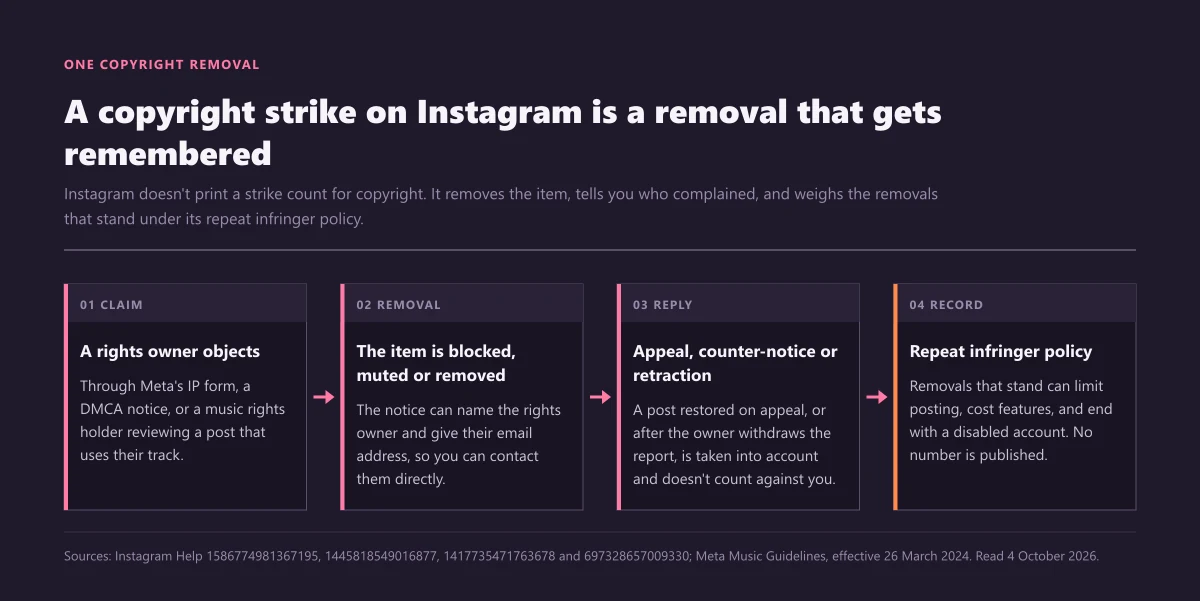
A copyright strike on Instagram isn't a numbered strike like YouTube's. When a rights owner reports your post, Instagram removes, mutes or blocks it and may show you who complained. Removals that stand count under its repeat infringer policy, which can limit posting and features and, in the end, disable the account.
Is a copyright strike on Instagram the same as one on YouTube?
No. YouTube counts strikes against a published limit. Instagram removes the item and keeps a record it never puts a number on.
The phrase comes from YouTube, where the rule is printed: YouTube's copyright strike basics page says channels that get 3 copyright strikes in 90 days are subject to termination, and that strikes can expire after 90 days. People carry that model over to Instagram and go looking for a strike counter. There isn't one.
What Instagram has instead is a repeat infringer policy. Its help page, read on 4 October 2026, says that if you repeatedly post content that infringes someone else's copyright or trademark, your account may be disabled or your Page removed
. Before that, your ability to post photos or videos may be limited and you can lose access to certain features. The page names no number, no window and no expiry. It adds one detail that matters a lot: if a post is restored on appeal, or because the rights owner withdrew the report, Instagram takes that restoration into account.
So when people talk about a copyright strike on Instagram, what they're really describing is a removal that sticks. Each one that stands adds to the record the policy weighs. Each one you get reversed comes off it. Meta also runs a separate strike count for Community Standards violations, which expires after a year, but Instagram's copyright pages never refer to it and describe their own policy instead.
Is there copyright on Instagram, and how big an issue is it?
Yes, on both sides. You keep the rights in what you make, and you need rights in what you post.
Instagram's Terms of Use forbid posting anything that infringes someone else's intellectual property, and they leave ownership of your own photos and videos with you: Instagram takes a non-exclusive licence to show them, which ends when you delete them. Its copyright help hub is plain that it can't give legal advice and that the law varies by country. Its basics page adds two points people get wrong: if you take a photo you are likely to own the copyright, and appearing in someone else's photo doesn't by itself give you one.
Is there any copyright issue on Instagram worth worrying about?
The EU numbers say copyright is the main thing lawyers write to Instagram about. In the European Commission's DSA Transparency Database, Instagram filed 117,346 decisions between 1 April and 31 August 2026 that answered legal notices under Article 16 of the Digital Services Act. 110,809 of them, 94.4%, were about intellectual property.
The same database shows how rarely that ends a whole account. In September 2026 Instagram filed 7,541,724 account-level decisions in the EU, and 2,411 of them were for intellectual property, about 0.03%. Copyright removals are routine. Copyright account bans are not, which is why one removal is a warning to act on, not a reason to panic.
Can you get copyrighted on Instagram without meaning to?
Yes. Intent doesn't decide it, and neither does credit, a disclaimer or a missing price tag.
"Can u get copyrighted on Instagram" is usually typed by someone who reposted a clip, added a song, or wrote "no copyright intended" under a video and now has a notice. Instagram answers the question on its page about making sure what you post doesn't violate copyright law, which lists ten things that do not protect a post. You can still infringe if you:
| What people assume covers them | Example |
|---|---|
| Bought or downloaded the content | A song bought on iTunes, set under a reel |
| Recorded it on your own phone | A track playing in the background at a party, wedding, match or concert |
| Gave credit to the owner | "All rights to the artist" in the caption |
| Added a disclaimer | "No copyright infringement intended" |
| Weren't trying to profit | A fan page with no shop and no ads |
| Changed it or added your own material | A film scene with your commentary laid over it |
| Found it on the internet | A photo from a search engine |
| Saw others post the same thing | A clip already going round a hundred meme pages |
| Believe it's fair use | Fair use is a legal defence decided case by case, not a setting |
| Used an unauthorised streaming app or device | A "jailbroken" or "loaded" app showing a live match |
The examples in the right-hand column are ours; the ten grounds are Instagram's. The page then gives four questions to ask before posting: did I make all of this myself, do I have permission for every part, does an exception to copyright apply, and is the thing protected at all? Short phrases, bare ideas and public-domain works generally aren't. Its advice is to get written permission from the author first.
What does an "intellectual property report" notice on Instagram mean?
Someone claiming to own a copyright or trademark filed a report against your post, and Instagram acted on it.
The notice is the moment most people first meet the system. Instagram's page on content removed for an intellectual property report says the notification may include the name and email address of the rights owner who reported you, or other details of the report. That makes IP reports the exception to Instagram's usual anonymity: as our guide to whether Instagram reveals who reported you explains, other reports stay anonymous, but an infringement report puts the rights owner's name in front of you. If the report was filed by a law firm or agent, you'll usually see the name of the client that owns the right.
The notice also tells you which kind of report it was. A copyright report and a trademark report lead to different replies: a trademark removal is appealed through the instructions in the notification, while a copyright removal is answered with an appeal or, if it was handled under the US Digital Millennium Copyright Act, a counter-notification. Section eight sorts out which.
One warning belongs here. Real notices arrive inside the app and by email. Messages that turn up as DMs or WhatsApp texts saying your account has a copyright violation and must be verified through a link are a common phishing lure, and our page on Instagram copyright report forms and the fakes around them shows what they look like. To check an email, open Settings, Accounts Center, Password and security, then Recent emails, which lists what Instagram really sent you in the last 14 days.
What are Instagram's Live copyright rules?
Live is checked while it runs. Too much recorded music can get a broadcast muted or cut off, and a listening session can cost the profile.
Instagram live copyright rules come from two documents. The first is Instagram's 20 May 2020 announcement, Updates and Guidelines for Including Music in Video. It admits that having a stream interrupted is frustrating, says notifications were moved earlier so broadcasters get warned sooner, and sets out the principles: the more full-length recorded tracks in a video, the more likely it is to be limited; shorter clips are better; there should always be a visual component. It also says traditional live music performances, such as filming a band playing, are permitted.
The second is Meta's Music Guidelines, effective 26 March 2024, which apply to every Meta product. They say you may not use content to create a music listening experience, and that if you do, your content may be blocked and your page, profile or group may be deleted. The next sentence reads, in full, This includes live videos.
That is the line a two-hour playlist stream crosses.
In practice Instagram live copyright trouble has three levels: a warning on screen while you broadcast, the audio muted or the stream ended, and the listening-experience rule that reaches the profile itself. Live has no separate copyright rulebook; the live copyright rules on Instagram are these general music rules applied in real time. If you play music while live, keep it short, keep the camera on something happening, and treat the on-screen warning as the time to stop the track.
How does copyright for Instagram Reels work when the song came from Instagram?
A song in the Reels picker is cleared for ordinary personal use where it appears. It isn't a licence for advertising or for countries where it's missing.
The safest music for Reels is the music Instagram offers you inside the editor, because Meta put those tracks there itself. Even so, the Music Guidelines say nothing in them authorises any use of music, and that use of music for commercial or non-personal purposes in particular is prohibited unless you have obtained appropriate licences
. A brand promoting a product with a chart song is in that commercial category whether the song came from the picker or not. The guidelines also note that taking part in Music Revenue Sharing doesn't by itself make a video commercial.
Two other limits catch people out. Music isn't licensed everywhere: Instagram's 2020 guidance says that while music launched in more than 90 countries, a video with recorded music may not be available in places where it isn't. And copyright for Instagram Reels covers the picture as much as the sound. A reel built from a film scene, a TV clip or another creator's video is judged on that footage, and adding a trending sound or your own voice-over is one of the ten non-defences in the table above.
When a reel is muted or blocked rather than removed, the guidelines say you may be able to dispute it from the notification if you hold the rights or think the action was wrong. Depending on the restriction, Meta may connect you with the rights holder, restore the reel automatically, or have someone on its operations team review it.
Copyright videos on Instagram: clips, sport and film scenes
Re-uploaded video is where removals pile up, because the rights owners watching for it are organised.
Meta's page on protecting intellectual property rights says it acts on valid reports typically within a day or less. Instagram's copyright guidance also names a category of its own: content that facilitates infringement through unauthorised devices or services, the "loaded" streaming apps and boxes that show paid channels for free. Posting a match from one of those, or promoting one, is a breach on two counts.
The copyright videos on Instagram that are safe to post share at least one of three traits: the footage is the uploader's own, the clip is short and visibly transformed, or the uploader has a licence they could show if asked. Everything else is a bet that nobody holding the rights is looking. A fan page that reposts highlights every day is the kind of account that reaches the repeat infringer stage, because each removal lands on the same record.
Meta's same page says a rights owner can report an entire profile or account when they believe it infringes in its entirety. A page built wholly from someone else's footage can therefore come down in one report, without passing through a run of single removals first.
A copyright removal just happened. What should you do first?
Find out which procedure removed it, then pick the one reply that fits. Doing nothing lets the removal count.
- Read which report it was. The message says whether the removal was for copyright or trademark, and whether it was handled under the DMCA. Instagram's page on appealing a copyright removal says a DMCA removal is answered with a counter-notification and any other copyright removal with an appeal, using the instructions in that same message.
- Contact the rights owner if it was a mistake. The notice may give their name and email. A licensor who reported their own licensee by accident can retract the report, and a retraction counts in your favour under the repeat infringer policy.
- File the counter-notice only if you're sure. Under Instagram's DMCA counter-notification process, your contact details go to the person who reported you, and the content comes back within up to 14 working days unless they tell Meta they have gone to court. Restored content isn't counted against you.
- Appeal everything else with evidence. The appeal page says a valid, substantiated appeal is reviewed quickly, and that answering Meta's requests for more information promptly helps. A licence, an invoice or the original file with its date does more than an explanation.
- Take down the twins yourself. If one reel with a song came down, the other reels using the same song are likely next. Removing them yourself costs posts; leaving them can add removals.
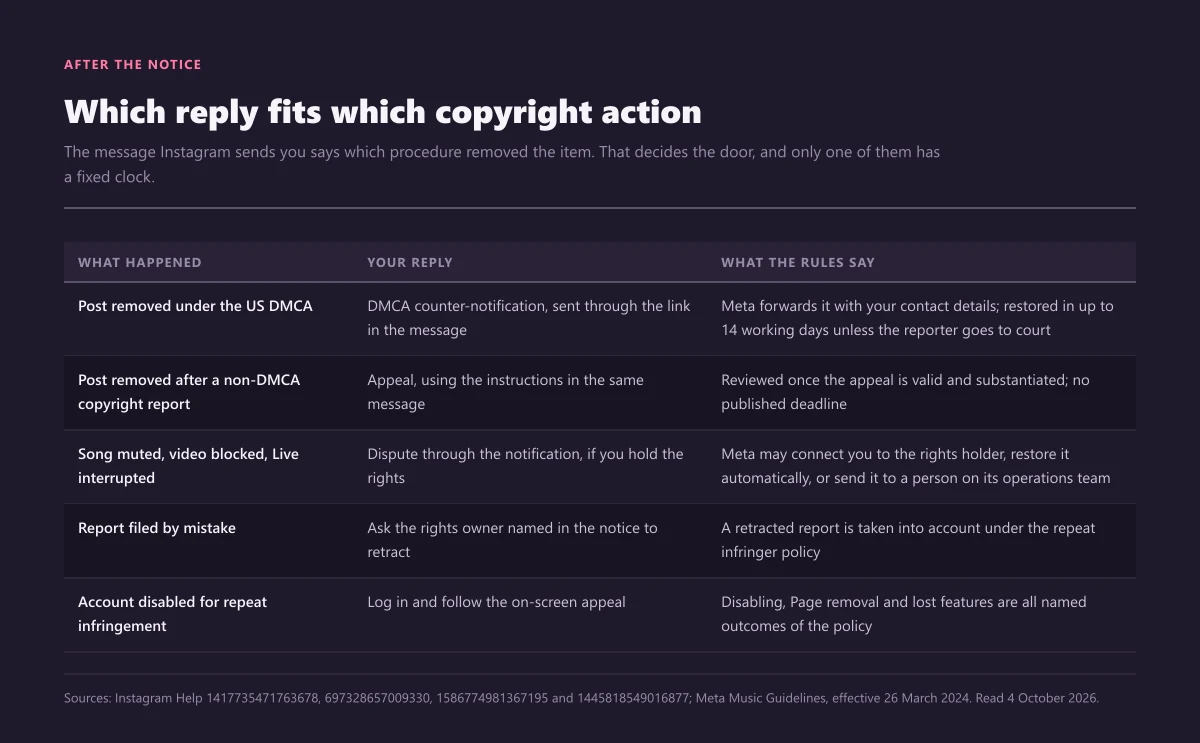
If the account itself was disabled for repeat infringement, the appeal page says to log in and follow the on-screen instructions. Our page on what triggers an Instagram ban covers the non-copyright reasons an account can be disabled.
Instagram stolen content: what if you're the one who was copied?
Then the same system works for you, through Meta's IP form, filed by the owner or someone authorised.
When we worked through Meta's intellectual property form in late September 2026, its first two questions were where you are asserting rights and whether you are the rights owner; answering no stops the form, because a report must come from the owner or someone authorised to act for them. The person you report usually receives your name and email, so many owners use a business address.
Instagram report infringement: what the form wants from you
Instagram report infringement requests ask for your full name, postal address and phone number, a description of the work, the links to the copies, and a declaration made under penalty of perjury. One report can list several links to the same account.
For a single stolen photo or reel, start with the copyright report route for stolen content. When the copy is a whole fake profile using your pictures, choosing between an impersonation report and a DMCA notice matters, and removing an account that pretends to be you walks through the impersonation side. A brand name squatted as a username is a trademark matter rather than a copyright one, and claiming a username someone is sitting on explains why Instagram treats handles as first come, first served unless a mark is infringed. Photos of someone who has died, reposted without the family's consent, sit closer to the memorialised-account process than to copyright.
Copyright reports have a known abuse: filing them to knock out a rival or an ex. Meta's IP page says human review is there to catch reports that are fraudulent, mistaken or made in bad faith, and the form's perjury declaration is not decoration. If someone threatens to bury your account in copyright claims unless you pay, that's extortion, which Instagram has its own report route for.
Copyright is one report among many, so pick the right one
A copyright form only removes copied work. Harassment, scams and fakes each have a route that fits them better.
People often reach for a copyright report because it feels strongest. It's the wrong tool when the real problem is behaviour. A post that mocks you with your own photo is better handled as bullying and harassment; reposting to frighten you points to the threats and doxxing route or to reporting an account that is stalking you; a fake shop using your product shots fits the scam and fraud report or the business and giveaway report. A fake account that copies a profile to blackmail its owner goes through impersonation used for blackmail, and a plain fake through the fake account report.
Ordinary reports work at the level of the item: reporting one post, a comment under it, a story or page, or a full profile. What a report sets in motion, whether the person you report finds out and how to check whether the account was banned afterwards each have their own guide, as do deciding between the post and the whole account and an account takedown from start to finish.
Volume doesn't help any of them. Bought mass reporting, mass report bots, spam report bots, report apps and panels, so-called reporter tools and ban-as-a-service sellers all sell repetition, and our trace of those offers shows how little it buys; nobody can say how many reports delete an account, because the count isn't what decides. The same answer comes back for getting someone banned, getting someone's Instagram deleted, deleting another person's account, a permanent ban, reporting an account until it's disabled, a full account takedown and the threads in Reddit's advice on taking down a page: only a real violation, shown through the official route, removes anything.
Instagram Ban Service works on the reporting side. When an account is stealing your work, impersonating you or scamming people, we prepare the evidence and file through Instagram's official forms; we don't file against accounts that follow the rules, and we can't undo a removal of content that really infringed. The full list of our Instagram guides covers every route, and our contact page takes a profile link if you'd like a case looked at.
Sources
- Instagram Help CentreCopyright
- Instagram Help CentreHow to make sure that content you post doesn't violate copyright law
- Instagram Help CentreHow to appeal the removal of content for copyright reasons
- Instagram Help CentreHow Instagram and Threads process DMCA counter-notifications
- Instagram Help CentreWhat is copyright?
- Instagram Help CentreReports are anonymous, except intellectual property reports
- Instagram Help CentreRecent emails from Instagram
- InstagramTerms of Use
- Meta Transparency CenterProtecting intellectual property rights
- Meta Transparency CenterCounting strikes, updated 23 April 2025
- YouTube HelpCopyright strike basics
Frequently asked questions
How many copyright strikes does it take to get banned on Instagram?
Instagram doesn't publish a number. Its repeat infringer policy says accounts that repeatedly post infringing content may be disabled, and that posting and features can be limited first. YouTube's three strikes in 90 days rule doesn't apply on Instagram.
Do copyright removals on Instagram ever expire?
Instagram's copyright pages give no expiry date. What they do say is that a post restored on appeal, or after the rights owner withdraws the report, is taken into account, and restored DMCA content isn't counted against you. Getting a wrong removal reversed is the reliable way to clear it.
Can u get copyrighted on Instagram for using a song from the Reels library?
Rarely for personal posts, because Meta placed those songs there itself. The Music Guidelines still bar commercial use without proper licences, so a brand ad with a chart song is at risk, and a track can be muted where it isn't licensed.
Will I find out who reported my Instagram post for copyright?
Usually, yes. Instagram's notice may include the rights owner's name and email address. If an agent or law firm filed it, you normally see the name of the client that owns the right. Other report types stay anonymous.
Can I put a copyrighted song in an Instagram Story?
Generally yes, through the music sticker. Instagram's 2020 music guidance says music in stories is permitted, and the songs offered there are ones Meta has made available. A song may still be missing in some countries, and a Story built only to play a full track is the kind of listening experience Meta's rules bar.
Can I play music during an Instagram Live?
Short clips with something happening on camera are the lowest risk. Instagram's 2020 guidance says full-length recorded tracks make an interruption more likely, and Meta's Music Guidelines say turning content, live videos included, into a music listening experience can get a profile deleted.
Does giving credit avoid copyright problems on Instagram?
No. Instagram's own copyright page lists giving credit, adding a disclaimer, not profiting, editing the work and finding it online among the things that don't stop a post from infringing. Permission or a licence is what protects you.
Is a DM saying my Instagram account has a copyright violation real?
Treat it as a scam until proven otherwise. Real copyright notices arrive in the app and by email. Check Settings, Accounts Center, Password and security, Recent emails, which shows what Instagram actually sent you in the last 14 days, and never log in through a link in a DM.
Can a copyright report take down my whole Instagram account at once?
It can. Meta says a rights owner may report an entire profile or account if they believe it infringes in its entirety. An account built wholly from other people's footage can come down in one report, without a run of single removals first.