Meta enforcement · Community Standards, strikes, restrictions and the Instagram link
How do you get someone banned from Facebook? What Meta's rules actually reward
Facebook has no ban button for other people's accounts. It has a report menu, a rulebook of 27 policy areas and a strike ladder, and this page reads all three as Meta publishes them, checked on 12 November 2026.
How do you get someone banned from Facebook? You report the specific posts or profile, and Meta disables the account only if its own review finds Community Standards breaches that are severe or repeated. Report counts do not decide it, Facebook's Help Centre says. Most violations climb a strike ladder of warnings and limits, reaching 30-day blocks at ten strikes, before a ban.
Can enough reports get someone banned from Facebook?
No. Facebook's own Help Centre says the number of times something is reported does not decide whether it is removed.
A Facebook ban is Meta's decision to disable an account, Page or group for breaking the Community Standards or the Terms of Service. A report is only the request that opens a review. Meta's page on how Facebook decides what to take down says reviews run through automated technology or a review team, and that report counts do not settle the result. Ten thousand clicks on a lawful profile still reach a reviewer who finds nothing to remove, and that reviewer closes the case. So the working answer to how do you get someone banned from Facebook is a broken rule, not a crowd.
Instagram Ban Service is an Instagram-focused reporting desk that also takes Facebook cases, because both apps sit on the same Meta review systems and many disputes cross between them. The honest answer it gives readers is short. The question is never how many people report. It is which written rule the account breaks, and whether the evidence shows it to someone who has never heard of either of you.
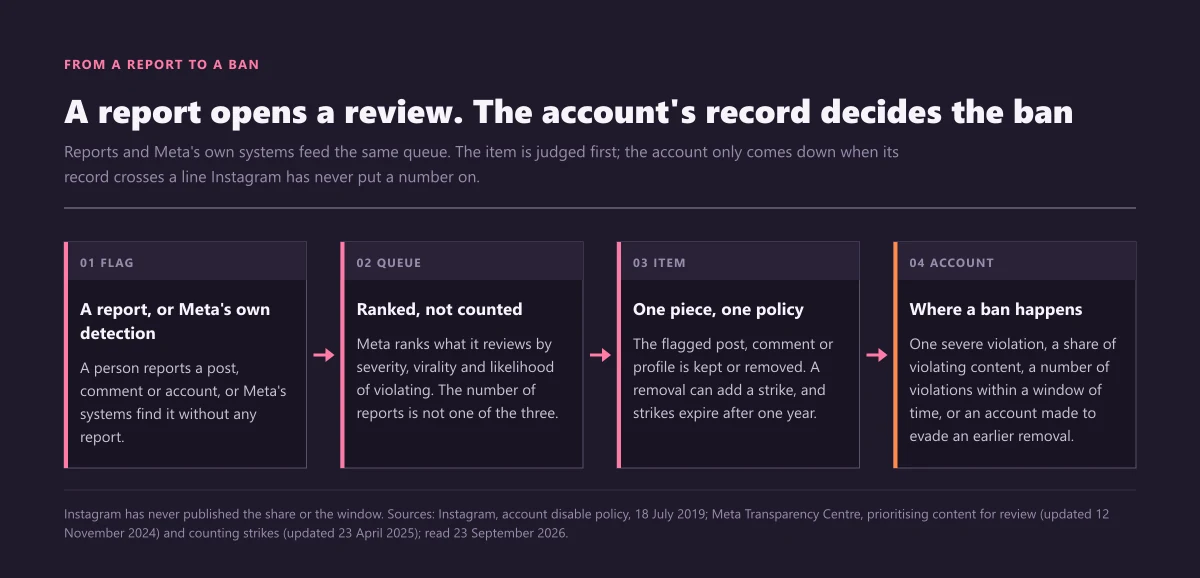
That is the first myth to drop.
What does Meta actually ban a Facebook account for?
Repeated or severe breaches of the Community Standards, the rulebook Meta applies to Facebook, Instagram, Messenger and Threads alike.
As of November 2026 the Meta Community Standards list 27 policy areas. They run from Bullying and Harassment, Hateful Conduct and Violence and Incitement to Spam, Account Integrity, Authentic Identity Representation and Third-Party Intellectual Property Infringement. A post that breaks one of them can be removed. Whether the account goes as well is a separate decision, made on its history rather than on one post.
Meta's page on when it disables accounts, updated 17 July 2025, says most accounts are disabled only when someone keeps posting violating content despite repeated warnings and restrictions. A short list skips the ladder entirely: accounts of dangerous individuals, convicted sex offenders, and accounts created to get around an earlier restriction. Meta's strike page adds that one post of child sexual exploitation material ends an account, Page or group after a single occurrence.
Disliking someone, arguing with them or competing with their business appears nowhere on that list. Instagram Ban Service checks every Facebook case against those 27 areas before anything else happens, and a case that fits none of them ends there.
If the account shares sexual images of a minor, do not collect or forward the images. Report the account in the app, then report it to the NCMEC CyberTipline or your local police, who can act beyond a platform ban.
Restricted or disabled: how does the Facebook strike ladder work?
Most violations add a strike, and strikes buy time limits on Facebook long before they buy a ban.
Meta's page on restricting accounts, updated 12 November 2024, sets out the ladder below for most policy areas. It applies to profiles; severe policies skip it.
| Strikes on the account | What Facebook does | What the reporter sees |
|---|---|---|
| 1 | A warning only | The post may vanish; the profile stays |
| 2 to 6 | Limits on specific features, such as posting in groups, for a set time | The person can still post on their own profile |
| 7 | One-day block on creating content: posting, commenting, creating a Page | A short silence, then normal activity |
| 8 | Three-day block on creating content | Same pattern, longer |
| 9 | Seven-day block on creating content | Same pattern, longer |
| 10 or more | Thirty-day block on creating content | Disablement becomes possible if violations continue |
Strikes do not last for ever. Meta's page on counting strikes, updated 23 April 2025, says every strike on Facebook or Instagram expires after one year. Meta also skips the strike for violating content posted more than 90 days before it was found, or more than four years earlier for the most severe violations. Severity, context and timing decide whether a removal earns a strike at all.
Read from a reporter's side, the ladder explains a familiar frustration. You report a post, it disappears, and the profile carries on. A removal and a warning happened. A ban did not, because one strike is a warning by design. That is why Instagram Ban Service tells people at the start that a single upheld report rarely ends an account.
Can you get someone banned from Facebook immediately?
Only in the categories Meta disables on sight: child sexual exploitation, dangerous individuals and organisations, convicted sex offenders, and accounts built to evade an earlier removal. Everything else climbs the ladder, one upheld violation at a time.
How to get someone banned from Facebook when the account really breaks a rule
Report the exact content under the exact policy, from the right menu, once. Then let the review run.
- Name the rule. Match what happened to one of the 27 policy areas. Threats sit under Violence and Incitement, a copy of your profile under Authentic Identity Representation, a fake shop under Prohibited Commercial Practices or Spam. If nothing fits, there is no report to make.
- Capture before you report. Save the profile link, each post link, and screenshots that show the date and the username. Content gets deleted once its owner notices a report, and your file should survive that.
- Report the item, not only the person. Use the report option in the post's own menu for each violating post. For the profile itself, open Options below the cover photo and choose Report profile.
- Use the specialist route where a right is involved. The impersonation report is for a profile pretending to be you, and it has a section for people without a Facebook login. Copyright and trademark claims belong to the owner or an agent; the guide to Meta's removal forms for posts, Pages and groups sets out who may file each one.
- Block for your own safety. Blocking is instant and needs no review, but it only hides the person from you.
- Stop there. Duplicate reports from friends add no weight, and section 3.2 of the Terms treats duplicative reports as misuse of the reporting channel.
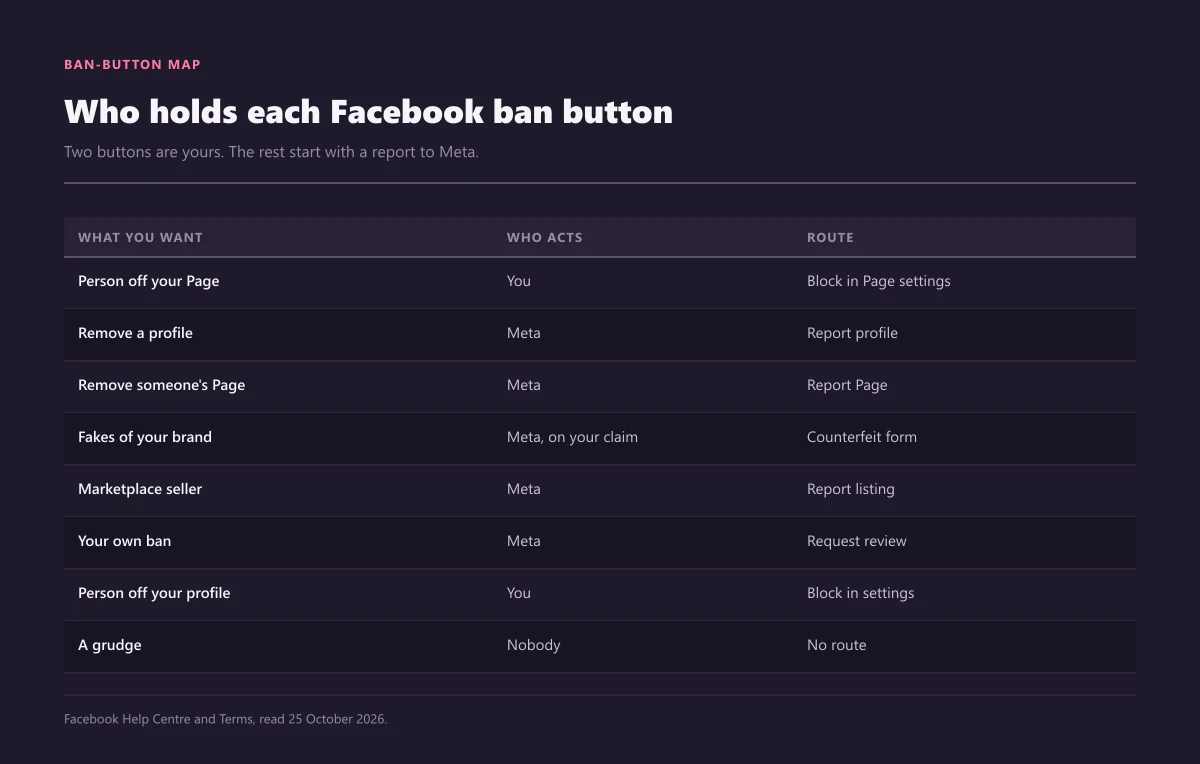
Pages and groups follow the same logic with a heavier burden: the file lists the posts that break a rule, because Meta weighs what a Page or group publishes. For a Page or group you do not run, the walkthrough on reporting a Facebook account or Page covers the menus, and taking down a Facebook post, photo or Page covers the copyright and privacy cases. Instagram Ban Service works through these same six steps when it prepares a Facebook file, which is the point: the route is public, and a careful report beats a loud one.
Does a Facebook ban reach the same person's Instagram?
Not by any rule Meta publishes. Strikes are counted on both apps, but the timed limits apply only to Facebook.
Meta's restricting-accounts page says it counts strikes on Facebook and Instagram, then states that the timed restrictions apply only to Facebook accounts. Accounts Center links a person's Facebook and Instagram profiles for shared login and settings. None of the Meta pages read for this guide on 12 November 2026 says that a disabled Facebook profile automatically takes the linked Instagram account with it. Section 4.2 of the Meta Terms of Service, effective 1 January 2025, does let Meta suspend or permanently disable access to Meta Company Products, which leaves room for wider action without promising it.
One link is firm. An account opened to dodge a restriction is disabled straight away, and section 3.1 of the Terms bars creating a new account after a disablement without Meta's permission.
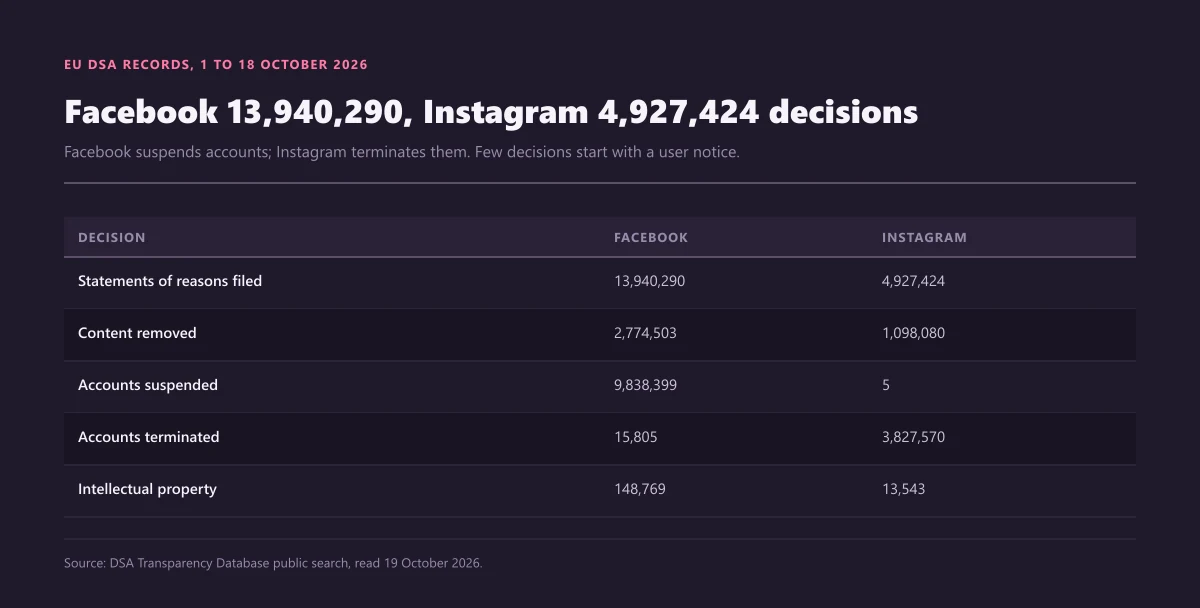
So Instagram Ban Service treats the Instagram side as its own case with its own evidence. The Instagram rules are close to Facebook's but not identical, and how an Instagram ban really happens walks through them. After filing, checking whether a reported Instagram profile was banned and telling a banned account from a deactivated one explain what the profile's disappearance does and does not prove. A sudden wave of removals is not always your report at work; read what an Instagram ban wave looks like and what a disabled Instagram account means before drawing conclusions.
Will a ban free up their Instagram username?
Not on any timetable Instagram publishes, so a ban is a poor plan for getting a handle. Start with finding an Instagram name that is still available, use an Instagram username checker or the manual availability check, and read the honest routes to a taken Instagram name. Picking a username you actually want and swapping usernames between your own accounts solve most cases. Buying is risky: see the risks of buying an IG handle and what Instagram's terms say about buying a username. If the handle is on your own old profile, deleting an old Instagram account is the cleaner move.
How can you get someone banned from Facebook without risking your own account?
File one accurate report for a real violation. Anything beyond that is the part Meta's Terms punish.
Section 3.2 of the Terms forbids misusing any reporting, flagging, dispute or appeals channel, and names fraudulent, duplicative or groundless reports as examples. Section 4.2 lets Meta suspend or disable the account of anyone who breaks the Terms. A report campaign therefore puts the reporters on the wrong side of the rules, not the target. Report bots and borrowed accounts fall under the Inauthentic Behavior and Account Integrity policies themselves, and logging in to someone else's account without permission is unauthorised access under the law of many countries.
Sellers who promise to remove any named Facebook account for a fee are offering mass false reports, a stolen login or nothing. Each leaves a trail that leads back to the buyer, and none can promise an outcome only Meta controls.
If your own account goes down in the middle of a report fight, the fix is an appeal, not a counter-campaign. Habits that keep an Instagram account clear of bans apply on both apps. For a disabled Instagram profile, see how to get an Instagram account unbanned, what is left after a failed disabled-account appeal, sending a support request to Instagram and contacting Instagram about account recovery. A profile that was deleted rather than disabled follows a different clock, set out in recovering a deleted Instagram account. Instagram Ban Service never asks for a password or a two-factor code at any point in that work.
What Instagram Ban Service files for a Facebook case, and what it declines
It prepares one evidence file for a real violation, sends it through Meta's own channels, and turns down everything else.
A case starts with a profile link and a plain account of what happened. The desk maps that to a named policy area, or declines and says why. If it fits, the file is built from public evidence: dated screenshots, post links, and identity proof when the case is impersonation. Next comes the route your role allows, whether an in-app report, the impersonation form, or a rights form signed by the owner. One filing goes out, the reference is kept, and the client receives the record of what was sent. Instagram Ban Service files the report; Meta makes the final decision, and no filer can change that order or speed it.
What it declines is a longer list. Rule-abiding accounts, critics, reviewers, competitors and ex-partners whose posts break nothing are not cases. Neither are mass reports, report bots, fake accounts, requests for someone's login, or any promise of a result. If the real aim is a person's whole profile, who has standing to delete someone's Facebook account covers the narrow cases Meta allows, such as a deceased relative.
Sources
- Facebook Help CentreHow does Facebook decide what to take down?
- Meta Transparency CenterCommunity Standards
- Meta Transparency CenterRestricting accounts (updated 12 November 2024)
- Meta Transparency CenterCounting strikes (updated 23 April 2025)
- Meta Transparency CenterDisabling accounts (updated 17 July 2025)
- Facebook Help CentreReport a profile or Page pretending to be you or someone else
- NCMECCyberTipline report
Frequently asked questions
How do you get someone banned from Facebook if they are harassing you?
Report each harassing post, comment or message from its own menu under Bullying and Harassment, then report the profile from Options below its cover photo. Meta reviews each item against the Community Standards and adds a strike to the account when it removes something. A single removal usually brings a warning, not a ban. Repeated upheld reports move the account up the restriction ladder, and Meta disables accounts that keep breaking the rules despite repeated warnings and restrictions. Save screenshots with dates and usernames before you report, because the person may delete posts once they notice. Block them as well; blocking is instant and needs no review. If the harassment includes threats of violence, stalking or sexual images shared without consent, contact the police too. A platform ban removes the account, but it does not stop a determined person, and a police report creates a record that a ban never will.
How many reports does it take to get someone banned from Facebook?
There is no number. Facebook's Help Centre says the number of times something is reported does not decide whether it is removed, and Meta does not rank its review queue by report count. One accurate report that names the policy, links the exact post and shows dated proof can lead to removal. A thousand reports on a lawful profile lead nowhere, because each reviewer finds nothing to act on. What moves an account toward a ban is upheld violations, not reports. Under the ladder Meta published in November 2024, one strike brings a warning, two to six bring feature limits, and seven to ten or more bring content blocks of one, three, seven and thirty days. Disablement follows only if violations continue. Organised mass reporting also breaks section 3.2 of the Terms, which forbids duplicative or groundless reports, so it risks the reporters' accounts first.
How to get someone banned from Facebook for making a fake profile of you?
Use Facebook's impersonation report rather than an ordinary report. Open Options below the fake profile's cover photo, choose Report profile, and follow the prompts for someone pretending to be you. Meta's impersonation article also has a Report without an account section with a contact form, for people who have no Facebook login or have lost access. Expect to prove who you are, usually with identification, because identity is what carries the claim. Keep side-by-side screenshots of your real profile and the copy, with dates. Impersonation falls under the Authentic Identity Representation policy, and a profile built only to copy you can be removed outright rather than climbing the strike ladder. If the same person runs a copy on Instagram, report that account separately inside Instagram. Instagram Ban Service can prepare the evidence for both, but you remain the person Meta verifies, and nobody will ask for your password.
How can you get someone banned from Facebook and Instagram at the same time?
You can report both, but you cannot make one ban trigger the other. Meta counts strikes on Facebook and Instagram, yet its restricting-accounts page says the timed restrictions apply only to Facebook accounts. None of Meta's published pages commits to disabling a linked Instagram account when a Facebook profile is disabled, even though both can sit in one Accounts Center. The practical route is two separate files: report the Facebook items from Facebook and the Instagram items from Instagram, each under the policy it breaks. Evidence from one app can support the other when the same person runs both. The one firm cross-link is evasion: Meta disables accounts made to get around an earlier restriction, so a banned person who opens a fresh account to carry on is reportable for that alone. Treat any seller who claims a combined ban switch with suspicion.
Can a banned person just open a new Facebook account?
Not legitimately. Section 3.1 of the Meta Terms of Service, effective 1 January 2025, says you may not create another account after Meta has disabled yours unless Meta gives permission. Meta's disabling page also names accounts created to get around an earlier restriction among those it disables straight away, without the usual warnings. So if someone you reported reappears under a new name and resumes the same behaviour, report the new profile and say in the report that it continues a removed account, attaching captures that link the two, such as the same photos, the same contacts or the same messages. That evidence matters more than repetition. Detection is not perfect, and some people get through for a while, which is why a careful file helps. If the new account threatens you, keep a record and involve the police, because ban evasion is a platform matter while threats are a legal one.
How long does a Facebook ban last?
It depends on which kind of action Meta took. A restriction is temporary. Under the restricting-accounts page updated 12 November 2024, seven strikes bring a one-day block on creating content, eight bring three days, nine bring seven days, and ten or more bring thirty days. Lower counts bring warnings or limits on specific features such as posting in groups. A disabled account is different: the person sees a message saying the account is disabled when trying to log in, and Meta tells them whether they can request another review. If the review fails, the disablement stands. Strikes themselves expire after one year, according to the counting-strikes page updated 23 April 2025, so an account that stops breaking rules drifts back down the ladder. That expiry is also why old reports cannot be stacked up later to force a ban. For a reporter, the useful reading is simple: a profile that vanishes for a day or a week has been restricted, not banned, and it will return unless the violations continue.
Can a service get someone banned from Facebook for me?
No service can ban anyone; only Meta can. A legitimate service does narrower work: it checks whether the account breaks a named Community Standard or a law, builds the evidence, chooses the route your role allows, and files once through Meta's official reporting channels. Instagram Ban Service works that way for Facebook cases linked to its Instagram desk. It declines rule-abiding accounts, critics, competitors and personal grudges, and it never asks for a password, a two-factor code or a login to anyone's account. Be wary of anyone who quotes a price per ban, promises a deadline or talks about report volume. Facebook's Help Centre says volume does not decide removals, and section 3.2 of the Terms forbids fraudulent, duplicative or groundless reports. A seller who ignores both is offering something that can rebound on the buyer, and their promise is worth nothing once Meta's reviewer looks at the account.