Meta routes · posts, accounts, Pages, groups, copyright and bereavement
Facebook post removal service: what a filer can send to Meta for posts, accounts, Pages and groups
Search for a Facebook post removal service and most results promise deletion. Meta's Help Centre describes something narrower: a set of public reports and forms, each open to a particular person for a particular problem. This page maps those routes as they read on 5 November 2026.
A Facebook post removal service files the report or legal form Meta already offers, for content that breaks a Community Standard or a law. Meta, not the filer, decides. The number of reports does not matter, Meta says, so the work is choosing the right form: copyright, impersonation, a deceased person's account, or an ordinary report.
What does a Facebook post removal service actually file?
It files the public reports and forms in the Facebook Help Centre, with evidence a reviewer can match to a rule.
A Facebook removal service is a third party that prepares and submits a removal request to Meta for content or an account that breaks Facebook's Community Standards, its Terms or the law. It holds no back door. Every route it uses is public: the report link on the post, the Intellectual Property Reporting Form, the impersonation report, the deceased person's account form and, in the EU, a notice under Article 16 of the Digital Services Act. What it adds is choice of route and a clean file.
That matters because Facebook is explicit about volume. Its page on how Facebook decides what to take down says the number of times something is reported does not determine whether it is removed. A single report that names the rule, links the exact post and shows a dated capture does the job that fifty vague ones cannot.
Instagram Ban Service is an Instagram-focused desk that also handles Facebook cases, since both run on Meta's review systems and many cases span the two apps. It writes the file. Meta decides, and no filer can change that order.
A Facebook content removal service that promises otherwise is selling volume.
Which route fits a post, an account, a Page or a group?
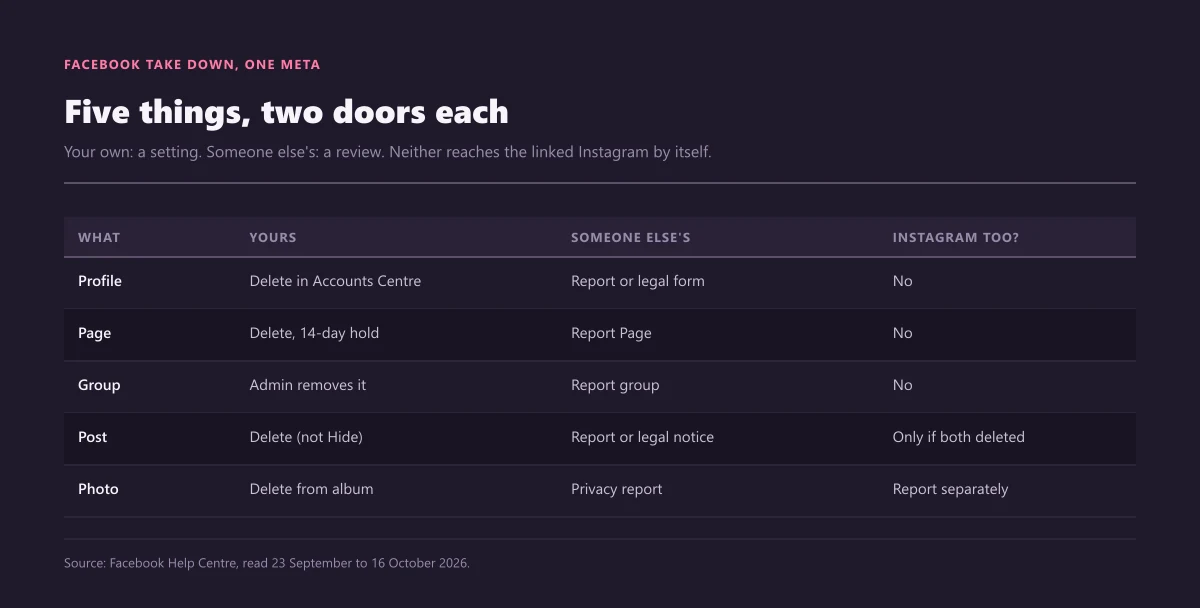
The object and your role pick the route. The owner gets a setting; everyone else gets a review, and some reviews are open only to the person harmed.
| Object | Who can file | Route that fits | What a filer adds |
|---|---|---|---|
| A post or comment | Anyone who sees it | Report link on the post; legal or IP form when a right is at stake | The rule named, the URL, a capture with date and username |
| A profile | Anyone; impersonation by the person copied or a representative | Report profile from Options below the cover photo | Proof of who is being copied, side-by-side captures |
| A Page | Anyone; brand claims by the rights owner | Report Page, or the IP form for a trademark | Which posts break which rule, not just the Page name |
| A group | Members and non-members who can see it | Report group, or report the individual posts | A sample of posts that show the group's purpose |
| Copyrighted work | The rights owner or an authorised agent only | Meta Intellectual Property Reporting Form | Proof of ownership and the exact infringing links |
Facebook page takedown service and group removal: a different burden
A Facebook page takedown service cannot point at a Page and ask for it to go. Meta weighs what the Page posts and does, so the file lists the posts that break a rule. The same holds for a Facebook group removal service: a group that hosts scams, threats or hate speech is reported with examples, and a group that simply disagrees with you is not a case. When a Page is your own, deletion is a setting with a 14-day hold before it is final, and no service is needed.
Facebook copyright removal and DMCA takedowns: who is allowed to file?
Only the person who owns the right, or an agent acting for them. A Facebook DMCA takedown service can file as your agent, but it cannot invent ownership.
Copyright claims run through the Meta Intellectual Property Reporting Form, and the Copyright section of the Help Centre explains what counts. A photo you took is your work. A photo of you, taken by someone else, belongs to the photographer, which is why that case goes to a privacy report instead. Facebook copyright removal is also not anonymous: the person who posted the content is usually told who filed and can reply with a counter-notice.
Account consequences come later and only for patterns. Section 4.2 of the Facebook Terms of Service lets Meta disable or delete accounts that repeatedly infringe other people's intellectual property. One stolen post does not end an account; a run of upheld claims can.
The same logic applies on Instagram. Readers whose work was lifted there can follow the stolen-content copyright report for Instagram, see how an Instagram copyright strike builds up, and decide between the two claim types with the impersonation-versus-DMCA comparison. A Facebook DMCA takedown service that files for someone who does not own the work is filing a false claim, and Instagram Ban Service will not do it.
How does Facebook fake account removal work in practice?
Report the profile for pretending to be you or someone else. Meta reviews the claim against the real person, so proof of identity carries more weight than any number of reports.
Under Meta's impersonation article, you open Options below the cover photo, choose Report profile and follow the prompts. The article also has a section labelled Report without an account, with a contact form for people who have no Facebook login or have lost theirs. Facebook fake account removal therefore does not need you to sign up.
Two limits keep this honest. A profile that shares your name is not impersonation, and neither is one that annoys you. And a Facebook account removal service cannot ask for a living adult's profile to be deleted because a client dislikes its owner; no form exists for that outcome.
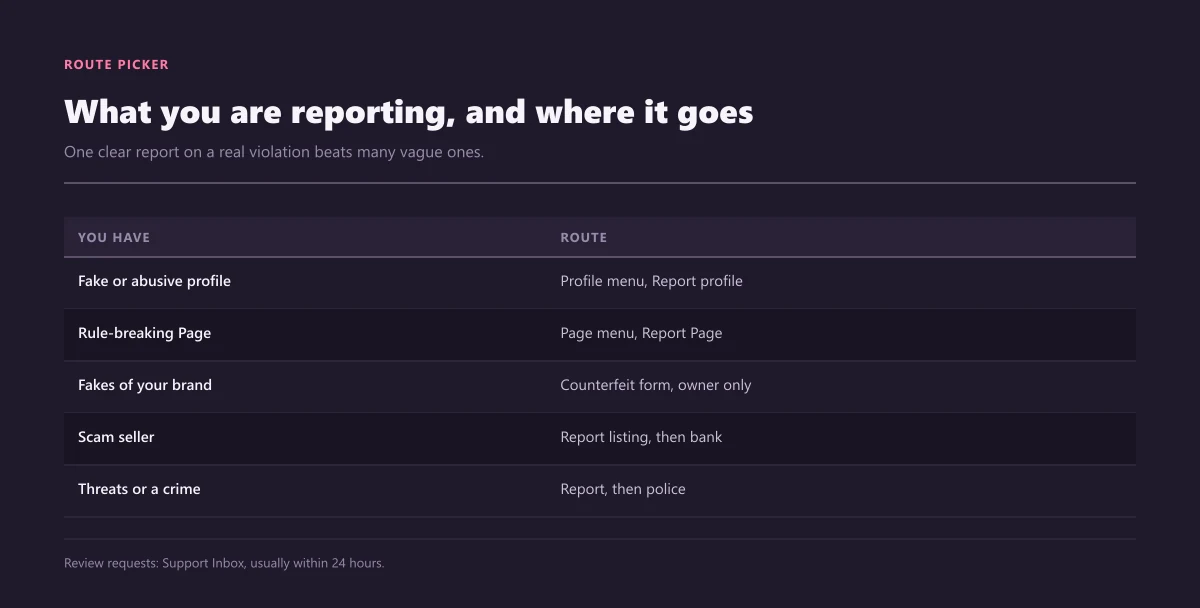
Scams and threats sit beside fakes in the same picture. A scam seller is reported on the listing and then to your bank; a threat is reported and then taken to the police, because Meta's review is no substitute for a criminal complaint.
Can you delete a deceased person's Facebook account?
Yes, if you are verified immediate family or an executor and no legacy contact manages the profile. Otherwise the family can ask for it to be memorialised instead.
Meta runs one form, the special request for a medically incapacitated or deceased person's account. Its removal article says a scan or photo of the death certificate is the fastest way. Without one, the family sends proof of authority, such as a will or an estate letter, together with proof of death, such as an obituary or memorial card. Details must match the account.
Delete deceased person Facebook profile, or memorialise it
A memorialised profile shows Remembering beside the name and keeps its posts for their original audience. A legacy contact can pin a post, change photos and request removal, but cannot sign in or read messages. Searches for delete deceased person facebook usually come from relatives who need to know that removal is final and memorialisation is not.
Instagram Ban Service does not file bereavement requests. Verification is personal to the family, the form is free, and a middleman adds delay.
Does removing a Facebook post or account touch the linked Instagram?
No. Facebook and Instagram are reviewed as separate accounts, even when they share an Accounts Centre, so each one is reported in its own app.
A post that appears on both apps is two items. Removing the Facebook copy leaves the Instagram copy live, which is why a cross-posted case needs an Instagram post report filed on its own and, for a Story, the Story or Page report from the Instagram menu. When the claim is legal rather than a rule breach, Instagram's legal removal request routes differ from Facebook's in detail.
Account outcomes do not travel cleanly either. Readers trying to remove a rule-breaking profile on Instagram can see what deleting someone else's Instagram account really involves. A disabled Instagram account notice on your own profile can follow a Facebook enforcement when both accounts sit in one Accounts Centre, and the milder We restrict certain activity warning is a limit rather than a ban. If the ban is wrong, an Instagram unban appeal runs separately, and an Instagram support request is the place to ask about it.
Instagram Ban Service treats your own old profiles as a different job. Deleting an old Instagram account you can no longer reach starts with recovery, and whether Instagram deletes inactive accounts decides whether waiting does anything.
Removing an account does not free its name
Some requests for a Facebook account removal service are really about a handle. Wanting a name is not a ground for any report. On Instagram, check first with the Instagram username availability check or an Instagram username checker reviewed for accuracy. If the holder has gone quiet, read the options for an inactive Instagram username and how a name leaves an inactive account. Getting the Instagram username you want usually means a variant, swapping usernames between two accounts you hold is a rename order, and buying an Instagram username carries Terms risk.
What Instagram Ban Service files for a Facebook case, and what it declines
One file, one filing, through the Meta channel the client is entitled to use. Cases with no broken rule and no legal right are declined before any work starts.
A case opens with the link and what the content does. We ask three questions. Which Community Standard or legal right is at stake? Does the client have standing, as the person harmed, the rights owner or their representative? Would the free report button do the job alone? If it would, we say so and stop there.
- Capture the post, profile, Page or group with the username, date and full text visible, and copy every URL.
- Match each item to one rule or one right, and pick the form that rule belongs to.
- File once. Rights claims go in the owner's name; reports go from an account the client controls.
- Keep the confirmation and watch the Support Inbox for Meta's decision and any review option.
Instagram Ban Service files the report; Meta makes the final decision, so no result or date can be promised. We decline posts that break no rule, critics, competitors and former partners, false or coordinated reports, bots and fake accounts, and any request that would need a password, a 2FA code or someone's login. Send the link through the case intake desk, or browse all reporting guides first.
Sources
- Facebook Help CentreHow does Facebook decide what to take down?
- Facebook Help CentreReport a profile or Page pretending to be you or someone else
- Facebook Help CentreCopyright section of the Help Centre
- Facebook Help CentreSpecial request for a medically incapacitated or deceased person's account
- Facebook Help CentreRequest removal of a deceased family member's account
- Facebook Help CentreAbout memorialised accounts
- Facebook Help CentreAbout legacy contacts on Facebook
Frequently asked questions
Is a Facebook post removal service allowed under Meta's rules?
Yes, as long as a Facebook removal service uses Meta's public routes for content that genuinely breaks a rule or a law. Facebook's reporting tools and legal forms are open to anyone, and copyright forms accept an authorised agent acting for the rights owner. What Meta forbids is misuse: section 3.2 of its Terms bars fraudulent, duplicative or groundless reports, and section 4.2 lets Meta suspend or disable people who breach the Terms. A service that files one accurate report, in the right form, for a real violation sits inside those rules. A service that sells mass reports, fake accounts or a guaranteed deletion sits outside them and puts the client's own account at risk. Before hiring anyone, ask which form they will use and which rule the post breaks. If they cannot name both, they are selling volume, and Meta has said in writing that volume does not decide removals.
Can a Facebook account removal service delete someone's profile?
Not on request. No Meta form lets a stranger ask for a living adult's profile to be deleted because they dislike it. A Facebook account removal service can only report what the account does: impersonation, scams, threats, under-age use or repeated copyright infringement. Meta reviews those reports against its Community Standards and Terms, and it alone decides whether to restrict, disable or leave the account. Repeat infringement is the clearest account-level ground, because section 4.2 of the Terms allows Meta to disable accounts that repeatedly infringe intellectual property. Families are the other exception, through the deceased or incapacitated person's account form. Anyone promising to remove a named person's profile for a fee is offering false reports, a stolen login or nothing at all, and logging in to someone else's account without permission is unauthorised access in many countries.
How does Facebook fake account removal work if I have no Facebook account?
Meta's impersonation article includes a section labelled Report without an account. It links to a contact form for people who have no Facebook login or who have lost access to theirs, so you can still report a profile that pretends to be you. With an account, you open Options below the profile's cover photo, choose Report profile and follow the prompts. In either case, identity is what carries the claim. Keep captures that show the fake profile beside your real one, note the date you found it and list any messages it sent to your contacts. A profile that only shares your name, or that you simply find irritating, is not impersonation and will not be removed on that ground. If the fake is being used to demand money or threaten you, report it and also contact the police, because Meta's review does not replace a criminal complaint.
What does a Facebook DMCA takedown service need from me?
Proof that you own the work, the exact links to each infringing post and your contact details as the rights owner. Meta's Intellectual Property Reporting Form accepts the owner or an authorised agent, so a Facebook DMCA takedown service can file for you, but the claim stays in your name. Expect the person who posted the content to learn who filed, because Meta usually shares the rights owner's details and they may send a counter-notice. Facebook copyright removal covers work you created: your photos, videos, music or writing. It does not cover a photo of you taken by someone else, which belongs to the photographer; that goes to a privacy report. Filing a claim for work you do not own is a false claim, and Instagram Ban Service will not file one. Gather the originals, their creation dates and any registration before you start.
How do I delete a deceased person's Facebook account?
Use Meta's special request form for a medically incapacitated or deceased person's account. Verified immediate family or an executor can ask for removal. Meta's removal article says a scan or photo of the death certificate is the fastest way; without one, send proof of authority, such as a will or estate letter, plus proof of death, such as an obituary or memorial card, with details matching the account. If the person named a legacy contact, only that contact can request removal. The alternative is memorialisation, which adds Remembering beside the name and keeps posts visible to their original audience, while nobody can sign in. People searching delete deceased person facebook often want the memorial instead once they see removal is permanent. The form is free and the checks are personal to the family, so no paid service needs to be involved.
Does a Facebook content removal service also remove the same post on Instagram?
No. Facebook and Instagram review content separately, even for accounts joined in the same Accounts Centre, so a cross-posted item has to be reported in each app. A Facebook content removal service that files only on Facebook leaves the Instagram copy untouched. On Instagram, report the post from its Options menu or the Story from its menu, and use Instagram's own legal or intellectual property forms when a right is involved. Outcomes can differ: one review may remove an item while the other keeps it, because the two apps apply related but not identical rules. Keep separate captures for each copy, with the username and date visible, since the reviewer on each side sees only what was reported there. Instagram Ban Service handles both sides of a cross-platform case, but each filing is still decided by Meta on its own merits.
Is there a Facebook group removal service that works for any group?
No, and that is by design. A Facebook group removal service can only report a group whose posts or purpose break Meta's rules, for example a group built around scams, threats, hate speech or sharing intimate images without consent. Meta looks at what the group hosts, so a useful file shows a sample of the breaking posts with dates and links, not just the group's name. A group that criticises you, a business or a public figure without breaking a rule is not a case, however unpleasant it feels. The same applies to a Facebook page takedown service: the Page's posts carry the claim. If you run the group or Page yourself, you can delete it from its settings, and no outside help is needed. For individual posts inside a group, report each one from its menu, since a single removed post does not close the group.