Facebook · third-party deletion · who has standing, checked against Meta's Help Centre on 5 November 2026
How to delete someone Facebook account: who has standing, and who never does
Most results for this search quietly swap the question and explain how to close your own profile. The question here is the one you asked: when the account belongs to someone else, whose request does Meta actually read?
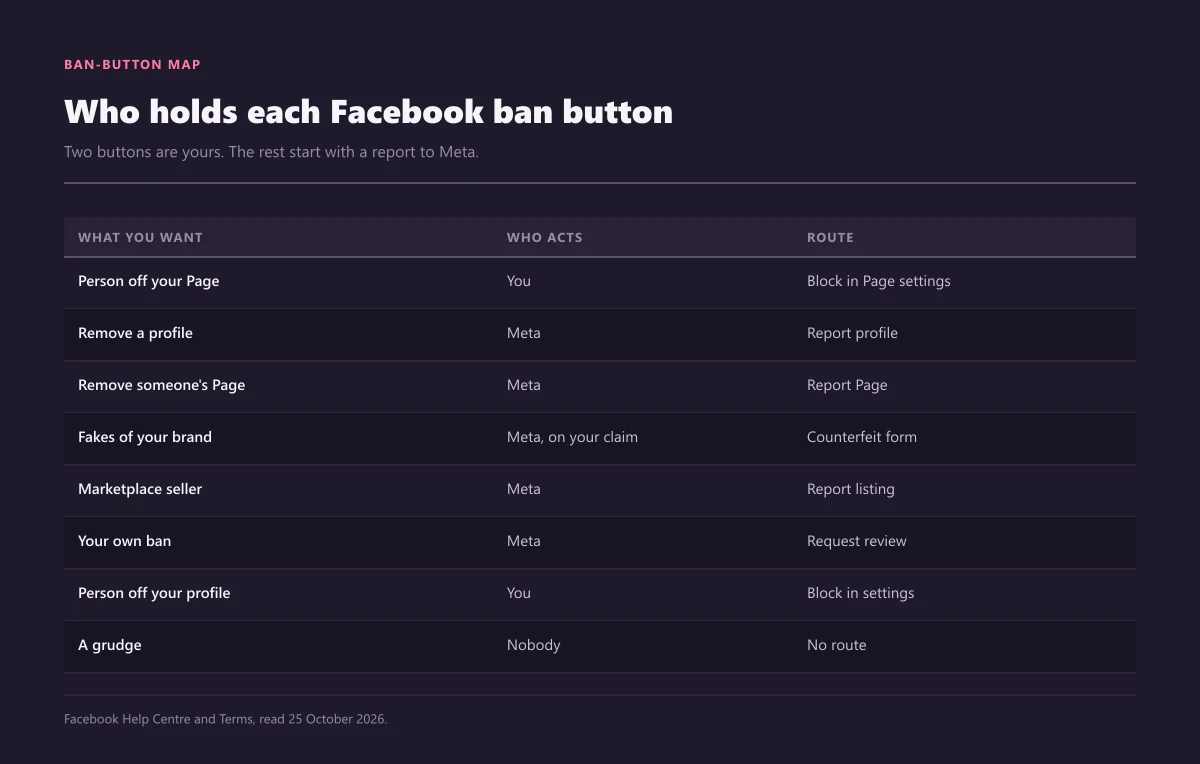
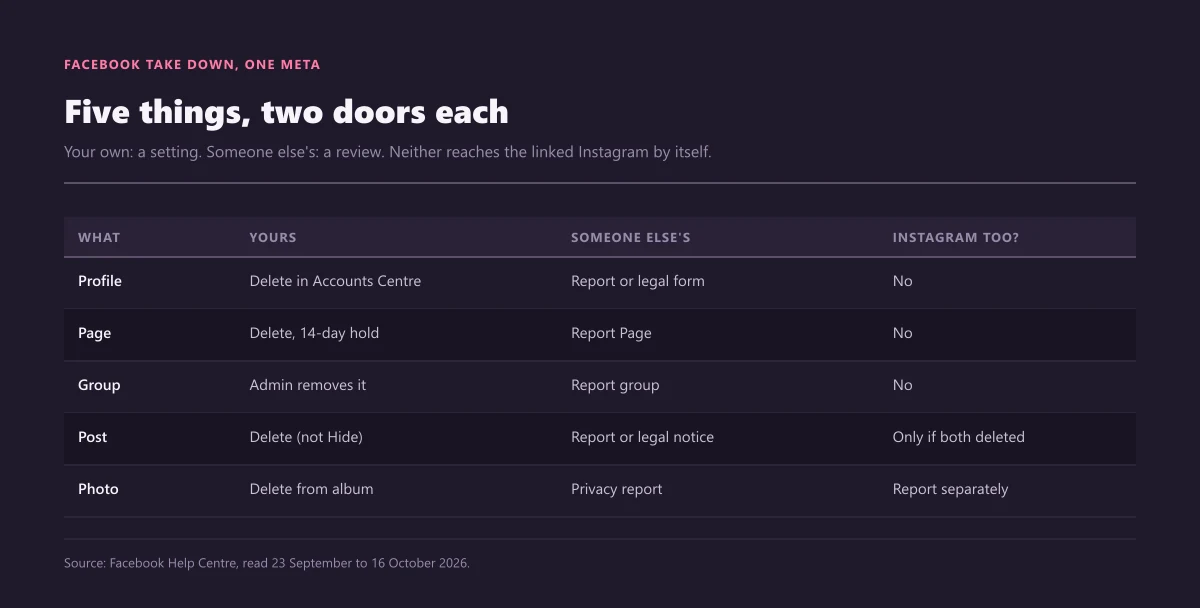
How to delete someone Facebook account has one honest answer: you can't. Only the owner can delete a profile, and only Meta can remove one from outside, for breaking its rules; its help page says report numbers don't decide that. Verified family can request removal for a relative who died or is incapacitated, and an under-age report can end in deletion.
Can anyone but the owner delete a Facebook account?
No. The delete control belongs to whoever is logged in to that profile, and Meta alone can remove an account from outside.
There is no form called "delete this person", and no button on another person's profile that starts the clock. What a stranger can do is ask Meta to review something. What a relative can do is prove a relationship. Standing is the entire question, because who you are to the account decides which request Meta will read at all.
Instagram Ban Service is a reporting desk for Instagram and Meta accounts that break the rules or the law, and it sits on the stranger's side of that line: it can prepare a case, never press delete. The table sorts every party we have found a verified route for. The same sorting on the sister app is in who can really remove another person's Instagram account, and the belief that a set number of complaints does it is tested in how many reports it takes on Instagram.
| You are | What you can ask for | Who decides | Can it end in deletion? |
|---|---|---|---|
| The owner | Deletion from their own login | The owner | Yes, once the cancel window closes |
| Legacy contact | Removal of the memorialised profile | Meta, on request | Yes |
| Immediate family or executor | Memorialisation or removal, with documents | Meta, after verification | Yes, unless a legacy contact holds the profile |
| Guardian of an incapacitated person | Removal, with guardianship proof and a medical note | Meta, after verification | Yes |
| Anyone who spots an under-age user | The under-age form, one profile link | Meta | Yes, if nobody old enough can be verified |
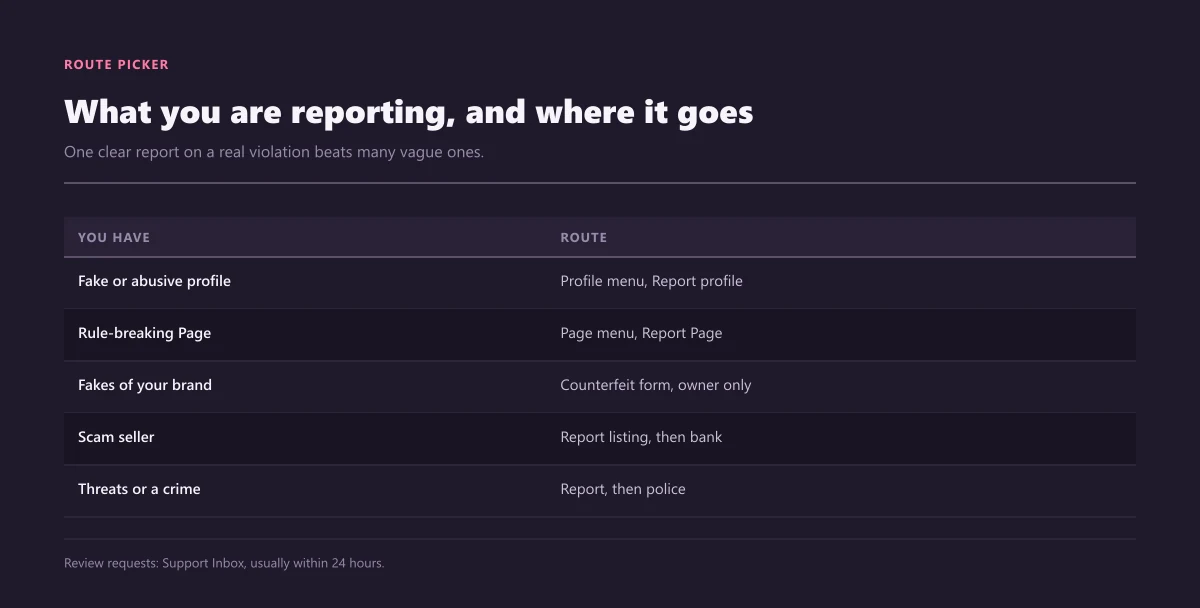
| The person impersonated | Report profile, or the no-account contact form | Meta | Only if review confirms the breach |
| Rights holder or legal claimant | IP form or legal notice | Meta | Content first; repeat infringement can reach the account |
| Ex, rival or annoyed stranger | A report, and only if a rule was really broken | Meta | Not because of the grudge |
Deactivated, deleted or disabled: what has happened to that profile?
Deactivation is the owner's pause, deletion is the owner's exit, and disabling is Meta's decision. From outside, a missing profile rarely tells you which.
| State | Who triggers it | What other people see | The way back |
|---|---|---|---|
| Deactivated | The owner | Profile hidden; the name may stay in friends' lists | Log in again, with access to the linked email or mobile |
| Deleted | The owner | Profile gone; sent messages stay with recipients | Cancel by logging in during the window, none after |
| Suspended | Meta | Not visible to anyone | Appeal by logging in within 180 days; varies by region |
| Disabled | Meta | Not visible to anyone | None once the decision is final |
| Memorialised | Family or legacy request | "Remembering" beside the name; posts stay | Nobody can log in |
Two details from Meta's pages change how you read a vanished profile. Deactivating does not switch off Messenger if the person keeps it on, and others "can search for you to send you a message", so somebody who has left your friends list may still be reachable. And a suspension is not an ending: the account can return after a successful appeal. Seeing nothing proves nothing, and Instagram Ban Service cannot look up the status for you either, because the notice appears only to the owner at login.
Instagram draws the same lines with its own details: the cancel window for a deleted Instagram profile, whether dormant Instagram accounts get removed and closing an old Instagram profile you are locked out of cover the owner's side. On Meta's side, read what a disabled notice means on Instagram, what remains after a final disable, the softer limit behind the "we restrict certain activity" message, and the bulk mistakes known as ban waves.
How to delete someone Facebook account permanently: what does permanently mean?
On Facebook, permanently means the cancel window has closed. A third party cannot open that window, shorten it or stop the owner cancelling.
Anyone asking how to delete someone facebook account permanently should know what the word buys. The deletion article gives the owner 30 days from starting deletion to log in and choose Cancel deletion, and adds that the number of days varies by region. Afterwards the account and its information are deleted for good. Erasure still takes time: removing everything posted can take up to 90 days, hidden from other users meanwhile, and copies may stay in backup storage after that for disaster recovery. Information may also be kept for legal issues, terms violations or harm prevention. Nothing in that sequence accepts input from anyone but the owner, and sent messages remain in the inboxes of the people who received them, which is why "deleted" rarely means every trace has gone.
A "permanent disable" is a separate event. Its suspended or disabled article says a suspension not appealed within 180 days, a window that also varies by region, or an appeal that fails, ends with the account disabled and no further review. Severe violations can skip the suspension. That page says the account is invisible and unusable. It does not say the data is erased, so a disable can be final for the owner without being the deletion a searcher has in mind.
One practical warning if you are the victim. Deletion also wipes the posts a police complaint would rely on, so save the profile URL and dated captures before you file anything.
Who can remove the account of someone who has died or cannot manage it?
Verified immediate family or an executor can, unless a legacy contact holds the profile. In that case only the legacy contact can request removal.
Meta runs one form for this, titled Special request for a medically incapacitated or deceased person's account. For a death, its removal article prefers a scan or photo of the death certificate and calls that the fastest way. Without one, you send two things: a document showing authority, such as a will, an estate letter or a birth certificate when the person was a minor, plus proof of the death, such as an obituary or memorial card. Details must match the account, and you may cover anything not needed for verification.
Incapacity has a higher bar. You send both proof of guardianship, such as a power of attorney or court order, and an official note from a doctor or medical facility describing the condition. The form states it is not for hacked accounts of living people.
Removal is not the only choice. A memorialised profile shows "Remembering" beside the name, keeps posts for their original audience and locks everyone out. A legacy contact can pin a post, change the photos and request removal, but cannot sign in or read messages. None of these routes hands over the login itself, so nobody inherits a password. The filing has to come from the relative, because the verification is personal; Instagram Ban Service does not stand in for it.
What can a stranger actually file against a living person's account?
Three things: an under-age report, an impersonation report and a rights or legal claim. Each needs a fact you can show, and only Meta decides.
Under the minimum age
The Report a Facebook user under the minimum age form has a single field, the profile link. The minimum is not always 13: Meta's age page lists 14 in South Korea, Quebec, Spain and Florida and 16 in Australia. Meta says it will delete the account if it can't verify that someone old enough manages it. You "will not get confirmation", so check the link yourself later. A parent whose own child opened the account has an easier way, because the page suggests showing the child how to delete it.
Pretending to be you or someone else
Under Meta's impersonation article, open Options below the cover photo, choose Report profile and follow the prompts. The section labelled "Report without an account" gives a contact form for people with no Facebook login or who have lost theirs. A profile that merely annoys you is not impersonation, and neither is one that shares your name.
Rights holders and legal claims
The Meta Intellectual Property Reporting Form and the Copyright section of the Help Centre serve people who own the work. These routes usually remove content, not the person. The account-level consequence sits in section 4.2 of the Terms: Meta may disable or delete an account for those who "repeatedly infringe other people's intellectual property rights", or where legal reasons require it. In the EU, an Article 16 notice under the Digital Services Act needs a reasoned explanation and the exact URL, and the platform must tell you its decision and your redress options.
Why don't a grudge, a pile of reports or a borrowed login work?
Meta checks violations, not complaint totals, and the two usual shortcuts move the legal and account risk onto the person trying them.
Facebook says it directly: "The number of times something is reported doesn't determine whether or not it's removed." Fifty friends filing against an account that broke no rule produce the same outcome as one person doing it. Volume can backfire as well. Section 3.2 of the Terms forbids misusing any reporting channel "by making fraudulent, duplicative or groundless reports or appeals", section 4.2 lets Meta suspend or permanently disable people who breach those Terms, and the inauthentic behaviour policy bars using fake assets to "misuse Meta reporting systems to harass, intimidate or silence others". The EU adds its own brake: Article 23 of the Digital Services Act makes platforms suspend, after a warning, the notices of anyone who frequently files manifestly unfounded ones. Instagram Ban Service will not join a filing campaign of any size.
Logging in to delete it is worse. Doing that without the owner's permission is unauthorised access, a crime in many countries, including the US under 18 U.S.C. 1030 and the UK under section 1 of the Computer Misuse Act 1990, whose maximum on indictment is two years in prison. Knowing an ex-partner's old password is not permission. Meta's cybersecurity standard separately prohibits attempts to access accounts by unauthorised means. If the account is really yours and someone took it, Meta's hacked account route is the lawful way back.
Would removing someone's account free up the name you want?
Not reliably, and wanting a name is no ground for a report. If the name is the real goal, deleting its holder is the wrong plan.
Some searches behind this keyword are about a handle, not a person. Facebook's Terms bar transferring an account without permission in section 3.1, and on Instagram, where most of these requests land, a name moves only when its holder deletes or renames or Meta removes the account, which is why an inactive Instagram username has no release form. A report written to pry a name loose has no rule behind it, so Instagram Ban Service treats it as one more grudge case and declines it.
Start with what you can test yourself:
- Run the two-step Instagram availability check and read why Instagram calls a username not available.
- Treat outside tools with care, given what a name checker cannot tell you and our test of handle checkers.
- Look for name patterns that passed a live check, and be realistic about the odds on four-letter handles.
- Hold both accounts already? Follow the rename order for swapping two usernames.
The private market carries its own risk, since Instagram's Terms of Use forbid the trade. Read what you risk selling a handle, how an IG handle handover works and why Instagram itself sells no usernames before any money moves.
What does Instagram Ban Service file, and what does it decline?
It files genuine violation cases through Meta's own channels. It declines any job whose real aim is removing an account that follows the rules.
A case starts with the link and what the account did. Instagram Ban Service then asks three plain questions. Which published rule or legal right is at stake? Does the person writing to us have standing, as the target, the rights owner or their representative? Is the free in-app report enough on its own? If it is, we say so. When there is a real case, we assemble one evidence file with dated captures, exact URLs and the rule cited, and it goes in once through the matching Meta channel. The final decision stays with Meta, so no outcome or date can be promised. Bereavement and under-age requests go straight to the family or reporter, since Meta's free forms need nothing from us.
We decline these outright:
- Accounts that break no rule, including critics, competitors and former partners.
- False reports, report bots, fake accounts and coordinated filing.
- Any request for a password, a 2FA code or access to someone's login.
- Promises of deletion, or a guaranteed result of any kind.
Sources
- Facebook Help CentrePermanently delete your Facebook profile
- Facebook Help CentreTemporarily deactivate your Facebook profile
- Facebook Help CentreMy personal Facebook account is suspended or disabled
- Facebook Help CentreRequest removal of a deceased family member's Facebook account
- Facebook Help CentreSpecial request for a medically incapacitated or deceased person's account
- Facebook Help CentreAbout memorialised accounts
- Facebook Help CentreAbout legacy contacts on Facebook
- Facebook Help CentreReport someone under the minimum age on Facebook
- Facebook Help CentreReport a Facebook profile or Page pretending to be you or someone else
- Facebook Help CentreHow does Facebook decide what to take down?
- Meta Transparency CentreInauthentic behaviour policy
- Meta Transparency CentreCybersecurity policy
- US Code, via Cornell LII18 U.S.C. 1030, computer fraud and related activity
- UK legislationComputer Misuse Act 1990, section 1
Frequently asked questions
Can you delete someone's Facebook account without their password?
No, and having the password would not make it lawful. Deletion runs from inside a logged-in profile, so without a login there is no control to reach, and Meta will not hand login details to anybody, not even to the family of someone who has died. What exists without a password is a request to Meta, which only works when you hold standing: verified family or an executor for a deceased relative, a guardian for an incapacitated one, a person being impersonated, a rights owner, or anyone reporting a user who is under the minimum age. Each of those routes ends with a Meta reviewer reading the facts, not with you pressing delete. A website or seller claiming to skip that review is offering either false reports or a stolen login, and both of those expose you, the buyer, far more than they expose the account you wanted gone.
How to delete someone Facebook account permanently if they have died?
Family can ask for that, and it is the one case where how to delete someone facebook account permanently has a clean answer. Use Meta's form called Special request for a medically incapacitated or deceased person's account and choose removal. An immediate family member or executor sends a death certificate, which Meta describes as the fastest way. Without a certificate, send a document showing authority, such as a will or estate letter, together with proof of the death such as an obituary. Details must match the profile. There is one exception worth checking first: if the person named a legacy contact, only that contact can request removal, and if they chose permanent deletion in their own settings, the choice was already made. Memorialising is the gentler alternative, because it keeps the photos and locks the login. No service needs to be involved at all, because the form itself is free.
How many reports does it take to get a Facebook account deleted?
No number does it. Facebook's Help Centre says the number of times something is reported doesn't determine whether or not it's removed, so a threshold of the kind sellers describe has no basis in Meta's own account of its process. A reviewer or automated system compares what the account posted with the Community Standards, and one precise report naming the post, the date and the broken rule gives that review more to work with than a hundred vague ones. Repeat filing carries a cost for the reporter. Section 3.2 of Meta's Terms forbids fraudulent, duplicative or groundless reports, and section 4.2 allows Meta to suspend or disable accounts that breach those Terms. Inside the EU, Article 23 of the Digital Services Act goes further and makes platforms suspend, after a warning, the notices of anyone who frequently files manifestly unfounded ones. Instagram Ban Service refuses coordinated filing for that reason.
Can a parent delete their child's Facebook account?
A parent can get it closed, by one of two routes. The simple one applies when you can reach the account together: Meta's minimum age page suggests showing the child how to delete it, and the normal cancel window then applies, typically 30 days and varying by region. If you can't get in, or the child refuses, use the form called Report a Facebook user under the minimum age and paste the profile link. Meta says it will delete the account if it can't verify that someone old enough manages it, and you should not expect a confirmation message, so check the link again later. Remember the age differs by place: 13 in most regions, 14 in South Korea, Quebec, Spain and Florida, and 16 in Australia. A teenager above the local minimum falls outside this form. Taking a phone and using a saved login for an older teen raises separate questions, so settle it with them directly.
Is it illegal to log in to someone's Facebook and delete their account?
Generally yes, when the owner has not authorised it. In the United States, 18 U.S.C. 1030 covers intentionally accessing a computer without authorisation and obtaining information from it, and in the United Kingdom, section 1 of the Computer Misuse Act 1990 makes unauthorised access an offence, with up to two years in prison on indictment. Other countries have similar laws, and details differ, so take local legal advice if this has already happened. A password saved on a shared laptop or remembered from a past relationship does not amount to permission to use it. Meta treats it as a rule breach too: its cybersecurity standard prohibits attempts to access accounts by unauthorised means, and Terms section 3.1 forbids sharing a password or giving access. The plan rarely even succeeds, because the owner has about 30 days to log back in and cancel. Anyone who has been harmed has safer options in Meta's reporting forms and through the police.
How can I tell if a Facebook account was deleted, deactivated or disabled?
Usually you can't tell from outside, and Meta's pages describe no public lookup for it. A deactivated profile, a deleted one and a disabled one can all simply stop appearing to you. Small clues exist, though none of them settles it. Meta says a deactivated person's name may stay in friends' lists, group admins may still see their posts and comments, and Messenger can remain active if they keep it on, so a message that still goes through suggests deactivation over deletion. A memorialised profile is the exception that identifies itself, since the word Remembering appears beside the name. Only the owner sees the real status, because the message "We've suspended your account" or "We've disabled your account" appears when they log in. Do not try their login to find out. If you reported the account yourself, watch for whatever update Meta sends you, and remember that under-age reports get no confirmation at all.
Can I get a fake Facebook account of me deleted?
You can ask, and you hold real standing for this one, because impersonation is about you. Open the profile, choose Options below the cover photo, then Report profile, and follow the prompts for an account pretending to be you. Without a Facebook login, use the contact form in the section Meta labels Report without an account. A reviewer has to work out who is genuine, so keep the profile URL and captures of what it posted, and be ready to prove your identity if asked. Meta decides whether the profile goes; a confirmed breach can end in removal, and the Terms allow it to disable accounts that breach them seriously or repeatedly. Instagram Ban Service can assemble that evidence into one takedown file if the free report stalls, though it cannot promise an outcome and it never needs your password. If the same impostor exists on Instagram, that account needs its own separate report.