Reporter’s desk · reading the result of a report, checked 26 September 2026
How to know if someone is banned on Instagram after you report them, and what each record can prove
A complaint turns up in r/Instagram again and again, in slightly different words: the report status says the account was removed, yet the profile still loads. Other people have the opposite problem, a profile that vanished the day after they reported it and no word from Instagram at all. Both are reading the wrong record. A report can leave four kinds of trace, and only one of them is written for the person who filed it.
You usually can't, from the outside. Instagram shows the same "Profile isn't available" page for a banned, deactivated, deleted or renamed account. If you report someone on Instagram, the decision in your Support requests is the only confirmation written for you, and trademark or copyright reports answer by email instead.
If you report someone on Instagram, which record tells you what happened?
Your own Support requests entry, and only for reports filed under the Community Guidelines. A blank profile or an EU statistic is a clue with several possible causes.
When you report someone on Instagram from the app, the follow-up addressed to you lands in one place. On a phone it sits under Help in your profile menu; on a computer the path is More, Settings, Help, Support requests, then Reports. Instagram's help page on report status says the entry shows when it acted on your report and what it decided, and lets you ask for a review, except for some types of content where no review is offered yet. A warning on that page is easy to skim past: not every report you have made may be viewable there.
Scope matters as much as that caveat. That page covers reports about things that break the Community Guidelines, so it has nothing to say about intellectual property complaints. Those produce paper instead. Trademark, counterfeit and copyright forms reply by email, and Instagram tells the account you named who complained. A notice sent through the EU illegal-content route has a rule of its own: under Article 16(5) of the Digital Services Act the platform must tell the sender what it decided, "without undue delay", and how that decision can be challenged.
Report someone on insta the ordinary way and they are not told it was you. Exceptions exist, and so do the guesses people make from timing; both are laid out in what the reported person can work out.
Instagram Ban Service sorts a client's evidence into five records before it says anything about an outcome:
| Record | Who can read it | What it can confirm | What it cannot |
|---|---|---|---|
| Support requests, then Reports | You, inside the app | The decision on the item or account you reported, and when it was made | Anything filed through a web form, or a report the app no longer lists |
| Emails after an IP report | You, and the account you named | Confirmation of the action taken on the links you listed | What happened to the rest of the account |
| Decision notice under Article 16(5) | Whoever sent an EU illegal-content notice | The decision and how to challenge it | Anything reported with the ordinary Report button |
| The profile address | Anyone | Whether a profile answers there today | Why it stopped answering |
| The EU DSA register | Anyone | Each restriction Meta files for EU users, with its legal ground and source | Whose account it was |
The report says removed, but the profile still loads
That pairing is ordinary, and it rarely means a mistake. Most reports concern an item: a post, a comment, a message, one Story. When Instagram removes the item, the decision says so and the account that posted it carries on, which is why Instagram Ban Service reads the wording of a decision before looking at the profile at all. Reversals and borders explain the rest. A post can be restored after its owner asks for a second look, a profile can be withheld only in the country whose law it broke, and an owner who deactivated can simply log back in. How losing one post differs from losing the account is set out in how a post and an account come down.
What 35.7 million Instagram bans in the EU register say about your report
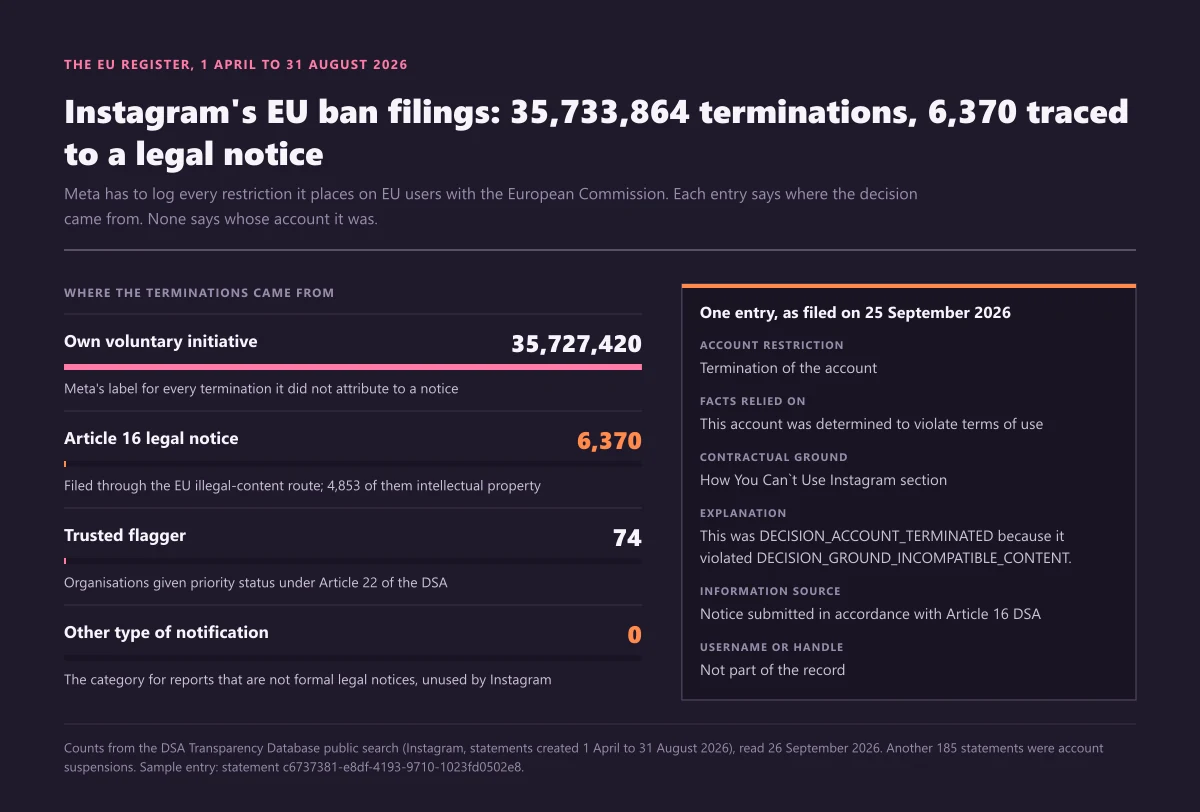
Between 1 April and 31 August 2026 Instagram filed 35,733,864 account terminations with the European Commission, and 6,370 of them name a legal notice as the trigger.
Every time a platform restricts an EU user's content or account, the Digital Services Act requires it to send a statement of reasons, the explanation owed to that user, to a public database the Commission runs. Anyone can search the DSA Transparency Database by platform, restriction and source. Instagram Ban Service ran the Instagram counts on 26 September 2026 for statements created in those five months. There were 42,067,712 of them, and account terminations made up 35,733,864, about 85%. Only 185 were account suspensions, so an account-level action on Instagram is filed almost every time as a termination rather than a time-limited block.
| Source Instagram recorded | All statements | Account terminations |
|---|---|---|
| Own voluntary initiative | 41,949,631 | 35,727,420 |
| Notice under Article 16 of the DSA | 117,346 | 6,370 |
| Trusted flagger | 735 | 74 |
| Other type of notification | 0 | 0 |
| Total, 1 April to 31 August 2026 | 42,067,712 | 35,733,864 |
Read the fourth row before any other. Platforms get a category for notifications that are not formal legal notices, and Instagram used it zero times. Ordinary in-app reports are not treated as Article 16 notices either: Meta's DSA report for the first half of 2026 counts 388,783 such notices on Instagram in six months, a number far too small to include the everyday taps on Report. A ban that followed your report most likely sits in the first row, filed as Meta's own initiative beside the accounts its systems caught unprompted. Nothing in the register can tell you whether your report counted, because Meta doesn't record that there.
Formal notices mostly come from rights owners. Of the 117,346 notice-led statements, 110,809, or 94%, concern intellectual property, and so do 4,853 of the 6,370 notice-led terminations.
Categories show what ends accounts. Meta's catch-all for other breaches of its terms covers 27,386,530 terminations, scams and fraud 6,715,545, data protection and privacy 1,172,711 and protection of minors 377,872. Illegal or harmful speech, the category that holds defamation and hate speech, produced 91. What sets those bans off is severity and an account's history rather than a crowd of complaints, and nothing in the register rewards the volume that paid mass-report offers sell.
A particular account can't be found here either. Instagram Ban Service opened one Instagram termination received on 25 September 2026, a notice-led intellectual property case, to see what the register keeps. The entry says the account was determined to violate the terms of use, cites the How You Can't Use Instagram section, gives the European Economic Area as its territorial scope and 2 November 2022 as the content date. Its explanation field reads, in full: "This was DECISION_ACCOUNT_TERMINATED because it violated DECISION_GROUND_INCOMPATIBLE_CONTENT." No username, no handle, no link. A scam termination received about four minutes later repeats the same words.
Two more fields limit what anyone can learn. Meta marks 34,372,493 of the terminations, 96%, as partially automated and none as fully automated, and it leaves the optional account-type field empty on every Instagram statement, so nobody, the Commission included, can count how many business accounts Instagram bans.
What does a ban checker see when it looks up an Instagram profile?
Only whether a page answers. No checker can tell a ban from a deletion, a deactivation or a rename, because Instagram gives all of them the same answer.
Instagram ban checker sites work by requesting the profile address and reading what comes back. Instagram Ban Service made that request itself on 26 September 2026, signed out and without cookies: once for instagram.com/nasa/, a live public profile, and once for a random handle with no account behind it. Both came back with HTTP status 200, the code for a successful request. Only the page title differed. The live profile's title named the account; the empty one said simply "Instagram" and carried no link-preview title. In a browser, the second address opens on the Profile isn't available notice, which adds that the link may be broken or the profile removed.
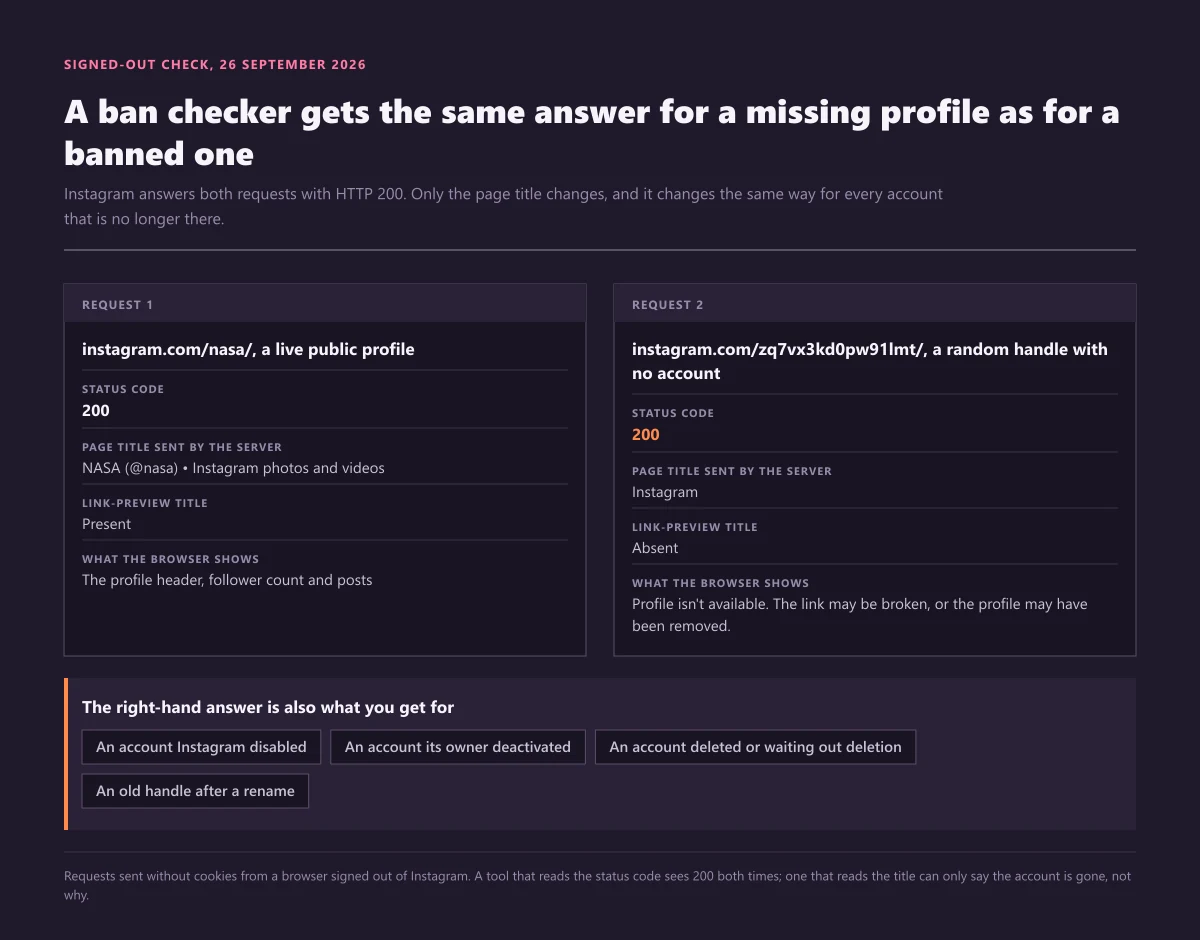
So a checker that reads the status code sees success every time, and one that reads the title can only report that an account is gone. Instagram serves that same empty page when it has disabled an account, when the owner has deactivated or deleted it, and at an old handle after a rename. One ranking tool advertises its live-or-dead verdict as highly accurate, which is true about the page and silent about the cause. Anything that asks for your own Instagram login to show you more is a different product, the kind examined in the teardown of report apps and panels, and it should never get your password.
How to know if someone is banned on Instagram when the report wasn't yours
You can narrow it down but not settle it. With no report of your own, no decision is addressed to you, and every sign you can see has more than one cause.
People searching how to know if someone's Instagram account got banned are usually watching a friend, a rival or a stranger they never reported. Start with the profile address, then add time, because the causes separate on the calendar. A deactivated account can stay dark for months and return overnight. One its owner deletes vanishes at once but can, in most regions, still be restored for 30 days. A disabled account can come back as well: the holder can ask for a review, and in Meta's DSA report for January to June 2026, 2,838,533 of 7,816,585 complaints about account suspensions and terminations ended with the decision reversed, a little over a third.
A profile that won't load for you but loads for someone abroad fits a different cause: a legal restriction confined to one country. In the five months of the EU register Instagram Ban Service counted, Instagram filed 1,692 decisions on the ground that content was illegal rather than against its rules, and 1,507 of them, 89%, disabled access instead of removing anything. A contact in another country opening the same link separates that case from a real ban.
Beyond that, nobody outside Meta can go. A profile still missing after two or three months is more likely gone for good, yet even then nothing tells you whether Instagram removed it or its owner walked away. Quick checks, from a friend's phone to the name on an old message thread, are listed in how to report someone and tell whether it worked.
How do you report trademark infringement on Instagram, and what does Meta ask for?
With the Trademark Report Form, as the owner of a registered mark or someone authorised to act for one, and with one mark per report.
An Instagram trademark infringement report started on Meta's intellectual property form ends up on Instagram's own Trademark Report Form. Its first screen pitches Brand Rights Protection, Meta's tool for registered owners who report at scale, then offers the form to everyone else for a word, slogan, symbol or design, such as a brand name or logo. A second question splits the route. You either continue with a trademark report or say you've found content offering counterfeit goods, and the second answer opens a separate Counterfeit Report Form, which defines a counterfeit as an unauthorised imitation of a product bearing the original owner's trademark.
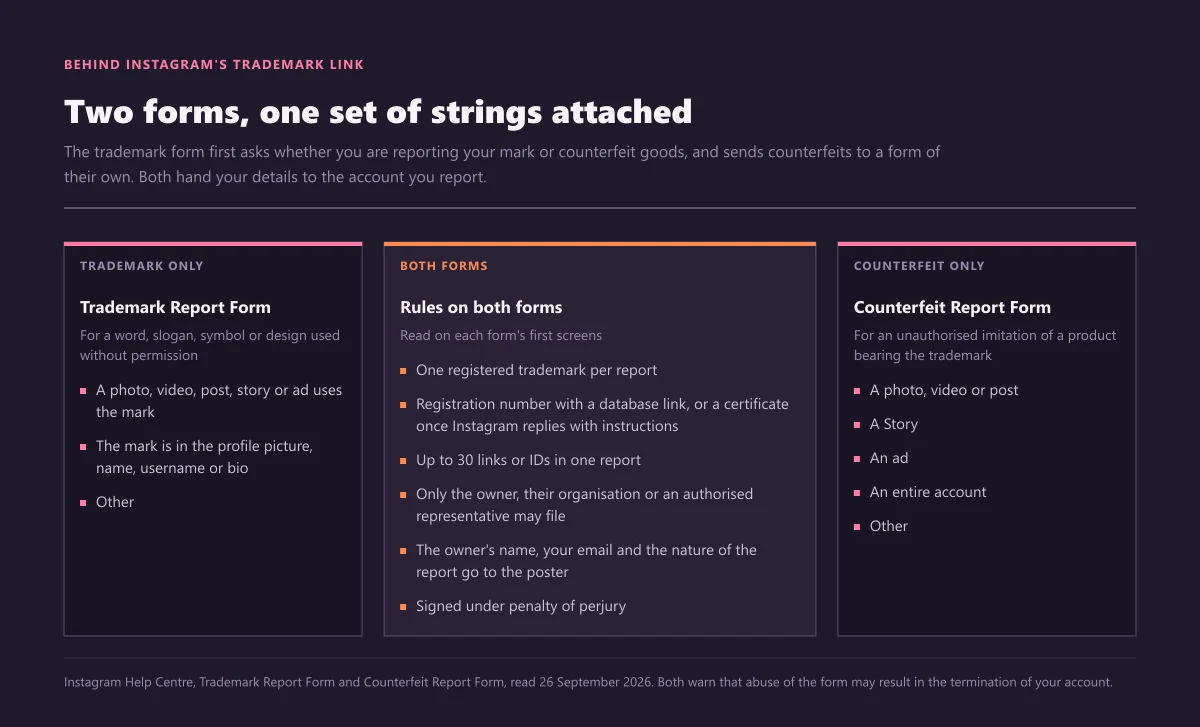
Both forms ask for the same things, and Instagram Ban Service prepares them in this order:
- Settle who is filing. The rights owner, their organisation or an authorised representative can report; choose someone else and the form stops.
- Name one registered trademark and the office that registered it. The country list includes the EUIPO and WIPO.
- Add the registration number and a link to its entry in an online trademark database. Without a link, choose the certificate option and wait for Instagram's instructions.
- Say where the mark appears. The trademark form offers a post, story or ad, or the profile picture, name, username or bio; the counterfeit form adds an entire account.
- List up to 30 links or IDs, one per box, and explain the infringement for each.
- Sign the declaration, made under penalty of perjury, with your full name.
Each form warns that abusing it may end your own account, Instagram's answer to people who reach for a trademark claim to settle a quarrel that has nothing to do with a brand. An Instagram trademark takedown reaches the links you list. Meta's intellectual property report says rights holders may report a whole profile or account they believe infringes in its entirety, that a complete and valid report is typically acted on within a day or less and confirmed to the person who filed it, and that repeat infringers lose their accounts in appropriate circumstances. That confirmation is the record Instagram Ban Service asks a trademark client to forward, and it arrives by email, not in Support requests.
When to report copyright on Instagram instead
To report copyright on Instagram you need a different branch of the same system. Copyright protects the photo or video itself, needs no registration and comes with its own counter-notice rules, all covered in the copyright report guide. A logo you drew can fall under both, while a name, a slogan or a word mark can't be copyrighted at all. When the copy is of a person rather than a brand, neither instrument fits cleanly, which is the subject of impersonation reports versus DMCA notices.
Can you send an Instagram trademark takedown by email?
No. Instagram publishes one intellectual property address, ip@instagram.com, and it belongs to its DMCA designated agent; that page asks anyone writing there to include a complete copyright claim and points to the online form as the faster route. People who try to report trademark infringement on Instagram by email are writing to the wrong department. The email that does matter is yours. Both forms say Instagram will pass the rights owner's name, your email address and the nature of the report to the person who posted the content, who may use them to contact you and try to resolve it, and both suggest a business or professional address for that reason. Instagram Ban Service files from a role mailbox, never from a client's personal inbox.
What Reddit threads about Instagram trademark reports keep running into
We pulled every post dated 1 January 2023 to 25 September 2026 with trademark in its title from r/Instagram, r/InstagramMarketing and r/InstagramSupport, plus posts naming Instagram in r/trademarks, r/IntellectualProperty, r/legaladvice and four business subreddits, through the Arctic Shift archive of Reddit. After merging one poster's seven copies of the same question and six other reposts, and setting aside three posts that used the word in passing, 44 threads remained. Most of what sits behind the instagram trademark infringement report reddit search turns out to be about something else: 24 of the 44, 55%, wanted to use a trademark to get a username, usually one held by an account with no posts and a handful of followers.
Those threads hit the same wall. One owner reported a handle, was told Instagram had removed the account, and still could not take the name. Another filed on 5 February and saw the content removed on 19 February, with the username still out of reach, and a third wrote in December 2025 that Instagram kept rejecting a claim against an account idle for more than ten years. A business that filed in 2023, while its US application was still pending, says Instagram removed the blank account sitting on its name and asked for the registration to finish a username transfer; when it came back with it in September 2026, nobody there remembered the case. Usernames on Instagram go to whoever claims them first, so a trademark report can clear an infringing account without passing its handle to the person who filed.
Eight threads, 18%, came from the other side: people whose own posts, stories or accounts were removed or frozen after a trademark report, one of them a photographer flagged over a sponsor's banner behind a race car. Only 6, 14%, were about stopping someone else's infringement.
How to report an Instagram business account, and when only the brand can
Exactly as you would any other account. There is no separate business report in the app; what changes the route is whether you are a customer or the brand.
A business or creator profile is still an account, so the Report option on its profile and the three account-level reasons work as they do for anyone. A customer who paid and got nothing, or got a fake, reports the account for scam or fraud and keeps the payment trail; the account-level version of that report is in reporting a scam or fraud account. Customers are shut out of the counterfeit form. Instagram Ban Service tried it on 26 September 2026: choose reporting on behalf of someone else and the form answers that an infringement report must come from the rights owner or someone authorised to act for them, suggesting you ask the owner to read the Help Centre's intellectual property section.
Brands have more options. The counterfeit form lists an entire account as something you can report, which fits a storefront whose every post sells copies. A business account that uses your name or logo to pass itself off as you can be a trademark problem, an impersonation problem or both; the impersonator takedown guide works through those cases, fakes with nothing to sell included. Don't expect a public number for how often any of this works. Meta leaves the account-type field blank on every Instagram entry in the EU register, so business-account bans can't be separated from anyone else's.
Instagram group chat report: what you can flag, and what stays
You can report the people and the messages in a group chat, never the chat as a whole, and the group carries on unless its admins act.
Instagram's help centre says entire group chats can't be reported, only the messages, photos, videos and people inside them, a limit also spelled out in the account and page reporting guide. So the way to report an Instagram group chat is member by member and message by message, starting with whoever added you and whoever posts the worst of it. Reporting a single message works as it does in a one-to-one chat, step by step in the single post, Story and message guide.
Leaving is not the same as getting out. Instagram's page on leaving a group chat says you stop receiving its messages unless someone adds you back, and group admins can add members, approve who joins and create an invitation link. Anyone added later can also read the earlier conversation, disappearing photos and videos aside. Instagram Ban Service asks clients to screenshot the thread, with names and dates visible, before they leave it.
If strangers keep pulling you into groups, look in your message settings. NapoleonCat's July 2026 guide describes a "Who can add you to group chats" control under Messages and story replies, then Message requests, that can be limited to people you follow, and a "Report group" prompt when you leave a spam group. Instagram's help centre documents neither, so treat both as features of some app versions and keep reporting members as the route that always exists.
Inappropriate content, explicit accounts and the spam bot in your followers
Report an explicit Instagram account from its profile, under content it shouldn't be posting, and treat a porn-bot follower as spam first.
Many explicit accounts that turn up in a follower list are not people at all. They are spam accounts using sexual images to steer viewers towards a link off Instagram, and the spam reason describes them better than a complaint about one picture. Report inappropriate content on Instagram at the level where the problem sits: a single post through that post's menu, the account through its profile when the whole profile exists for this. To report an explicit Instagram account that belongs to a real person, report the Instagram account for nudity from its profile first and block it second; a block on its own only hides the account from you.
No Instagram spam reports bot changes that result. Tools sold under the name promise to file reports in bulk, but Instagram's help centre says the number of times something is reported doesn't decide whether it is removed. Fifty automated reports are still one question put to one reviewer.
When the nudity is of you, shared without consent
Intimate images of you shared without consent are a separate report with firmer law behind it. Instagram's page on an intimate photo shared without permission says trained reviewers check the image and, where it breaks the rules, use photo-matching to stop it being posted again on Instagram, Facebook and Messenger. StopNCII.org lets adults hash their own images so participating platforms can block them before anyone reports anything. In the United States the Take It Down Act obliges covered platforms to remove such images within 48 hours of a valid request, and the FTC's consumer alert of 10 September 2026 tells people to report to the platform first and to tell the FTC about platforms that don't comply. Images of anyone under 18 go to NCMEC's CyberTipline or its Take It Down service as well as to Instagram.
In the register, protection of minors accounted for 824,437 Instagram decisions over the five months Instagram Ban Service counted, and 377,872 of them, 46%, terminated an account rather than removing a single item.
Can you report and remove a defamatory Instagram profile, or a doxxing one?
Rarely. A defamation report reaches the posts you list and often ends in a restriction for one country, and a doxxing report targets the exposed details rather than the account.
Instagram treats defamation as a legal claim, not a rule, so the in-app menu has no option for it. Its defamation help page links to a form that may not be offered where you live and says filing it doesn't guarantee Instagram will restrict access to what you report. The jurisdiction you pick changes the rest. Choose the United States and the form stops at a statement that Instagram won't judge whether other people's statements are true and, citing Section 230 of the Communications Decency Act, isn't liable to act. Choose the United Kingdom, Germany or Spain and it goes on to ask who you are, your postal address and, for each URL, the exact statements you say are false.
That per-URL design is why attempts to report and remove a defamatory Instagram profile seldom remove the profile. In the EU register, the illegal or harmful speech category, where defamation sits beside hate speech, produced 107,547 decisions between April and August 2026 and 91 account terminations. A profile built to attack one person usually breaks Instagram's harassment rules too, and that route, which judges conduct rather than truth, is in the bullying and harassment guide. Exposé and rating pages aimed at one school or one crowd are a case of their own, with the Reddit evidence in the takedown request survey.
Report doxxing on Instagram as a privacy violation, post by post and message by message, naming the detail each one exposes: a home address, a phone number, an identity document. Instagram Ban Service logs every exposed detail with its link and date before filing, so the report names exactly what has to come down. If the details arrive with a threat, report the threat as well and consider the police. Restricting a post does nothing about someone who already has your address.
Can you report an Instagram account to delete it?
Not as a request. No report lets a stranger ask for deletion; a report asks Instagram to review a breach, and the usual end point is a disabled account that may be restored on appeal. One exception is the under-13 form: if the person running the account can't show they are old enough, Instagram says it will delete it. Owners delete their own accounts, and if the profile you want gone is your own from years ago, the route for an old account applies instead.
What Instagram Ban Service checks before it calls an account banned
Three things, in this order: the client's own report record, the address seen from outside, and a second look a week later.
On 26 September 2026 we ran every check described on this page ourselves. That meant two signed-out requests to instagram.com, the Instagram counts in the EU register, one full statement of reasons, and both trademark forms read up to the point of submission. We saw no banned account identified anywhere along the way, and that was the useful result. When a client says an account is gone, Instagram Ban Service asks for the Support requests entry or the IP report email first, because only those speak about the report the client filed.
Without either, we record the profile's state with a date and time, check it again from outside the client's network and country, and wait, logging a page that stays empty for a week as unavailable, never as banned, until a decision or a form reply says otherwise. Instagram Ban Service files and escalates reports through Instagram's own channels; the decision belongs to Instagram alone, and nothing we send a client predicts it.
If you reported an account and want to know where it stands, open Support requests before you open the profile. If the entry says no violation and the harm is still live, file the route that fits the breach, whether that's the trademark form, the counterfeit form or the legal form for your country, instead of sending the same in-app report again. Every route is listed on the solutions index, and the contact page reaches the desk if you'd rather have the route chosen and filed for you.
Sources
- Meta Transparency CentreInstagram DSA transparency report, January to June 2026
- Instagram Help CentreCheck the status of something that you've reported to Instagram
- Instagram Help CentreTrademark Report Form
- Instagram Help CentreCounterfeit Report Form
- Instagram Help CentreHow to contact Threads or Instagram's DMCA designated agent
- Meta Transparency CentreIntellectual property report: protecting intellectual property rights
- Instagram Help CentreAbout defamation and how to report it on Instagram or Threads
- Instagram Help CentreWhat admins of Instagram group chats can do
- Instagram Help CentreLeave a group chat on Instagram
- Instagram Help CentreThe number of reports and whether content is removed
- Instagram Help CentreIf someone shares an intimate photo of you on Instagram
- US Federal Trade CommissionWas your intimate image shared online without your consent? Consumer alert, 10 September 2026
- StopNCII.orgStop non-consensual intimate image abuse
Frequently asked questions
Does Instagram tell you when an account you reported gets banned?
Only through the decision on your own report, which Support requests shows with its date if that report is listed at all. No help page describes a separate message to reporters when an account is disabled later, and the public profile looks the same after a ban, a deletion or a rename.
Why does my report say the account was removed when I can still see it?
Usually the decision was about the item you reported, not the account. A post, comment or message can go while its author stays. Removals are also reversed after second reviews, and a legal restriction can hide a profile in one country only. Check the wording and date in Support requests before you report again.
Can I report a counterfeit seller on Instagram if I'm only a customer?
Not through the counterfeit form, which only processes infringement reports from the rights owner or someone authorised to act for them. Report the seller's account for scam or fraud from its profile, and keep your payment records. Then tell the brand, which can file the counterfeit report itself.
Will the account I report for trademark infringement see my name?
It sees the rights owner's name, your email address and the nature of your report, as both the trademark and the counterfeit form state. Because the person you report may use that address to contact you, Instagram suggests a business or professional email rather than a personal one.
Can someone add me back to an Instagram group chat after I leave?
Yes. Leaving only stops the group's messages until someone adds you back, and admins can add members or share an invitation link. Report the member who keeps adding you and block them if you need to. Your message-request settings may also offer a control over who can add you to groups.
Is there a site that shows why an Instagram account was banned?
No. Europe's DSA Transparency Database lists the restrictions Meta files for EU users, with the legal ground and the source but no username or handle; an Instagram termination opened for this page on 26 September 2026 carried only a stock sentence about the terms of use. Instagram explains a ban to the account holder alone.
How long before you know if someone's account got banned on Instagram?
Longer than a day or two, because owners can deactivate for months, a deletion can usually be cancelled for 30 days and disabled accounts can come back after review. Treat a missing profile as unconfirmed until Support requests or a form reply says what happened, and keep your evidence until then.