Item life cycle·Reviewed 28 October 2026·14 min read
Reported posts on Instagram: what happens to one photo, video or Story
Two phones, one post. On the first, somebody has just tapped Report. On the second, the person who uploaded the photo is scrolling with no idea. This page follows that single item from the tap to the verdict and shows what each side is actually allowed to see.
Reported posts on Instagram are checked against the one rule the reporter picked, not removed because somebody complained. If the photo, video or Story breaks a Community Guideline, Instagram hides or removes it and the poster finds it in Account Status. If it breaks nothing, it stays up and nobody learns who reported it.
What happens to reported posts on Instagram in the first few minutes?
On screen, almost nothing. The post stays live for its audience while your report waits in a queue, tied to one item and to the one reason you tapped.
Instagram's Help Centre puts the whole promise into a conditional: it will take action to hide or remove that content if it finds the content goes against the Community Guidelines. No timer starts and no message goes to the uploader. The same page adds a quieter effect that fires regardless of the verdict: your report may push similar content lower in your own feed.
So what happens if you report a post on Instagram is, at first, a private event. Only two parties know it exists: you and Meta's review system.
What happens when you report a picture on Instagram compared with a video?
The route is identical. A single photo, a pic inside a carousel, a Reel and an ordinary video post are all reported from the same Options menu, and the report attaches to the post as a whole, so the reviewer opens everything that sits under that link: caption, images, the clip itself. That settles the variants people type into search, from if u report a photo on Instagram what happens to what happens when you report a pic on Instagram, and it covers what happens when you report a video on Instagram too. A video simply takes a reviewer longer to watch than a still takes to read. What changes the outcome is the reason you chose, because that reason is the question the reviewer answers. The step-by-step taps for each surface live in our walkthrough for reporting a single post, Story or message.
Both sides of the same report, stage by stage
| Stage | What the reporter sees | What the poster sees |
|---|---|---|
| Report submitted | A thank-you screen; the post usually stays in view | Nothing at all |
| Under review | No live status; maybe a row in Support requests | Nothing at all |
| No breach found | A closed decision, where the row is listed | Nothing, then or later |
| Breach confirmed | The post is gone; the row shows action taken | A removal notice and an entry in Account Status |
| Poster appeals | Nothing | A review request against that one decision |
| Decision reversed | The post reappears | Content restored |
Read the right-hand column twice. The poster's side stays blank in every row until a reviewer decides against them.
If you report an Instagram post, will it be deleted?
Only if it breaks a rule. A reported post has three possible endings: it is hidden or removed, it is left exactly as it was, or, for misleading claims, it gets context added instead of being taken down.
Volume does not change which ending you get. Instagram states that "the number of times that something is reported doesn't determine whether or not it's removed from Instagram", and that sentence is the most useful thing to remember when a friend offers to report the same photo with you. A reported photo on Instagram is judged on what it shows, once.
The reason you pick is the lever. Here is how the common reasons tend to end for a single item:
| Reason chosen | Usual ending if it holds up | Usual ending if it does not |
|---|---|---|
| Nudity or sexual activity | Removed, and a strike for the account | Left up |
| Scam or fraud | Removed; the account can follow if it was built for the scheme | Left up |
| Bullying or harassment | Removed | Left up, though the author may still get a "hurtful" nudge |
| Intellectual property | Removed under a legal notice that names you | Left up after the claim is rejected |
| False information | Context, a label or lower reach; removal only in narrow cases | Left up |
| "I just don't like it" | No policy to apply | Left up; your own feed shows less like it |
Meta's decisions are right most of the time but not always. Its Integrity Reports, updated on 27 August 2026, put enforcement precision on Instagram at roughly 92% at the end of the first half of 2026, so around one action in twelve deserves a second look. That number matters more to the poster than the reporter, and it is why the appeal route in section 07 exists. For what this means when the target is an entire profile rather than one item, our page on account-level mass reporting sets out the evidence.
I reported a post on Instagram and it disappeared: removed, or just gone from my view?
A vanished post is not proof of a takedown. Four different events look identical from the reporter's phone, and only one of them is Instagram acting on your report.
- Instagram removed it. The breach was confirmed. Support requests, under Settings and Help, will usually show the report with action taken.
- The poster deleted or archived it. Deleted posts sit in Recently deleted for 30 days before they are erased, and archived ones are hidden from everyone but the owner. People often pull a photo the moment comments turn hostile.
- The poster blocked you, went private or deactivated. Any of the three makes the post unreachable for you while it stays live for others.
- It was hidden for you alone. For comments Instagram says it plainly: once you report one, you'll no longer see it, "but this doesn't mean that the comment was removed by Instagram". Feed ranking can do something similar to posts.
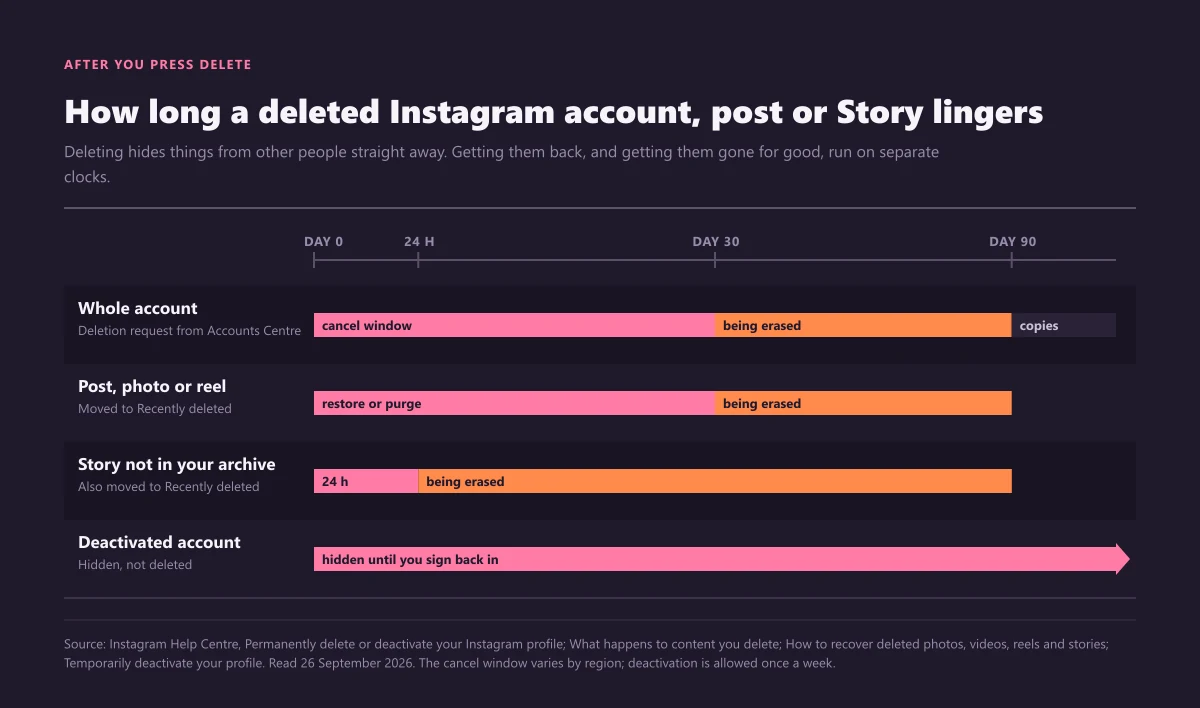
To tell them apart, open the post's link in a browser where you are not signed in. If it loads, nothing was removed; it was only hidden from you. If the whole profile has gone, a block or a deactivation is more likely than enforcement on a single photo. Then check the report itself, keeping in mind Meta's warning that not every report you've made may be viewable in Support requests. The comment version of this puzzle has its own logic, explained in what happens after you report a comment.
What happens if you report a Story on Instagram before the 24 hours run out?
The Story keeps its normal clock. A report does not freeze it, extend it or take it down early unless a reviewer finds a breach first, and when the 24 hours end it disappears from viewers as usual.
Expiry is not the same as erasure, though. Instagram does not say that a report is cancelled when the Story times out, and a Story the owner has saved to a Highlight never expires at all, so it stays reviewable and removable for as long as it is pinned. A reported Instagram story that sits in a Highlight is, in practice, an ordinary post with a different frame.
What happens when you report someone's Instagram Story is, from the reporter's side, the same thing that happens with a post. The difference is evidence. Once the Story is gone, you cannot show anyone else what it said. Take a dated screenshot before you tap Report; the surface-by-surface menus are mapped in our guide to reporting a Story or a page.
If you report an Instagram Story, will it be deleted?
Only for a confirmed breach, exactly like a feed post. A Story that breaks no rule simply runs out its 24 hours.
Someone reported my Instagram Story: what changes for me?
Nothing you can observe unless the Story is removed. Did someone report my Instagram Story is a question people usually ask after their views drop, but the viewer list carries no report flag, and dips in reach have plenty of ordinary causes. What happens if someone reports your Story on Instagram is identical to the post route: silence if it is fine, and a notice in Account Status if it is taken down.
What happens when you report false information on Instagram?
Usually the post stays up. Misinformation is the one category where Meta's default answer is added context rather than deletion, and where that context comes from now depends on the country.
In the United States, Meta ended its third-party fact-checking programme on 7 April 2025 and Community Notes started appearing on Facebook, Instagram and Threads. Meta's announcement set three details worth knowing: a note is capped at 500 characters, it must carry a supporting link, and posts with notes are not shown to fewer people, unlike posts the fact-checkers rated. The announcement limited the change to the US "for now". Where the older programme still runs, a post rated false gets a warning label and reduced distribution, and it still is not deleted.
Coverage is thin. An Indicator analysis found that only 3.0% of Instagram posts fact-checked by AFP's US bureau since April 2025 carried a corrective note, against 20.5% for comparable posts on X. A false-information report on a US post may therefore produce no visible change at all.
When we checked Instagram's own help article on reducing the distribution of false information while writing this page on 28 October 2026, we found its listing still described fact-checker ratings and warning screens with no word about notes. We read it as the non-US half of the picture. Removal is kept for narrow cases, such as false claims likely to contribute to imminent physical harm or to interfere with voting, and those are judged under Meta's misinformation policy rather than by any count of reports.
Someone reported my Instagram post: what will I see, and when?
If the post breaks no rule, you will see nothing, ever. If it is removed, you get a notice about that specific item and an entry in Account Status, but not the name of the person who reported it.
Anonymity is written into the reporting page itself: "your report is anonymous, except if you're reporting an intellectual property infringement." Copyright and trademark notices are the exception because they are legal claims, and the claimant's details can be passed to the person accused. Everything else stays hidden, and we go through the edge cases in whether the person you report finds out.
One nuance trips people up. When a comment or caption is flagged as possibly hurtful, Instagram can show its author the flagged content even if it does not go against the rules. That is a nudge, not a penalty. Still, if the words were aimed at one person, the author can usually guess who complained.
Account Status is where a removal lives. On a professional account the Help Centre route is More, then Settings, then Account Status under More info and support, and the screen lists removed posts, Stories and comments alongside any features you have lost. The page warns that removed content "may lead to your account being taken down", and adds that in most cases you'll get a warning before losing access. A single instagram reported photo removed once is a strike, not a ban.
How does a removed photo come back after a wrong decision?
Through the poster, never the reporter. The review request has to be filed from the account the decision landed on, against that one item.
- Open Account Status. Find the removed photo, video or Story in the list of removed content.
- Choose Request a review. The Account Status help page places the option there for anyone who believes the content should not have been removed.
- Keep your own copy. Save the original file and a capture of the caption before you appeal, so the context survives whatever happens next.
- Ask for the statement of reasons in the EU. The Digital Services Act requires a statement of reasons for content restrictions, and certified out-of-court bodies such as Appeals Centre Europe can review the decision afterwards without a fee for the user.
- Escalate only once Meta has answered. After Meta's own review, some decisions become eligible for the Oversight Board; the reference arrives with the outcome.
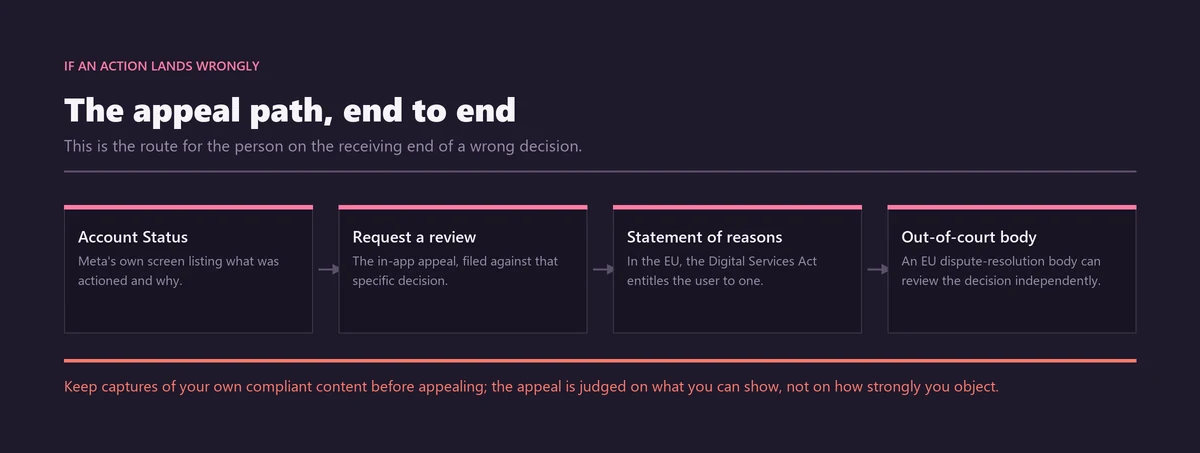
If the post comes back, it reappears in place with its likes and comments, and the reporter sees it in their feed again with no explanation. That is the whole story from both phones. If the appeal fails and the item was a genuine breach, a fresh upload of the same photo will meet the same rule.
Why does one accurate report outweigh fifty angry ones?
Because Instagram is answering a policy question, not counting hands. Fifty reports under the wrong reason ask the wrong question fifty times.
The EU's DSA Transparency Database shows how little the public flag drives the numbers. Of roughly 35.7 million Instagram account terminations logged between 1 April and 31 August 2026, Meta filed all but about 6,400 as decisions on its own initiative. That split partly reflects how Meta labels in-app reports, so it is not proof that reports never matter, but it does show that enforcement runs on the platform's own detection and policy calls. Meta's Inauthentic Behavior policy, updated on 11 December 2025, goes further and prohibits using its reporting systems to harass, intimidate or silence others.
Every large platform takes the same line, which is why we keep separate files on reporting an account on X, taking down a Facebook page or post, reporting Telegram groups and mass-reporting a Kick channel. Wherever automation is sold as a shortcut, the evidence is examined in our reviews of Discord mass-report services, the Twitter mass report bot, the Telegram mass report bot, the WhatsApp mass report bot, Snapchat mass reporting, the Snapchat report bot, the TikTok mass report bot and the YouTube mass report bot. Creators on the receiving end should read a channel banned after mass reporting, because the same appeal logic applies to them.
Two more limits. Reporting a post never frees up the handle that published it, which is a separate problem covered under rare Instagram usernames. And when a reported post is advertising a fake shop, removing the post leaves the website live; that needs a domain takedown of its own.
Instagram Ban Service works from that reality. We file once, under the reason that names the actual harm, with the post link, the date and a capture attached, and we tell the client in advance that Instagram, not us, makes the call. If the photo breaks no rule, we say so and close the file, because a report can only ask a question the guidelines can answer.
Sources, as checked for this page
- Instagram Help CentreHow Instagram decides what to remove: report count does not decide removal
- Instagram Help CentreAccount Status: removed content, lost features and Request a review
- Instagram Help CentreCheck the status of a report in Support requests
- Instagram Help CentreReport a comment: a reported comment is hidden for you, not necessarily removed
- Meta Transparency CenterIntegrity Reports: enforcement precision of about 92% on Instagram, H1 2026
- Meta Transparency CenterInauthentic Behavior: misusing reporting systems to harass, intimidate or silence others
Frequently asked questions
Does Instagram tell the poster which post was reported?
Only when it acts. A removal notice and the Account Status entry name the specific post, Story or comment that came down, so the poster knows exactly which item failed. A report that ends with no action is never mentioned to them, so they cannot tell a reported picture on Instagram from one nobody flagged.
Can I see whether my report on a photo is still under review?
Partly. Settings, then Help, then Support requests, then Reports lists what you filed and the decisions attached. Meta warns that not every report appears there, and reports sent through the standalone web forms often do not, so an empty list does not mean your report was lost.
Is reporting a Reel any different from reporting a photo?
No. A Reel is a post, so it is reported from the same Options menu, reviewed against the same Community Guidelines and, if removed, counts against the account in the same way. The only practical difference is time: a reviewer has to watch a clip rather than glance at a still.
Will a post I reported come back after it was removed?
It can. If the poster requests a review from Account Status and Meta reverses the decision, the post is restored where it was, and it will show up in your feed again with no notice to you. Reporting it a second time under the same reason will not change a decision that has already been reviewed.
What happens if I report a post on Instagram by mistake?
Nothing lands on the poster. A reviewer finds no breach and closes the report; no strike, no notice. Instagram has no button to withdraw an ordinary report, so the only thing to undo is your own action, such as unblocking the account if you blocked it in the same flow.
Did someone report my Instagram story if it vanished before 24 hours?
Possibly, but only one kind of report explains it. A Story leaves early when its owner deletes it or when Instagram removes it for a confirmed breach, and a removal is always listed in the owner's Account Status. If nothing is there, the Story was deleted by hand or you are looking at a Highlight that changed.
What happens when u report a post on Instagram from a computer?
The same review. On the web you click Options in the top right of the post, choose Report and follow the prompts, and the report joins the same queue as one filed from the app. Instagram's anonymity rule is identical, so the poster sees nothing unless the post is removed.
Can a group report the same picture to get it removed faster?
No. Instagram says the number of reports does not decide removal, and Meta's Inauthentic Behavior policy prohibits misusing reporting systems to harass or silence people. Coordinated flagging puts the accounts doing it at risk; it does not move a lawful photo any closer to removal.