WhatsApp mass reporting · a repo count, why these tools do nothing, and the in-app route that reaches a reviewer
WhatsApp mass report bot: what a GitHub search really returns, and the one route WhatsApp reads
People who write to us about a WhatsApp scammer or a fake profile often ask about a bot first. On 18 October 2026 we pulled every public GitHub repository named for WhatsApp banning or reporting to see what the market behind that search actually holds.
A WhatsApp mass report bot claims it can ban a phone number by flooding WhatsApp with complaints. WhatsApp says the only way to report someone is inside the app, where a report sends a small sample of the chat for human review and a number is not notified. A bot cannot touch that review, and of 752 GitHub repositories, 424 were even named as ban or report tools.
What is a WhatsApp mass report bot supposed to be?
A tool that claims to ban a phone number by making it look as if a crowd complained. The word "report" is doing a lot of work in that promise.
WhatsApp mass reporting is a crowd idea: a group agrees on a number and everyone taps Report. A bot is sold as the crowd in a box, and sellers wrap it three ways: a whatsapp mass report tool you install, a chat bot that takes a number and a payment, or a person who offers to mass report whatsapp numbers on your behalf. All three make the same claim, that volume forces a ban.
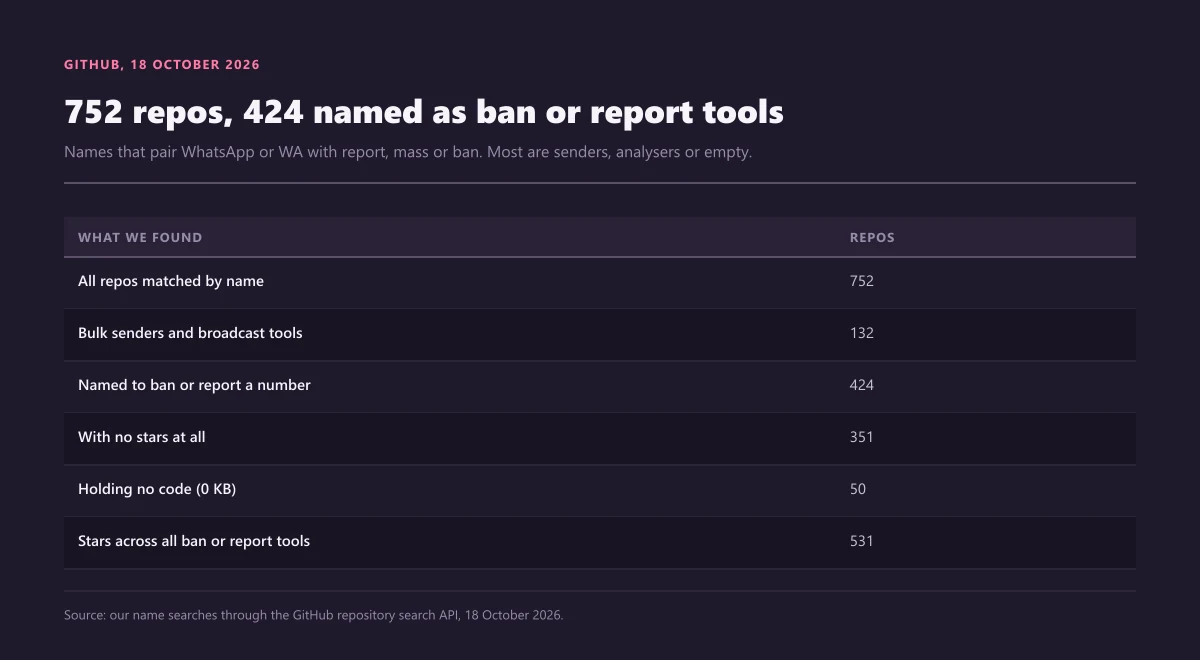
The search also surfaces plenty that has nothing to do with it. Of the 752 repositories we sorted, 132 were bulk senders and broadcast tools for marketing, and others were chat analysers that make a "report" in the document sense. The claim worth testing is the one aimed at someone else's number, so that is what the rest of this page looks at.
What did 752 GitHub repositories for WhatsApp reporting turn out to be?
Mostly new, mostly tiny and mostly ignored. The ban-a-number tools are a churn of copies, not a working category.
On 18 October 2026 we ran seven name searches through GitHub's repository search API, including "whatsapp report", "whatsapp mass" and "whatsapp ban", and kept every name that joined WhatsApp or WA with report, mass or ban. We set aside the banking demos, chat analysers, group-admin bots and unban helpers by name and description.
| What we found | Repos |
|---|---|
| Repositories whose names pair WhatsApp or WA with report, mass or ban | 752 |
| Bulk senders, broadcast and marketing tools | 132 |
| Named as tools to ban or report a number | 424 |
| … with no stars at all | 351 |
| … that are completely empty (0 KB of code) | 50 |
| … created in 2025 or 2026 | 340 |
| Stars across all 424 ban and report tools | 531 |
So a search for a whatsapp mass report bot mostly returns code nobody uses. 351 of the ban or report repos have no stars, and 50 hold no code at all. The most-starred one has 143 stars and dates from 2020; the newest are copies of older ones with a fresh banner.
Do these WhatsApp ban tools actually do anything?
In the ones people star most, no. Many print a fake countdown and a made-up success line; a growing share are a README with a download button and no code behind it.
We read the code of the best-known ones on 18 October 2026, without running any of them. The pattern repeats: the program asks for a number, shows a progress animation, then prints a sentence like "reports sent, the number will be banned soon". Nothing in the file contacts WhatsApp. One popular example ends by editing the user's own device so an animation reruns on every login, which is a prank on the operator, not an action against the target.
A second group is purely a storefront: a README that advertises a download, a rating and a Telegram contact, with an empty or near-empty repository behind it. That is why 50 of the ban or report repos carry no code at all. The promise is the product; there is nothing to test.
When a client sent us one of these tools last month and asked whether to pay the seller, we opened it first. It was a few dozen lines that printed a banner, counted down from fifty and announced a ban that never left the laptop. We told them to keep their money and reported the real scammer from the client's own chat instead.
The reason none of them can work sits in how WhatsApp actually handles a report, which is the next section.
Why can't a bot force a WhatsApp ban through volume?
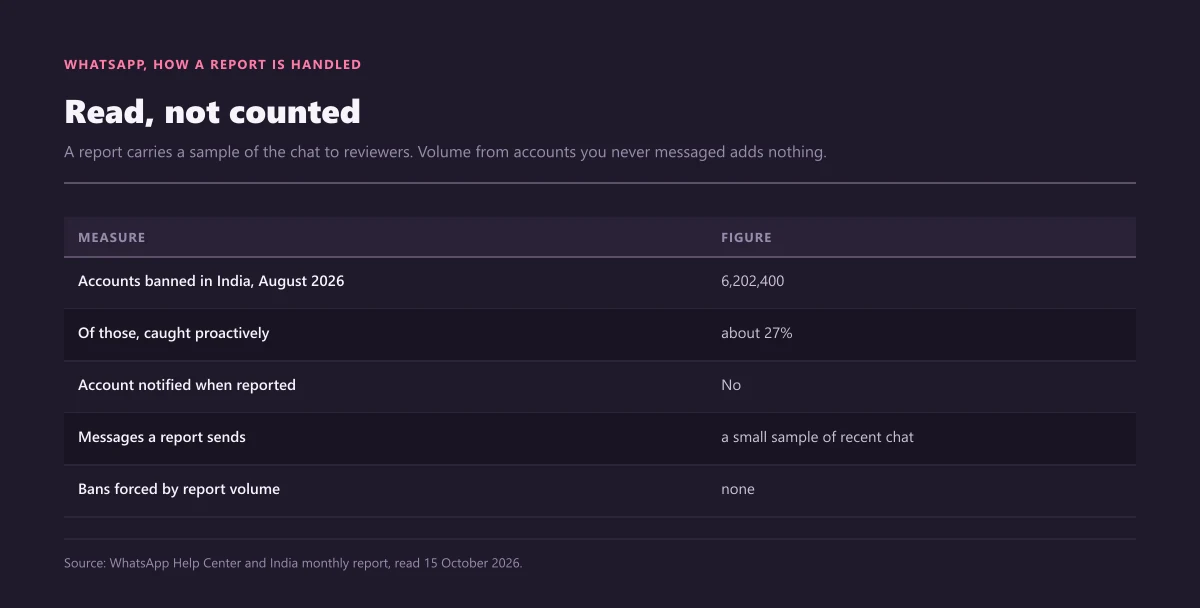
Because a WhatsApp report is read, not counted. It carries a small sample of the chat to human reviewers, and an account with no violating messages survives any number of copies.
WhatsApp's own help page on reporting a contact explains what a report is: when you report someone, WhatsApp receives a sample of recent messages that person sent you, and basic details of the account. Because chats are end-to-end encrypted, WhatsApp cannot read a conversation it was never part of, so a report only means anything when the reporter has actually been messaged by the number. A pool of accounts that never spoke to the target has nothing to hand over.
WhatsApp also states that a report does not on its own ban the account, and that reporting is a signal for review rather than a vote. Its India monthly report for August 2026 shows the scale of enforcement that runs without any of this: 6,202,400 accounts banned in a single month, about 27% of them caught proactively before anyone reported them. That is the machine a bot would have to outvote, and it cannot.
What are you actually paying for when you buy a WhatsApp report bot?
A claim, and often a download. Both carry more risk to you than to the number you wanted gone.
Anyone searching buy whatsapp mass report bot or a whatsapp mass report service meets the same pitch: a rate like "500 reports a second", a badge showing thousands of downloads, and a promise of "no bans". The rates are invented and the badges are images anyone can set to any number. Behind them is usually a file to install or a bot that wants your details first.
- A download or an install step instead of anything that runs in the open.
- Counts and ratings shown as pictures, not the platform's own figures.
- A payment, a login or your own number requested before anything happens.
- A Telegram contact standing in for any code you can inspect.
The download is the real hazard. Kaspersky's GitVenom research, reported by The Hacker News in February 2025, traced hundreds of fake GitHub projects, some fronted by a chat bot, whose advertised features were fake while hidden code stole passwords and cryptocurrency. A "free whatsapp mass report bot" is the same shape of bait.
What happens to the person who runs a mass report campaign?
They take on the risk, not the target. It breaks WhatsApp's terms, and a campaign aimed at one person can be harassment in law.
WhatsApp's Terms of Service forbid using the service in ways that are illegal or that harass others, and automated or bulk abuse of its systems is a basis for losing your own account. The accounts feeding a report bot, and the number that hired it, are the ones a provider can act against, while the target is judged only on what it actually sent.
The legal side depends on where you are. In England and Wales, section 7 of the Protection from Harassment Act 1997 treats conduct you arranged for others to carry out as yours, and the US stalking statute reaches a course of conduct through online services meant to harass. WhatsApp does not tell a reported person who filed, which is why buyers assume they are invisible. Legal process is a different matter, and a paid campaign leaves a paper trail that a single honest report does not.
How do you report a WhatsApp number so it gets a real review?
Report from inside the app, as someone the number actually contacted, with the messages still in the chat. That beats any count.
People asking how to mass report a whatsapp number, or for a whatsapp mass report tool, nearly always have one specific number in mind. The way that reaches a reviewer with something to act on is the ordinary in-app route, used once and honestly.
- Open the chat with the number, tap its name, and choose Report. WhatsApp forwards a sample of its recent messages to you as the evidence, so keep those messages rather than deleting the chat.
- Block at the same time. On Android the report screen offers to block in one step, which stops the number messaging you further.
- If it is a business account, use Report business; if it is a group, reporting it forwards recent group messages and removes you from the group.
- For a crime, report to the police as well. In the UK, fraud goes to Report Fraud; keep screenshots with visible numbers and timestamps.
- Give it time. A report is reviewed, not actioned on arrival, and the number is not told you reported it.
If several real people were messaged by the same scammer, each can report what they received. That is ordinary use; the copied, coordinated version built on accounts the number never contacted is the part that sends nothing a reviewer can read.
Same scammer on Instagram: does anything change?
Not much. The sellers advertise both platforms, Meta reviews reports on the content, and the honest routes look alike.
Most of the people we hear from face the same account on WhatsApp and Instagram. When we traced Instagram mass reporting offers to their sellers, the pitch matched the WhatsApp storefronts line for line, and our look at the Instagram report apps, bots and panels on sale found the same empty promises. A real report against an Instagram scam or fraud account triggers a review on the content, and whether a reported person on Instagram finds out shows how little the reporter sees afterwards, as on WhatsApp. For a profile using your identity to extort, the impersonation and blackmail report route is the one to use, and removing an old Instagram account or a single photo covers the narrower jobs.
On the receiving end, start with what a disabled Instagram account notice means or Instagram's "we restrict certain activity" warning, and if a deleted account is the problem, how to recover a deleted Instagram account sets out the real steps.
Why do username hunters end up on these bot pages too?
Because the sales pitch promises that banning a holder frees the name. Neither WhatsApp nor Instagram releases a handle that way.
A banned WhatsApp number is tied to a SIM, not a username, so there is no handle to inherit. On Instagram a disabled account keeps its handle blocked, which is why Instagram says a username is not available when it looks free and an unavailable Instagram username stays that way after a report. A campaign changes neither rule.
The real routes start with checks. Try an Instagram name checker or the username availability checker, see which 4-letter Instagram usernames and rare Instagram usernames are realistic, and learn how to get a taken Instagram name the legitimate way. For a dormant holder, see getting an Instagram username from an inactive account and what actually frees an inactive Instagram username.
If you are moving or buying a name, read how to swap Instagram usernames and the market for Instagram usernames for sale. None of it needs a bot.
Sources
- WhatsApp Help CenterReport a contact or group, what a report sends
- WhatsApp Help CenterBlock and report, effect on messages
- WhatsApp Help CenterBanned accounts and requesting a review
- WhatsAppTerms of Service, acceptable use
- The Hacker NewsGitVenom malware campaign, 25 February 2025
- legislation.gov.ukProtection from Harassment Act 1997, section 7
- Cornell LII18 U.S.C. 2261A, stalking
Frequently asked questions
Is there a free WhatsApp mass report bot that works?
No. The ones on GitHub either print a fake success message or hold no code, and WhatsApp reviews reports by reading a sample of the chat rather than counting them. Of 752 repositories we sorted on 18 October 2026, 424 were even named as ban or report tools, and 50 of those were empty.
How many reports does it take to ban a WhatsApp number?
There is no number. A WhatsApp report is a signal for human review, not a vote, and a number with no violating messages to you is not banned however many copies are filed. WhatsApp banned 6,202,400 accounts in India in August 2026, most of them through its own detection.
Can you get banned for mass reporting on WhatsApp?
Yes. Automated or bulk abuse of WhatsApp's systems breaks its Terms of Service, so the accounts running a report bot, and the number behind them, are the ones at risk of losing access.
Does WhatsApp tell someone who reported them?
No. WhatsApp says a reported user or group is not notified. That is also why buyers of report bots assume they are safe, but it does not protect them from legal process.
Is it safe to download a WhatsApp report tool?
Treat it as unsafe. Security researchers at Kaspersky documented a 2025 campaign, GitVenom, that planted fake tools on GitHub to steal wallets and login details from the people who installed them.
What should I do about a WhatsApp scammer instead?
Report the number from inside the chat so WhatsApp receives the messages it sent you, block it, and report any crime to the police. One honest report from someone the number actually contacted carries more than a thousand empty ones.