YouTube mass reporting · a sorted GitHub count, Q2 2026 flag figures, channel rules and the report that counts
YouTube mass report bot: 309 repositories, 10 that report, and the flag numbers YouTube publishes
Clients who ask us to take down an Instagram scammer often mention, in the same message, a YouTube channel they want gone and a bot someone sold them for it. On 17 October 2026 we searched GitHub for every public repository named for YouTube reporting and sorted the results by hand.
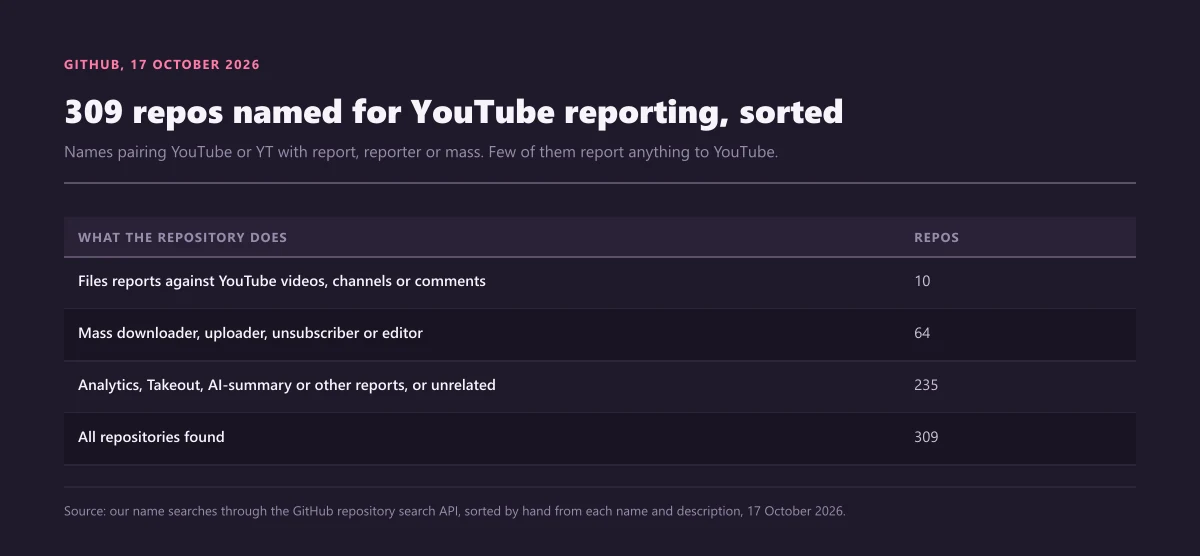
A YouTube mass report bot is a script, app or paid panel that sends the same flag against one video or channel from many accounts. YouTube says reported content is not taken down automatically, and that if reviewers find no violation, no amount of reporting changes that. Of 309 GitHub repositories we sorted, 10 filed reports at all.
What does a YouTube mass report bot actually send?
Copies of one flag. The bot logs into a batch of Google accounts, opens the same video or channel, picks a report reason and submits it again and again.
Strip the marketing off any youtube mass report tool and that's what's left. Some are Python scripts that drive a browser with Selenium, some are Telegram bots that take a link and a fee, and some are web panels with a counter that climbs while you watch. The buyer types a target, chooses "spam" or "harassment" from YouTube's own list, and waits.
Nothing in that loop adds a fact. A mass report bot youtube sellers advertise can repeat a claim, but it can't attach a timestamp of the abuse, a copyright registration or a link to the account being impersonated. Those are the things a reviewer acts on. The bot also needs real, signed-in accounts to do anything: when we opened a video signed out on 17 October 2026, the Report button only asked us to sign in first.
What did we find when we sorted 309 GitHub repos named for YouTube reporting?
Mostly projects that have nothing to do with flagging. Only 10 of the 309 send reports to YouTube, and between them they hold 36 stars.
We ran five name searches through GitHub's public repository search, the ones a person hunting for a youtube mass report bot on GitHub would try, and read every name and description. "Report" on GitHub mostly means a document. The biggest hit is a tool that turns your Google Takeout history into a personal viewing report. Many others write channel performance summaries or AI digests of videos.
| What the repository does | Repos |
|---|---|
| Files reports against YouTube videos, channels or comments | 10 |
| Mass downloader, uploader, unsubscriber or editor | 64 |
| Analytics, Takeout, AI-summary or other reports, or unrelated | 235 |
| All repositories found | 309 |
Of the 10 that do report content, three were built for causes: pirated videos in 2017, propaganda in 2020 and war footage in 2022. None of those three has been updated since 2022. Two carry the identical pitch of "10k+ Reports / Minute"; when we opened them, one held no files at all and the other about 2 KB. The newest, created on 26 September 2026, promises reports on Facebook, YouTube, TikTok and Instagram from one page and contains 5 KB. 3 of the 10 had no stars and 5 were 20 KB or smaller.
The pattern matches what we saw with the Instagram spam report bots we examined: a loud name, a README and very little underneath. We didn't run any of this code.
Does mass reporting work on YouTube once a reviewer opens the flag?
No, not in the way the sellers mean. A flag puts a video in front of review; the review checks the rules, and the count of flags isn't one of them.
YouTube answers the question in its own help page on reporting content: "When content is reported, it's not automatically taken down." If the team finds no violation, the page says, "no amount of reporting will change that". The flags section of Google's Transparency Report adds that reviewers judge flagged videos against all of YouTube's policies, whatever reason the flag gave.
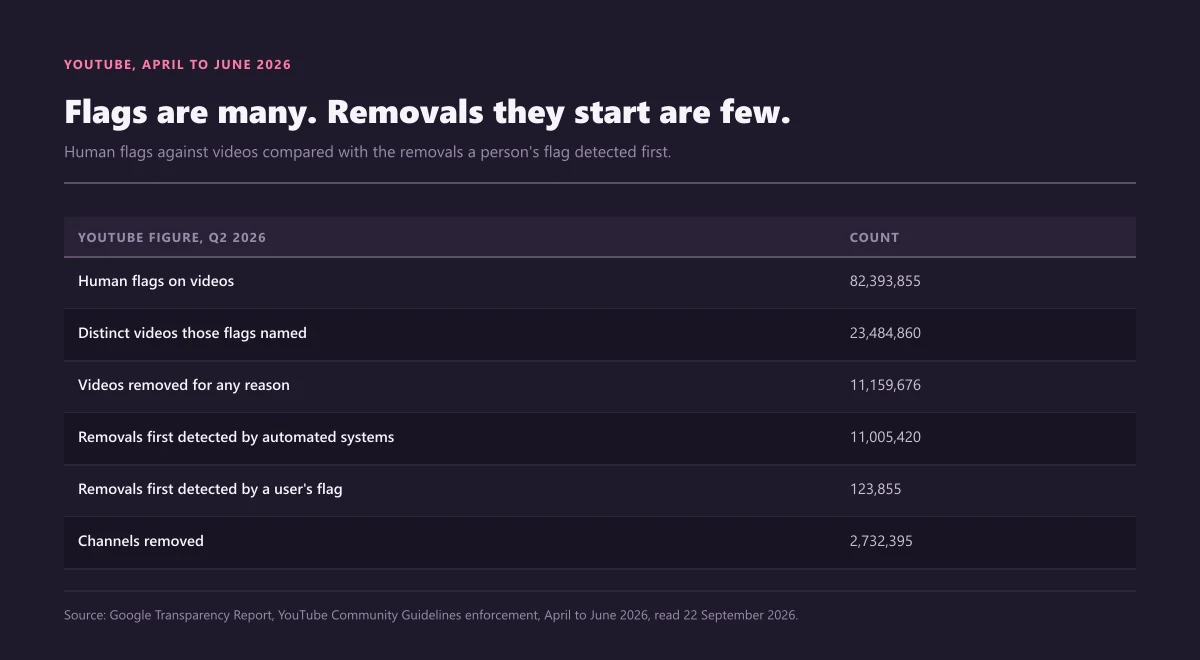
The numbers show how little user flags carry on their own. Between April and June 2026 people flagged videos 82,393,855 times, naming 23,484,860 distinct videos, roughly 3.5 flags per video. YouTube removed 11,159,676 videos in that quarter. Its removals data credits automated systems with first spotting 11,005,420 of them, and a user's flag with 123,855, about 1.1%. Google also says it identifies "suspicious or exceptionally high flagging volumes" and leaves them out of the data. A flood, in other words, is a pattern YouTube looks for.
So mass reporting youtube content buys, at most, a look that one accurate flag would also have bought. It's the same logic we laid out for what a report on Instagram actually sets in motion.
Can you take down a whole channel by reporting it, or only single videos?
A channel goes when it collects three strikes in 90 days, or at once for severe abuse or for existing mainly to break the rules. Reports start reviews; strikes come from what the reviews find.
That's the rule set out on YouTube's Community Guidelines strike page. The first confirmed violation usually brings a warning, each later one a strike, and a third strike inside 90 days ends the channel. A channel dedicated to violating policy, or one with a single case of severe abuse, skips the ladder. People asking how to mass report a youtube channel are really asking how to make that ladder move faster, and the honest answer is that only violations move it.
Channels do fall in large numbers. YouTube removed 2,732,395 channels in Q2 2026, and 84.5% of them went for spam, deceptive practices and scams. Those channel terminations took 86,686,063 videos down with them. A scam channel is exactly what one well-documented report can bring down. A rival creator with a clean record is what a mass report youtube channel bot keeps failing to touch.
| What you report | Where to do it | What review can lead to |
|---|---|---|
| One video | Report under the video | Removal, age restriction or no action |
| A channel | Channel page, then Report user | Strikes, or termination for severe or dedicated abuse |
| A comment | Three-dot menu on the comment | Comment removed; commenting may be paused |
| An ad | Sponsored label, then Report ad | Ad or advertiser account review |
What happens to the person running a YouTube mass report tool?
They break YouTube's Terms twice over and put their own Google accounts on the line. The target, if clean, loses nothing.
YouTube's Terms of Service forbid accessing the service "using any automated means (such as robots, botnets or scrapers)", and they separately bar misuse of any reporting, flagging, complaint or appeals process through groundless submissions. A mass report youtube video run does both at once. The help page adds a sharper line for the legal forms: abuse of them "may result in the termination of your Google Account", which is far more than a YouTube login.
Then there is the code itself. Scripts that ask for a list of Gmail passwords are a standing invitation to steal them, and the two "10k+ Reports / Minute" listings we opened shipped no code to inspect, only a name and a promise. If a seller wants your accounts, your money and your silence about results, you are the one carrying the risk. We've written up the same trade on the Instagram side, where we followed mass reporting offers back to the people selling them.
Your channel is being mass flagged. What should you check first?
Whether anything was actually removed. Flags that end in no action leave no mark, and YouTube tells you by email and in channel settings when it does act.
Reports are anonymous, so you won't see who flagged you or how often. What you will see is any outcome: Google says creators are notified of a removal or restriction over email and on their channel settings. Work from that.
- Open the strikes and warnings area of YouTube Studio and screenshot it, dated.
- Appeal any strike you think is wrong, once, and say why the video fits the policy it was removed under. A different reviewer decides.
- Don't re-upload the removed video while the appeal runs.
- Lock down the Google account. Report threats often come with login attempts, and a recovery phone that still works matters here as much as it does for the phone number on an Instagram account.
- Save messages from anyone threatening a report campaign. The threat can be reported as harassment.
Appeals are worth filing, though they're no formality: in Q2 2026 YouTube received 1,269,277 appeals and reinstated 87,953 videos. If an Instagram account was swept up in the same campaign, start with whether it's deleted and still recoverable or merely restricted.
How do you report a YouTube channel or video so the report counts?
Pick the narrowest target, the true reason and the right form. One report filed that way does what a thousand copies can't.
Most people who search how to mass report youtube channel pages have a real grievance: a scam channel using a celebrity face, a re-upload of their video, someone posting their address. Here is the short route.
- Report the single video if one video is the problem; report the channel only when the channel itself is the violation.
- Choose the reason you can show, not the gravest one on the list.
- Use the dedicated forms for what flags can't prove. Impersonation can be reported for your own or another creator's channel; a privacy complaint is judged on whether you are identifiable; copyright needs the rightsholder's notice.
- Track it in Report history, which lists reported videos as Live, Restricted or Removed. A video missing from the list usually means many others already flagged it.
- If you speak for an NGO or agency that flags often, ask about the Priority Flagger programme, whose flags YouTube reviews first because they prove accurate more often.
Several people who each saw the abuse can each file their own report. What the Terms forbid is the copied, groundless flag, and that is the only product a youtube mass report seller has.
Why does an Instagram takedown service care about YouTube report bots?
Because the same sellers push the same panel at both platforms, and the honest routes on Instagram follow the same logic.
Reporting and getting reported
The Instagram cases we take mostly involve impersonators, extortion and stolen images. For those, deciding between an impersonation report or a DMCA notice matters far more than volume, and reporting extortion on Instagram has its own route. When the problem is a picture of you, the options for a photo or video posted without consent start with a privacy claim. On the receiving end, read what Instagram's disabled-account notice means, the "we restrict certain activity" warning and how to get a real support request in front of Instagram before paying anyone for a fix.
The username pitch
A share of report-bot buyers want a handle, not a ban. Sellers claim that knocking out the holder frees the name. On Instagram it usually doesn't: a disabled or deleted holder keeps the name blocked, which is why a username can look free and still be refused and the causes behind "username not available" are worth reading first. Check the name in an Instagram username checker, read the legal ways to land the username you want and what Instagram does with inactive handles.
Short names are where money changes hands. See how scarce four-letter Instagram usernames are, how rare usernames free up, what sits behind Instagram usernames listed for sale and the ways an IG handle purchase can go wrong. None of them needs a report bot.
Sources
- YouTube HelpReport inappropriate content
- Google Transparency ReportYouTube Community Guidelines enforcement, removals, April to June 2026
- Google Transparency ReportYouTube flags, April to June 2026
- YouTube HelpCommunity Guidelines strike basics
- YouTube HelpReport history
- YouTube HelpImpersonation policy
- YouTube HelpPrivacy complaint process
Frequently asked questions
Is there a YouTube mass report bot that works?
Not one that changes outcomes. YouTube says reported content is not removed automatically, and if no violation is found, no amount of reporting changes that. Of 309 GitHub repositories named for YouTube reporting that we sorted on 17 October 2026, 10 filed reports at all.
How many reports does it take to delete a YouTube channel?
YouTube publishes no report threshold. Channels are terminated after three strikes in 90 days, or at once for severe abuse or for being dedicated to violating policy. Strikes come from confirmed violations, not from the number of flags.
Can YouTube tell when flags come from a bot?
YouTube doesn't publish its methods, but Google says it identifies suspicious or exceptionally high flagging volumes and excludes them from its flag data. Automated access through bots or botnets is already against YouTube's Terms.
Does YouTube tell a creator who reported them?
No. YouTube's help page says reporting is anonymous, so other users can't tell who made a report. Creators hear about outcomes, such as a removal or restriction, by email and in their channel settings.
Is it against the rules to ask friends to report a channel?
Each person may report what they genuinely saw. YouTube's Terms bar misuse of the reporting and flagging process through groundless submissions, so copied reports about content nobody checked fall on the wrong side of that line.
What works better than a mass report against a scam channel?
One report on the specific video or channel with the accurate reason, plus the dedicated form where one exists: impersonation, privacy or copyright. Those forms ask for proof a flag can't carry, and Report history shows the result.