YouTube ban services · flags, strikes, legal forms and the EU notice count for October 2026
Can a YouTube channel get banned for mass reporting, and what does a YouTube ban service really sell?
Two kinds of people send us YouTube questions: someone who wants a channel gone and has been quoted a price for it, and a creator who has been told a report campaign is coming. Both are asking the same thing, so this page answers it once, with YouTube's rules and the numbers it files in the EU.
No, not by the volume of reports. YouTube says reported content is not taken down automatically, and a channel ends only after three strikes in 90 days or one severe violation. A buy youtube ban service offer sells flags a reviewer judges on content, not count. Notices that remove things come from people entitled to file them.
Can a YouTube channel get banned for mass reporting alone?
Reports alone don't do it. Every flag lands in a review queue, and the reviewer checks the video against the rules. The number of people who flagged it isn't on the checklist.
YouTube's page on reporting inappropriate content puts it plainly: reported content isn't removed automatically, and if no violation is found, "no amount of reporting will change that". That one sentence is the whole answer to whether a youtube channel can be banned for mass reporting. It can be banned for what the reports point at, if the point is true. It can't be banned for being popular with people who dislike it.
A channel that does fall after a wave of flags fell for a strike that a reviewer could defend. That's the trap in the sales pitch: sellers point at channels that broke the rules and were removed anyway, then claim the credit. The same sleight of hand shows up on Instagram, where people mistake an Instagram ban wave caused by a policy sweep for proof that reporting works. Read what really triggers an Instagram ban and the pattern is identical.
What are you buying when you pay for a YouTube ban service?
One of three products, and none of them is a ban. Sellers offer copied flags, a claimed insider, or a complaint filed in someone else's name.
The listings use the same phrases across platforms: youtube channel ban service, youtube mass report service, "permanent removal in 24 hours". Under the wording, what's on offer falls into three groups, and we keep this at the level of what they claim, not how they're built.
| What the seller claims | What YouTube's process does with it | Who carries the risk |
|---|---|---|
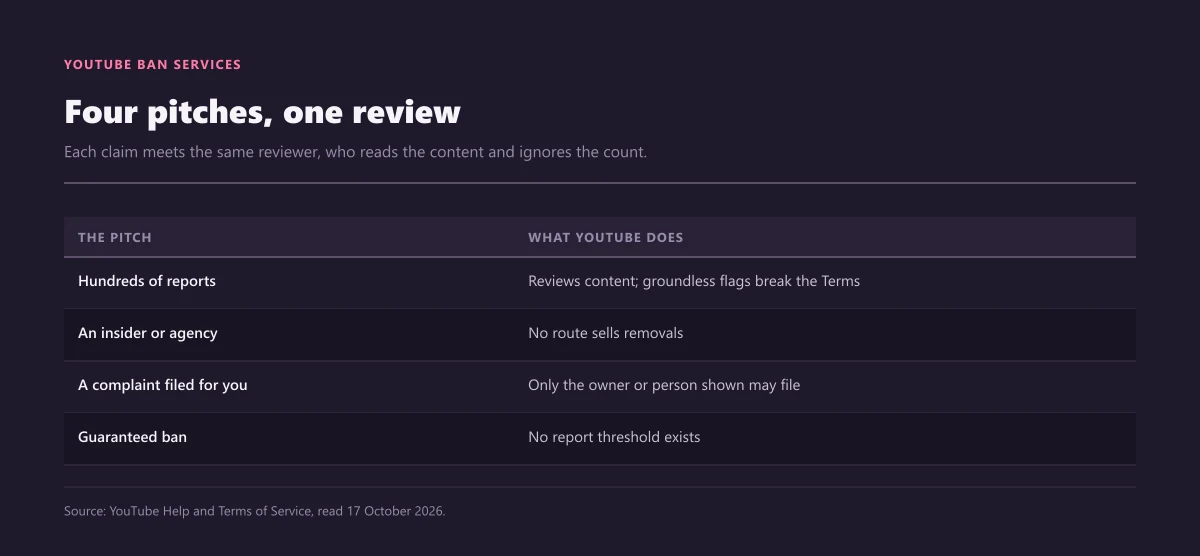
| Hundreds of accounts will report the channel | Review checks the content; repeated groundless flags break the Terms | The buyer's money; the seller's accounts |
| A contact inside YouTube or an agency badge | No public route sells removals; flaggers are vetted organisations | The buyer, who usually pays twice |
| A copyright or privacy complaint filed for you | Only the owner, the person shown or their agent may file | Whoever signs the false statement |
| Guaranteed result or money back | YouTube publishes no report threshold, so nobody can guarantee one | The buyer |
The third product is the dangerous one. A complaint in the legal forms is a signed statement, and YouTube warns on the same help page that abusing those forms can end the filer's whole Google Account. On Instagram we followed who stands behind mass reporting offers, and the sellers rarely sign anything themselves.
Can a youtube mass report service get the buyer in trouble?
It can, in two ways. The Terms bar automated access and groundless reports, and the person behind a false legal complaint is the one exposed to the consequences.
YouTube's Terms of Service forbid using the service through "any automated means (such as robots, botnets or scrapers)", and separately forbid misuse of the reporting, flagging and complaint processes. A flag farm breaks both. That risk sits with whoever's accounts send the flags, and sellers often ask buyers to hand over accounts of their own.
A forged copyright notice moves the risk into law. Under 17 U.S.C. § 512(f), a person who knowingly misrepresents that material infringes can be liable for the damages, including the uploader's legal costs. The privacy flow has its own warning screen: abusing the privacy process may result in account suspension. If you hired someone and they filed in your name, the statement carries your name, not theirs. It's the same exposure we describe for people who try to report an Instagram account and get it disabled without a real violation.
What does a legitimate youtube takedown service actually file?
A notice from someone entitled to send it: the copyright owner, the person shown, the person impersonated, or their authorised representative. Each route has its own form.
This is where a real youtube video removal service earns its fee. The work is choosing the right door, collecting evidence and writing a notice a reviewer can verify. Here are the four doors YouTube runs.
| Route | Who may file | Target | What success looks like |
|---|---|---|---|
| Copyright removal request | The rights owner or their agent | One video per URL | Video removed and a copyright strike |
| Privacy complaint | The person shown, or a listed representative | Video, comment or a whole channel | Content trimmed, blurred or removed; no strike |
| Impersonation report | You, or anyone for another creator | Channel or comment | Channel or comment removed |
| Legal removal (defamation, court order) | The affected person or their lawyer | Named URLs | Removed or blocked in a country |
The privacy complaint process judges whether you are uniquely identifiable, and a report about impersonation can come from you or from someone protecting another creator. Instagram mirrors the split; our page on the Instagram legal removal request covers its court-order and defamation side, and if the problem is a photo of you, start with what to do when someone posted your picture or video.
Is there a youtube channel removal service that can take down a whole channel at once?
Only when the channel itself breaks the rules. Copyright works video by video; impersonation and some privacy complaints can name the channel.
YouTube's copyright removal page doesn't accept a request against a whole channel or playlist: each video needs its own URL. What ends a channel is the copyright strike rule: three active strikes and the channel is terminated, along with any linked channels. Community Guidelines work the same way through their own strike ladder, three in 90 days, with immediate termination kept for severe abuse or channels built to break the rules.
So a youtube channel takedown service that is honest will tell you which ladder the channel is on, and how many confirmed violations it can prove. An impostor channel is different: impersonation goes to the channel itself, and a whole-channel privacy complaint needs no video URL. Instagram has a similar split between a post and an Instagram account takedown, which is the right request when the entire profile exists to deceive.
How many YouTube removals in the EU start from someone else's notice?
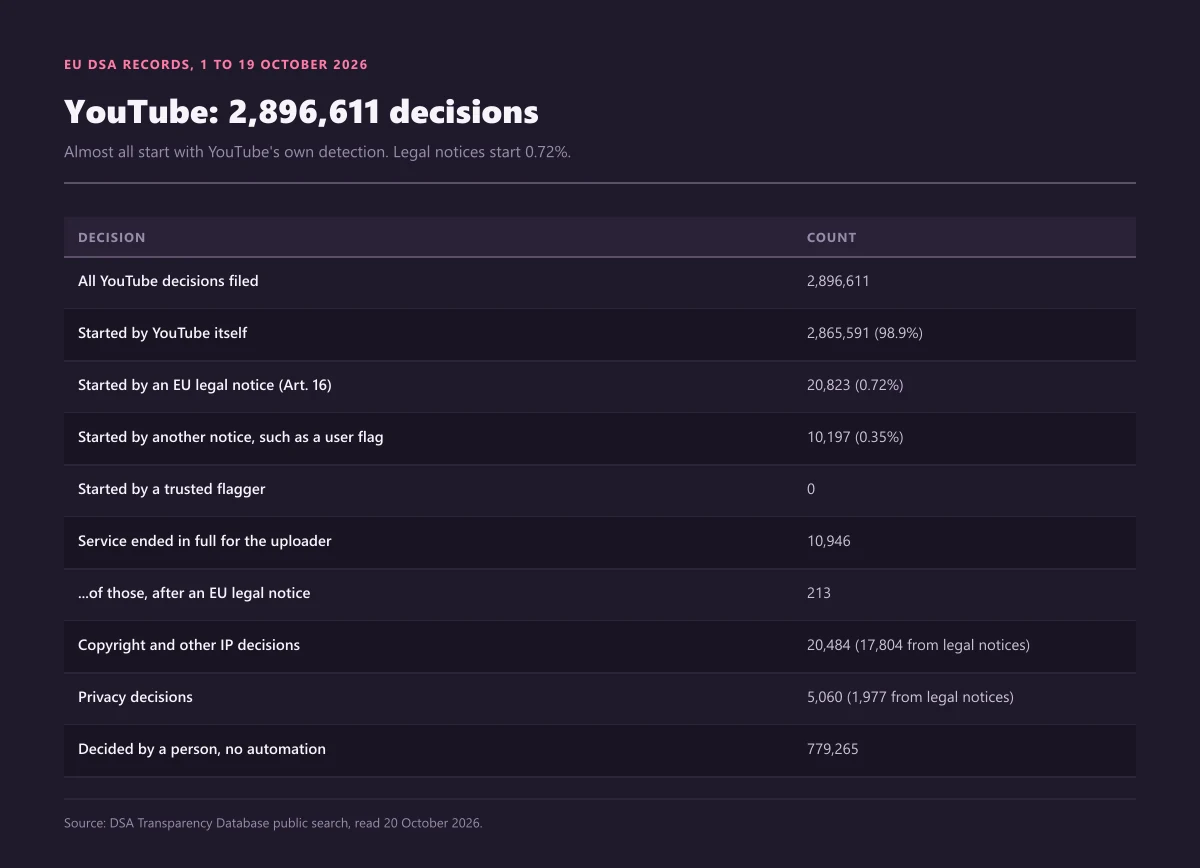
Only a small share do. Between 1 and 19 October 2026 YouTube filed 2,896,611 decisions in the EU database, and 0.72% of them began with an Article 16 legal notice.
On 20 October 2026 we queried the EU DSA Transparency Database, where every platform operating in the EU must log each moderation decision with its source. YouTube is platform 27. We filtered by source, outcome and category for 1 to 19 October. When we first filtered by account bans, we saw zero in every count: YouTube doesn't log a channel ban as an account decision but as the service ended for that uploader, so we re-ran the count on that field.
| YouTube decision, 1 to 19 Oct 2026 | Count |
|---|---|
| All YouTube decisions filed | 2,896,611 |
| Started by YouTube itself | 2,865,591 (98.9%) |
| Started by an EU legal notice (Art. 16) | 20,823 (0.72%) |
| Started by another notice, such as a user flag | 10,197 (0.35%) |
| Started by a trusted flagger | 0 |
| Service ended in full for the uploader | 10,946 |
| ...of those, after an EU legal notice | 213 |
| Copyright and other IP decisions | 20,484 (17,804 from legal notices) |
| Privacy decisions | 5,060 (1,977 from legal notices) |
| Decided by a person, no automation | 779,265 |
98.9% of the decisions began on YouTube's own initiative. Ordinary notices, the bucket a user flag falls into, started 10,197, and formal legal notices from people and companies started 20,823. The legal notices punch above their share where a right is at stake: 17,804 of the 20,484 copyright and IP decisions began with one. YouTube ended the service in full for 10,946 uploaders in the window, and 213 of those cases began with a legal notice. Volume of flags shows up nowhere as a cause.
What should a YouTube takedown cost, and which quote is a warning sign?
A fair quote pays for case work: reading the channel, collecting proof, drafting the notice. A price per report or per ban is the warning sign.
We won't print a price list, because the work varies from a single re-upload to a network of impostor channels. What we can say is which offers are built to fail. Watch for these:
- Pricing by number of reports or by "accounts used".
- A deadline promise, such as banned within 24 or 48 hours.
- No question about what the channel did, only its link.
- A request for your Google login or a copy of your ID to "file as you".
- Payment only in crypto or gift cards, with no invoice.
The same signs separate honest firms from fakes on the recovery side; our checklist on whether Instagram recovery services are legit or a scam works for YouTube too. If a seller also offers to reverse any ban for a second fee, compare the pitch with what a real Instagram unban service can and can't promise.
Your channel was threatened with a ban service. Can the threat itself be acted on?
In many cases it can. A threat to flood your channel is harassment you can report, and any strike that does land can be appealed with your evidence.
Keep the message, the sender's profile link and the date. Then work through the outcome, not the noise:
- Check YouTube Studio for warnings or strikes. Flags that end in no action leave nothing there.
- If a copyright claim was filed against you falsely, send a counter notification. The claimant then has to show a court action or the video comes back.
- Appeal a Community Guidelines strike once, explaining why the video fits the policy.
- Report the threat itself as harassment, with the screenshots.
If your Instagram was hit by the same group, the recovery steps differ. Look at what a disabled account on Instagram means, the "we restrict certain activity" notice, and how to get an Instagram account back before anyone sells you a fix.
Why do some buyers really want the username, not the ban?
Because a removed channel or profile looks like a freed name. On Instagram it usually isn't, and the handle market has legal routes of its own.
A good share of the ban requests we turn down are about a name. The buyer assumes a banned holder releases it. On Instagram a disabled account keeps its name reserved, which is why Instagram says a username is not available even when the profile looks empty, and the fixes for an IG username that's not available start with checking the right signal. Run the name through an Instagram username checker first.
If you need the name, buy or trade it openly. Read how to buy an Instagram username safely, the traps when you buy an IG handle from a stranger, and how two accounts swap usernames. Short names cost more for a reason; see the market for an Instagram 4-letter username and how rare Instagram usernames actually change hands. None of it needs a ban service.
Sources
- YouTube HelpReport inappropriate content
- YouTube HelpCommunity Guidelines strike basics
- YouTube HelpCopyright strike basics
- YouTube HelpSubmit a copyright removal request
- YouTube HelpPrivacy complaint process
- YouTube HelpImpersonation policy
Frequently asked questions
Can a YouTube channel get banned for mass reporting alone?
No. YouTube says reported content is not removed automatically and that no amount of reporting changes a decision where no violation was found. Channels end after three strikes in 90 days, three copyright strikes, or one severe violation.
Is it legal to buy a YouTube ban service?
Paying for copied flags breaks YouTube's Terms, which bar automated access and groundless reports. Paying someone to file a false copyright notice can create liability under 17 U.S.C. 512(f) for the person who signed it.
What is the difference between a YouTube takedown service and a ban service?
A takedown service files a notice from someone entitled to send it, such as the copyright owner or the person shown in a video, with evidence. A ban service sells report volume, which YouTube's reviewers don't count.
Can a youtube video removal service remove any video I don't like?
No. A video comes down only if it breaks YouTube's Community Guidelines or infringes a right you hold, such as copyright or privacy. Disliking a video, or a creator, is not a ground any form accepts.
How many YouTube decisions start from a legal notice?
In the EU DSA Transparency Database, YouTube logged 2,896,611 decisions between 1 and 19 October 2026. 20,823 of them, 0.72%, began with an Article 16 legal notice, and 10,197 with another notice such as a flag. Almost all the rest began on YouTube's own initiative.
Can someone mass report my channel and get it deleted?
Not if the channel follows the rules. A flood of flags still ends in a review of the content. If a strike does land, appeal it, and answer a false copyright claim with a counter notification.
Does a privacy complaint give the channel a strike?
No. YouTube's strike page says content removed after a first-party privacy complaint or a court order does not bring a strike. Repeated privacy violations can still lead YouTube to suspend the account.
Can a terminated YouTube channel come back?
In some cases it can. A creator can appeal a termination, and under a YouTube pilot a terminated creator may ask for a new channel after one year. That option is closed to channels terminated for copyright infringement.