Snapchat report bots · what Snap's own triage does, which reports end in action, and why a bought flood lands in the no-action pile
Snapchat report bot: the machine that actually reads your report belongs to Snap
Most messages we get about Snapchat start with the same question: is there a bot that can report an account until it disappears? There is a machine in the loop, but it sits on Snap's side. We took Snap's latest category figures apart on 19 October 2026 to show what it does with what it is sent.
A Snapchat report bot is a script or paid service that files the same complaint about one account over and over. It cannot force a ban, because Snap's own triage judges each report on the content, drops duplicates down the queue, and acted on only 3.6 of every 1,000 impersonation reports in the second half of 2025.
What is a Snapchat report bot, and which of three things do people mean by it?
Usually one of three: a script on GitHub, a paid service on Telegram, or the automated triage Snap runs itself. Only the third one decides anything.
The first kind is code. We already sorted every public GitHub repo named for Snapchat mass reporting and found six aimed at accounts, most of them empty or fake. The second kind is a snapchat bulk report tool or a snapchat mass report service sold through a Telegram channel, a Discord server or a one-page site, usually for a flat fee per target.
The third kind gets forgotten. Snap reviews reports with a mix of automated systems and people, and its own transparency report credits "prioritisation processes and automated technology" for getting the median response to about a minute. That machine is the real snapchat report bot. Everything a buyer pays for has to get past it, and it was built specifically to ignore volume.
What does Snap's own triage do with a report?
It reads what the report points at, attaches the evidence, files duplicates lower in the queue and acts in about a minute when the content breaks a rule.
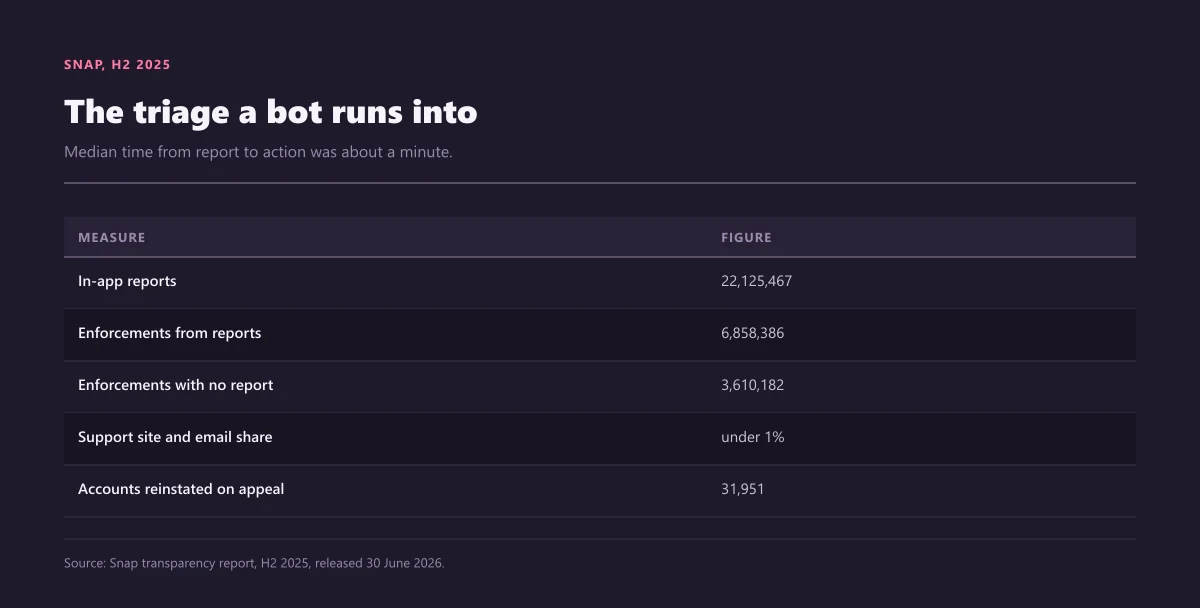
Between July and December 2025, Snap's transparency report counted 22,125,467 in-app reports. They led to 6,858,386 enforcement actions against 4,548,479 separate accounts, with a median turnaround of about one minute. Reports through the support site and email made up less than 1% of that volume, so the in-app button is where almost everything lands.
Snap's safety-reporting page explains what travels with a report: a copy of the Snap or Story, or some of the messages before a reported chat line. The moderation explainer adds that duplicate and spammy reports are deprioritised. In plain terms, the first report with evidence gets read and the hundredth identical one waits behind real cases.
Snap also finds a lot on its own. In the same half-year it took 3,610,182 enforcement actions after automated detection, through hash matching and machine-learning classifiers, with no report at all. A rule-breaking account does not need a crowd to be found.
Which Snapchat reports actually end in action?
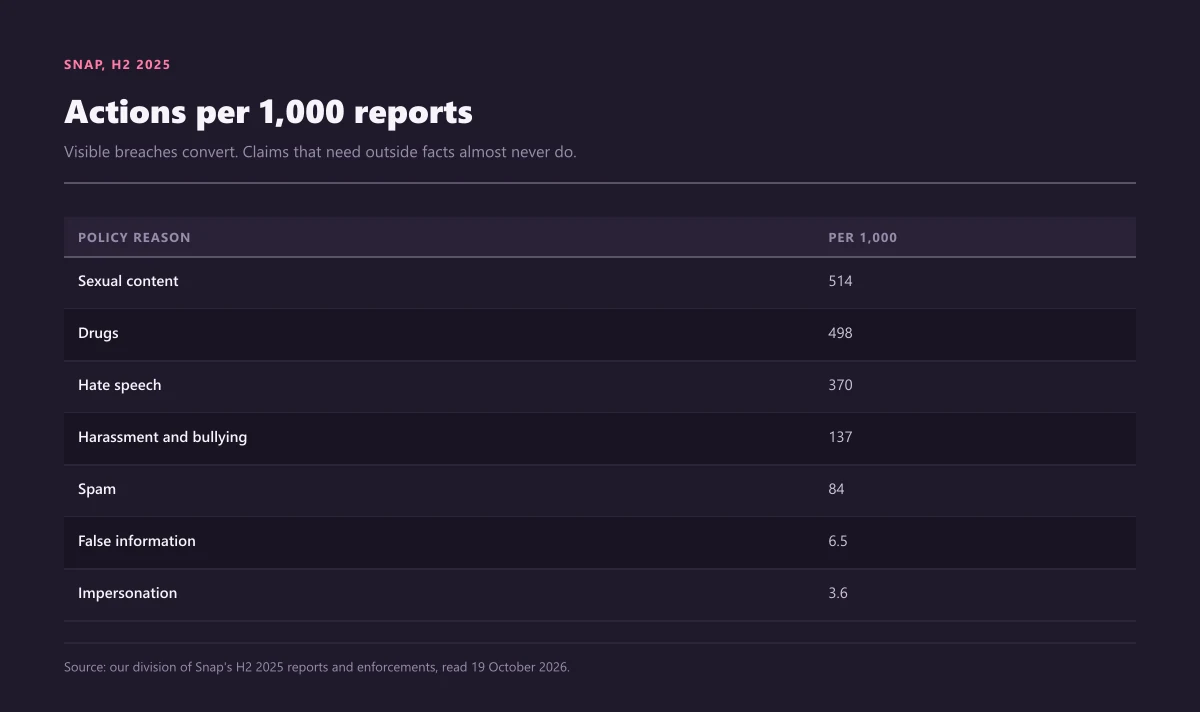
It depends almost entirely on the category. Out of every 1,000 reports, sexual content led to 514 actions and impersonation to fewer than four.
We divided Snap's enforcements by its reports for each policy reason. Snap's own table has a "% of total" column, but that is each category's share of all enforcements, not a success rate, so the right column below is our arithmetic, not Snap's.
| Policy reason (H2 2025) | In-app reports | Enforcements | Actions per 1,000 reports |
|---|---|---|---|
| Sexual content | 8,246,730 | 4,238,019 | 514 |
| Drugs | 520,572 | 259,237 | 498 |
| Child sexual exploitation | 1,736,669 | 819,339 | 472 |
| Hate speech | 907,230 | 335,547 | 370 |
| Weapons | 309,670 | 88,079 | 284 |
| Other regulated goods | 489,068 | 114,982 | 235 |
| Threats and violence | 1,088,184 | 153,715 | 141 |
| Harassment and bullying | 4,538,512 | 622,465 | 137 |
| Self-harm and suicide | 356,875 | 39,437 | 111 |
| Spam | 2,105,039 | 177,757 | 84 |
| False information | 795,267 | 5,202 | 6.5 |
| Terrorism and extremism | 303,137 | 1,981 | 6.5 |
| Impersonation | 728,514 | 2,626 | 3.6 |
The pattern is hard to miss. Where a reviewer can see the breach in the reported item itself, nudity, drug sales, weapons, the hit rate is high. Where the claim depends on facts outside the app, it collapses: false information converts at 6.5 per 1,000 and impersonation at 3.6. Those are exactly the reasons people pick when they want a working account gone, which is why that pile is so large and so rarely acted on.
How many reports does it take to delete a Snapchat account?
There is no number. Snap acts on a single valid report and ignores any number of invalid ones, so a count is the wrong question.
Snap publishes no report threshold, and its rules explain why. The moderation explainer describes a ladder based on what the account did: content removed, a notice, then a strike, with the account disabled after "too many strikes over a defined period". Severe harms, and accounts "created or used primarily to violate" the rules, are disabled promptly. None of those steps is triggered by how many people pressed the button.
So how many reports to delete a Snapchat account? One, if it shows a real breach; no amount, if it does not. Instagram works the same way, as our page on the report count that supposedly deletes an Instagram account shows, and what a single Instagram report sets in motion mirrors the Snapchat review almost step for step.
A disabled account is also not instantly gone. A locked owner gets a one-time appeal that can take up to 30 days, and across H2 2025 Snap reinstated 31,951 accounts out of 471,892 appeals.
Does mass reporting work on Snapchat, or does a report bot backfire?
It backfires. Copies of one report are treated as spam, and the accounts sending them are the ones that break Snap's rules.
Does mass reporting work on Snapchat? Snap's answer is in writing. Anyone who "repeatedly sends duplicative or otherwise spammy reports" can have their reports deprioritised, and someone who keeps filing unfounded ones can, after a warning, have review of their reports suspended for up to a year or their account disabled. The same clause covers appeals.
The bot itself is the second problem. Snapchat's Terms of Service forbid any "robot, spider, crawler, scraper, script, software or other automated" means of using the service. Every login in a report pool is breaking that clause when it fires. In our experience the pattern is consistent: the target survives untouched, and the buyer later finds their own account limited.
- Real violation, one report with evidence: likely action within minutes.
- Real violation, a flood of copies: same action, plus noise that slows other cases.
- No violation, one report: no action.
- No violation, a flood: no action, and the senders risk losing their reporting rights.
What does a Snapchat mass report service actually sell?
A promise and a screenshot. Payment comes first, results are unverifiable, and the most common add-on is a request for your own login.
The listings follow a template: a price per account, a turnaround in hours, a "guarantee" and a Telegram handle. When we traced Instagram mass reporting offers to the people behind them, the same storefronts sold Snapchat jobs off the same price list. Nothing in a seller's control can change how Snap's reviewers read a report, so what the buyer pays for is the chance that the target would have been banned anyway.
The risks fall on the buyer. Payment is usually in crypto or gift cards with no way back. A "proof" screen of sent reports is trivial to fake. Some sellers ask for the buyer's own Snapchat or Instagram login "to boost reports", which is how accounts get stolen. And a campaign aimed at one person can count as harassment in law: in England and Wales, section 7 of the Protection from Harassment Act 1997 treats conduct you get others to carry out as your own.
How to mass report a Snapchat account the legitimate way
Not with copies. Every real witness files one report, from the right place, under the honest reason. That is the only kind of volume Snap welcomes.
When people ask how to mass report a Snapchat account, the honest version is a handful of people who each saw the abuse and each report what they saw. Snap's reporting guide covers every object:
- Press and hold the Snap, Story, message or profile and tap Report. Choose the reason that matches what is on screen, not the one you think hits hardest.
- Let the report carry the evidence. A copy of the Snap or the preceding messages travels with it automatically.
- If the account blocked you, the app won't let you report it, but the support-site route still works.
- For illegal content in the EU or UK, pick the illegal-content option in the report flow. Snap's EU figures for H1 2026 show 8,675 such notices, judged under law as well as under the rules.
- Follow progress in My Reports, which shows each report as Submitted, In Review or Complete for 30 days.
If you are the one being threatened, report first and keep your own screenshots too. Snap retains reported content even when it would otherwise vanish.
Same person on Instagram: which routes carry over?
Nearly all of them. Meta also judges reports on the content, and the cases that work on Snapchat have a direct Instagram equivalent.
A fake profile on Snapchat usually has a twin on Instagram. There, an impersonation takedown on Instagram runs through a dedicated form that accepts proof of identity, which Snapchat's version does not. If the impersonator is also threatening you, our guide to reporting impersonation used for blackmail sets out the order of steps.
On the receiving side, the vocabulary differs but the logic is the same. A sudden Instagram ban wave is automation, not a crowd of reporters. Start with what a disabled Instagram account notice means or the "we restrict certain activity" warning, then read how to unban an Instagram account step by step. If you want someone to handle the appeal, there is our Instagram unban service. Retiring an account yourself is easier: see how to delete an old Instagram account, and whether Instagram removes inactive accounts on its own.
Why do so many report jobs turn out to be about usernames?
Because the buyer wants the handle, not the ban. A suspended account keeps its name, so the plan fails even when the ban succeeds.
A share of report requests are really bids for a short handle. Banning the holder does not release it on either app. That is often why the Instagram username you want shows as taken, and why Instagram calls a username unavailable covers the other reasons.
The routes that work start with a check. Run the name through an Instagram handle checker, see which four-letter Instagram names and rare handles are realistic, and follow the steps to get a username you want on Instagram. To trade names between accounts you control, read how to swap usernames between two Instagram accounts. If the holder is willing to sell, buying an IG handle the open way is safer than paying anyone to report it.
Sources
- Snap Inc.Terms of Service, automation clause
- Snap Inc.Safety and reporting overview
- Snap Inc.EU DSA transparency data, H1 2026
- Snapchat SupportHow to report a Snap, Story, chat or account
- Snapchat SupportReporting an account that blocked you
- Snapchat SupportMy Reports, 30-day status tracker
- Snapchat SupportLocked account appeals
- legislation.gov.ukProtection from Harassment Act 1997, section 7
Frequently asked questions
Is there a Snapchat report bot that actually works?
No bot can make Snap ban an account that has not broken a rule. Snap's triage judges each report on the content, deprioritises duplicates, and in H2 2025 acted on only 2,626 of 728,514 impersonation reports.
How many reports does it take to delete a Snapchat account?
Snap sets no number. One report showing a real violation can lead to action within minutes, and any number of reports about a clean account leads to nothing. Accounts are disabled after strikes for what they did, not for how often they were reported.
Is a Snapchat mass report service legal?
Paying one breaks Snapchat's Terms, which ban automated use, and a campaign against one person can be harassment in law. In England and Wales the Protection from Harassment Act 1997 treats conduct you procure as your own.
Can Snapchat ban you for reporting too much?
Yes. Snap's moderation explainer says repeated duplicate or unfounded reports can be deprioritised, and after a warning Snap may stop reviewing your reports for up to a year or disable your account.
Does Snapchat tell the person who reported them?
No. Snap says the reported person is not told who reported them, even on appeal. A report also cannot be taken back once it is filed.
What should I do if a Snapchat account is harassing me?
Report the specific Snaps or messages from inside the app under the honest reason, keep your own screenshots, and block the account. If it blocked you first, use the Snapchat support site, and track the case in My Reports.