Off-Instagram removals · DNS abuse, copyright, counterfeits, platform rules and court orders, checked 16 October 2026
Domain takedown service or content removal service: the five hooks that actually remove something
Your stolen photos are on Instagram, and then you find them on a shop site, a listing and an art page as well. Each of those has its own owner and its own rules. This guide sorts the jobs people hire a takedown firm for by the one thing that decides the result: the rule the request can point to.
A domain takedown service asks a registrar or host to suspend a whole site, which only works for phishing, malware or a clear trademark claim. A content removal service targets single pages, listings or accounts through copyright, counterfeit, platform-rule or court-order routes. Neither works without a rule the content actually breaks.
What does a domain takedown service actually remove?
A whole site, and only when the domain itself is being abused. Everything smaller, a page, a listing, a profile, is content removal and goes to a different owner.
The name promises more than the route delivers. A registrar can suspend a domain, and the host can switch off the server behind it, but both act on a short list of reasons. Since 5 April 2024 the ICANN DNS abuse amendments have obliged registrars to act "promptly" on actionable evidence of malware, botnets, phishing, pharming, and spam that delivers one of those. Defamation, bad reviews and stolen photos are not on that list, and ICANN says plainly that website content sits outside its remit.
So a website takedown service that offers to remove a page because it's unflattering is selling a switch it can't reach. What it can reach is the page's own owner, the host's acceptable-use team, the platform where the content sits, or a search engine. A content removal service that's honest about this will ask one question before it quotes: which rule does this content break?
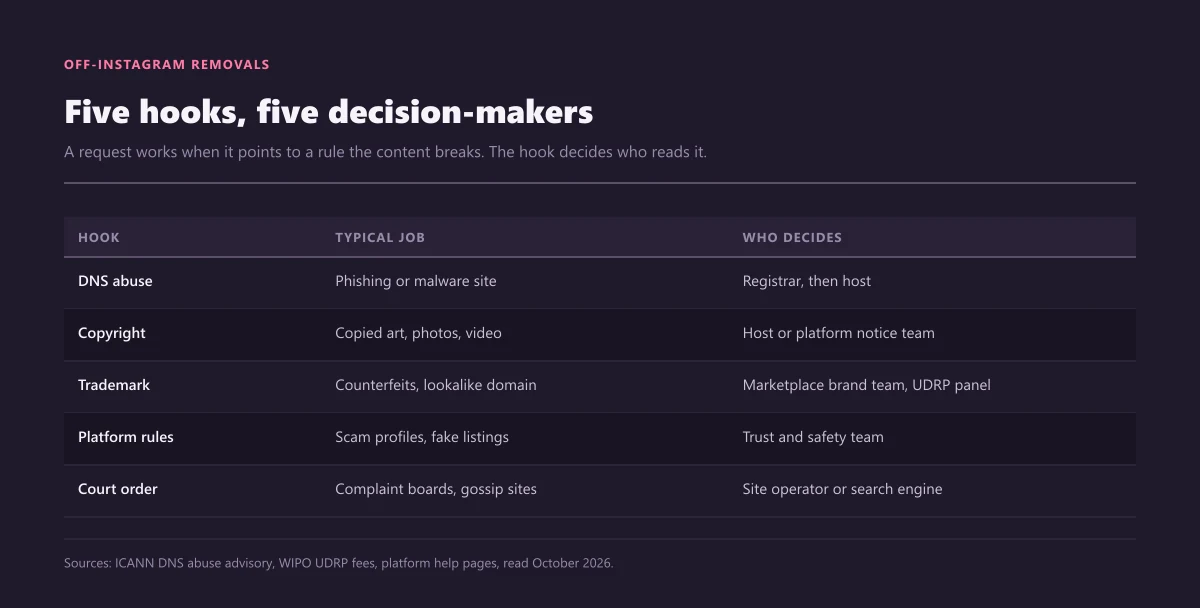
That question gives five answers in practice. We call them hooks, because each one is something a request can hang on, and each one has its own decision-maker.
Which of the five hooks does your problem hang on?
Pick the hook first and the right recipient follows. Most failed requests went to the right company with the wrong hook.
| Hook | Typical job | Who decides | What they want to see |
|---|---|---|---|
| DNS abuse | Phishing copy of your login page, malware download site | Registrar, then host | The live URL, a screenshot, how it harms users |
| Copyright | Your art, photos or video reposted | The host or platform, under its notice process | The original, the copy, a signed notice |
| Trademark and counterfeit | Fake goods, a lookalike domain | Marketplace brand team, or a UDRP panel | A registered mark, test purchases, listing IDs |
| Platform rules | Scam profiles, harassment, fake listings | The platform's trust and safety team | Links to the exact items, the rule they break |
| Court order | Complaint boards, gossip sites | The site operator, or a search engine | A signed order naming the URL |
Two hooks often apply at once. A fake shop that copies your product photos breaks copyright and trademark both, and on Instagram it usually breaks the platform's own rules as well. File each route in parallel rather than hoping one notice covers the rest. Our page on Instagram's legal removal request forms shows which of these hooks Instagram itself accepts through its legal channel.
When is the domain itself the right target?
When the name is the harm, or when the whole site exists to steal logins or spread malware. Then a registrar complaint or a UDRP case is the tool.
Phishing is the clean case. A page that copies your bank or your Instagram login is DNS abuse in ICANN's sense, and the registrar's abuse contact is obliged to acknowledge your report and act on good evidence. This is most of what a cyber takedown service or cybersecurity takedown service sells to brands: watching for lookalike domains and filing abuse reports fast. Cyber takedown services earn their fee on speed and volume, not on secret access.
Lookalike names with no phishing on them are a trademark matter. Under the UDRP, WIPO charges USD 1,500 for one to five domains before a single panelist, and USD 4,000 for three panelists. The only remedies are cancellation or transfer. The UDRP Rules give the respondent 20 days to answer and the panel 14 days to decide, and the registrar then waits 10 business days before it acts. No fee buys a faster panel.
What a domain route never does is remove one bad article from an otherwise lawful site. For that you need the page-level hooks below.
How does a content removal service get copied art and video taken down?
Through the host's copyright notice, filed by the rights holder or someone acting for them. It is the most reliable hook there is, because the host has its own legal reason to act.
An art theft takedown service is, underneath, a notice-writing service. On DeviantArt the copyright policy sends rights holders to a web form, which needs an account, or to violations@deviantart.com. Anyone asking about a deviantart art removal service should know the form is free. DeviantArt also runs DeviantArt Protect, launched in 2021, which scans for copies of uploads; Core members get it without a time limit, standard accounts for three months per upload.
Video works the same way. The Dailymotion help centre points rights holders to its "Send a copyright notification" form, so a dailymotion content removal service is filing the same form you could file. Where the copy sits on a small site with no form, the notice goes to the host, found through a WHOIS or IP lookup.
If the same picture also turned up on Instagram, two pages here cover it: how Instagram copyright strikes add up for reposted work, and what to do when someone posts a picture or video of you when the problem is privacy rather than ownership.
Can counterfeit products and fake listings be removed?
Yes, and marketplaces remove them in large numbers on their own. Your report matters most when it carries proof the platform can't produce itself, such as a registered mark or a test purchase.
Amazon's Trustworthy Shopping Experience report for 2025 says it seized and disposed of more than 15 million counterfeit products, and that its Counterfeit Crimes Unit has pursued over 32,000 bad actors in 14 countries since 2020. An amazon counterfeit removal service or amazon listing takedown service works inside that system: Brand Registry reports, listing IDs, test buys. A brand without a registered mark has far less to file with.
Rentals and classifieds run on platform rules instead. In September 2023 Airbnb told NBC News it had removed 59,000 fake listings and blocked 157,000 more at sign-up, so an airbnb listing takedown service is mainly a well-documented report through Airbnb's own channel. Craigslist is blunter still. Its flagging help page says free ads that are "sufficiently flagged" are removed automatically. A craigslist ad takedown service or craigslist post removal service can't add more than your own flag and, for scams, a report to Craigslist with the details.
Will complaint boards and cheater sites remove a post?
Rarely, and usually only with a court order. Search engines are the more useful door for some of these pages.
We read the ComplaintsBoard FAQ again on 16 October 2026. The answer to "How do I delete my complaint?" still opens with "We do not remove complaints", followed by one exception: an officially signed court order. A complaintsboard removal service or complaintsboard takedown service that promises more is either going to court for you or not telling you the truth. The site does let a business reply and mark a complaint resolved, which costs nothing.
Cheater sites change hands and vanish. While writing this page we took the cheater and complaint sites people search for and asked who would actually read a removal request on each. Searches for a cheater land removal service mostly name cheaterland.com, and for that one the answer was nobody: on 4 October 2026 the domain redirected to a for-sale page, and on 16 October its plain http address returned a 404. That sounds like good news until the same posts surface on a mirror. So a cheater report removal service or cheater website removal service often ends up chasing copies on other domains, where the owner may not answer at all.
Google offers one route that doesn't need the site's help. Its form for exploitative removal sites covers pages about you on sites that charge to take them down. If Google accepts the request, the URL drops out of its results while the page itself stays up. That is the honest limit of most negative content removal services too.
Do mass reports, ban services or ban bots take accounts down?
No. Every major platform says report volume doesn't decide removal, and several treat coordinated reporting as abuse in its own right.
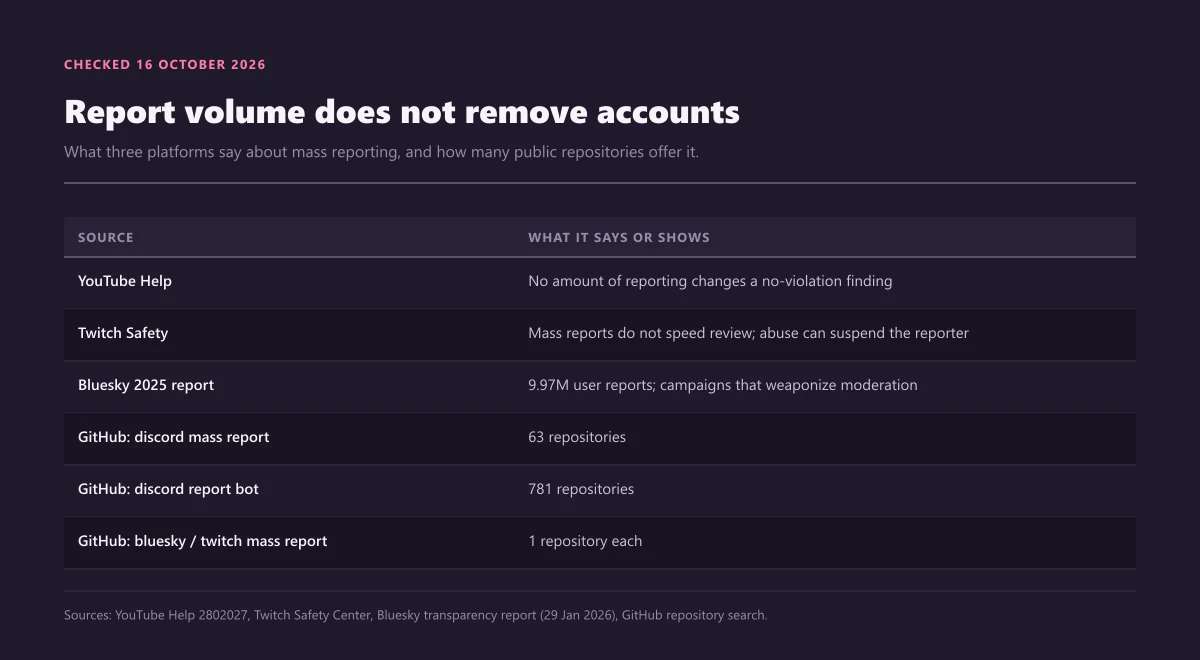
YouTube's help page on reporting, read on 16 October 2026, says reported content is "not automatically taken down" and that if no violation is found, "no amount of reporting will change that". That answers the question people ask most: can a youtube channel get banned from mass reporting? Only if the reports point reviewers at real violations, and the three-strikes-in-90-days rule then does the work, not the count.
Twitch's user report guide says mass or repeated reporting of the same content won't speed anything up, and that abusing the report tool can get the reporter suspended. Anyone tempted to buy mass report twitch packages is paying to put their own account at risk. Bluesky's 2025 transparency report counted 9.97 million user reports, up 54%, and named campaigns that try to "weaponize our moderation systems". A bluesky ban service or bluesky mass report offer runs straight into that review.
On 16 October 2026 we counted repositories on GitHub search: 63 for "discord mass report", 781 for "discord report bot", one for "bluesky mass report" and one for "twitch mass report". Discord's platform manipulation policy bans self-bots outright, so a discord account ban service built on them breaks the rules it claims to use. A discord ban bot in the ordinary sense is a moderation bot that bans members from your own server, with the Ban Members permission. It can't touch anyone's account beyond that server.
Instagram is no different. We traced where Instagram mass-reporting offers lead, looked at what an Instagram spam report bot really does, and wrote up how to report an account that breaks the rules so it can be disabled the legitimate way.
What should a social media removal service hand you as proof?
A record of each route it filed: the form, the date, the reference it got back. If it can't show that, you can't tell its work from waiting.
Any social media removal service, online removal service or content takedown service files through the same doors you can open. Its value is in choosing the right hook, gathering evidence the reviewer will accept and following up. So the deliverable is paperwork, and you are entitled to see it.
- The exact URLs or handles it reported, one line each.
- The hook and the form or address used for each one.
- The date filed and any ticket or case number returned.
- A copy of the notice as sent, for copyright and legal routes.
- The platform's answer, including refusals.
Be wary of any channel takedown service or bluesky account takedown service that only reports "in progress" with nothing behind it. Walk away from a quote too if it is priced per report sent, because the number of reports is the one thing the platforms told us doesn't count.
What if the same people are also on Instagram?
Then the Instagram side gets its own reports, filed in parallel. A fake shop rarely lives on one platform.
Start with the content. Our guide on reporting a single Instagram post covers the item-level route, which is often faster than reporting the whole account. If the copycat has grabbed your brand's handle, the name side matters too: what it means when your Instagram username is taken, why Instagram says a username isn't available, and testing names with an Instagram name checker.
Some brands try to buy the name back instead. Before paying anyone, read how buying an Instagram username works and the risks of buying an IG handle. The odds differ a lot by name shape, as the four-letter username test and our look at rare Instagram usernames show, and a quiet holder is a different case, covered in getting an inactive Instagram handle.
Retaliation happens too. A seller you reported may report you back. If your own account gets hit, the "we restrict certain activity" message, what a disabled account on Instagram means, getting your Instagram account back and what an Instagram unban service can and can't do cover the routes. If many accounts fall at once, check whether it's a wider Instagram ban wave before you assume you were targeted.
How long does each route take?
Only the UDRP publishes a clock. Everything else runs on the platform's own queue, so plan in weeks for domains and days to weeks for content.
The UDRP numbers add up to roughly six to eight weeks from filing to transfer once the 20-day answer period, the 14-day decision period and the 10-business-day wait are counted, plus time for the panel to be appointed. Registrar abuse reports under the ICANN rules must be handled "promptly", a word ICANN left undefined. Copyright notices to large hosts tend to move fastest because the host's own legal protection depends on acting.
Court-order routes are the slowest, because the order has to exist first. Any service quoting a fixed 48-hour removal across all of these is quoting a number none of the decision-makers publish.
Sources
- DeviantArtCopyright policy
- ComplaintsBoardFAQ: How do I delete my complaint?
- Google Search HelpRemove content about you on sites with exploitative removal practices
- Twitch Safety CenterFiling a report
- YouTube HelpWhat happens after I report content?
- GitHubRepository search counts
Frequently asked questions
What is the difference between a domain takedown service and a content removal service?
A domain takedown targets the whole site through its registrar or host, and works for phishing, malware or trademark claims. Content removal targets single pages, listings or accounts through copyright, platform rules or court orders.
Can a youtube channel get banned from mass reporting?
Not from the number of reports. YouTube says reported content is not automatically taken down and no amount of reporting changes a finding of no violation. Channels are removed for real violations, such as three strikes in 90 days.
Is a cyber takedown service worth paying for?
For brands that face repeated phishing or lookalike domains, often yes, because speed and monitoring matter. For one stolen photo, the free copyright form on the host usually does the same job.
Will ComplaintsBoard remove a complaint about my business?
Its FAQ says it does not remove complaints unless it receives an officially signed court order. You can reply publicly and mark the complaint resolved without paying anyone.
How much does a UDRP domain case cost?
WIPO charges USD 1,500 for one to five domains before a single panelist and USD 4,000 for a three-member panel, before any lawyer's fees. The panel can only cancel or transfer the domain.
Does a discord ban bot remove accounts from Discord?
No. A moderation bot with the Ban Members permission bans people from your own server only. Self-bots and report bots break Discord's platform manipulation policy.
Can a removal service take down a negative review that is true?
Not through any legitimate route. Copyright, platform rules and court orders all need the content to break something. A truthful review that breaks no rule usually stays.