Copyright and policy takedowns · the DMCA form, Community Standards reports, disputes and what a service refuses
Instagram account banning service: how the DMCA form and Meta's report routes really decide
People who search for an account-banning service usually have a stolen photo, a reposted video or a copycat profile. This page follows a copyright complaint and a policy report through Instagram's own forms, read on 11 November 2026.
An instagram account banning service cannot ban anyone. It prepares a valid copyright notice or policy report, files it through Instagram's official forms, and Instagram decides. Under 17 U.S.C. 512, a DMCA notice needs a signature, the work, the infringing URL and a good-faith statement; enough upheld notices can disable an account.
How do Instagram ban for service work in practice?
The search phrase "how do instagram ban for service work" has a short answer: a service files, Instagram reviews, and only Instagram removes.
An instagram account banning service, in the honest sense, is a paperwork desk. It takes a real complaint from a rights owner or a harmed person, matches it to the right Instagram channel, and writes it so a reviewer can act on it in one read. Instagram Ban Service works this way: it checks the evidence, picks the form, drafts the text and submits through Instagram's public forms. It holds no staff login, no partner queue and no private contact at Meta.
Two routes carry almost every case. Intellectual property complaints go through the Copyright Report Form or the trademark form, which are legal notices reviewed by Meta's IP team. Everything else, such as scams, harassment or fake profiles copying a real person, goes through in-app reports judged against the Community Standards.
Neither route counts votes. That is why the page on what a review checks when many people report one account ends where it does.
What goes into a DMCA takedown notice for Instagram?
A DMCA takedown notice for Instagram needs six elements set out in 17 U.S.C. 512(c)(3), and Instagram's form asks for each of them.
The statute lists a physical or electronic signature, identification of the copyrighted work, identification of the infringing material with enough detail to find it, contact details, a statement of good-faith belief that the use is not authorised, and a statement under penalty of perjury that the notice is accurate and the sender is the owner or authorised to act. You can read the text on the Cornell copy of 17 U.S.C. 512.
Instagram's own Copyright Report Form says it is only for reports of alleged infringement of your copyright on Instagram or Threads, and that reports from someone who is not the owner or an authorised representative cannot be processed. That rule shapes everything a service does. Each dmca takedown notice instagram receives is checked against these elements, and sending a DMCA takedown notice to Instagram on a client's behalf only works when the client owns the work and authorises the filing in writing.
Copyright, trademark or impersonation?
A copied photo is copyright. A copied logo on a shop is trademark. A profile pretending to be you is impersonation, a separate policy route explained in the impersonation report versus DMCA comparison.
How to issue a DMCA takedown on Instagram, step by step
To file dmca takedown request instagram style, as many people search it, you file a DMCA takedown request on Instagram through the Copyright Report Form, not through the in-app Report button.
- Collect the URL of every infringing post, reel or story, and a link or file showing your original with a date.
- Confirm you own the rights, or hold written authority from the owner. If not, stop here.
- Open the Copyright Report Form while logged in or out, and choose the option for content that uses your work.
- Describe the work in plain words, paste the infringing links one per field, and give a reachable email.
- Tick the good-faith and accuracy statements and type your full legal name as the electronic signature.
- Keep the confirmation email. Meta's reply arrives there, often with a reference number.
That is the official DMCA takedown process for Instagram that Meta runs (searched as "official dmca takedown process for instagram meta"), and how to issue a DMCA takedown on Instagram without a service at all. The process is free. A service adds evidence checks and drafting, which matters most when dozens of links or a whole account are involved, or when the same content sits on Facebook too.
A single in-app post report follows a different path, covered in how to report a post on Instagram and reporting one post, story or message.
What does Meta decide after a copyright notice arrives?
Meta decides whether the notice is complete and whether the reported item matches the work; it does not rule on who would win in court.
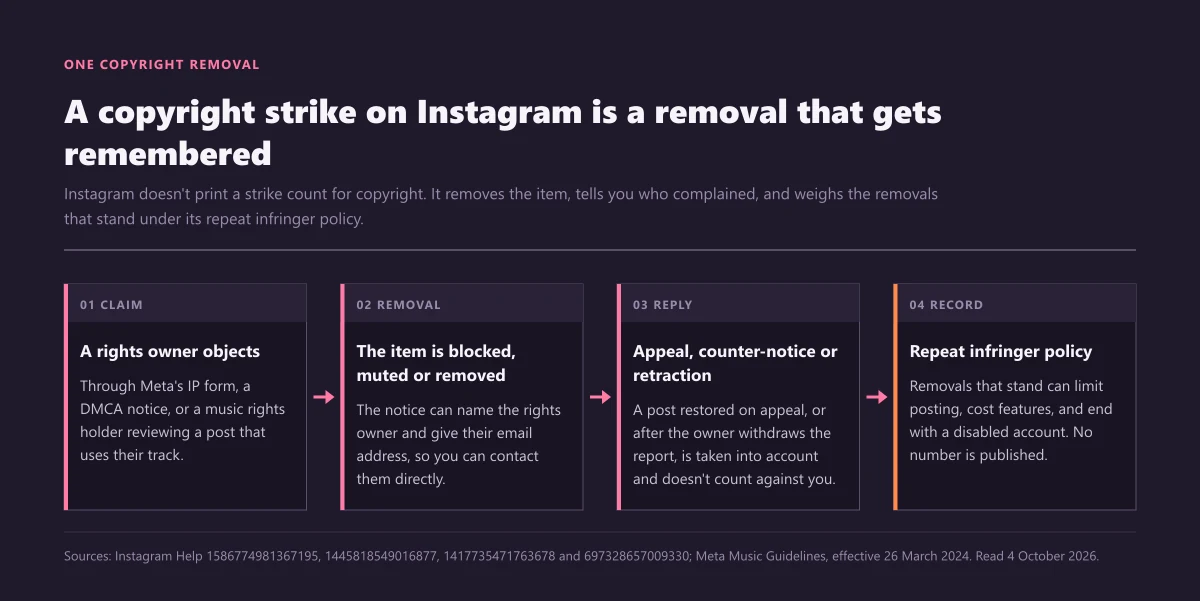
The Instagram copyright takedown process ends in one of three places. The item is removed and the poster is told who complained, the report is returned as incomplete, or Meta declines because the match is unclear. Meta's intellectual property transparency page describes how its teams review notices and publishes the volume of IP reports it receives in each reporting period.
Under the Instagram copyright policy takedown rules, which the Instagram takedown policy pages summarise, removals that stand count toward a repeat infringer policy. Instagram does not print a strike number, but upheld removals can limit features and, at the end, disable the account. That is the only sense in which copyright work can lead to an account ban, and it rests on what the account posted. How a copyright strike on Instagram builds up covers that record in more depth.
Instagram Ban Service files the notice; Instagram makes the final decision on removal and on any account action.
How does an Instagram dispute post takedown work for the other side?
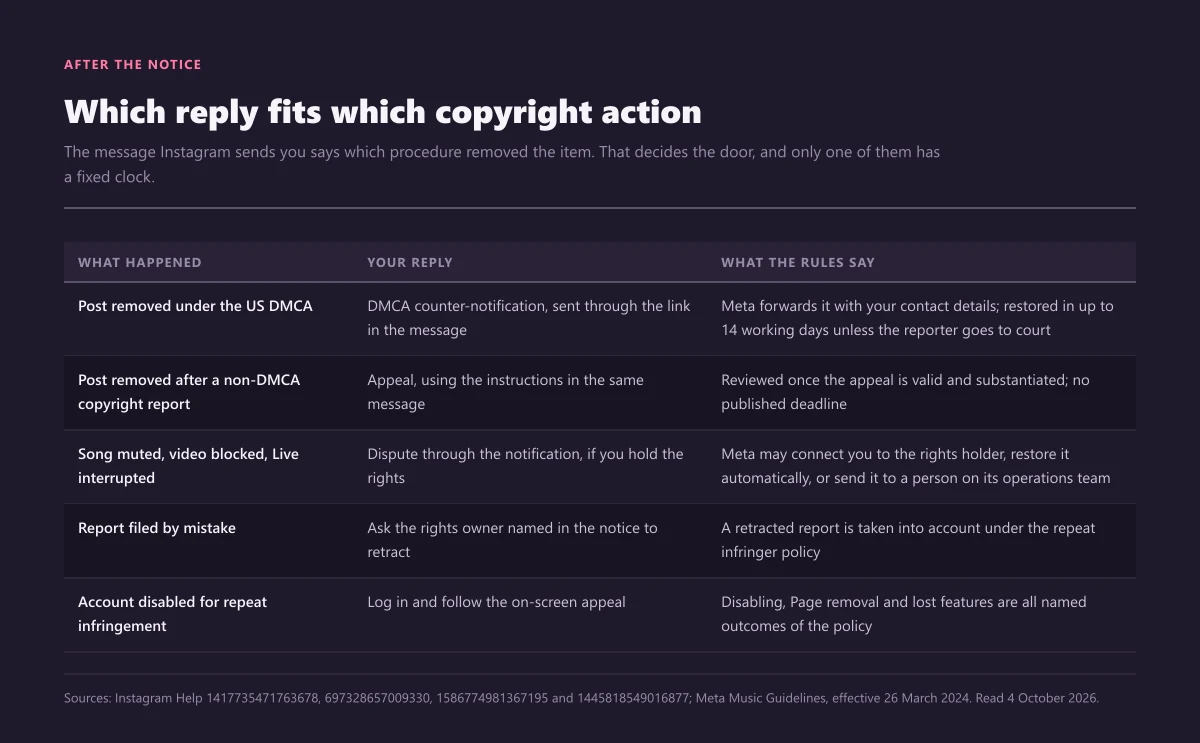
The person whose post was removed can file a counter-notification, appeal, or ask the reporter to retract.
An Instagram dispute post takedown starts from the message the poster receives. For a removal under the US DMCA, Instagram's U.S. Copyright Appeal Form lets them file a counter-notification if they believe the removal was a mistake or misidentification. Instagram forwards it, with the poster's name, address and phone number, to the person who filed the notice.
Instagram Ban Service tells every client about this step before filing. Then a clock starts. Section 512(g)(2)(C) says the platform restores the material in 10 to 14 business days after the counter-notice unless the complainant tells it they have filed a court action. A rights owner who is not ready to sue should know this before filing.
If your own account lost posts this way, the guide to a disabled Instagram account and our unban help for wrongly removed accounts start from the notice you received.
Where does the Meta report and takedown policy cover non-copyright harm?
The Meta report and takedown policy for Facebook and Instagram, outside IP, is the Community Standards.
Meta publishes one set of Community Standards that applies to Facebook, Instagram, Messenger and Threads. In search terms this is the meta report and takedown policy facebook instagram users look up, or the meta facebook instagram report and takedown policy community standards page. It covers fraud and scams, bullying and harassment, account integrity and authentic identity, privacy violations and more. Reports for these go through the Report option on a profile, post or message, and a reviewer or an automated system checks the reported item against the named policy.
A legal complaint that is not copyright, such as defamation or a privacy law claim, uses separate legal forms; see the Instagram legal removal request guide. For a profile that breaks several rules at once, reporting with the aim of disabling an account sets out the evidence order.
Account action under the Community Standards follows strikes and severity. Some violations, such as child exploitation, can remove an account on the first instance; most build up. Instagram's activity restriction notices are often the first visible step.
What does a legitimate banning service refuse to do?
It refuses any job against an account that breaks no rule, and any copyright claim the client cannot back.
False DMCA notices are not a grey area. Section 512(f) makes a person who knowingly misrepresents that material is infringing liable for damages, including costs and attorney's fees, and Instagram's appeal form repeats the same warning for false counter-notices. A competitor's post, a critic's review or an ex-partner's profile is not a copyright case because you dislike it.
Instagram Ban Service will not file for anyone who does not own the work, will not report rule-abiding accounts, critics or rivals, does not run bots or buy reports, and never asks for your password or a 2FA code. It also offers no guarantee, because only Instagram decides.
Volume does not help either. Sellers of "ban waves" describe a pattern, which our explainer on Instagram ban waves shows is enforcement sweeps by Instagram itself, not paid reports. To keep your own account clear while you report others, read how to avoid being banned on Instagram.
How a case moves through our desk
Each case runs in four checks before anything reaches Instagram.
First, ownership: an original file, a dated upload or a registration, plus written authority when we act for a company. Second, matching: every infringing link is opened and compared with the original, and links that do not match are removed from the notice. Third, route: copyright, trademark, impersonation or a Community Standards report, because the wrong form gets returned. Fourth, the draft is read back by the client, who signs it in their own name.
Instagram Ban Service never files before that sign-off. After filing, the confirmation email and any Meta reply go to the client. If Instagram asks for more detail, we answer through the same thread with an Instagram support request only where that channel fits.
Handle and username disputes are a separate kind of case. Trademark owners sometimes ask about inactive handles; see getting a username you want, 4-letter usernames, swapping usernames between your accounts, and the risks in buying an IG handle or usernames listed for sale. A deceased person's account follows the memorialization route, not a takedown.
Sources
- Instagram Help CenterCopyright Report Form
- Instagram Help CenterU.S. Copyright Appeal Form and DMCA counter-notification
- US Code via Cornell LII17 U.S.C. 512, notice, counter-notice and misrepresentation
- Meta Transparency CenterMeta Community Standards
- Meta Transparency CenterHow Meta protects intellectual property rights
Frequently asked questions
What is an instagram account banning service, and is it legal?
An instagram account banning service is a reporting desk that prepares copyright notices and policy reports and files them through Instagram's official forms. It is legal when the complaint is true and the client has the right to make it, for example a photographer whose image was reposted or a shop whose product photos were copied. It becomes unlawful, and risky for the client, when the claim is false: 17 U.S.C. 512(f) makes a person who knowingly misrepresents infringement liable for damages and attorney's fees. No service can ban an account directly. Instagram reviews each notice or report, removes what breaks its rules, and applies its repeat infringer policy or Community Standards strikes to decide whether an account is disabled. A real service will ask for proof of ownership, refuse rule-abiding targets, and never request your password, a login code or payment for guaranteed results.
How do instagram ban for service work when the problem is copyright?
When people ask how do instagram ban for service work on copyright, the honest answer is that the service only drafts and submits the notice. The rights owner, or someone they authorise in writing, fills Instagram's Copyright Report Form with the original work, the infringing links, contact details, a good-faith statement and an electronic signature. Meta's IP team checks the notice for completeness and checks whether the reported posts match the work. If they do, the posts come down and the poster is told who complained. Each upheld removal counts under Instagram's repeat infringer policy, and enough of them can disable the account. A single report about one post rarely ends an account; a documented pattern of copied posts can. The outcome stays with Instagram at every step, and the account owner keeps the right to dispute.
How do I file a DMCA takedown request on Instagram myself?
To file a DMCA takedown request on Instagram, the search many people type as file dmca takedown request instagram, open the Copyright Report Form on help.instagram.com, choose the option for content that uses your copyrighted work, and give the details the law requires. This is also how to issue a dmca takedown on instagram for any dmca takedown notice instagram accepts. Those are a description of your work, the exact URL of each infringing post or reel, your name and email, a statement that you believe in good faith the use is not authorised, a statement that the notice is accurate, and your full name typed as a signature. Instagram says it only processes reports from the rights owner or an authorised representative. The form is free, and a confirmation goes to your email. Sending a DMCA takedown notice to Instagram this way is the same route a service uses; the difference is checking each link against the original before you submit, because unmatched links slow the review.
What is Instagram's copyright policy takedown rule for repeat infringers?
Instagram's copyright policy takedown rule, the instagram copyright policy takedown question people ask most, is that accounts which repeatedly post content that infringes others' rights can lose features or be disabled. The Instagram takedown policy does not publish a fixed strike number for copyright. Instead, removals that stand are recorded, while removals reversed on appeal, restored after a counter-notification, or withdrawn by the rights owner do not count against the account. That design means an account ban for copyright depends on a real pattern of infringing posts, each confirmed through a valid notice. It also means a rights owner has a reason to report every infringing post, not just one, when the same account copies their work again and again. A service can help keep that record accurate, but it cannot add weight to it. Meta decides each item on its own merits, and the account owner can dispute any removal.
Can the account owner fight back with an Instagram dispute post takedown?
Yes. An Instagram dispute post takedown is open to anyone whose content was removed. After a US DMCA removal, the poster can file a counter-notification through the U.S. Copyright Appeal Form, using the link in the message Instagram sent. Instagram passes it to the complainant with the poster's name, address and phone number. Under 17 U.S.C. 512(g), the material is restored 10 to 14 business days later unless the complainant reports that they have filed a court action. For a non-DMCA copyright report, the poster appeals through the instructions in the same message instead. Either way, a false counter-notice also carries 512(f) liability. Rights owners should file only claims they are prepared to defend, and keep their original files and dates ready. Instagram Ban Service explains this timeline to every client before a notice goes out, so nobody is surprised by a restored post.
Does the meta report and takedown policy facebook instagram use differ by app?
No, for policy reports. The meta report and takedown policy facebook instagram share is one set of Community Standards covering Facebook, Instagram, Messenger and Threads, so the meta facebook instagram report and takedown policy community standards text is the same rulebook in each app. Reports are still filed per app: a scam profile on Instagram is reported on Instagram, and its twin on Facebook is reported on Facebook. Copyright notices also go app by app, though Meta's IP forms let a rights owner list links from both. The reviewed item is the post, profile or message reported, judged against a named policy such as fraud, harassment or authentic identity. Report counts do not decide outcomes. Meta's transparency site publishes enforcement figures per policy area, which is the right place to check scale rather than any seller's claim.
What is the official DMCA takedown process for Instagram Meta runs, and how long does it take?
The official DMCA takedown process for Instagram Meta runs, which is the instagram copyright takedown process in full, is the Copyright Report Form on Instagram's Help Center, with a parallel form for Facebook. You submit once per batch of links, receive an email confirmation, and Meta's IP team replies by email when it acts or needs more detail. Meta does not publish a fixed review time for copyright notices, so any seller quoting hours is guessing. The only fixed window in the law sits on the dispute side: 10 to 14 business days after a counter-notification. The process is free to use. Paying a service buys preparation, not speed: ownership checks, link matching and a clean draft. If you hold the rights and have only a few links, filing yourself through the same form is a sound choice, and no one needs your password at any point.