YouTube removals · which form reaches a video, what ends a channel, and what a helper may not do
YouTube ban service: which route removes one video and which ends a channel
Most people who message us about YouTube have one problem on two apps: the same person who copied, exposed or impersonated them on Instagram has done it on YouTube too. This page sorts YouTube's own removal routes by what they can reach, using YouTube Help pages read on 11 November 2026.
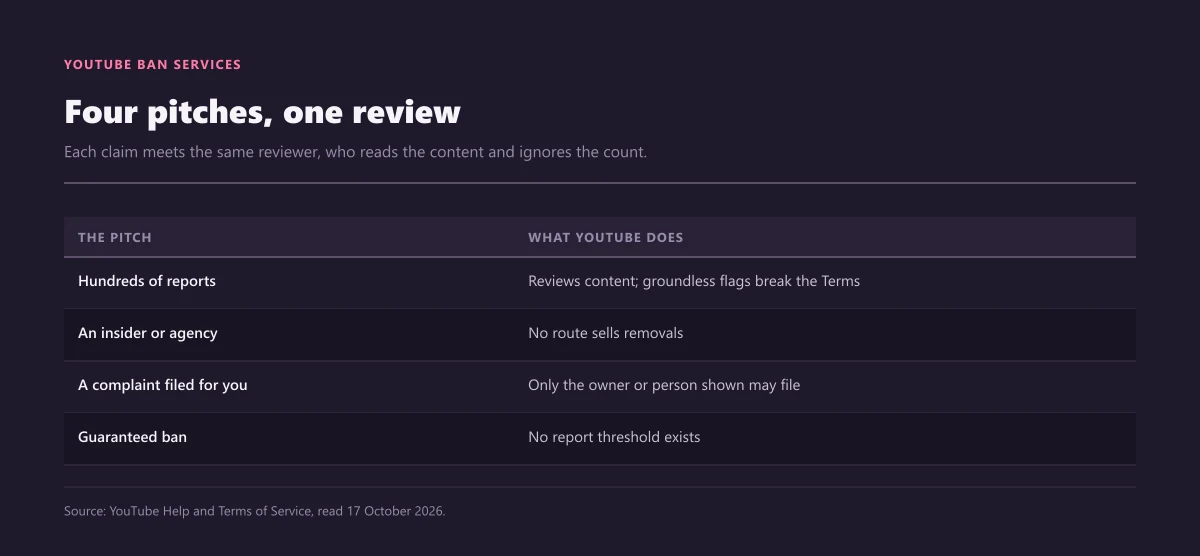
A YouTube ban service cannot buy a removal; YouTube decides every case through its own routes. A copyright removal request or privacy complaint targets single videos, while a whole channel goes only after three Community Guidelines strikes in 90 days, one severe violation, or a channel built to impersonate. Report counts do not decide it.
What is a YouTube ban service, and what can it touch?
A YouTube ban service is a paid helper that claims it can get videos or channels removed; the honest version only prepares reports for YouTube's own forms.
Sellers use the phrase for two very different things. Some sell volume: hundreds of flags against a channel, delivered by accounts that have never watched it. Others sell paperwork, meaning help with the forms YouTube already offers to people with a real complaint. Only the second can lead anywhere, because a reviewer at YouTube reads the content against a named policy and does not tally reports.
Instagram Ban Service is an Instagram reporting desk, and YouTube questions reach it because abuse rarely stays on one app. A reuploaded clip, a stolen face or a copycat profile usually shows up on Instagram and YouTube in the same week. Our role on the YouTube side is narrow: identify which route fits, help you assemble the timestamps, links and proof, and explain what happens next.
YouTube makes the final decision on every report, and no outside party can change its outcome or its speed.
Which official routes lead to a YouTube video takedown?
Three routes can remove a single video: the copyright removal request, the privacy complaint, and a Community Guidelines report from the video's Report menu.
Each route has its own owner, its own form and its own test. Choosing the wrong one is the most common reason a valid complaint goes nowhere, so Instagram Ban Service starts every YouTube question by naming the route.
- Copyright removal request. For your own footage, music or images reused without permission. YouTube's page on how to submit a copyright removal request says the copyright owner or an authorised agent files it, and owners with access can file from YouTube Studio under Content detection, then Removal requests.
- Privacy complaint. For a video that shows your face, full name, contact details or other information that identifies you. YouTube's Protecting your identity page asks you to contact the uploader first, and then lets the person shown, or a legal representative, file through the Privacy Complaint Process.
- Community Guidelines report. For harassment, scams, hate, threats or impersonation. Anyone can flag the video from its three-dot menu, as YouTube's report inappropriate content guide explains.
Defamation and other legal claims use the Legal issue option in the same menu, described on YouTube's Other legal complaints page for the United States. A YouTube video takedown through any of these routes removes or restricts that video only; the rest of the channel stays up.
Why does YouTube video removal not end the channel?
Because YouTube judges a channel by its strike record and purpose, not by a single upload.
YouTube video removal and YouTube channel removal run on different rules. A removed video can leave a strike behind, and strikes are what add up. According to YouTube's Community Guidelines strike basics, a first violation usually brings a warning, a first strike blocks uploads for one week, a second strike within 90 days blocks them for two weeks, and three strikes inside the same 90 days can lead to the channel being permanently removed.
Two exceptions cut that path short. A single case of severe abuse can end a channel without a warning, and so can a channel dedicated to breaking a policy, such as one built to impersonate someone.
Copyright follows a parallel track. YouTube's page About copyright removal requests notes that you cannot submit a copyright removal request for an entire channel or playlist; each video is listed on its own. So a channel that reuploads your work is reached one video at a time, and only the strikes those removals create can end the account.
When is a YouTube channel takedown realistic?
A YouTube channel takedown is realistic when the channel itself exists to break a rule: impersonation, scams, spam networks or repeated harassment of one person.
Impersonation is the clearest case. A channel copying your name, photo and banner to pose as you breaks YouTube's impersonation policy as a whole, so the report targets the channel, not one clip. From the channel page, open About, choose the report option and pick the impersonation reason.
Repeat offenders are the second case. A channel that keeps posting the same harassing or scam content collects strikes, and the three-strike rule does the rest. That route needs patience, because each video gets its own review.
A channel you simply dislike is not a case at all. Criticism, bad reviews of your business, parody that is labelled as parody and a rival's honest content all stay up, and Instagram Ban Service will not file against them. The service also declines fake reports, report bots, requests to report from bought accounts and any job that asks for your password or two-step code.
If the same person runs a fake profile on Instagram, the matching job there is an Instagram account takedown for impersonation or fraud, filed through Instagram's own forms.
How does a takedown video YouTube case run from first message to filing?
It runs in four steps, and the person harmed files YouTube's owner-only forms with our help rather than through us.
People often search "takedown video youtube" when a clip of them has just gone up. Instagram Ban Service handles each one the same way. First, we ask for the video and channel links, the upload dates, and proof of the problem: your original file with its date, or a photo that shows the video identifies you. Second, we match the problem to one route from the list above and say plainly if none fits. Third, you submit the form, because YouTube accepts copyright and privacy claims only from the owner, the person shown or a legal representative, while we check your wording and timestamps. Fourth, if the same person posts on Instagram, we file there, where reporting by a helper is part of the official process.
Copyright claims carry legal weight. A false one can expose the sender to liability, so we never file one for footage you do not own.
For questions about whether helpers are worth paying at all, our review of which recovery services are legitimate and which are scams sets out the warning signs.
The same content is on Instagram too: what is the matching route?
Instagram has its own forms for the same harms, and some of them accept reports from people who are not logged in.
A reuploaded video on Instagram calls for the Instagram copyright strike process, which mirrors YouTube's owner-only rule. A photo or clip of you posted without consent belongs in the guide for when someone posted a picture or video of me on Instagram, and defamation or court orders go through the Instagram legal removal request.
Instagram also runs enforcement in sweeps, which can catch innocent accounts; our note on the latest Instagram ban wave explains how those sweeps look. Reporting someone does not put your own account at risk when the report is true, and the habits that keep your account clear of a ban cover the rest. A limit notice is a different thing again: read what "we restrict certain activity" on Instagram means before assuming a ban.
Instagram Ban Service files on Instagram only for content that breaks its Community Guidelines or the law.
What if your own account was the one removed?
Then the job is an appeal, and both apps keep appeals inside their own tools.
On YouTube, a creator can appeal a strike or a termination from YouTube Studio. On Instagram, start with what the screen says: a disabled account on Instagram has a set appeal window, and the Instagram appeal form is where the request goes. If you were caught by mistake, the Instagram Ban Service Instagram unban service page explains what help is possible, and the steps to get back an Instagram account cover hacked and locked cases. Lost access to your login details is handled by contacting Instagram for account recovery, and a phone number linked to the Instagram account often decides which recovery path opens.
Handle theft causes a lot of these cases. Before paying anyone, use an Instagram handle checker, learn how to check Instagram username availability, and read the fix when a username is not available. The guides on getting the username you want, swapping usernames between two accounts and buying an Instagram username safely close the loop.
Sources
- YouTube HelpCommunity Guidelines strike basics on YouTube
- YouTube HelpSubmit a copyright removal request
- YouTube HelpAbout copyright removal requests
- YouTube HelpOther legal complaints, United States
Frequently asked questions
Can a YouTube ban service guarantee a channel is removed?
No. YouTube decides every removal after reviewing the content against its Community Guidelines, its copyright rules or its privacy policy, and it publishes no report threshold that forces a ban. A YouTube ban service that promises a result is selling volume, and groundless flags break YouTube's Terms of Service, so they can put the reporting accounts at risk instead of the target. What a legitimate helper can do is narrower: identify the route that fits, help gather the links, dates and proof that route needs, and explain the strike system so you know what to expect. Under YouTube's strike basics, a channel faces permanent removal after three strikes within 90 days, after one severe violation, or when it exists only to break a policy. Instagram Ban Service works only on that basis, never asks for your password, and turns down channels that follow the rules.
How does a YouTube video takedown for copyright work?
A YouTube video takedown for copyright starts with a copyright removal request filed by the owner of the work or an authorised agent. YouTube's Help page on submitting a copyright removal request describes the webform, and owners with Studio access can file from Content detection, then Removal requests. You identify your original work, list each infringing video by its link, and confirm under legal penalty that the claim is accurate. You can also schedule the request to take effect in 7 days, which gives the uploader time to remove the video and avoid a strike. A request cannot name a whole channel or playlist, so each video is listed separately. Because the claim is a legal statement, a false one can create liability for the sender. Instagram Ban Service helps prepare the evidence and wording, but the owner submits the form.
What gets a YouTube channel removal instead of single videos?
A YouTube channel removal follows the channel's record and purpose. Under YouTube's Community Guidelines strike basics, three strikes in the same 90-day period can lead to permanent removal, and a first strike already blocks uploads for one week. A single severe violation can end a channel without warning, and so can a channel dedicated to breaking a policy, such as one set up to impersonate a person or brand. Copyright works in parallel: removals create copyright strikes, and repeated strikes can also end the account. Single complaints, even many of them, do not jump this ladder. That is why a report against one offensive clip removes the clip while the channel stays up. If you are dealing with an impersonating channel, report the channel from its About page using the impersonation reason, because the whole channel is the violation in that case.
Is a YouTube channel takedown possible for impersonation?
Yes, when the channel is genuinely built to pose as you or your brand. YouTube treats a channel that copies another person's name, image or identity to mislead viewers as an impersonation violation, and the report covers the channel rather than one upload. Open the channel, go to its About section, choose the report option and select impersonation; YouTube may ask the person impersonated, or a representative, to confirm identity. Fan channels that clearly say they are unofficial, parody that is labelled, and accounts that merely share a common name are not impersonation and stay up. A YouTube channel takedown on these grounds still rests on YouTube's review, with no fixed timeline published. Instagram Ban Service helps you collect the matching evidence, such as your original profile, the copied banner and dates, and files the equivalent Instagram report if the impersonator also runs an Instagram account.
Who can file a takedown video YouTube privacy complaint?
Only the person who is uniquely identifiable in the video, or their legal representative, can file one. People type "takedown video youtube" when footage of them appears without consent, and YouTube's Protecting your identity page sets out the route. First, try asking the uploader to remove it. If that fails or feels unsafe, open the video, choose More, then Report, select Legal issue and the privacy option, and complete the form. YouTube weighs whether you can be identified by your image, voice, full name or contact details, and it also considers public interest, newsworthiness and consent before deciding. For intimate images shared without consent, YouTube runs a separate webform and says it reviews confirmed cases within 48 hours. A friend or paid service cannot file a privacy complaint for you, which is why Instagram Ban Service only helps you prepare it.
Does YouTube video removal through mass reporting work?
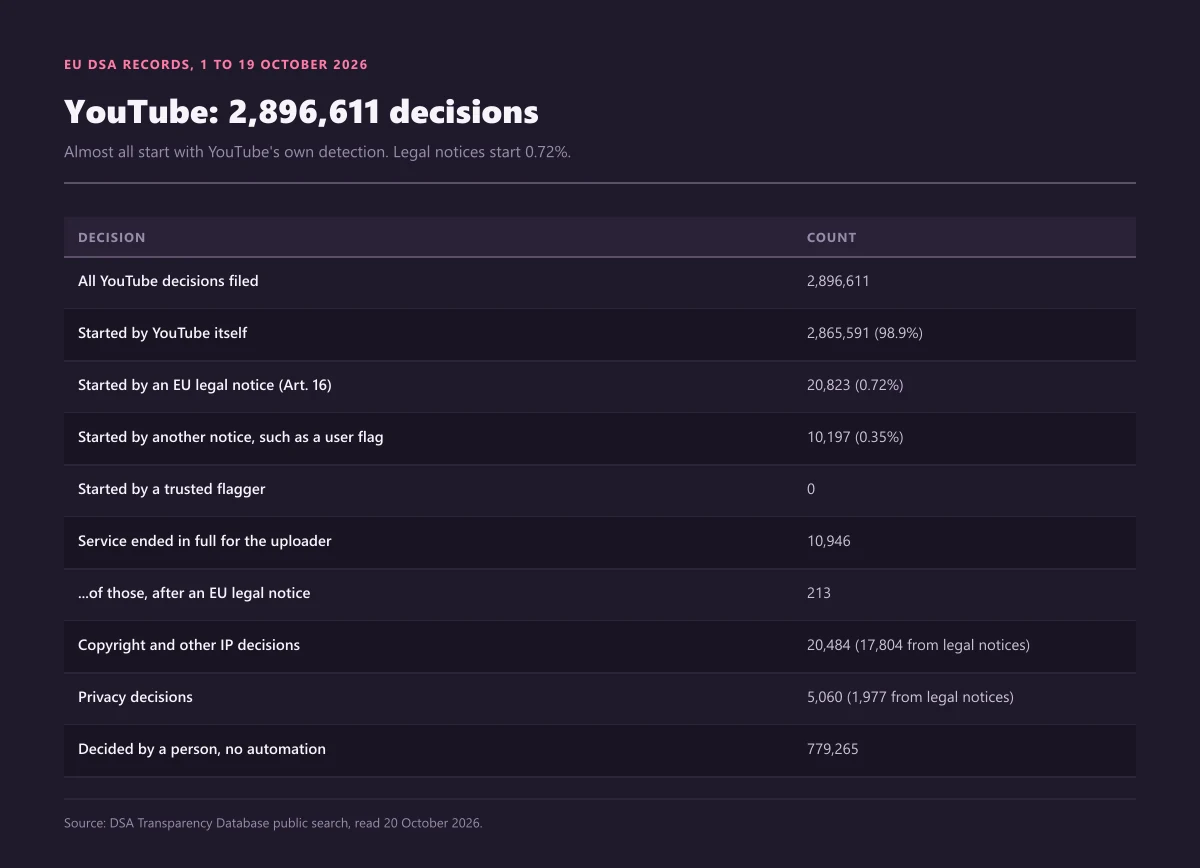
No. YouTube video removal comes from a reviewer matching the content to a named policy, and a pile of flags from accounts with no connection to the video adds no evidence. YouTube's Terms of Service forbid misuse of reporting tools, so coordinated false flags can bring penalties to the accounts that send them. Public data points the same way. YouTube's entries in the EU Digital Services Act Transparency Database for 1 to 19 October 2026 show 2,896,611 decisions, of which 98.9 percent started with YouTube's own detection and 0.35 percent started from notices such as user flags, as read on 20 October 2026. One accurate report on the correct route outweighs hundreds of empty ones. Instagram Ban Service declines every request to run, buy or resell report volume, on YouTube or anywhere else, and works only on content that breaks the rules.