YouTube enforcement · the five routes that reach a channel, who may use each, and what volume cannot do
How to get someone's YouTube channel banned, and who is allowed to ask
Two very different people type this search: someone being harassed, copied or impersonated by a channel, and someone who simply wants a channel gone. YouTube's Help Center, read on 12 November 2026, gives both the same answer about what can end a channel and who may ask for it.
How to get someone's YouTube channel banned comes down to one test: did the channel break a YouTube rule? A report only starts a review. YouTube ends a channel after three Community Guidelines strikes in 90 days, three copyright strikes in 90 days, one severe violation, or when the channel exists to impersonate or harass, and its Help Center says report volume cannot overturn a no-violation verdict.
Can you get someone banned from YouTube just by reporting them?
No. A report only puts content in front of a reviewer, and a video with no violation stays up whatever the count.
Most guides that promise to explain how to get someone banned from YouTube skip that point, but YouTube states it directly on its page about how to report inappropriate videos, channels and other content: when reviewers find nothing wrong, "no amount of reporting will change that." The reviewer reads the upload or the channel against a named policy. Ten flags and ten thousand flags meet exactly the same test.
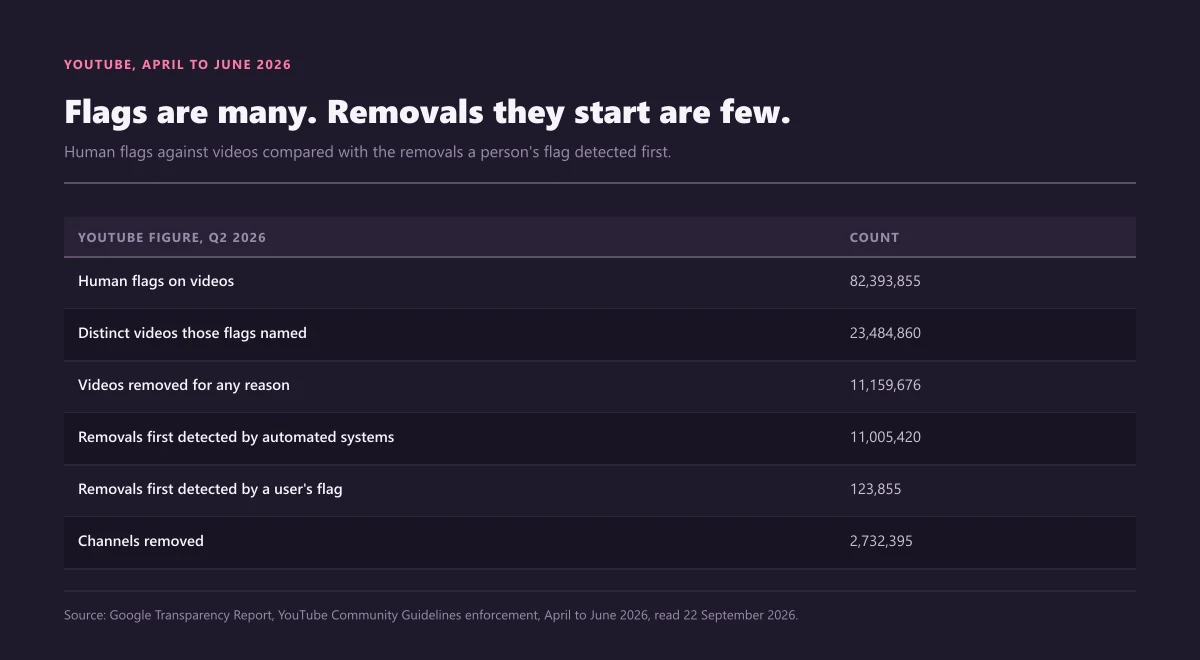
Google's published figures show how little the flag count carries. In the YouTube section of the Google Transparency Report for April to June 2026, people flagged videos 82,393,855 times, yet only 123,855 of the 11,159,676 videos removed that quarter were first detected by a user's flag, as read on 22 September 2026. Automated systems found nearly all the rest.
Instagram Ban Service is a reporting desk built around Instagram, and YouTube questions arrive because the person copying, threatening or posing as someone on one app is usually busy on the other. On YouTube its part is advisory: naming the route that fits, then getting the evidence into a shape a reviewer can check quickly.
So the better question is which rule the channel broke.
Which routes can actually end a YouTube channel?
Four things end a channel outright: Community Guidelines strikes, copyright strikes, one severe case, or a channel dedicated to a violation.
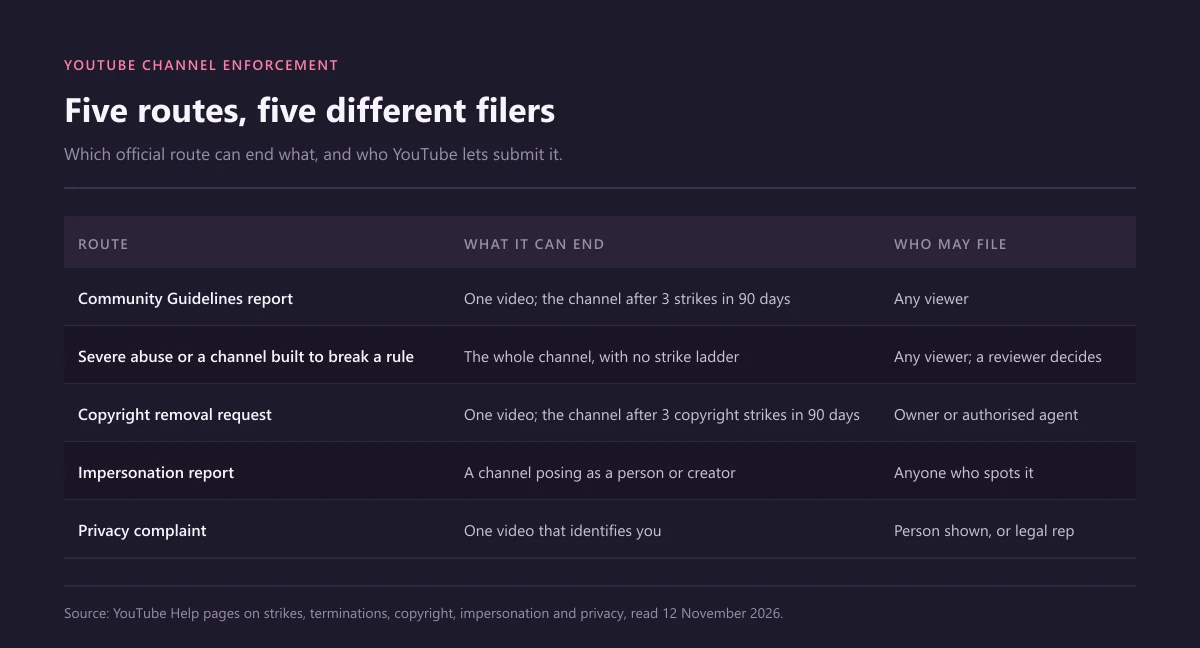
YouTube's page on channel or account terminations names three grounds on the Community Guidelines side. The first is repeated violations across any kind of content. The second is one case of severe abuse, with predatory behaviour, spam and pornography given as examples. The third is "dedication to a policy violation", which covers channels that exist for hate speech, harassment or impersonation. Copyright sits on a separate ladder with its own strike count, and privacy complaints reach single videos rather than whole channels.
| Route | What it can end | Who may file | What the filer needs |
|---|---|---|---|
| Community Guidelines report | One video now; the channel after three strikes in 90 days | Any viewer | The video link, the policy it breaks, a timestamp |
| Severe abuse | The channel at once, with no warning ladder | Any viewer | The upload or comment that shows the abuse |
| Channel dedicated to a violation | The channel as a whole | Any viewer; impersonation has its own report | Proof the channel's purpose is the violation, such as a copied identity |
| Copyright removal request | Each listed video; the channel after three copyright strikes in 90 days | The owner or an authorised agent | Your original work and every infringing link |
| Privacy complaint | The video that identifies you | The person shown or a legal representative | Proof the video shows your face, name or contact details |
Read that way, how to get someone's YouTube channel banned is a question about which row applies. A channel that is rude, wrong about you, or competing with your business falls outside every row. There is no route for it, which is the honest end of that search, and the point where Instagram Ban Service says no before any money changes hands.
Who is allowed to file each complaint against a channel?
Anyone may flag a Community Guidelines or impersonation problem, while YouTube keeps its copyright and privacy forms for the person whose rights were hit.
Routes open to any viewer
A Community Guidelines report starts under the video, through More and then Report, followed by the reason that fits. YouTube says reporting is anonymous, so the uploader cannot see who flagged them. For copycats, the YouTube impersonation policy says that if your channel or another creator's channel is being impersonated, you can report the channel, and it treats tricks such as adding "Official" or "Backup" to a creator's name, or a near-identical handle, as deceptive copying. Labelled fan channels are allowed.
Routes restricted to the rights holder
The copyright removal request comes from the copyright owner or an agent they authorised, and each infringing video is listed by its link. A privacy complaint under YouTube's Protecting your identity page comes from the person who can be identified in the video, or a legal representative, ideally after asking the uploader to take it down first.
A friend cannot file either form for you, and neither can a paid helper who is not your agent or lawyer. Instagram Ban Service therefore prepares these forms with you and never submits them in your name. YouTube's reporting page also carries a warning that abuse of its legal forms may result in the termination of the filer's Google Account.
How do strikes add up to a banned channel?
Strikes are counted in 90-day windows, and for most channels the third strike inside one window is the end.
On the Community Guidelines side, YouTube's strike basics page sets out the ladder. A first violation usually brings a warning. The first strike after that blocks uploads for one week, a second strike within 90 days blocks them for two weeks, and a third strike in the same 90 days can lead to the channel being permanently removed.
Copyright works in parallel. YouTube's copyright strike basics page says channels that get three copyright strikes in 90 days are subject to termination, and strikes on linked channels can count too. A strike can expire after 90 days once the channel owner completes Copyright School, provided the channel holds fewer than three. It can also disappear through a retraction by the claimant, or through a counter notification when the uploader believes the removal was a mistake or fair use. A scheduled removal request gives the uploader seven days to delete the video and avoid the strike.
That design explains why one report rarely ends anything, and why Instagram Ban Service talks to clients about patterns rather than single flags. The system warns first, then escalates only when confirmed violations build up.
Termination also follows the person. The terminations page says someone whose channel was removed may not use, own or create other YouTube channels, including ones they acquire or appear in prominently, so a replacement channel can be reported on that ground alone.
How to get someone banned on YouTube when the channel really breaks a rule
Match the harm to a single route, file it once with specific evidence, and leave the escalation to YouTube's strike system.
Here is how Instagram Ban Service handles a YouTube question that reaches it. The first message asks for the channel link, the links to the worst videos, their upload dates, and a short note on the harm: your footage reused, your face or name exposed, your identity copied, or a threat. The reply names one route from the table above, or says plainly that none applies. Where the route is a copyright or privacy form, you submit it yourself while the desk checks your wording, timestamps and proof before you send. Where the route is open to anyone, such as impersonation or harassment, you get the exact reason to choose and the evidence to attach.
One accurate report on the right form gives a reviewer more to act on than a thousand flags on the wrong one.
The Instagram side is where the desk files directly. If the same person runs an Instagram account that breaks Instagram's rules, those reports go through Instagram's official channels, and you can learn later whether a reported Instagram account was actually banned or how to check the outcome after you report someone on Instagram. When the person behind the channel also broke into your account, start with recovering the hacked Instagram account and the official ways to reach Instagram about account recovery.
What if the channel you want gone breaks no rule?
Then it stays up, and pushing harder mostly creates risk for you rather than for the channel.
A lot of people who type how to get someones youtube channel banned are angry at a critic, an ex, a rival creator or a business competitor. None of those is a violation by itself. Negative reviews, harsh commentary and parody that is labelled as parody remain on YouTube, and a reviewer who finds no breach closes the report.
The workarounds backfire. A copyright claim for footage you do not own is a false legal notice. A privacy complaint about someone else is not yours to file. Flags sent from bought or borrowed accounts break YouTube's Terms of Service, and the accounts doing the flagging are the ones exposed, while the target's channel is untouched.
Instagram Ban Service declines these jobs:
- channels, critics or competitors that follow YouTube's rules;
- copyright or privacy claims for work or people that are not yours;
- report bots, report panels and flagging from bought accounts;
- any request that involves your password or a two-step code;
- any promise of a ban or a deadline, which no outsider can give.
If your worry runs the other way, and your own accounts are exposed to false reports, the habits that keep an Instagram account clear of a ban are a sensible place to start.
When the dispute is really about an Instagram account or username
Many YouTube feuds begin on Instagram: a profile disabled after a pile of reports, a hijacked account, or a fight over a handle.
If your own profile went down, read what a disabled account on Instagram notice means and how the appeal window works. A ban that looks final is covered in the guide to recovering a permanently disabled Instagram account, and a rejected appeal in what is still possible after a failed appeal. For anything else that needs Instagram staff, the Instagram support request routes page lists the forms that exist.
Handle disputes drive a surprising share of these cases, since a person who wants your name on one app often wants it on all of them. Before paying anyone, try an Instagram username checker, learn how to check Instagram username availability by hand, and browse how to find an available Instagram name. The guides on getting the username you want on Instagram, the options when the username is already taken and the IG username not available message explain the rules, while claiming an Instagram username through official channels and swapping usernames between two accounts you control cover the legitimate moves. Dormant names are a separate question: whether Instagram deletes inactive accounts. Paid transfers carry scam risk, which the pages on buying an IG handle and how to buy an Instagram username without being scammed set out.
The Instagram Ban Service desk files Instagram reports only for content that breaks Instagram's Community Guidelines or the law; Instagram makes the final decision.
Sources
- YouTube HelpChannel or account terminations
- YouTube HelpImpersonation policy
- YouTube HelpCommunity Guidelines strike basics on YouTube
- YouTube HelpCopyright strike basics
- YouTube HelpSubmit a copyright removal request
Frequently asked questions
How to get someone banned from YouTube without breaking the rules yourself?
Report only what breaks a published policy, use the route that matches it, and file once with specifics. That is the whole method for how to get someone banned from YouTube legitimately. A Community Guidelines report from the More menu, then Report, puts a video or channel in front of a reviewer, and a copyright removal request or privacy complaint does the same for owners and for people shown in a video. The reviewer checks the content against the named policy, so a precise timestamp and reason matter far more than repetition. Breaking the rules looks like the opposite approach: flagging from several accounts, asking friends to pile on, or filing a copyright claim for work you do not own. YouTube warns that abuse of its legal forms can cost the filer their Google Account. If the content is within the rules, the honest outcome is that it stays up, and no paid helper can change that.
How do I get someone's YouTube channel banned for impersonating me?
Report the channel itself for impersonation, because a channel built to pose as you is a violation as a whole. YouTube's impersonation policy covers channels that copy another person's or creator's name, branding, content or handle to mislead viewers, including adding words like Official, Real or Backup to a name, or using a near-identical handle. The policy page links a dedicated impersonation report for channels and says you can use it when your channel, or another creator's, is being copied. Gather the original channel link, the copy's link, and screenshots of the copied banner, avatar and description with dates. YouTube's terminations page lists impersonation as an example of a channel dedicated to a policy violation, which can end the channel without waiting for three strikes. Fan channels that say they are fan channels are treated differently, so a clearly labelled tribute is unlikely to come down.
How many reports does it take to get a YouTube channel banned?
There is no number. YouTube does not count reports toward a ban; it counts strikes, and a strike comes only from a reviewer confirming a violation. Its reporting help page says content without a violation remains on the site no matter how often it is reported. The thresholds that do exist are about strikes: three Community Guidelines strikes inside the same 90-day window, or three copyright strikes within 90 days, can lead to termination, and a single severe case can end a channel at once. Public data agrees. In the Google Transparency Report for April to June 2026, read on 22 September 2026, human flags on videos reached 82,393,855, while removals first detected by a user's flag came to 123,855. A seller who quotes a report count as the price of a ban is describing a mechanism YouTube does not have.
Can I use a copyright claim to get someone banned on YouTube?
Only if you own the work they used, and only for the specific videos that use it. A copyright removal request comes from the copyright owner or an authorised agent, lists each infringing video by its link, and is made under legal penalty; YouTube does not accept one request for a whole channel. Each accepted request usually adds a copyright strike, and YouTube's copyright strike basics say three copyright strikes within 90 days make a channel subject to termination. The uploader can answer with a counter notification if they believe the removal was a mistake or fair use, and the claimant can retract the request at any point. Anyone weighing how to get someone banned on YouTube through copyright should know that a claim for content you do not own is a false legal statement. YouTube states that abusing its legal forms can lead to the termination of the filer's own Google Account.
Will the channel owner find out who reported them?
Not from an ordinary report. YouTube's reporting help page says reporting is anonymous, so other users cannot tell who made the report, and you can follow your own reports through Report history on a computer. That anonymity covers Community Guidelines flags sent from the More menu under a video or from a channel page. The legal routes are different in kind. A copyright removal request is a formal legal notice made under penalty, not an anonymous flag, and a privacy complaint can only come from the person shown in the video or their legal representative, so the filer is identified to YouTube. If safety is a concern, use the anonymous route where the content qualifies, and keep a dated log of links and screenshots in case the matter later needs a legal form or the police. Instagram Ban Service never needs your YouTube or Google login to help you prepare any of this.
Can someone just open a new channel after being banned?
Not under YouTube's rules. The YouTube Help page on channel or account terminations says a person whose channel was terminated is prohibited from using, possessing or creating any other YouTube channel. The restriction reaches channels the person creates or acquires and channels in which they are repeatedly or prominently featured, and it also bars letting a terminated user work through someone else's channel. In practice a replacement channel can be reported on circumvention grounds before it posts anything harmful, as long as the report shows the link between the two: the same face or voice, the same branding, or an announcement that the old channel is back. Report it with the reason that fits and name the terminated channel in the details. YouTube still decides whether the link is clear, and some replacement channels do run for a while before a reviewer connects them to the original.
Can Instagram Ban Service get a YouTube channel banned for me?
No, and nobody outside YouTube can. People searching how to get someones youtube channel banned often meet sellers who promise exactly that, but YouTube makes every removal and termination decision after its own review. Instagram Ban Service works mainly on Instagram, where it files takedown reports through Instagram's official channels when an account genuinely breaks the Community Guidelines or the law. On YouTube the help is narrower: choosing the route that fits, organising the links, dates and proof, and explaining how the strike system escalates. Copyright and privacy forms are submitted by you, as the owner or the person shown, because YouTube accepts them only from those people. The desk declines channels that break no rule, critics and competitors, false copyright or privacy claims, report bots and bought accounts, and anything that involves a password or two-step code. It never promises an outcome or a timeline.