TikTok · third-party deletion · checked against TikTok Support and the Community Guidelines on 7 November 2026
How to delete someone else's TikTok account: what is possible, and what never is
Most results for this search explain how to close your own profile. This page takes the question as asked: the account belongs to someone else, and you want it gone. Every route below was checked against TikTok's own help pages on 7 November 2026.
How to delete someone else's TikTok account has a short answer: you can't. Deletion runs only from the owner's own Settings and privacy menu. Outsiders can report a real violation, such as impersonation or copyright infringement, and TikTok may ban the account; family can request deletion after a death, and an under-13 report can end an account.
Can anyone other than the owner delete a TikTok account?
No. The delete control sits inside the owner's own login, and TikTok describes no outside version of it.
Deletion on TikTok is a path only a logged-in owner can walk: Profile, the Menu button, Settings and privacy, then Account and Deactivate or delete account, as set out in TikTok's Delete your account article. Nothing on another person's profile starts that process. The same article sends anyone who suspects a user is underage to a separate report, which shows how TikTok frames the whole problem. Outsiders report. The platform decides.
Instagram Ban Service is a reporting desk for accounts that genuinely break platform rules or the law, and it works on the outsider's side of that line: it can document a violation, never press delete. Instagram follows the same logic, laid out in who can really remove another person's Instagram account. The owner-side steps covered there, such as closing an old Instagram profile you can no longer reach or reversing an Instagram deletion before its window closes, belong to the account holder and to nobody else.
So anyone asking how to delete someone else's TikTok account is really asking a narrower question. What can you prove, and which of TikTok's channels reads that kind of proof?
Deleted, deactivated, banned or content removed: which do you mean?
They are four different outcomes with four different triggers, and only one of them is ever in an outsider's reach.
| Outcome | Who triggers it | What others see | The way back |
|---|---|---|---|
| Deactivated | The owner | No profile and no videos | Log in and tap Reactivate |
| Deleted | The owner, a legacy contact, or TikTok on a verified family or under-age request | The account is gone | None described for outsiders |
| Banned | TikTok, after a violation | Not stated publicly; the owner sees a message in the app | The owner can appeal |
| Content removed | TikTok, after review or a rights report | One video is gone; the account stays | Appeal from the in-app notice |
| Memorialized | TikTok, on a family request or credible confirmation of death | Profile and videos stay visible | Nobody can log in again |
Most people typing this search want row three or four and say row two. The difference decides everything that follows. TikTok's enforcement page says a banned user will "see a message in the app" and may appeal, with the status shown in the in-app Safety Center, so a ban is a decision with a review path rather than an erasure. A profile that vanishes can just as easily be a deactivation: the Deactivate your account article says "No one will see your content or profile" until the owner logs back in, which means silence proves very little from outside. Instagram Ban Service cannot look the state up either, since the notice appears only to the owner.
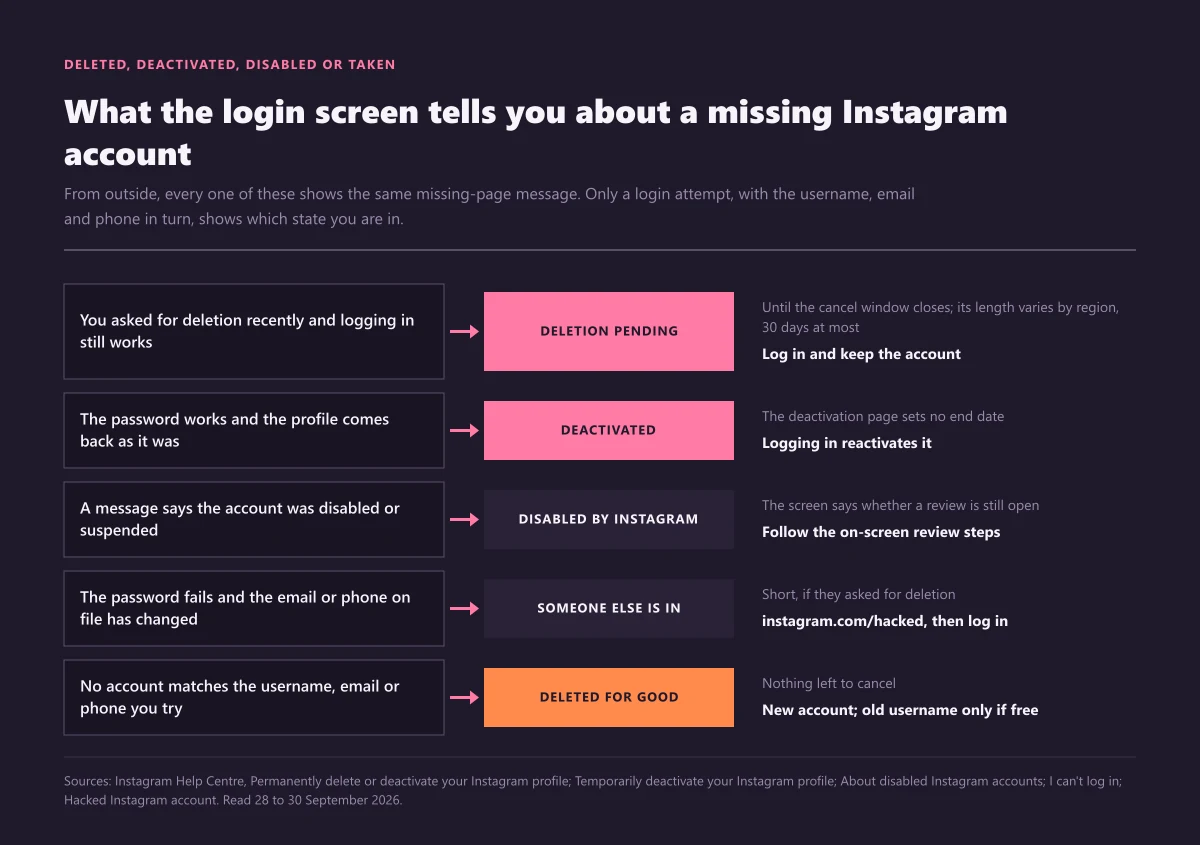
The Instagram side is worth comparing: what a disabled notice on Instagram actually means, the lighter Instagram limit on certain activity, why disabling errors tend to arrive in waves and whether Instagram ever clears out dormant accounts.
What can an outsider actually get TikTok to review?
Four kinds of report: impersonation, intellectual property, harassment or privacy, and age. Each one needs a fact you can show.
The enforcement page explains the order of events. Content first passes automated review, and additional review happens when content "gains popularity or has been reported". A report asks for a second look; it is not a vote. TikTok's Community Guidelines Enforcement Report for April to June 2026 puts 99.5% of violative videos as removed before anyone reported them, which leaves user reports a narrow but real job: pointing reviewers at what the automated pass missed. Searches for how to get someone else's tiktok account delete action usually land on one of the four routes below.
How to get someone else's TikTok account delete review started when it pretends to be you
Impersonation is the strongest outsider route, because the fact at stake is about you. TikTok's impersonation article gives this in-app path:
- Open the profile and tap the Share button at the top.
- Tap Report, then Report account.
- Select Pretending to Be Someone.
- Choose Me if it copies you, or Celebrity if it copies someone else, then tap Submit.
Separate web forms exist for accounts in the U.S. and outside it. The U.S. form asks for valid identification and an electronic signature; the other one runs through the topic Report a potential violation, the category Account violation and the reason Impersonation. A profile that merely annoys you, or shares your name, is not impersonation.
Copyright and trademark claims
The Intellectual Property Policy says TikTok runs a repeat infringer policy under which it will, "in appropriate circumstances", ban an account that repeatedly infringes copyright, and it may ban at once for severe violations. Most claims still remove a video, not a person, and TikTok may pass the copyright owner's name to the user. Instagram handles rights claims the same way, as the guide to taking down an Instagram post or account shows. Instagram Ban Service only files a rights claim for the owner of the work or their representative.
Harassment, threats and private information
Report the specific video, comment or account in the app and pick the reason that really matches. One precise report naming the post and the rule beats a pile of vague ones; that is the same lesson as the myth of a report count that deletes Instagram accounts, and the route from report to disabled account on Instagram shows what review weighs.
Users under the minimum age
The underage account article uses Report, then Report account, then User could be under 13 years old. Without the app, the online form takes the topic Report an underage user. A parent who wants TikTok to delete the account of a child under 13 can use that form; in the U.S. the article sends parents to a privacy webform instead.
Who files after a death or a crime?
Family members and legacy contacts file after a death; police and courts file when a crime is involved. In both cases the request is theirs to make.
Family and legacy contacts
Managing TikTok accounts after death says TikTok can memorialize or delete a deceased user's account, and the process "typically begins with a request from a family member or legal guardian". The requester must provide three things: their relationship to the deceased user, proof of death, and proof that the deceased owned the account. TikTok points such requests to its online form for deletion and memorialization requests. If the owner chose a legacy contact, TikTok honours that choice, and a contact holding the right permission can request deletion. Owners who are at least 18 can instead pick delete-after-death in Account legacy, so check that first.
Nobody inherits the login. A legacy contact cannot sign in or read messages, and a memorialized profile accepts no new log-ins at all.
Police and courts
Threats, extortion and child safety cases belong with the police, who use the TikTok Law Enforcement Guidelines. Those guidelines say TikTok will not answer user-data requests from non-law-enforcement officials or through informal channels, so a private person cannot pose as one. Keep the profile URL and dated captures before you report, because a removed account takes its evidence with it. Instagram Ban Service does not stand in for a family or an officer on either route.
Why are login requests and paid deletion services a trap?
Anyone selling the deletion of a named account is offering false reports, a bot, a stolen login or nothing at all.
None of those four can do what the seller claims. Report volume does not settle a case, because review compares the account with the Community Guidelines. A bot only repeats one report from many accounts, and the people who run such tools usually ask for your own logins or a payment up front. The stolen-login version is worse. Logging in to someone else's account without permission is unauthorised access in many countries, including the U.S. under 18 U.S.C. 1030 and the UK under section 1 of the Computer Misuse Act 1990, and a remembered password from a past relationship is not permission.
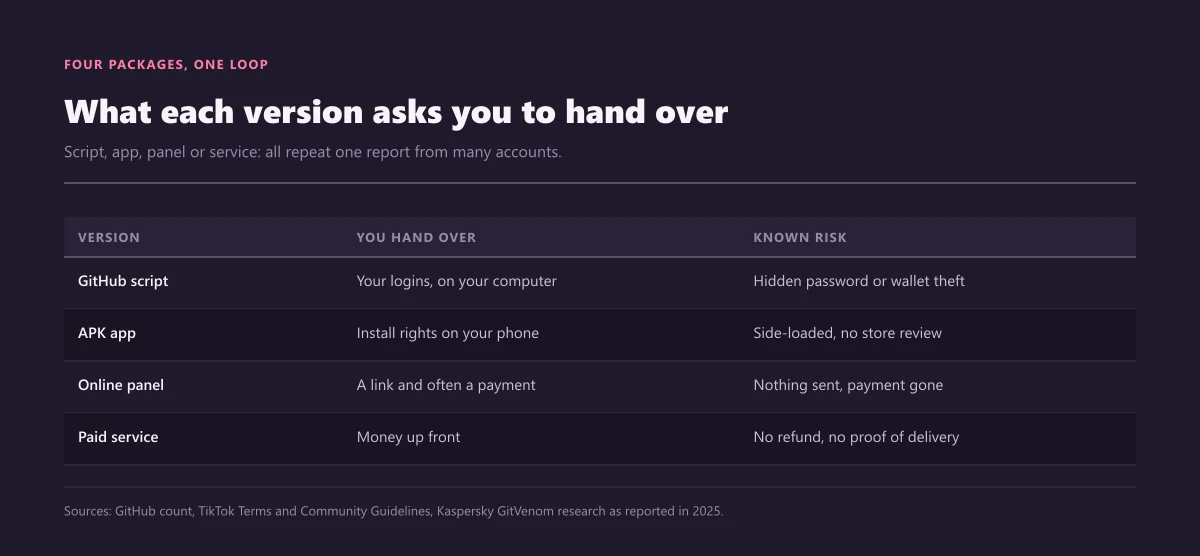
This desk declines every one of these requests, whatever the reason given for them.
Is the real goal the username?
Sometimes the account is not the target at all; the handle is. Deleting its holder is the wrong plan for that.
TikTok's Inactive Account Policy says that after 180 days without use, a username "may be reset to a randomized numeric username", and that a valid request such as a trademark infringement notice can also reset one. It adds that "In most instances, we cannot reassign a username", and that inactive users are not blocked or removed. So a quiet account is not a broken rule, and a report written to pry a name loose has nothing behind it. Instagram Ban Service treats that kind of request as a grudge case and turns it down.
Instagram's handle rules run along the same lines, and these pages test them:
- Fixing the "username not available" message on Instagram and checking whether an Instagram username is free.
- Why a dormant Instagram username has no release form and what you can legitimately try for a taken Instagram name.
- What an outside Instagram name checker cannot see, and the rename order for swapping two usernames you own.
- Before any money moves: how an IG handle handover works and what it risks and why Instagram itself sells no usernames.
What this desk files, and what it declines
Only cases with a real rule or right behind them, sent through TikTok's own forms. Anything aimed at a lawful account is refused at the first message.
Instagram Ban Service starts from the evidence, not from the account name. You send the TikTok profile link, the videos or messages involved and the date you first saw them. The desk then checks three points in order: which Community Guideline or legal right the material breaks, whether you are the person targeted, the rights owner or someone acting for them, and whether TikTok's free in-app report would already cover it. If the free report is enough, you are told so and the case stops there. If it is not, the desk assembles a single file of dated captures, exact URLs and the cited rule, and submits it once through the matching TikTok channel, such as the impersonation or copyright form. TikTok then decides, on its own schedule, so no result or timeline is offered.
Refused at intake, every time:
- A TikTok account whose only fault is that someone dislikes it, whether a critic, a rival creator or an ex.
- Report bots, waves of reports, duplicate filings or fake reporting accounts.
- Logins of any kind: no passwords, no 2FA codes, no shared sessions.
- Requests to promise a ban, a deletion or a date.
Sources
- TikTok SupportDelete your account
- TikTok SupportDeactivate your account
- TikTok SupportManaging TikTok accounts after death
- TikTok SupportReport an underage account on TikTok
- TikTok SupportReport an impersonation account
- TikTok SupportInactive Account Policy
- TikTok Community GuidelinesEnforcement
- TikTok Transparency CenterCommunity Guidelines Enforcement Report, April to June 2026
- TikTok LegalIntellectual Property Policy
- US Code, via Cornell LII18 U.S.C. 1030, computer fraud and related activity
- UK legislationComputer Misuse Act 1990, section 1
Frequently asked questions
Can you delete someone's TikTok account without their password?
No, and having the password would not make it lawful. Deletion on TikTok runs from inside the owner's own Settings and privacy menu, so without a login there is no control to reach, and TikTok gives nobody else's login to anyone, not even a legacy contact after a death. What exists without a password is a request for TikTok to review something. That works when you hold a real fact: an account pretending to be you, a video using your copyrighted work, a user under the minimum age, or a relative who has died. Each of those routes ends with TikTok deciding, not with you pressing delete. A website or seller claiming to skip that review is offering false reports, a bot or a stolen login, and every one of those exposes the buyer far more than the account they wanted gone. Report through the app or TikTok's own web forms instead.
How to get someone else's TikTok account delete request approved after a death?
A family member or legal guardian can ask, and it is the one case where a third party can request deletion directly. TikTok's article Managing TikTok accounts after death says the requester must show their relationship to the deceased user, proof of death, and proof that the deceased owned the account, and it points to an online form for deletion and memorialization requests. Check two things first. If the person named a legacy contact, TikTok honours that choice, and only a contact with the right permission can ask for deletion. If the owner chose delete-after-death in their Account legacy settings, the decision was already made. Memorialization is the gentler alternative: the profile and videos stay visible, but nobody can log in, post or message the account. The request is free, and no outside service needs to be involved, because the verification is personal to the family.
Is there a number of reports that gets a TikTok account banned?
No published number does it. TikTok's enforcement page says content first goes through automated review, and that additional review happens when content gains popularity or has been reported, so a report triggers a closer look rather than counting toward a threshold. In the Community Guidelines Enforcement Report for April to June 2026, TikTok put 99.5% of violative videos as removed before anyone reported them. That means review is driven by what an account actually posts. One precise report that names the video, the date and the broken rule gives a reviewer more to work with than fifty vague ones from friends. Coordinated filing against an account that breaks nothing simply produces the same result as one report: nothing. Instagram Ban Service will not join a filing campaign of any size, because volume is not evidence and the accounts used for it are themselves at risk.
Can a parent delete their child's TikTok account?
Usually, yes. The simplest route is to sit down together and use the child's own Settings and privacy menu, then Account and Deactivate or delete account. If that is not possible and the child is under 13, TikTok's underage account article says a parent or legal guardian can ask TikTok to delete the account through the online reporting form; in the United States, parents are sent to a privacy webform instead. Anyone else who spots a likely under-age user can report it in the app by choosing Report account and then User could be under 13 years old, or use the form topic Report an underage user. The minimum age is 13 in most places, or another age set out in TikTok's Privacy Policy and Terms. A teenager above the local minimum falls outside this route, so talk the decision through with them.
How can I tell if a TikTok account was deleted, deactivated or banned?
From outside you usually can't, because all three can look the same: the profile simply stops appearing. TikTok's Deactivate your account article says no one will see a deactivated user's content or profile, yet the data is kept and the owner can reactivate by logging back in. A banned owner, according to TikTok's enforcement page, sees a message in the app and may appeal, so a ban can also be reversed. A memorialized profile is the exception, since its videos stay visible while nobody can log in. If you filed a report yourself, the in-app Safety Center shows the status of reports you have made. Do not try the owner's login to find out what happened; that is unauthorised access in many countries. If the account was harming you, keep your saved captures and URLs, because they matter more than its current status.
Is it illegal to log in to someone's TikTok and delete it?
Generally yes, when the owner has not authorised it. In the United States, 18 U.S.C. 1030 covers intentionally accessing a computer without authorisation and obtaining information from it. In the United Kingdom, section 1 of the Computer Misuse Act 1990 makes unauthorised access an offence. Other countries have comparable laws and the details differ, so take local legal advice if this has already happened. A password saved on a shared phone or remembered from a past relationship is not permission to use it. The plan also tends to fail on its own terms, because TikTok keeps a My account has been hacked route in its help centre for owners who lose control of an account. Anyone who has been harmed by the account has lawful options: TikTok's impersonation, copyright and safety reports, and the police, who can make requests under TikTok's Law Enforcement Guidelines.