X (Twitter) · enforcement options, report forms and service limits
Twitter ban service: how X really enforces its rules, and what a takedown request can reach
Most offers for a twitter ban service sell the one thing X punishes: report volume. This page starts from X's own Help Center instead, read on 10 November 2026, and walks through what X does when a report lands, which form fits which problem, and where any outside service stops.
A twitter ban service can only file reports through X's official forms for accounts that break the X Rules. X then decides: it may limit a post's reach, require its removal, lock the account, set it to read-only or suspend it. X's enforcement page says suspension follows repeated violations or serious ones such as fraud, threats or privacy breaches.
What is a twitter ban service, if X decides every case?
It is a filing service, not an enforcement switch. It prepares reports for X's reviewers, and X's reviewers alone decide what happens.
The phrase covers two very different products. One kind of seller takes money to aim fake or coordinated reports at an account, which X's authenticity policy names as platform manipulation: it forbids operating multiple accounts to manipulate the prominence of content or to misuse engagement features. The other kind reads the X Rules, finds the policy an account actually breaks, and files the report X built for that policy with evidence attached.
Instagram Ban Service belongs to the second kind and runs the same method on X that it uses for Instagram. That method is described in the Instagram account takedown process, and the warning signs of the first kind are laid out in our breakdown of report apps, bots and panels.
Short version: a report is a request for review, never a verdict.
The buyer should judge any seller by what it files, under which policy, and in whose name. A seller who cannot say which X policy applies to your case has nothing to file, and the same test sorts honest recovery offers from fake ones in our check of recovery services.
How does X enforce its rules, from one post to a whole account?
X acts at three levels: the single post, the direct message, and the account. Most reports end at the post level.
X's enforcement options page lists the tools. For a post, X can limit its visibility, which can mean dropping it from search, trends and timelines or restricting replies and reposts; since April 2023 such posts can carry a label telling the author and viewers that reach was limited. For a severe violation, X requires the author to delete the post before they can post again, and the post sits behind a notice in the meantime. For direct messages, a report stops the reported account from messaging the reporter.
Suspension, read-only and locked accounts
Account-level action is narrower than sellers imply. X suspends accounts for repeated violations or for breaches that create significant risk, such as fraud, privacy violations, violent threats and targeted harassment. Below that sit read-only mode and a lock held until the owner verifies a phone or email. Instagram Ban Service reads every outcome on this ladder before calling anything a ban, and the "we restrict certain activity" notice is its closest match to read-only mode.
Which X report form fits an x account takedown?
The problem picks the door. Abuse, impersonation, private information and copyright each run through a different report, and each expects different proof.
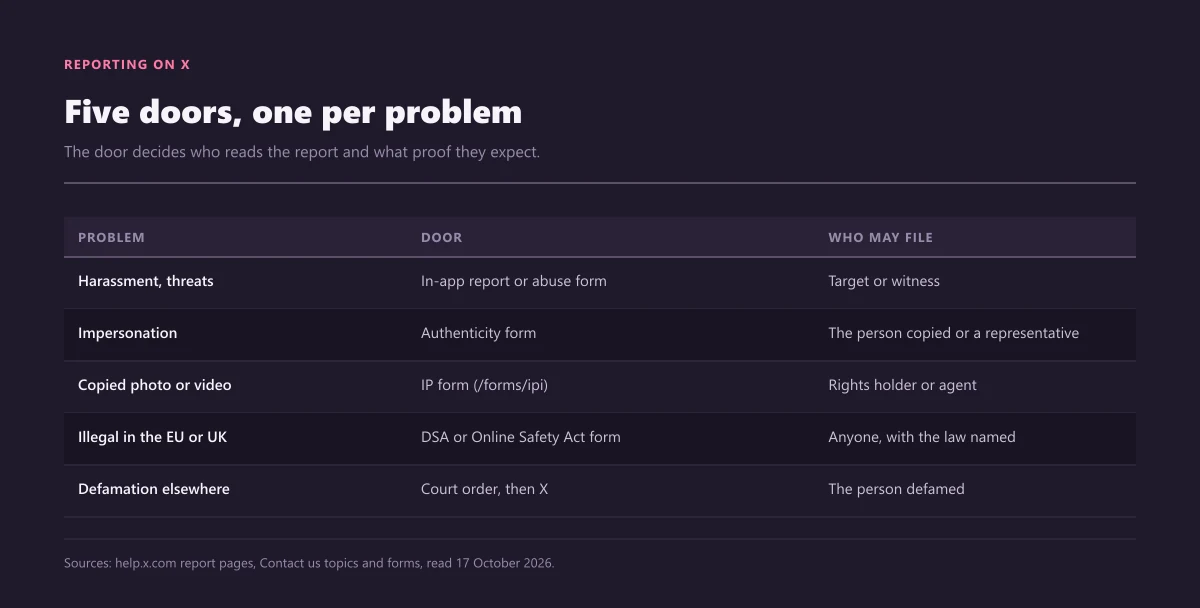
| Problem | Where it is reported | What X expects |
|---|---|---|
| Harassment or threats | Report option on the post or profile | Links to the posts; the target or a witness may report |
| Account posing as you | Authenticity (impersonation) report | Proof it is you or your brand; compliant parody accounts are allowed |
| Your address, phone or ID posted | Private information report | The posts that expose the details |
| Your photo or video reused | Copyright complaint under the DMCA | A rights statement; the poster may counter-notify |
| Content unlawful in one country | Legal request route | A named law; X may withhold the post in that country only |
Parody needs care. X's authenticity policy lets parody, commentary and fan accounts stay if they carry a PCF label, avoid an identical avatar and put words such as "parody" or "fan" in both the name and the bio. An account that meets all four is not an impersonator, and an x account takedown filed against it will fail. Copyright has its own limits too: X's copyright policy notes that not every unauthorised use is infringement, and it sends brand-name complaints to the trademark policy instead. Filing under the wrong door rarely fails loudly. X simply finds no breach of the policy you named and closes the report, while the same evidence filed under the right policy might have been enough.
How a twitter account takedown service handles a case
In four steps: confirm the violation, pick the policy, file once with evidence, then follow the decision.
- Read the account against the X Rules. If no policy is broken, the file closes there and the client is told why.
- Name one policy per report. A twitter account takedown that cites impersonation and harassment at once reads as noise; two clean reports read as two cases.
- Collect what that policy needs: post URLs, dated captures, the original of any copied media, and, for impersonation, the proof of identity X asks the person copied to supply.
- File through X's own report or form, in the client's name or as the authorised representative, then watch for the outcome and any counter-notice or appeal.
Instagram Ban Service files the report; X makes the final decision, and nothing in this process changes how quickly X reviews it. That is why the intake asks for the evidence before any filing rather than after. The same order applies on Instagram, where the evidence thresholds are set out in what makes an Instagram ban permanent. A twitter account takedown service that skips step one is not saving you time. It is filing reports X will reject, and a run of rejected reports from one source is exactly the pattern a reviewer learns to discount.
What an x ban service should refuse
Anything aimed at an account that follows the rules, and any method that breaks them.
An honest x ban service turns away more requests than it files, and the refusals follow a pattern. Accounts belonging to critics, competitors, ex-partners or reviewers who posted lawful opinions are declined, because X gives reviewers nothing to act on. Requests for bulk reports, bot networks or report panels are declined, because coordinated reporting is itself the platform manipulation X prohibits and the accounts doing the reporting are the ones exposed. False copyright claims are declined, because a DMCA notice is a legal statement made under penalty of perjury in the United States.
Instagram Ban Service never asks for a password or two-factor code and gives no guaranteed outcome or deadline. Volume decides nothing here either, a point made in our look at Instagram ban waves. The opposite case, keeping your own account safe from false flags, is covered in how to avoid being banned on Instagram.
X and Instagram enforcement side by side
Both platforms act on reported behaviour, never on report counts, but the vocabulary and the appeal routes differ.
On X the account-level words are suspended, read-only and locked. On Instagram the matching outcomes are a disabled account, restricted activity and a security checkpoint, and the disabled account explainer walks through what Instagram means by each. Appeals differ too. X takes suspension appeals through the platform or a report; Instagram routes them through its own review screens, set out in the steps to unban an Instagram account and in what an Instagram unban service can and cannot do. Instagram Ban Service treats the two platforms as separate files for that reason: evidence that won an Instagram review is re-read against the X Rules before it goes anywhere near an X report, because the policies are worded differently and a reviewer checks the policy named.
Usernames are the other big difference. X has no public process for claiming a handle someone else holds, apart from trademark and impersonation complaints. Instagram is similar, and the honest paths are laid out in claiming an inactive Instagram username, getting the username you want, checking whether a handle is free and our Instagram handle checker. People asking whether Instagram frees up dormant names should read whether Instagram deletes inactive accounts and why a username shows as not available before they pay anyone. Trading handles carries its own risk, explained in swapping usernames between two accounts and the rules on buying a username.
If the suspended account is yours
Appeal it yourself through X first. An appeal needs your login, and no outside service should hold it.
X says owners can appeal a suspension through the platform interface or by filing a report, and a lock clears once the owner completes the phone or email challenge. Neither step needs a third party. Write the appeal in plain terms, name the post X cited if it cited one, and say what you changed. If you were hit by a wave of reports and believe X erred, say that too; X reviews the account, not the number of reports.
Many people searching for a twitter ban service are also locked out of an Instagram account at the same time. For that side, getting an Instagram account back and contacting Instagram about recovery list the official routes. To open a file on an X account that genuinely breaks the rules, send the profile link, the post links and the policy you think applies through the case intake desk, or browse every reporting guide on Instagram Ban Service.
Sources
Frequently asked questions
What does a twitter ban service actually do on X?
A twitter ban service prepares and files reports through X's own channels for accounts that genuinely break the X Rules, and then follows what X decides. In practice that means three jobs. The first is matching the problem to the right door: the in-app report for harassment or threats, the authenticity report for an impersonator, the private information report for doxxing, and the copyright form for stolen photos or video. The second is building the evidence each door expects, such as post links, dated captures, a rights statement or proof that the account copies you. The third is following the decision, including the appeal X allows on most actions. Instagram Ban Service works this way on X as it does on Instagram. What it cannot do is press a button inside X, speed a review, or remove an account that follows the rules, because only X's own reviewers decide enforcement.
Is an x ban service legal to use?
Hiring someone to help you file accurate reports is legal in most places, and X's forms let a representative act for the person harmed or the rights holder. What turns an x ban service into a problem is the method. Mass or false reporting, bot networks and coordinated accounts break X's own authenticity policy, which forbids operating multiple accounts to manipulate the platform, and a copyright complaint with false statements can carry legal consequences under the DMCA's notice rules. So the legal question is really about what the seller does. A service that files one well-evidenced report under the correct policy, under your name or as your authorised agent, sits inside both the law and X's rules. A service that promises a ban for a fee, asks for your password, or talks about report counts is selling the method X penalises, and the account that gets suspended may be yours.
How long does a twitter account takedown take?
X publishes no fixed review time for reports, so any twitter account takedown timeline quoted as a promise is invented. What can be said honestly is how the process runs. A report enters review, X decides whether the post or account breaks a named policy, and it may act on a single post first, for example by limiting its visibility or requiring the author to delete it before posting again. Account-level steps, such as read-only mode, a lock pending phone or email verification, or a suspension, usually follow repeated violations or one severe breach like violent threats, fraud or a privacy violation. Copyright complaints move on their own track: X restricts the reported media and forwards the notice, and the poster may file a counter-notice. Severe and well-evidenced cases tend to move faster than vague ones, but no service can set the clock.
Can a twitter account takedown service remove an account that breaks no rules?
No, and a twitter account takedown service that says yes is describing either a scam or a method that breaks X's rules. X enforces against behaviour and content that violates a named policy, or against content withheld in one country after a valid legal request. An account that annoys you, competes with you, criticises you or posted something lawful you dislike gives X nothing to act on, however many reports arrive. Volume is not a ground. Coordinated reporting is itself a form of the platform manipulation that X's authenticity policy prohibits, which means the reporters' accounts carry the risk. Instagram Ban Service declines these cases outright. If the real issue is a single post that is false and damaging, a lawyer and the defamation route in your own country are the honest path, and X may then act on a court order.
Is a suspended X account the same as a locked one?
No. A locked account is one X has paused until the owner completes a challenge, typically verifying a phone number or email address, and X notes that while locked it drops out of follower counts, reposts and likes. Read-only mode is another temporary step: the owner can read timelines and message followers but cannot post, repost or like. A suspension is the heavier account-level action and follows repeated violations or a single breach that X treats as serious, such as threats, fraud, privacy violations or targeted harassment. Suspensions can be appealed through the platform or by filing a report. This matters for anyone judging an x account takedown request: a lock or read-only period is often the real outcome, and it can be reversed by the owner. Treat a service that calls every lock a ban as unreliable.
Does X tell the account who reported it?
For ordinary in-app reports of abuse, impersonation or private information, X does not name the reporter to the reported account. Copyright is different. X's copyright policy has a section on what information is forwarded to the reported user, and a DMCA complaint generally passes the complainant's details on, because the poster needs them to file a counter-notice. Plan for that before you file: use a professional email address, state only facts you can support, and keep your captures. For direct messages, reporting another participant stops that account from messaging you and removes the conversation from your inbox, although the conversation resumes if you message them again. If you are worried about retaliation from someone who is threatening you, keep the evidence, report the threat on X, and contact local police as well, because a platform report is not a safety plan.