Facebook · hiring help, Meta routes and red flags
Facebook ban service: what legitimate help covers, and what it turns down
Sellers advertise Facebook bans as if they were a product on a shelf. This page sets out what a hire can honestly cover, where Meta's own forms take over, and which offers to walk away from, checked against Meta's Help Centre and transparency pages on 15 November 2026.
A facebook ban service, done legitimately, cannot switch an account off. It gathers proof and files it through the Meta route that matches the breach: the impersonation report, the intellectual property forms or the Page report. Meta's reviewers decide, and Meta's transparency centre says an account may be removed after five strikes, depending on severity and frequency.
Is there a Facebook ban service that can switch an account off?
No. Nobody outside Meta holds a ban button, and Meta does not rent one out.
The phrase facebook ban service covers two very different offers. One is a paid promise to get a named profile or Page removed on demand, usually by flooding it with reports. The other is evidence work, where someone who knows Meta's report routes helps a harmed person file the right report with the right proof. Only the second fits Meta's rules. Meta's page on how it prioritises content for review lists three factors: severity, virality and the likelihood that the content breaks a policy. Report count is not among them, and the same page answers "not necessarily" when asked whether human reviewers look at every report. A seller who counts reports is selling the input the queue was built to discount.
Instagram Ban Service is a reporting desk built around Instagram cases, and it takes Facebook questions when the same impersonator, brand problem or harasser turns up on both apps. Spikes in removals have other causes; the page on why Instagram ban waves hit many accounts at once looks at what sits behind them.
What does a legitimate facebook ban service actually do?
It turns a grievance into a report Meta can act on, and then it steps back.
The work is preparation. A case opens with one question: which rule does the account break? Impersonation, a copied photo, a trademark used to sell goods, threats and doxxing each sit under a different policy with its own form. Proof comes next. That means profile URLs, dated full-screen captures, the link to your real account and, for intellectual property claims, the original work or the registration number. Then the report goes in through the matching route and the file records what was sent and when. On Facebook the filing is yours, because Meta's forms expect the person harmed or an authorised representative; Instagram Ban Service drafts and checks, and the account holder presses submit. The same discipline runs through an Instagram account takedown handled through official reports and through reporting an Instagram profile or business page, which is why the checklist below looks the same on both apps.
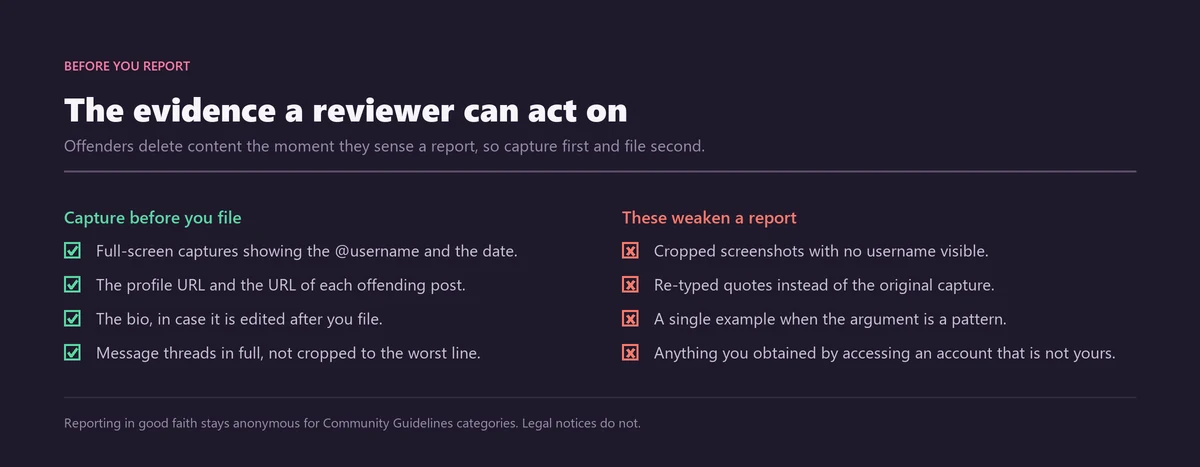
How a case moves through the desk
- You send links and a short account of the harm. No login details, ever.
- The case is mapped to one Meta policy, or declined when none applies.
- The evidence pack is checked against what that form actually asks for.
- You file the Facebook form; any linked Instagram account that breaks a rule is reported on Instagram.
Facebook account takedown vs page takedown facebook: which route fits?
A profile belongs to a person and a Page is a public presence, so Meta reports them from different menus.
A facebook account takedown targets a personal profile. When that profile pretends to be you, Meta's Help Centre article on reporting a profile or Page that pretends to be you or someone else sends you to the profile, the options button under the cover photo, then Report profile. Someone without a Facebook account, or locked out of one, can use Meta's impersonation contact form, which needs no login. A page takedown facebook request starts the same way from the Page itself, through Report Page. Brand misuse runs elsewhere. Names and logos fall under trademark, photos and videos under copyright, and Meta's intellectual property policy sends both to dedicated forms; its IP Reporting Center asks reporters to log in with a Facebook, Instagram or Business Manager account. Material that sexualises a child goes to Meta in the app and to the NCMEC CyberTipline, never to a hired service.
| Target | Typical breach | Route | Who files |
|---|---|---|---|
| Profile posing as you | Impersonation | Report profile, or the no-login contact form | You, or someone authorised to act for you |
| Page posing as your business | Impersonation or trademark | Report Page, or the trademark form | The brand owner or its representative |
| Profile or Page reusing your photos | Copyright | Copyright form | The rights owner or an authorised agent |
| Content sexualising a minor | Child safety | In-app report plus NCMEC | Anyone who sees it |
| A profile you simply dislike | None | No route | Not filed |
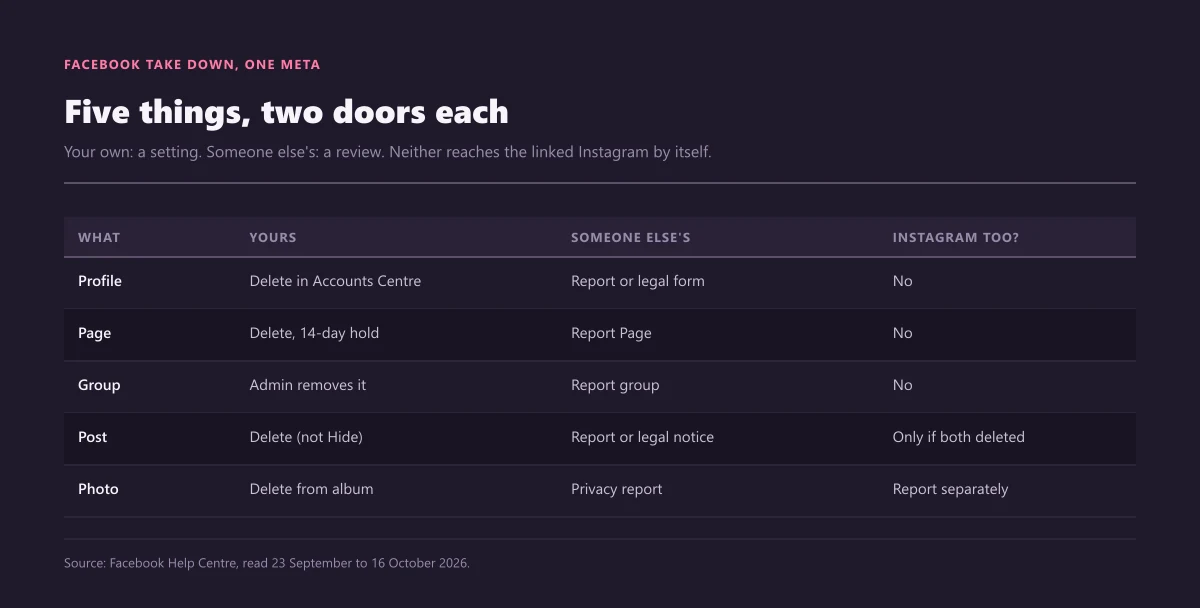
When the same person also runs an Instagram account, Instagram Ban Service can report that account on Instagram itself, and the end state there is explained in what a disabled Instagram account actually means.
What can a facebook account ban service never promise?
An outcome, a date, or a ban on someone who breaks no rule.
Meta's page on disabling accounts describes a ladder rather than a switch. For most violations an account is disabled only after repeated warnings and restrictions, and after five strikes it may face a 30-day restriction on creating content or removal, depending on how severe and how frequent the breaches were. A few violations, child sexual exploitation among them, can end an account after one occurrence. Meta also removes some accounts as soon as it finds them, including accounts made to get around restrictions and accounts whose owners misrepresent their identity. That ladder is why a facebook account ban service cannot quote a timeline: the decision rests on the account's own strike history, which no outsider can see. Instagram Ban Service prepares the case; Meta weighs it against its own records and makes the final call.
This desk turns down Facebook and Instagram requests aimed at rule-abiding people, including critics, former partners and competitors. It sends no report waves, runs no bots or fake accounts, files nothing false, never asks for a password or two-factor code, and offers no guarantee.
If the banned account is yours, the work runs the other way: through the Instagram appeal form, an Instagram unban service that works inside Meta's appeal routes, and the habits in how to avoid being banned on Instagram.
How do you spot a ban-for-hire seller?
Watch what they count, and what they ask you to hand over.
| The pitch | What it tells you |
|---|---|
| "Guaranteed ban within 24 hours" | Nobody outside Meta controls review timing or outcome |
| "We send hundreds of reports from aged accounts" | Report count is not one of Meta's published review factors, and the sending accounts are fake |
| "Just send the link, no reason needed" | No breach identified means no form to file |
| "Log in for us so we can report from your account" | A credential request is a takeover risk, whatever the excuse |
| "Pay again and we bring it back" | Selling removal and reversal together means the ban was never the product |
Buying reports can also rebound on the buyer. The accounts that sellers fire reports from are fake by design, which is the misrepresented-identity category Meta's disabling page lists for removal on sight, and a buyer who lends a real account to the campaign attaches it to that behaviour. Forum advice repeats this lesson, as the Reddit threads on taking down an Instagram page show. Recovery sellers run the same scripts in reverse, covered in whether Instagram recovery services are legit or a scam, and the real routes for getting a hacked account back are in contacting Instagram for account recovery. Instagram Ban Service gives every ban-for-hire request the same refusal, and when a real breach sits underneath, it points the person to the form that fits.
What does legitimate help cost, and what should you expect back?
You pay for preparation time, never for a result.
Every Meta form named on this page is free to submit. A fee therefore only makes sense for time you would otherwise spend sorting the case yourself: reading policies, picking a route, assembling captures that a reviewer can follow. This desk quotes each case after reading it, because one impersonating profile with a clean paper trail takes far less work than a brand facing a cluster of fake Pages and copied ads. A fair quote lists deliverables. The policy mapped. The evidence pack. The form chosen and the filing record. It never lists a ban.
Expect Meta's answer to reach whoever filed, and expect some reports to close with no action when the reviewer finds no breach. A refusal on a genuine breach calls for a better-matched route rather than a second wave: a trademark claim for a Page trading under your name, or a legal request when the content is unlawful where you live.
After the fake is gone, can you get the name back?
Sometimes, but a removal does not hand you the impersonator's handle on either app.
Facebook display names are not unique, so on Facebook the win is the fake disappearing. Impersonators often hold a matching Instagram handle too, and Meta does not publish when a removed account's handle becomes free again. Before planning a rename, run an Instagram username availability check and read the step-by-step way to check a handle, because the sign-up field and the search bar can disagree. What an Instagram name checker can and cannot tell you and the two signals behind Instagram name availability explain why. If the squatter simply went quiet, claiming an inactive Instagram username and getting a username from an inactive account cover what is realistic. For a fresh start, see finding an available Instagram name or getting the username you want; to move a name between your own profiles, use swapping Instagram usernames. Copied photos are a separate claim, set out in what to do when someone posted a picture or video of you.
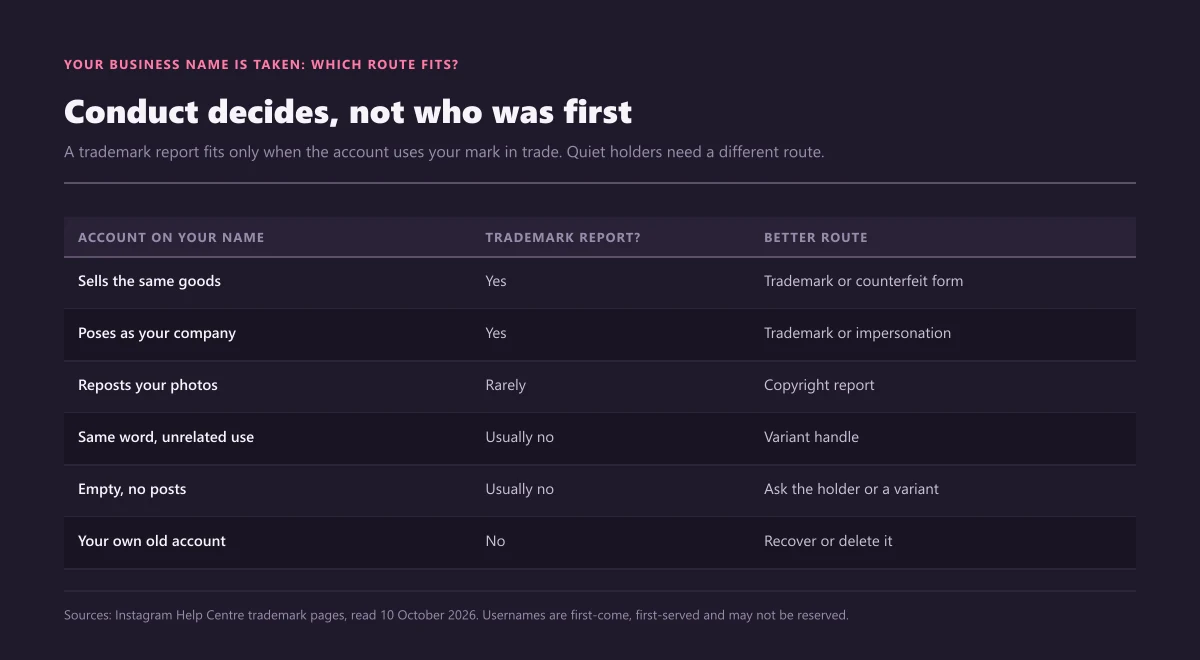
Every route above, with the Instagram reports this desk files, is listed in the full set of reporting solutions, and the desk itself is described on the Instagram Ban Service home page.
Sources
- Facebook Help CentreReport a profile or Page pretending to be you or someone else
- Facebook Help CentreImpersonation contact form for people without an account
- Meta Transparency CenterDisabling accounts: strikes, severe violations, removal on sight
- Meta Transparency CenterHow Meta prioritises content for review: severity, virality, likelihood
- Meta Transparency CenterThird-party intellectual property infringement policy
Frequently asked questions
Is a facebook ban service legal?
Help that prepares a genuine report is legal; a service that sells bans through fake or coordinated reporting is not something Meta permits. A legitimate facebook ban service does nothing a harmed person could not do alone. It reads Meta's policies, matches the problem to a rule, assembles dated proof and points to the correct form, whether that is the impersonation report, the copyright form or the trademark form. The person harmed, or someone authorised to act for them, files it. Trouble starts when the offer is volume. Reports fired from bought or fake accounts break Meta's rules on authentic identity, and a false intellectual property claim can expose the sender to legal risk where they live. Ask any seller which policy the target breaks and which form they will use. A seller with no answer to both questions is selling a campaign, not a service, and should be avoided.
Can a facebook account ban service guarantee a ban?
No. Meta alone decides, and its own transparency pages describe a decision that depends on severity, frequency and the account's strike history. For most violations an account is disabled only after repeated warnings; after five strikes Meta may restrict content creation for 30 days or remove the account. A few severe breaches end an account at once. None of that is visible from outside, so a facebook account ban service that promises a ban, a date or a refund tied to removal is describing something it cannot control. What a service can promise is narrower and checkable: the policy it mapped, the evidence it built, the form it recommended and a record of what was filed. If a profile breaks no rule, the honest answer is that nothing should be filed at all. That answer costs the seller a sale, which is exactly why the guarantee sellers never give it.
How does a facebook account takedown work for an impersonator?
You report the profile as pretending to be you, and Meta reviews whether it is. A facebook account takedown for impersonation starts on the fake profile: open the options under the cover photo, choose Report profile and follow the prompts, picking the option that the account is pretending to be you. Without a Facebook account, or when locked out, Meta's Help Centre points to a separate impersonation contact form that needs no login. Attach the URL of the fake, the URL of your real profile and dated captures of the copied photos and bio, because the reviewer needs to see both accounts side by side. Fan or parody accounts that do not pass themselves off as you are judged differently. If the impersonator also reuses photos you took, a copyright report can remove those images separately. Neither route promises a date, and Meta notifies whoever filed once it decides.
What is the difference between a page takedown facebook request and a profile report?
A Page is reported from the Page itself, and brand cases often belong on the trademark form instead. A page takedown facebook request uses Report Page under the Page's options, while a personal profile uses Report profile. The bigger difference is the evidence. A Page that poses as your company is judged on whether it misleads people about who runs it, so show your registered name, your real Page or site, and posts where the fake takes orders or payments. When it trades under your brand name or logo, Meta's intellectual property policy sends the claim to the trademark form, which expects the rights owner or an authorised representative and asks for registration details. Copied product photos go to the copyright form. Mixing these routes is the most common reason a valid complaint stalls, so pick one breach per report. Nothing in this process speeds up review; it only makes a review possible.
Do mass reports work against a Facebook Page or profile?
They do not decide the outcome, and they can hurt whoever buys them. Meta's page on prioritising content for review names severity, virality and the likelihood of a violation as its factors, and it says human reviewers do not necessarily look at every report. Fifty identical reports about a Page that breaks no rule still describe a Page that breaks no rule. The accounts that sellers use to send report waves are usually fake, which is a category Meta removes on sight, and anyone who joins with a real account ties it to that pattern. Volume also wastes the one report that matters, because a vague complaint buried among copies is harder for a reviewer to read than a single clear filing. If a Page or profile genuinely breaks a rule, one well-evidenced report through the right form beats a hundred empty ones. If it does not, no number of reports will change that.
Why does an Instagram-focused service help with Facebook cases at all?
Because the same impersonator, brand thief or harasser often runs accounts on both Meta apps. Instagram Ban Service files reports on Instagram through official channels when a genuine rule is broken. On Facebook its role is advisory: it reads the case, names the Meta form that fits, builds the evidence pack and checks it, and the person harmed or their authorised representative submits it. That split follows Meta's own design. Facebook's impersonation, copyright and trademark forms expect the affected person or an agent with authority, and the IP Reporting Center requires its own login. Working both sides at once has a practical benefit. Captures, dates and links gathered for one app usually support the other, and a pattern visible across two accounts is easier for a reviewer to follow. The desk declines both sides of any case aimed at a rule-abiding account, and never asks for a password or two-factor code.